We remain fully operational. Our teams are working around the clock to ensure your deliveries continue safely.

DOWNLOAD THE APP


Customer Services
Copyright © 2025 Desertcart Holdings Limited
DOWNLOAD THE APP

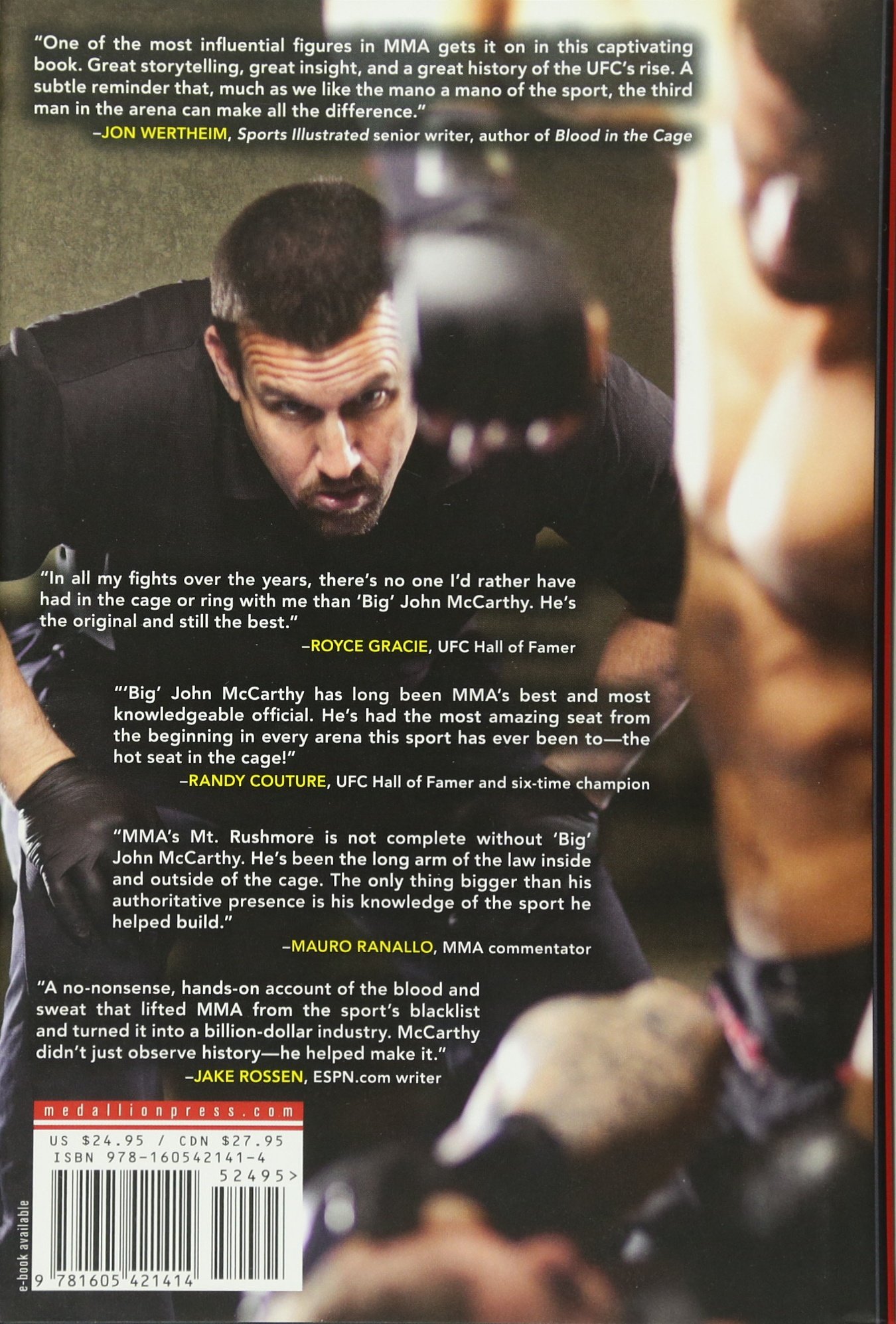

desertcart.com: Let's Get It On!: The Making of MMA and Its Ultimate Referee (Spirit of the River Series): 9781605421414: McCarthy, "Big" John, Rutten, Bas, Hunt, Loretta: Books Review: Required reading for MMA fans - I had no idea the debt that the sport of MMA, especially professional MMA owes Big John Mc Carthy, but it's huge. This book is a must read for those interested in the sport of mixed martial arts. John helped organise the original pre Zuffa, pre SEG UFC when it was nothing but an info-mercial for Rorion Gracie's gym He literally wrote the rule book for the sport - and then was a massive influence in getting the rules recognise by state regulators. To me the biggest down side of this book is John's integrity - he spoke of a few times he saw weakness, doubt etc in a fighter or organisation, but unless it is already out there is some form, he pretty much has not told us much that was pretty much unique to his viewpoint. Highly recommended despite that. If you're into MMA and want to understand the sport today, you should read this book to understand where it came from and how it got to where it is. Review: MMA Icon Offers Insider's Perspective - Most pro sports referees fade into the background and they like it like that. Few NFL refs are noticed, unless they blow a pass interference call. Major league baseball umps vie for notoriety with outlandish gyrations on strike-out calls, but please just try to name one. NBA refs only make headlines when they are caught betting on games, perhaps during their sentencing hearings. If fans know your name as a ref in most sports, that's not necessarily a good thing. Not so in mixed martial arts. Here we have a cast of characters almost as well known as some of the fighters. These refs in this increasingly popular sport are well known, somewhat celebs in their own right. Many have their own "signature" way of starting the fights. Some are understated and quietly professional, like Mario Yamasaki. Some just bark, "Fight!" Others, like Steve Mazzagatti, yell "Let's hook em'-up!" Perhaps the most iconic MMA ref tag-line, though, belongs to "Big" John McCarthy and his patented start to each contest, as he shakes his hand and exhorts the two fighters, "Let's get it on!" Big John has been around since the start of MMA and the Ultimate Fighting Championships (UFC). Now along comes his long-awaited autobiography, co-authored by Loretta Hunt. Hunt is one of the nation's premier MMA journalists. She attained some unintended notoriety of her own a few years ago in a well-publicized dust-up with UFC Emperor Dana White, who launched into a profanity-laced tantrum after one of Hunt's journalistic forays. In a sense, the story of Big John is the story of modern MMA. He was there at the beginning, from UFC 1 when a slender dude in white pajamas somehow was able to choke out and submit a succession of incredible hulks. So ... does Big John "get it on" in this book? Does he give us the inside scoop on the modern world of mixed martial arts? From his vantage point inside the octagon, does he bring us there in a credible way? To get to the good stuff, you first have to wade through about 100 pages of back story on Big John's upbringing. This is not bad, because it gives you a context for his interest in athletics and combative sports. As a member of the LAPD during the time of the Rodney King race riots, he became interested in non-lethal ways to control suspects. This led him to intersect with Rorion Gracie who, at the time, was popularizing his own variant of Brazilian Jiu-Jitsu in Southern California. In turn, this growing collaboration with the Gracies gave McCarthy a front-row vantage point regarding the very first UFC events. He was, literally, "present at the creation" of the modern UFC and the phenomenon of mixed martial arts. Little known fact: before becoming the iconic ref for MMA events, Big John wanted to compete in UFC 2. Rorion Gracie nixed the idea, though, as he did not want Big John potentially having to fight Royce. Instead, he suggested that McCarthy wait until after Royce's reign ended, then get involved as a competitor. In the meantime, McCarthy continued reffing, grew increasingly comfortable in the role, and abandoned any thoughts of entering MMA as a competitor. Another little-known fact: the yardstick of "intelligently defending yourself" is a phrase and standard coined by McCarthy in the early days of MMA.. Before the ref had the power to stop a one-sided fight, he had to rely on the fighter either tapping out or the fighter's corner literally throwing in the towel. Stubborn corners often refused to do the latter, creating situations where Big John genuinely feared for a fighter's safety. Concerned about this, McCarthy prevailed upon Rorion Gracie to tweak the rules to enable the referee to end a fight when, in the ref's judgment, one of the fighters was not "intelligently defending himself." This made MMA safer, which in turn likely hastened its acceptance by a growing number of state athletic commissions. Much of the meat of book involves Big John going back, event by event, through the early days of the UFC. For some, this may be a tedious journey. For others, it is an interesting perspective on the early years of some fighters who are now luminaries but who were relative unknowns at the time, including Randy Couture, Vitor Belfort and B.J. Penn. He notes the way the sport was professionalized once Zuffa and the Fertita brothers purchased the franchise. This circumscribed the role which McCarthy had played during the SEG/Meyrowitz years of UFC ownership. Further, McCarthy found himself pulled in opposite career directions, trying to balance his police career with a growing involvement in MMA. In the final phase of LGIO, McCarthy traces the fall-out he had with Zuffa and the UFC. His take is that much of it started over a misunderstanding about travel logistics to an UFC event in London. As a jumbo-sized humanoid, McCarthy asked to be upgraded to business class for the marathon flight from Los Angeles to the UK. By the time this was relayed to Dana White and the UFC brass, they got the impression that McCarthy was holding them up by demanding a first-class upgrade. From there, the relationship frayed. Still, in time, Big John returned to the UFC fold, exited his self-imposed "retirement" and is once again one of the most recognizable features on the UFC/MMA landscape. McCarthy comes across as an earnest, no B.S. kind of guy, with no taste for bureaucracy or office politics. If you are a UFC or MMA fan, you will enjoy this book. You may never view Big John the same after you read this book and hear him exhort the fighters, "Let's get it ON!"
| Best Sellers Rank | #2,102,599 in Books ( See Top 100 in Books ) #321 in Mixed Martial Arts #321 in Martial Artist Biographies #2,858 in Biographical Historical Fiction |
| Customer Reviews | 4.4 4.4 out of 5 stars (218) |
| Dimensions | 6.35 x 1.48 x 9.32 inches |
| Edition | First Edition |
| ISBN-10 | 1605421413 |
| ISBN-13 | 978-1605421414 |
| Item Weight | 1.8 pounds |
| Language | English |
| Print length | 418 pages |
| Publication date | September 1, 2011 |
| Publisher | Medallion Press |
J**N
Required reading for MMA fans
I had no idea the debt that the sport of MMA, especially professional MMA owes Big John Mc Carthy, but it's huge. This book is a must read for those interested in the sport of mixed martial arts. John helped organise the original pre Zuffa, pre SEG UFC when it was nothing but an info-mercial for Rorion Gracie's gym He literally wrote the rule book for the sport - and then was a massive influence in getting the rules recognise by state regulators. To me the biggest down side of this book is John's integrity - he spoke of a few times he saw weakness, doubt etc in a fighter or organisation, but unless it is already out there is some form, he pretty much has not told us much that was pretty much unique to his viewpoint. Highly recommended despite that. If you're into MMA and want to understand the sport today, you should read this book to understand where it came from and how it got to where it is.
K**Y
MMA Icon Offers Insider's Perspective
Most pro sports referees fade into the background and they like it like that. Few NFL refs are noticed, unless they blow a pass interference call. Major league baseball umps vie for notoriety with outlandish gyrations on strike-out calls, but please just try to name one. NBA refs only make headlines when they are caught betting on games, perhaps during their sentencing hearings. If fans know your name as a ref in most sports, that's not necessarily a good thing. Not so in mixed martial arts. Here we have a cast of characters almost as well known as some of the fighters. These refs in this increasingly popular sport are well known, somewhat celebs in their own right. Many have their own "signature" way of starting the fights. Some are understated and quietly professional, like Mario Yamasaki. Some just bark, "Fight!" Others, like Steve Mazzagatti, yell "Let's hook em'-up!" Perhaps the most iconic MMA ref tag-line, though, belongs to "Big" John McCarthy and his patented start to each contest, as he shakes his hand and exhorts the two fighters, "Let's get it on!" Big John has been around since the start of MMA and the Ultimate Fighting Championships (UFC). Now along comes his long-awaited autobiography, co-authored by Loretta Hunt. Hunt is one of the nation's premier MMA journalists. She attained some unintended notoriety of her own a few years ago in a well-publicized dust-up with UFC Emperor Dana White, who launched into a profanity-laced tantrum after one of Hunt's journalistic forays. In a sense, the story of Big John is the story of modern MMA. He was there at the beginning, from UFC 1 when a slender dude in white pajamas somehow was able to choke out and submit a succession of incredible hulks. So ... does Big John "get it on" in this book? Does he give us the inside scoop on the modern world of mixed martial arts? From his vantage point inside the octagon, does he bring us there in a credible way? To get to the good stuff, you first have to wade through about 100 pages of back story on Big John's upbringing. This is not bad, because it gives you a context for his interest in athletics and combative sports. As a member of the LAPD during the time of the Rodney King race riots, he became interested in non-lethal ways to control suspects. This led him to intersect with Rorion Gracie who, at the time, was popularizing his own variant of Brazilian Jiu-Jitsu in Southern California. In turn, this growing collaboration with the Gracies gave McCarthy a front-row vantage point regarding the very first UFC events. He was, literally, "present at the creation" of the modern UFC and the phenomenon of mixed martial arts. Little known fact: before becoming the iconic ref for MMA events, Big John wanted to compete in UFC 2. Rorion Gracie nixed the idea, though, as he did not want Big John potentially having to fight Royce. Instead, he suggested that McCarthy wait until after Royce's reign ended, then get involved as a competitor. In the meantime, McCarthy continued reffing, grew increasingly comfortable in the role, and abandoned any thoughts of entering MMA as a competitor. Another little-known fact: the yardstick of "intelligently defending yourself" is a phrase and standard coined by McCarthy in the early days of MMA.. Before the ref had the power to stop a one-sided fight, he had to rely on the fighter either tapping out or the fighter's corner literally throwing in the towel. Stubborn corners often refused to do the latter, creating situations where Big John genuinely feared for a fighter's safety. Concerned about this, McCarthy prevailed upon Rorion Gracie to tweak the rules to enable the referee to end a fight when, in the ref's judgment, one of the fighters was not "intelligently defending himself." This made MMA safer, which in turn likely hastened its acceptance by a growing number of state athletic commissions. Much of the meat of book involves Big John going back, event by event, through the early days of the UFC. For some, this may be a tedious journey. For others, it is an interesting perspective on the early years of some fighters who are now luminaries but who were relative unknowns at the time, including Randy Couture, Vitor Belfort and B.J. Penn. He notes the way the sport was professionalized once Zuffa and the Fertita brothers purchased the franchise. This circumscribed the role which McCarthy had played during the SEG/Meyrowitz years of UFC ownership. Further, McCarthy found himself pulled in opposite career directions, trying to balance his police career with a growing involvement in MMA. In the final phase of LGIO, McCarthy traces the fall-out he had with Zuffa and the UFC. His take is that much of it started over a misunderstanding about travel logistics to an UFC event in London. As a jumbo-sized humanoid, McCarthy asked to be upgraded to business class for the marathon flight from Los Angeles to the UK. By the time this was relayed to Dana White and the UFC brass, they got the impression that McCarthy was holding them up by demanding a first-class upgrade. From there, the relationship frayed. Still, in time, Big John returned to the UFC fold, exited his self-imposed "retirement" and is once again one of the most recognizable features on the UFC/MMA landscape. McCarthy comes across as an earnest, no B.S. kind of guy, with no taste for bureaucracy or office politics. If you are a UFC or MMA fan, you will enjoy this book. You may never view Big John the same after you read this book and hear him exhort the fighters, "Let's get it ON!"
C**E
Let's get it on
From start to finish this book is a must read for the true MMA fan. "Big John" has been around since UFC 2, from the days of style vs. style till today, which has seen MMA become a sport, and one of the fastest growing ones at that. If you're a true MMA fan, his unique insights and his point of view in the cage is a true gem for the reader to behold. Big John talks about greats such as Royce Gracie, Ken Shamrock and some of the forgotten cage blazers like, Fred Ettish and Cal Worsham. Give it a try; I think you'll like it.
M**G
From another refs point of view.... Awesome
Loved the insights of Johns methodology of the in-fight process, and his opinion of fighter welfare etc. wasn't really interested in the background of the ufc as it's all been covered before ( however, if you're not familiar, prepare to get educated!). Some have criticized the "look at me" aspect of the story, but, In my opinion, that's a backstory that goes toward his mindset/explains where he's at. I've even written down a few of his quotes that struck a chord which I have put on my garage/gym wall. Well worth the read.
K**I
Excellent book. I have always had a great a great deal of respect for John McCarthy as a referee. This book has only enhanced my opinion of him professionally and personally. Now only was John one of the first MMA referees, but after reading this book as a reader I found out how instrumental he was in making MMA and especially the UFC what it is today. I have heard quotes form people saving that the reason John was so good at his job is because you did not notice him in the Octagon till the time he was needed. He writes the book the same way he puts emphasis on the fact that the fighter are the one doing the hard work as a referee he is in there to protect the fighters when they cannot protect themselves. Another great thing is the way he manages to humanize the fighters themselves. He talks about the emotions of different fighters before, during and after a fight. There ecstasy in victory and the crushing raw emotion of disappointment when they lose. The book starts with John giving his family history. He starts with his grandfather, then his father and his career and innovations in the police force in terms of training and most prominently S.W.A.T. Then we get John's early family and school life, his early sporting career. For those that you don't know you might be surprised by his choice of high school sport. I know I was. Then following in his father's footsteps, to stepping out of his father shadow and carving out his own legacy on the force. During this period he vents his frustrations of the internal politics inside the police department. The difference between an office wanting to arrest the bad guys but protect and serve the public, compared to someone drunk on their own power or hungry for a promotion. A point about Johns character is that in the position he is in he could very easily made this book a tell all behind the scenes gossip book. He does not he mentions certain situations and stories but a number of cases he does not name and same the person involved. Then from the half-way point of the book. Here the book becomes less about John, and much more about the history of MMA, and the UFC. At the time the UFC was MMA in America. Now that MMA is (finally) recognized as a sport how the new management made the UFC the biggest MMA league in the world. John was there from the beginning and helped in a number of ways behind the scenes more they just following the rules; he helped make the rules and made sure they were followed. The book ends round the end of 2011. If you are an MMA fan this is a great book, on both the history of MMA and one of the true pioneers of the sport. Great book bread it you will not regret it.
G**E
This was easily the best mma book I've ever read. It not only serves as an autobiography of John McCarthy but it's also a fascinating look at the early days and evolution of mma and the ufc from a guy who was right in the middle of it all.
G**V
I did not know Big John was so intimately involved in the early days of MMA/UFC. Great "inside" storytelling and an interesting lifestory. If you are a fan of the progression of the UFC you will likely enjoy McCarthy's comments on every event that has been put on. The only disappointment is that the story stops around the time McCarthy "retires", but , of course he has come back and is still very active in the MMA scene. Perhaps any future edition would include a follow-up.
A**S
An enjoyable, quick read providing interesting insight into the life of the world's most famous MMA referee . Big John comes across as a principled, decent guy but also one who is prepared to get stuck into a fight himself and likely an athlete who could have performed admirably in the Octagon Ring itself. He tells briefly of his early childhood and experience in the LAPD and the importance of his family unit. He describes the origins of the UFC and the significance of the Gracie family, he describes the mishaps and the evolution of the UFC from the army days to what it has become today and I now better appreciate the importance of having a knowledgeable, decisive referee. Big John comes across as candid and honest and refrains from spilling juicy gossip in favour of a straightforward, fair account of the. Ups and downs in the profession. There are also occasional philosophical gems and words of wisdom which come over as especially heartfelt considering the life he has led. Four rather than five stars for me as I felt that there was so much more that could be told about the inner goings and machine toons of the UFC and provide more detail as to his favourite fights and fighters. But I guess we will need to wait for his notebook for that.
E**C
Love the stories! Great read from the godfather of MMA officiating.
Trustpilot
2 weeks ago
1 month ago