

🌍 Design Your Future: Where Urban Meets Innovation!
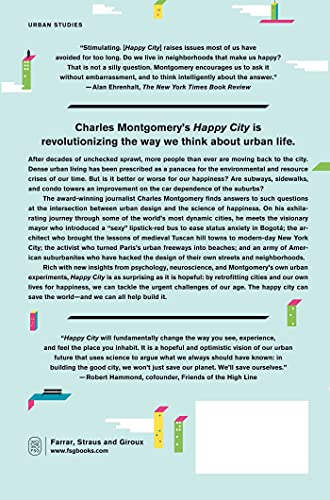
Happy City: Transforming Our Lives Through Urban Design is a groundbreaking exploration of how innovative urban design can enhance our daily lives, promote sustainability, and foster community engagement. This book offers a wealth of data-driven insights and global perspectives, making it an essential read for anyone interested in the future of urban living.
| Best Sellers Rank | #45,246 in Books ( See Top 100 in Books ) #5 in City Planning & Urban Development #6 in Urban Planning and Development #21 in Sociology of Urban Areas |
| Customer Reviews | 4.6 4.6 out of 5 stars (1,128) |
| Dimensions | 5.49 x 0.92 x 8.25 inches |
| Edition | Reprint |
| ISBN-10 | 0374534888 |
| ISBN-13 | 978-0374534882 |
| Item Weight | 11.2 ounces |
| Language | English |
| Print length | 368 pages |
| Publication date | October 7, 2014 |
| Publisher | Farrar, Straus and Giroux |
S**Y
Interesting book
In depth, thought provoking book.
J**Y
Great Book That Holds Your Attention
Throughly enjoyed this book. A lot of urban design books are written in a dry manner; Montgomery does a great job keeping attention through his prose. The stories were relevant and on point, if not a bit recycled for other sources. His assessment is strong, but you couldn't call it objective. He uses many points in the book to assert his position, mainly around how awful cars are (which, while I don't disagree, is getting old as a rant in these kinds of books). I highly recommend it for any urban studies nerd, and would encourage you to additionally read Walkable City and Street Smarts as companion pieces. Between those three books, they do a great job of giving you the history, the science, the statistics, and the possibilities for the future of smart, happy, walkable cities.
N**E
Motivating and interesting read
I've always been intrigued by traffic engineering and urban design, though admittedly not very knowledgeable about either, so this book interested me as soon as I read an excerpt from Slate.com. Despite occasionally veering toward the preachy, it offers well researched and extremely compelling arguments for cultivating more diversity and "conviviality" in the places we live. I'd recommend to anyone intrigued by similar subjects or just trying to understand more about how we're impacted by the structures and patterns around us. Quitting my day job to rewrite city code might be a bridge too far for me right now, even if it has some appeal after reading this. I'll at least invite the neighbors over for happy hour and maybe start reading more about the new development plans for my town... it's a start. :)
S**T
Great read!
Very well written book that, unlike other urban planning-related books, is accessible to the average person and a great overview of some of the more important, but less widely understood issues that need to shape the way our communities are built. It's even good for long-time planners to update their priorities. Definitely worthwhile for anyone with a mild interest in the built environment or who's looking for a few suggestions of how to subconsciously make themselves happier in their daily life.
T**.
Really, Really Good Read for Urban Planners and City/Town Enthusiasts
I'm not yet finished reading this book but I can already sense that it would further widen my knowledge and perspectives on how people and their elected representatives run their towns and cities in the pursuit of happiness, which of course differs according to one's interests, agenda, and predisposition.
P**.
The blueprint to scaling happiness
A book that is relevant far past the urban planner - anyone who wants to thrive with their environment needs to understand what Charles says here! A masterpiece.
J**T
the two over lap in the areas of the city and how to grow best. This book is also a great primer for ...
This book was a chaning experience for me. It altered how I looked at my city, my neighborhood, and stores. The message here was really powerful. I accendentally read this around the time I read Antifragile by Talib, the two over lap in the areas of the city and how to grow best. This book is also a great primer for urban design, bike commuting, and civic involvement. I think everyone should read it and I recommend it constantly.
P**G
Gave it as a gift
Sustainability in communities is seriously being considered across America. I gave this book as a gift to both my bosses - The Mayor and the CAO who have our town's best interest at heart. I ordered it for my Kindle and am reading it at the present time, so although I have not completed reading it, I am finding the author to have a sense of humour, good writing skills, and he touches on a subject that is interesting for me - and I hope, for the people I work for and with. His research bears out the need for serious thinking when it comes to happy places we live in.
F**A
Always enjoy reading a good book and its great that amazon offers such a good collection of paperback books.. The story is very interesting but not exactly my type
A**E
Un libro más al estante.
P**A
The book is excellent. Worth reading for any amateur . Talks about how our environments need to have a perspective other than "development" in monetary aspect or consumption patterns
M**.
As an urban planner, I was familiar with a lot of the theory in this book. It feels like a great summary of everything every planner and urbanist should know. There are plenty of examples from around the world to remember and bring up in conversation to make points. In some parts, it feels very focused on North America. Living and working in Europe, it is interesting to learn about American sprawl to avoid repeating it, but it gets a bit much and doesn't feel too relevant after a while. Still a great book, fun to read, would recommend to anyone interested in urbanism, sustainable development, equity, mobility, public space, urban design, housing and pretty much anyone.
A**T
*A full executive summary of this book is available at newbooksinbrief dot com. The modern city owes much of its current design to two major trends or ‘movements’ that have emerged since the time of the industrial revolution. The first trend traces back to the industrial revolution itself, when the appearance of smoke-billowing factories (and egregiously dirty slums) necessitated new solutions to the problem of how to organize city life. The answer—still reflected in cities all over the world—was to compartmentalize functions, such that industrial areas, shopping areas, office areas, and living areas were separated off from one another into distinct blocks of the city. The second trend in urban design took full hold in the post-war era, with the rise of the suburbs. In a sense, the suburbs represent a continuation and intensification of the compartmentalization movement, as the living areas of the upper classes were separated-off still further from the other areas of the city—out into sprawling districts miles away (as automobiles made it possible for certain city dwellers to escape to an idealized haven away from the hustle and bustle). While the suburban movement has had the bulk of its impact on the landscape outside of the city proper, the city itself has not been spared of its influence. For indeed, the city was gutted of many of the inhabitants that formerly occupied it; and, what’s more, it has been reshaped by the roads and freeways introduced to shuttle-in the suburbanites from their faraway destinations. Now, it may well be the case that all this compartmentalization and suburbification was originally intended to benefit (most of) the city’s inhabitants. Unfortunately, however, the longer we live with these trends in urban design, the more it is becoming clear that this way of organizing the city leaves much to be desired. Let us begin with the suburbs, and work our way inwards. In the first place, those who have fled to the suburbs have found that there is a steep price to pay for escaping the hustle and bustle of the city, and that price begins with all the driving. And the hellish commute is only half of it: virtually nothing that the average suburbanite wants and needs, and no place they want to go, is accessible without a car trip. Obviously, all this driving is unpleasant in itself, but this is just the beginning. Second, and even more important, it leaves less time for other things—including family life. Also, the piling up of time spent behind the wheel is just plain unhealthy, as it leads to both obesity and—by extension—several other health problems. Additionally, having to drive everywhere is expensive, and is only getting more so as the price of oil continues to rise. Finally, because suburbanites spend so little time actually walking through their neighborhoods, they tend to have little casual contact with neighbors, which at least partly explains why they tend to be more detached from their communities. With all the negative consequences of suburban life, it is no surprise that many of those who had formerly fled to the burbs are now fleeing back to the city. Actually, in many cases, suburbanites have had little choice, as the rising price of oil—together with the housing crash of 2008—has left them with no way to afford their suburban nightmare regardless (thus many of the suburbs have become as abandoned as the inner city once was). Unfortunately, life back in the city has seldom been much better. For one thing, outdated compartmentalization in the city has interfered with accessibility in a manner that is similar to the way that sprawl has interfered with accessibility out in the suburbs. Second, since transportation networks in the city have been rearranged to suit cars, alternative forms of transportation have largely been compromised, thus leaving citizens with less real choice when it comes to getting around. Also, because it has been so expensive for cities to service the suburbs (they being so far away, and so spread out), there has been less money to fund public goods that serve the city, such as public transit, parks and sociability-inviting squares—thus the city has actually become a less livable place in the suburban era. Thankfully, at least some cities around the world (from Bogota to Copenhagen to Vancouver etc.) have begun taking efforts to remedy these issues, and are beginning to embrace a vision of the city which (according to the research) is both better-functioning and leads to happier citizens. In broad outline, the happy city is composed of multi-use, multi-income communities; laced with parks and public squares of varying sizes; and tied together with transportation networks that reintroduce walking, cycling and public transport as real options. (This vision of the city is often referred to as the new urbanist movement.) In his new book 'Happy City: Transforming Our Lives Through Urban Design' urbanist and writer Charles Montgomery takes us through the history of the modern city, and the latest efforts to reform over a century of ill-conceived design decisions. Montgomery's book is a fantastically informative and fun read, and the author does well to introduce the ideas of the new urbanist movement, and the efforts that are currently underway to implement it around the world (as well as the forces that continue to oppose it). If the stories and research presented here do not render you a full convert to the new urbanist movement, it will at least make you rethink where (and how) you'd like to live. Bravo Charles Montgomery! A full executive summary of the book is available at newbooksinbrief dot com; a podcast discussion of the book will be available soon.
Trustpilot
3 weeks ago
2 weeks ago