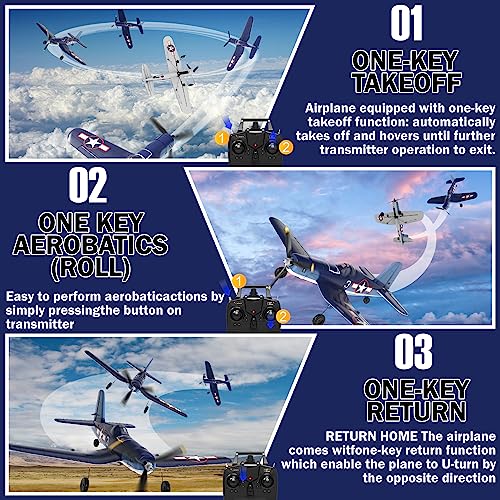

🛫 Own the skies with effortless control and nonstop flight thrills!
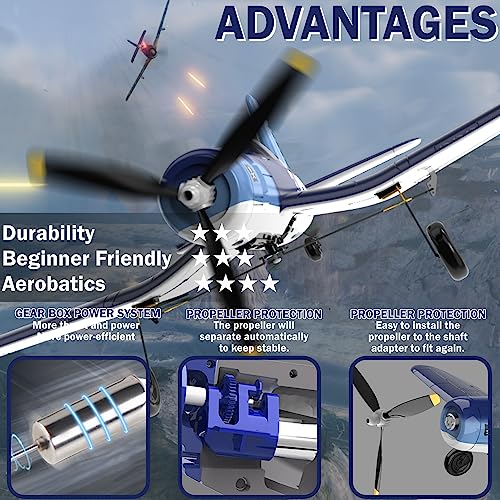
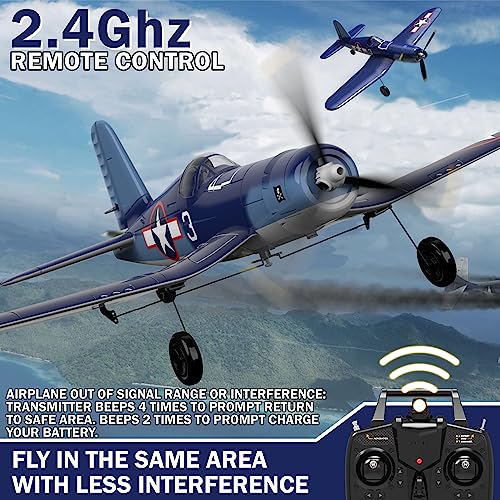
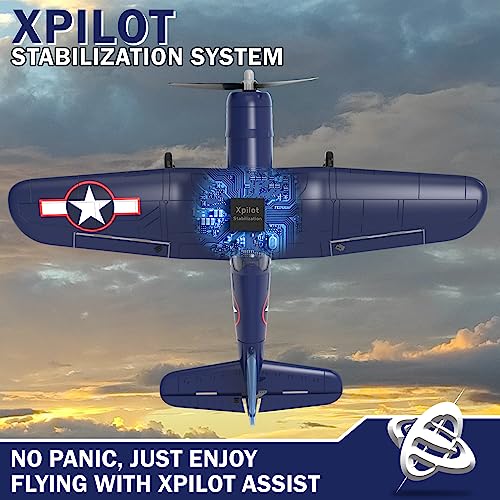
The LEAMBE 4 Channel RC Plane is a beginner-friendly, aerobatic remote control aircraft featuring 4-channel precision control, dual lithium-ion batteries offering up to 15 minutes of flight each, and a max flight distance of 656 feet. Built with durable EPP foam and equipped with Xpilot gyro stabilization, it ensures stable, high-speed flights and smooth landings. Ready to fly with minimal assembly, it’s the perfect gift for kids and outdoor enthusiasts eager to master RC flying.


| ASIN | B08XYP8MMC |
| Assembly Required | No |
| Batteries | 1 Lithium Ion batteries required. (included) |
| Batteries Included | Yes |
| Batteries Required | Yes |
| Best Sellers Rank | #199,261 in Toys & Games ( See Top 100 in Toys & Games ) #351 in Remote Controlled Airplanes |
| Colour | F4u |
| Customer Reviews | 4.1 4.1 out of 5 stars (783) |
| Date First Available | 2 February 2025 |
| Educational Objective(s) | Teach basic flight control and aerodynamics, promote outdoor play and physical activity |
| Included Components | Charging Cable, Product Manual, Remote |
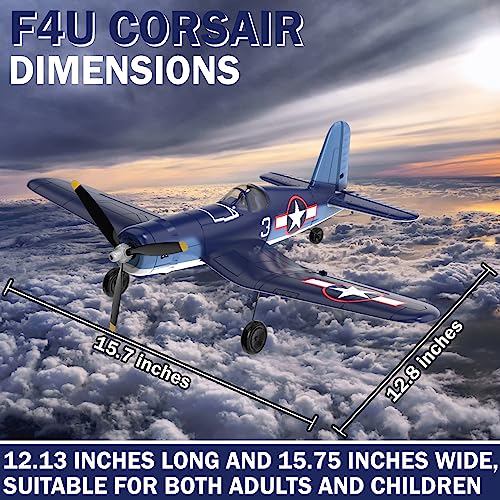
| Item Dimensions LxWxH | 40 x 29.4 x 9.7 Centimeters |
| Item Weight | 49.9 g |
| Item model number | YKFJ-BLUE1 |
| Manufacturer | LEAMBE |
| Manufacturer recommended age | 5 years and up |
| Manufacturer's Suggested Maximum Weight | 680 g |
| Material Type(s) | Foam |
| Model Number | YKFJ-BLUE1 |
| Number of Game Players | 1 |
| Product Dimensions | 40.01 x 29.39 x 9.7 cm; 49.9 g |
| Remote Control Included? | Yes |
| tech_spec_battery_description_toys | Lithium-Ion |
A**R
Good buy
Good buy, bought it for my nephew, he is enjoying it😊
S**G
VERY BAD QUALITY
The plane is made of foam. It is being imported from USA. Very Very Costly
A**R
Initial take off was hard for it on the ground as the wheels don't role the greatest and get stuck periodically. Broke first propeller on the concrete cause of wheels. Then I figured out I can just lightly throw it like a paper plane and works great. I have hit so many trees and few other things and it just keeps on going. Had to glue the wheel brackets back on and have had few holes from the tree branches I've took out of it and filled the whole with glue and still air worthy. Glad I am learning with this little guy to fly my big expensive jet . Lands ok on concrete. ATON OF FUN. Thanks will be buying all the rest of the varieties
J**Z
excelente avion, muy bueno para los que empezamos a practir con aviones rc, y tambien para los mas avanzados recomendable en todos los aspectos.
A**R
This is a pretty good little plane in my opinion. It flies great and it's pretty easy to do fun tricks without smashing it into the ground. Also, I definitely appreciate the option change the gyro, from having it on to being in full control of the plane. Now I'm not good at flying without the gyro yet, still need a bit of practice there but the ability to turn it on midflight to help avoid a major crash is pretty nice. BUT don't think that the gyro by itself will prevent crashing, it simply helps keep the plane level, you still have a lot of control and need to keep said control of the plane. Speaking of, I've accidentally smashed this plane into the ground real hard and real fast with it ending up with barely a scratch on it, ready to get back into the air(well after you put the prop back on). In my opinion this plane is great if you want to just have fun or practice flying rc planes without gyro assistance, it can take a hit. And if something does break(as what tends to happen in this hobby) don't let that discourage you, the fix can be as simple as foam safe super glue. One last thing, even though the booklet that comes with it suggest you don't fly in the wind(and maybe don't if you don't know anything about how flying works or you're trying to learn how to fly without gyro), you can totally take this thing into the wind, the planes motor has the power and you have more than enough authority of the control surfaces to fly through the wind with ease. Just make sure you don't let the plane get too far when it has a tailwind, and beware of gust when flying near the ground, they can be a one-way trip for your plane barreling into it. But yeah overall, really good plane!
L**Y
This is a actually a piece of exercise equipment. When you're learning, every landing is a crash landing. Do your best to crash it near you or you'll be walking all over the place. But you won't mind the walking much because learning to fly this thing is so fun. -Only fly over grass if able - pavement impacts break propellers. -Make sure propeller is well seated before flying - press it onto the shaft firmly -Don't rev up the motor with the propeller spinning in the same plane as your face in case it flies off. -Don't attempt to takeoff from the ground, instead gently toss into the air and throttle up as this taildragger model is so front heavy, and without a nosewheel, any chip in pavement causes it to faceplant and shatter propeller tips. You can trim down and use slightly damaged props - make sure it's still balanced! If the surface is perfectly smooth takeoff is sometimes possible. If you use 1mm music wire to make new, longer, stronger main landing gear, you can takeoff and land more reliably - but if you want to learn to fly a plane that will do this reliably -DON'T BUY THIS PLANE. -The spring steel main landing gear get bent back after crash landings, and if you try to bend them back into shape too many times you'll break the wires. They'll break anyways after enough crashes. -Keep controller in "beginner mode" -Don't fly near trees. I lost mine 25 feet up a pine tree just as I was finally getting good. Luckily I borrowed a tall ladder and the plane only spent one night in the tree. -Lightly sand your propellers with 150 grit paper and spray paint white to help find the propellers after crashing if you're near bushes. Can’t stress this enough. -Since there is a deadzone in throttle stick between 0 throttle and some (but not enough to stay airborne) throttle, you'll have to learn where that lowest throttle position is to help you descend/ land in a controlled way. Being able to hear the plane's motor helps, and this is possible from >50ft away unless it's really noisy out. Learning basic control must be accomplished in steps: 1 fly straight/ low level with constant throttle 1.5 play with throttle settings - cutting power completely in flight is risky! Learn to adjust trim in flight. 2 controlled crash landings 3 turn big circles/ ovals - no rudder 4 add rudder to turns (learn about how too much rudder will cause a stall and spin/ crash if you're flying too low to recover) 5 turn tight circles/ ovals 6 reverse turns/ figure eights 7 learn to use elevators at full deflection up/down 8 fly higher 9 glide -Start by flying in a straight line, cut the motor, let the plane sink, even nose down to a degree, then pull back on the stick at the last second to cushion the crash landing. This can be a frustrating process. -Try flying in big circles next just be leaving the throttle at medium power and banking in one direction -Tighten down the circles by pulling back on the stick as you're banking, adjust throttle to keep from changing altitude too much -As soon as you can start learning how to move the rudder in the same direction that you're banking to make even tighter and more coordinated turns. Soon, you'll be always moving your left and right thumbs in the same direction in similar amounts and making nicer, predictable turns. Since the rudder stick works the throttle, you'll have to practice not changing throttle with your left thumb unless you mean to. -Learn to spot the yellow nose of the plane/ white propeller from far away to know when it's facing you - this will help you know when to stop turning and level out in a new direction -Fly really high and cut the throttle, play with the controls as you coast all the way down - this is really helpful in learning flying without worrying about the throttle. You can even dangle a string from the ceiling in your house and tie another string around the plane forward of the wings, the other end around the plane forward of the tail, and suspend the plane in front of a big box fan. You can play with the controls without running the motor at all, and go between expert and beginner modes, learn how to bring the plane back to stable as you fight the side to side oscillations that develop. Propellers from the Mustang fit my Corsair (Corsair props unavailable at this time) - order extras and also from the get go - so you can fly when you're free to without having to wait for parts that commonly break/ get lost. The landing gear seems so useless that when they snap you might just fly without them rather than waste money.
M**N
I don’t want to leave a bad review because when it worked during the two times I took it out, it was great.. as far as handling goes. It’s not bad in minor wind for its size. It’s fast and zippy. Sadly, the prop saver won’t keep the prop on. You can change the piece connected to the motor, because sometimes that piece breaks, and by sometimes, I mean once per outing.. and I fly in a field with fluffy soft grass. I’ve made no hard landings. That piece is $3.99 for 2 at a hobby store. The prop is $3.99 for one. After gently changing the saver piece a couple of times, the motor no longer runs at speed and makes noise. I’m assuming it’s because of some motor damage from pulling on shaft.. WE ALL KNOW WHERE THIS THING IS MADE.. so expect thy kind of quality. The motor is not accessible and not replaceable. It’s sad that a plane that works so well has suck garbage components. I’d happily pay twice as much for top end electronics and an easily maintainable plane. Anyway.. I got it on sale for $80. That’s $40 per outing.. ouch!! I would have bought at least 3 more that I wanted really bad, until this experience. Oh well. I’ll just get a big P51 from the hobby store with retractable landing gear for $350. You def get what you pay for. Let’s hope a legit company picks up this design and gives a warranty.
Trustpilot
1 month ago
2 months ago