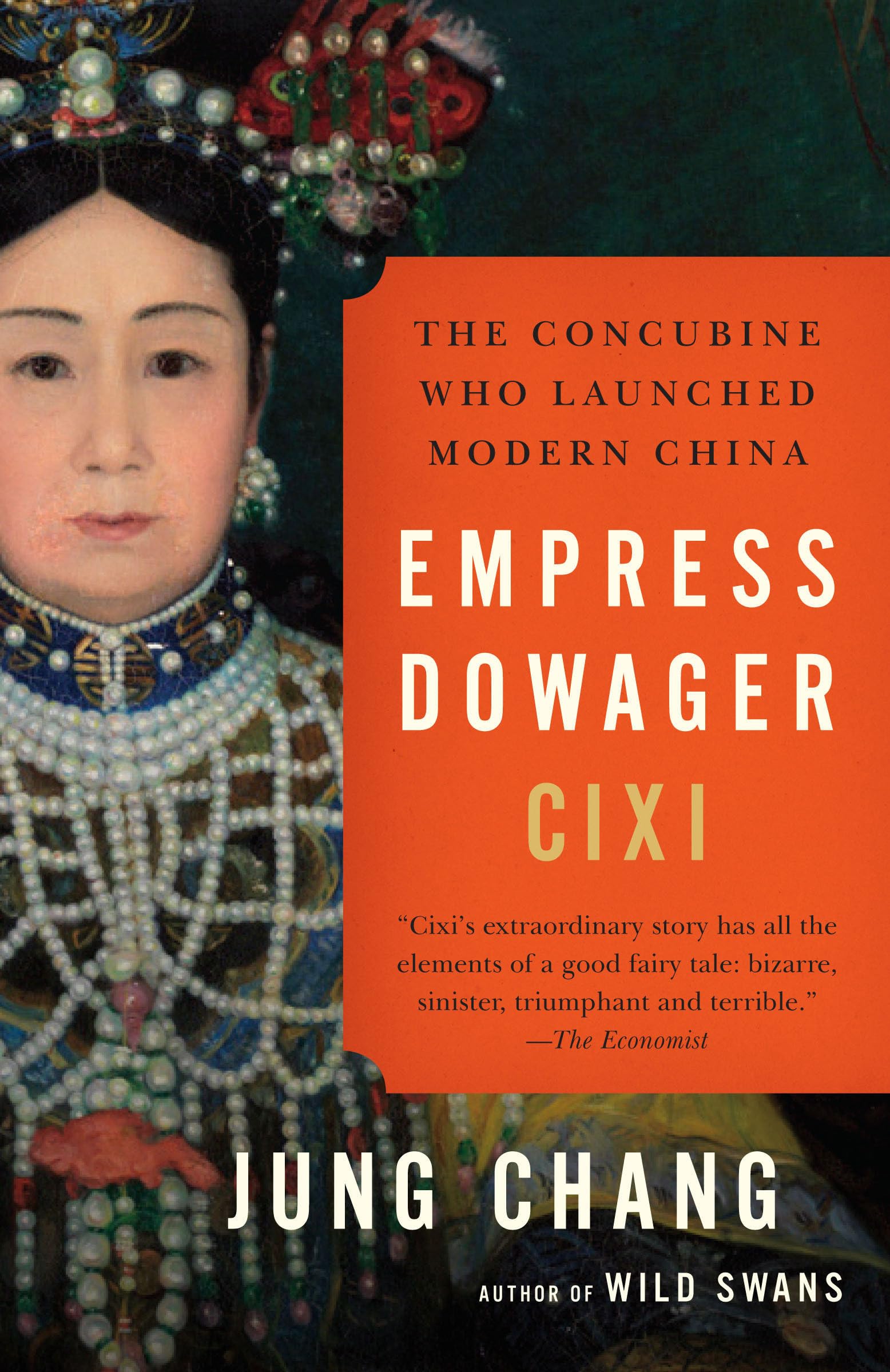
desertcart.com: Empress Dowager Cixi: The Concubine Who Launched Modern China: 9780307456700: Chang, Jung: Books Review: Unveiling the True Empres - Jung Chang’s Empress Dowager Cixi: The Concubine Who Launched Modern China offers a compelling and well-documented reinterpretation of one of China’s most influential yet misunderstood historical figures. The book vividly portrays the life of Empress Dowager Cixi, emphasizing her intelligence, political skill, and vision for modernization amid the rigid structures of the Qing dynasty. Contrary to earlier depictions that portrayed Cixi as a ruthless and conservative ruler, Chang presents her as a pragmatic and forward-thinking leader who initiated significant reforms in governance, diplomacy, and technology. The author’s meticulous research and engaging narrative provide a nuanced view that restores fairness to Cixi’s legacy, long overshadowed by historical bias and gender prejudice. Set against the backdrop of the final years of imperial China, the book immerses readers in the complexities of political transition and cultural change. Overall, it is an insightful and thought-provoking work that contributes meaningfully to the understanding of women’s leadership and China’s path to modernity. Highly recommended for readers of history and gender studies. Review: Don't Know Much About (Chinese) History - I don't know how history is taught these days, but in my generation, the term "history" in the schools was largely European history - and that usually meant British, French and Italian. Northern European history was not taught, presumably because I was a post-WWII baby and we didn't want to know about THEM, nor was Asian history. As a result, most of what I know about Chinese history is what I've read, and I don't really have a sense of whether what I read is accurate or not. Thus, I can't tell you whether Jung Chang's history of Empress Dowager Cixi is factual, or if - as some reviewers say - revisionist and inaccurate. What I can tell you is that this is an interesting book about a very interesting period and a fascinating woman who ruled China for many years in the 19th and early 20th centuries. Is it a perfect book? Not really. It's well written and interesting, but I wouldn't necessarily call it gripping and a page-turner. The author also prompts one of my pet peeves in history and biography - she has a point to prove and insists upon making it over and over and over again. As a result, she never misses an opportunity to tell us that Cixi wasn't the bitch on wheels that some say she was, a reactionary determined to preserve the ruling Manchus at any cost and opposing modernization wherever it reared its ugly head; instead, we're constantly reminded that Cixi really led the way for modernization. I wish I knew the truth, but I suppose even history (or capital-H History) doesn't know the right answer, so I'll have to be content with a good read if not a great one and a lingering question whether the author protests too much. It's not as bad as it is in some works (for example, Meacham's biography of Jefferson), and it doesn't detract from the fascinating life Cixi led, but it is irksome at times. That said, it's definitely a worthwhile read, and one I recommend pretty highly, if not at the 5-star level.
| Best Sellers Rank | #436,453 in Books ( See Top 100 in Books ) #39 in Historical China Biographies #44 in Chinese History (Books) #771 in Women's Biographies |
| Customer Reviews | 4.4 4.4 out of 5 stars (2,153) |
| Dimensions | 6.13 x 1.25 x 9.16 inches |
| Edition | Reprint |
| ISBN-10 | 0307456706 |
| ISBN-13 | 978-0307456700 |
| Item Weight | 1.5 pounds |
| Language | English |
| Print length | 496 pages |
| Publication date | September 9, 2014 |
| Publisher | Vintage |
R**C
Unveiling the True Empres
Jung Chang’s Empress Dowager Cixi: The Concubine Who Launched Modern China offers a compelling and well-documented reinterpretation of one of China’s most influential yet misunderstood historical figures. The book vividly portrays the life of Empress Dowager Cixi, emphasizing her intelligence, political skill, and vision for modernization amid the rigid structures of the Qing dynasty. Contrary to earlier depictions that portrayed Cixi as a ruthless and conservative ruler, Chang presents her as a pragmatic and forward-thinking leader who initiated significant reforms in governance, diplomacy, and technology. The author’s meticulous research and engaging narrative provide a nuanced view that restores fairness to Cixi’s legacy, long overshadowed by historical bias and gender prejudice. Set against the backdrop of the final years of imperial China, the book immerses readers in the complexities of political transition and cultural change. Overall, it is an insightful and thought-provoking work that contributes meaningfully to the understanding of women’s leadership and China’s path to modernity. Highly recommended for readers of history and gender studies.
R**M
Don't Know Much About (Chinese) History
I don't know how history is taught these days, but in my generation, the term "history" in the schools was largely European history - and that usually meant British, French and Italian. Northern European history was not taught, presumably because I was a post-WWII baby and we didn't want to know about THEM, nor was Asian history. As a result, most of what I know about Chinese history is what I've read, and I don't really have a sense of whether what I read is accurate or not. Thus, I can't tell you whether Jung Chang's history of Empress Dowager Cixi is factual, or if - as some reviewers say - revisionist and inaccurate. What I can tell you is that this is an interesting book about a very interesting period and a fascinating woman who ruled China for many years in the 19th and early 20th centuries. Is it a perfect book? Not really. It's well written and interesting, but I wouldn't necessarily call it gripping and a page-turner. The author also prompts one of my pet peeves in history and biography - she has a point to prove and insists upon making it over and over and over again. As a result, she never misses an opportunity to tell us that Cixi wasn't the bitch on wheels that some say she was, a reactionary determined to preserve the ruling Manchus at any cost and opposing modernization wherever it reared its ugly head; instead, we're constantly reminded that Cixi really led the way for modernization. I wish I knew the truth, but I suppose even history (or capital-H History) doesn't know the right answer, so I'll have to be content with a good read if not a great one and a lingering question whether the author protests too much. It's not as bad as it is in some works (for example, Meacham's biography of Jefferson), and it doesn't detract from the fascinating life Cixi led, but it is irksome at times. That said, it's definitely a worthwhile read, and one I recommend pretty highly, if not at the 5-star level.
G**S
Cixi: The ultimate survivor!
In response to the many criticisms of this biography by Jung Chang being predisposed to admiration of Cixi rather than impartial, let us all imagine the empire of China as it was. Thoroughly despotic, enshrined traditions that refused updating, Emperors isolated and encumbered by court rituals and the courtiers who clung almost irrationally to them, China had imposed self isolation upon itself further encouraging fatal stagnation. For all its intense inventiveness and the one grand voyage of exploration, China faced no real unity, entrenched in Confucian ideology, a corrupt bureaurcracy, and numerous peasant revolts. With no incentive to change, there was no standing professional national army, only regional armies whose governance lay under the governors of those states, no navy, China was in actuality very weak. Foreign nations found her ready for despoliation, and in the classic imperialistic trend of the 19th century, China suffered humiliation after humiliation at their unjust invasions, and found her people enslaved to the opium trade. She was raped and pillaged; her national treasures looted and burned, then made to pay reparations to those who savaged her! Imagine how Europeans and Americans would respond to enforced religious proselytism, alien take overs of ports, and having alien armed services to quell any revolt against them and to punish any person who harmed one of the occupiers' people! Imagine being treated as a second class citizen in one's own country! Imagine the legitimate governments having to bow to their demands, to helplessly watch their populaces succumb to drug addiction with drugs provided by those "civilized Christian" nations! Chang's biography of this amazing woman who overcame the stigma of her sex, her lack of formal education, and whose survival skills allowed her to become a formidable force, reveals Cixi to be thoroughly human, a complex woman with many more virtues than flaws. She had no points of reference from which she could derive deduced plans of action; she had to learn by doing, so of course she made mistakes, of course she authorized actions that came from her gut reaction to the almost impossible horrific situations created by the so-called civilized countries. In the end she regretted her missteps bespeaking her conscience. She never had recognition as the legitimate leader of her country; she could not interact with foreigners because of court protocol. She was constantly balancing her rule with managing her obstreperous Court Advisors, all while learning how to interact with aggressive, pugnacious, greedy, avaricious foreign powers. She was almost literally blindfolded with her hands tied behind her back! Remember, China had no previous foreign missions, no previous diplomatic contact, and no one who could or would school her. China had closed her doors; China now found herself totally unprepared for the whirlwind landing on her shores. Cixi overcame her inexperience by being precociously able to evolve; she overcame her prejudices by becoming open to change. Placed into her shoes with only her knowledge of her environment, who among us could rise (let alone survive) from concubine to empress, then from a virtually powerless ceremonial position to being the invisible ultimate power of the largest nation in the world even while constrained by obsolescent but nearly insurmountable court protocol! Chang did an amazing scholarly work relying on newly uncovered primary resources that bely previous held beliefs about Cixi. This is an amazingly well written biography that is also easily read. Considering it is not welcome in China may speak to its veracity. For future editions, a pronunciation guide would be welcomed by most. Also numbered footnotes would be lovely.
M**E
marvelous work
It is fair to say this book was very fun to read very informative and well researched you get to know Cixi not just as a political figure but as a woman and as a mother, I wouldn’t defend Cixi as she has done many bad things as well as good she was a very complex figure in her own right and a brilliant politician, however I must warn you the writer might be slightly biased or favoring towards Cixi (I would do the same cuz there’s tons of other figures who did worse things than her yet seems to get praised for it) she’s definitely an icon and needs to be portrayed more often in mainstream media and pop culture not in a western propaganda way but in a way who she truly was, Jung Chang’s book has made me fall in love with Cixi and her regency over the years
I**Z
Amazing description of the evolution of China under her mandate. Certainly worth reading a book so entertaining. I recommend it
M**T
Excellente biographie. Sans doute un peu subjective mais une fresque superbe qui se lit très bien dans un bon anglais.
L**N
Intriguing read, although at places, Jung Chang sounds too attracted to/ inclined with Cixi and trying to save her from her mistakes. Albeit the criticism raised on this work, a compelling account of one of the important historical figures!
L**O
Dies ist nicht nur eine Biographie der letzten Kaiserin Chinas, sondern genauso gut auch ein Geschichtsbuch über Chinas Entwicklung von 1839 - 1911. Für ein erstes Kennenlernen ist es weder zu knapp, noch zu ausführlich. Natürlich bekommen wir zunächst Einblicke in das Leben und Funktionieren des Kaiserhofs in Peking, später über die Intrigen am Hof und Cixis clevere Schachzüge und womit sie sich noch beschäftigt außer Politik, aber wir lesen auch über den Opium-Krieg und seinen Ursachen, über den Taiping-Aufstand, über das Wirken des Engländers Robert Hart und anderer Westler, über den Krieg mit Frankreich an der vietnamesischen Grenze, über den Krieg mit Japan 1894/95, über Kaiser Wilhelms Kriegsschiffe vor Chinas Küste, über den Boxer-Aufstand, und schließlich über die Ursachen des Sturzes der Manchu-Dynastie. All dies erklärt uns die Autorin in stilistisch guter Manier, teils mit dicken, teils mit feineren Pinselstrichen, immer durchsichtig und verständlich. Besonders gegen Ende der Regierung Cixis, wenn die Ereignisse und Politik kompliziert werden, empfand ich es als ein Genuss, wie sie in klaren, fortschreitenden Sätzen diese Ereignisse darstellt und interpretiert: genau richtig für Einsteiger in die moderne Geschichte Chinas. Jung Chang weist auch auf einige Übertreibungen und Erfindungen hin, die von erheblich früheren Schriftstellern über Cixi herrühren. Mein Eindruck ist, dass sie dabei eine faire Objektivität bewahrt: sie beschreibt auch, was sie für Cixis Schwächen und politische Fehler hält. Zu ihren Quellen schreibt sie auf Seite XI: "This book is based on historical documents, chiefly Chinese. They include imperial decrees, court records, official communications, personal correspondence, diaries and eye-witness accounts. Most of them have only come to light since the death of Mao in 1976, when historians were able to resume working on the archives." Aber auch: "The Empress Dowager's Western contemporaries left valuable diaries, letters and memoirs."
A**E
The Empress Dowager Cixi lived at the end of nineteenth century and the turn of the twentieth. She was the concubine of one emperor and the mother of the next after seizing power. With two interruptions she ruled China for the rest of her life but always in the name of male emperor at the time and often from behind a screen so that she never saw the officials who enacted her decisions. She was an absolute ruler who recognised that China's isolation had made it very backward but who then had to struggle to modernise against the weight of inflexible tradition. I knew very little about China at this time (or at any time) and I felt that the author aimed this book very successfully at the general and rather ignorant Western reader. She is very clear in her explanations and repeats information when necessary. She concentrated on the personalities rather than the strategy and the details so that it made for an interesting and understandable read. To understand the period in detail and the implications of what the empress did and didn't do you would need to do some additional reading around the events but for a general understanding this book is excellent. Although I thought that the writing style made the content very accessible I do have to say that I found that the author had an obvious affection for this woman who was, despite everything good that she does, a bit of a monster. The book is clear about the murders she ordered and the beatings and torture that were very much a part of court life. It is true that these things were expected and that they were necessary for her to keep power but the woman was a tyrant who overthrew the rightful emperor and used any method possible to maintain her position - this is evident from the content of this book but the author never makes it explicit. I really enjoyed this history/biography and found that I was devouring it like a novel - some of this was because I genuinely didn't know what would happen next, unlike most European histories that I read. It is great to have such an easy way to learn about a new culture and its history. I recommend this book to all who enjoy history whether or not they know anything about China.
Trustpilot
1 month ago
2 weeks ago