We remain fully operational. Our teams are working around the clock to ensure your deliveries continue safely.

DOWNLOAD THE APP


Customer Services
Copyright © 2025 Desertcart Holdings Limited
DOWNLOAD THE APP
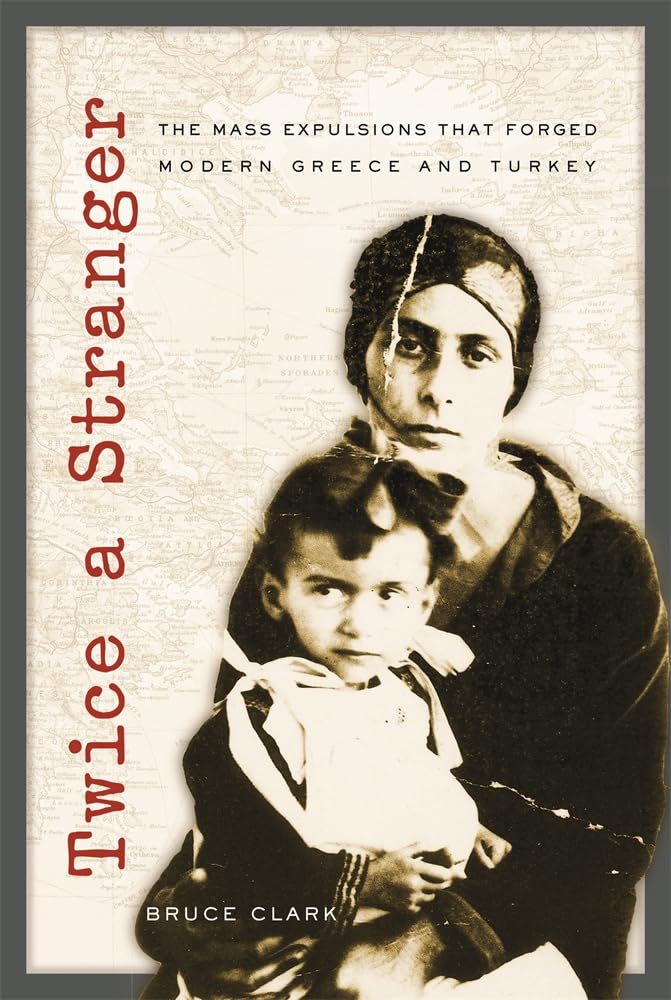
Twice a Stranger: The Mass Expulsions That Forged Modern Greece and Turkey
S**Y
Having lived in Greece for many years, I was pleased to have an impartial resource.
Highly recommended. The bibliography is superb.As presented in this book, the history of the consequences, mostly unintended, of the Treaty of Lausanne help to explain a great deal of life in modern day Greece. Why do so many Greek songs, both modern and 'laika,' speak of leaving and yearning for a homeland? Why does every region of Greece call itself the 'real Greece'? Why do so many people in northern Greece speak a little Turkish and Russian...and curse so fluently? Where did the expression "O thanatos sou einai n zwn mou... (""Your death is my life..." apologies for the attempt at transcription) arise in the national soul? Can there really such a thing as an ethnic identity, in Greece and Turkey, as well as elsewhere?One could read this book in search of answers to the many questions that arise on a daily basis about this infuriatingly beloved adopted homeland of mine, but I found as much food for thought in the applications of the well-intentioned actions of so many government and international political agencies today, right now, and a well-researched lesson in unintended consequences. Perhaps we can apply these concepts to the decisions we are making today in Pakistan and Afghanistan.
F**7
Well written, well presented and objective
I found the first and the last chapters the most rewarding in appreciating the problems and solutions of population exchanges based on religion or any other criterion. The chapters in between present details of the exchange both from the administrative and the persons involved points of view in this forced relocation. An interesting concept in nation building, I find the concept of religious "purity" a very difficult one to overcome in building cooperation and coexistence in the future.An easy book to read and to enjoy the presentation of the underlying concepts in a sensitive and thought provoking manner.
A**R
End of Multiculturalism
This is a fascinating subject. I do not entirely share the author's sceptisism about the Lausanne process given the histocal context: The multi-cultural Ottoman state had died along with multiculturalism. As the author indicates the idea for "unmixing" the population was proposed by Europe which itself has ever been failing to practice multiculturalisim "miserably".The book contains some errors. For example, there couldn't have been a "Fethiye Bey".Judging by the way different groups of people subjected to the population exchange are described one is left with the impression that all were Greeks in actuality. According to the author there were Cretan Muslims who spoke Greek, Thracian Muslims who were actually Greek speaking crypto-Christians, Pontic Greeks, other Orthodox Christian Greeks, and finally Turkish-speaking Cappadocian Christians (Karamans) who also must have forgotten their original Greek language. There is also repeated references to Greeks and Muslims instead of Christians and Muslims or Greeks and Turks. (I am not referring to the text of the Lausanne agreement) But this kind of bias has always been present in the west. We do not see foreign TV correspondents standing in front of a church when reporting from a majority-Christian country, say, Sweeden but when they report from a secular country with a majority-Muslim population the background is almost always a mosque and the country is referred to as a "Muslim" country. This book is also a product of that mentality despite the author's effort to remain impartial.
A**E
The book I've been waiting for the last twenty years!
My maternal grandparents were Orthodox Christians from Cappadocia. As a child I was told I was Greek; they were Greek, yet they spoke mostly Turkish. I noticed the other Greeks I met in the community were different than my grandparents. When I got to high school, after having lived in Greece for a year, I began asking questions of my grandmother, who told me many details of their Christian lives in a small town outside of Kayseri,then of the march out of Cappadocia, the ship to Greece that ran out of food as they had nowhere to put the refugees, finally debarking and being housed on the floor of a church until the parishioners got angry. She told me they were lucky; her father got a job as a teacher in orphange, as he was educated, a teacher certified by the patriarchate and so ended up on Evia at an American run orphanage. My grandfather and great uncle had escaped with false visas more than ten years earlier. I never fully understood why, based on my reading, the accounts of my grandfather and his brother having to escape at age 14. Now I do. Now I understand why the accounts that I've read from different regions of Anatolia are so different. I appreciated the author's methodology to get to every ethnic and regional group, and all the political parties that put their two cents in and influenced all these people who didn't want to go anywhere.I have read all the history books and personal accounts I could find but all were clearly heavily biased and didn't reflect all of my grandparents' accounts. My grandparents never spoke ill of the Turkish people, only the Turkish soldiers. I wondered why my grandmother constantly referenced clothing, music, food, or anything to being Turkish-like. I wondered how they came to be called Greeks when my grandfather's written family history shows them having lived in the same valley for at least three hundred years. His ancestors were Persian; my grandmother's were from one of the -stahn countries, southeast of the Caspian Sea. Their family photos looked Mongolian, not Greek.I once asked my grandmother how she could leave her home, her parents and siblings in Greece to marry a man she'd never met in the United States. (She never saw her parents again and didn't see her siblings for forty five years.)Her answers were forever etched in my mind.First: She didn't like the Greek "boys" and where they were living wasn't "home." The man she was to marry was from her own village, and although she didn't know him other than to have seen him at church he was their kind.Second was a lesson for my own marriage and a theme discussed in the book when refugee Christians moved into Muslim homes and shared their homes until the Muslims were deported. "Any two people can live together forever and be happy, if they both work at it." It seems that any two peoples can live together forever and be happy, if there are no politicians involved.
K**C
Read this book.
The problems that were created by zealous 19th century European nationalism are no less damaging today than 100 years hence. The poisonous notion of one majority, exclusive or favored ethnos per state continues to be played out. It has become acceptable and it is now considered "civilized" that differing religious, linguistic, tribal, or cultural groups be segregated and minorities relocated. This is the great shame of our era. Stirring up ethnic and religious passions is ever the lever for cheap civil and religious politicians to gain and maintain power. Whether it's Islamist or Zionist, National Fascist or Soviet Republic the result is the same and the agenda belongs to the autocrats and their aligned oligarchies.The "two-state" solutions that are ever proposed in the name of peace always are accompanied by human suffering and forced or economic population re-locations. The victims only get to vote with their feet, if they are fortunate enough to survive.TWICE A STRANGER illustrates not the first but perhaps the most unfortunate of the mutual ethnic cleansings of the twentieth century. I say most unfortunate not because others were less barbaric or less debilitating, but because Greek-Turkish population exchanging has legitimatized the concept and it was agreed to by the world powers. It set a devastating precedent.TWICE A STRANGER obliquely illustrates what we lost when the leaders of these "nations" set out to homogenize and segregate the cultures of their co-religionists. Local custom, craft, and dialect even charming ambiguities fell victim to the schemes of the nation builder politicians. There was left small room for natural diversity. Even today, the Greek Orthodox label themselves the "homogenis" or "same race" while ostensibly adhering to a faith that recognizes "neither Jew nor Hellene" within their ranks. (Gal. 3:28) Islamic fundamentalism is flourishing in the erstwhile secular state of (some of) the Turks.
Trustpilot
4 days ago
2 days ago