We remain fully operational. Our teams are working around the clock to ensure your deliveries continue safely.

DOWNLOAD THE APP


Customer Services
Copyright © 2025 Desertcart Holdings Limited
DOWNLOAD THE APP
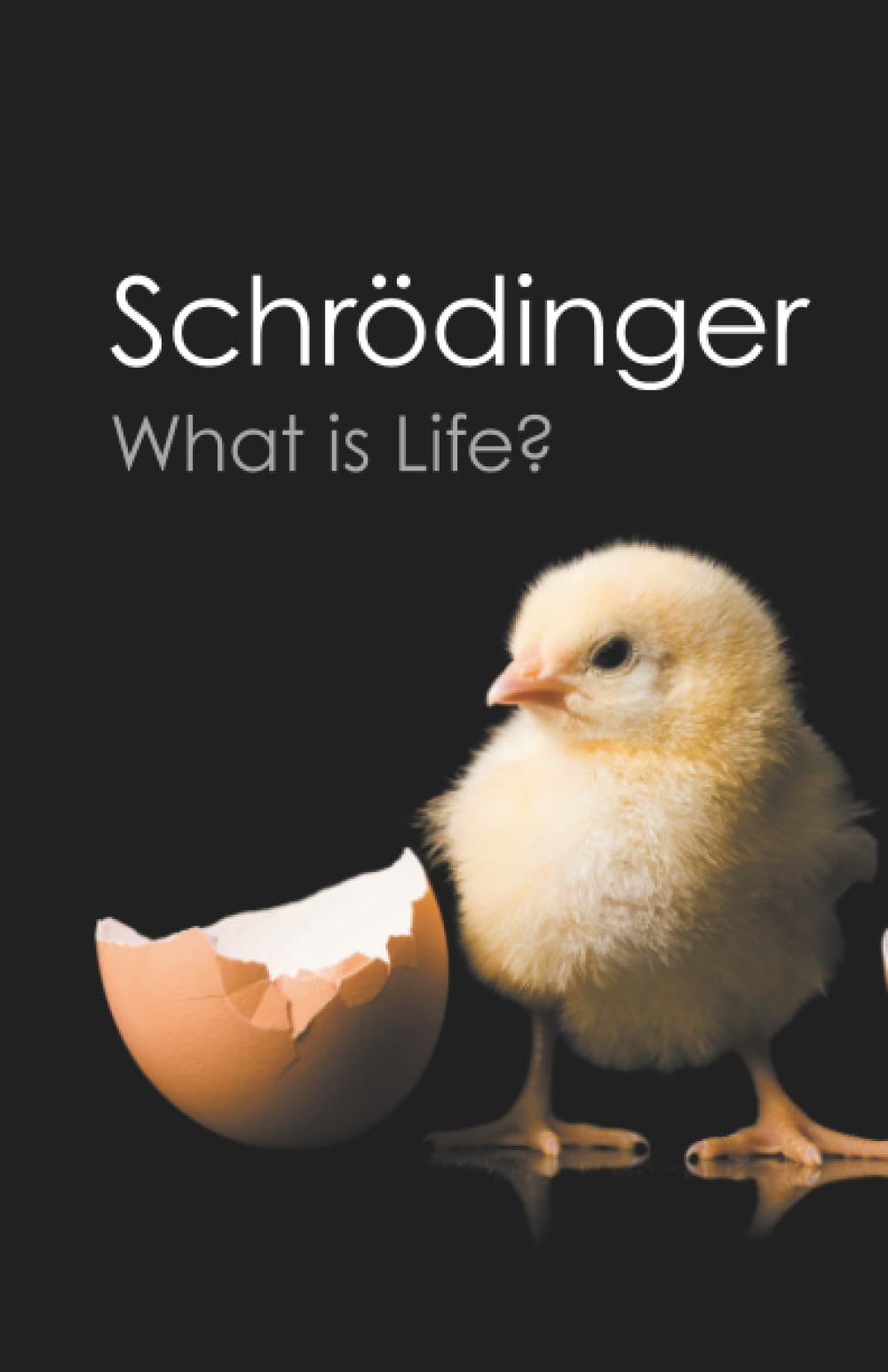


Buy What is Life? (Canto Classics): With Mind and Matter and Autobiographical Sketches Reprint by Schrodinger, Erwin (ISBN: 8601419978748) from desertcart's Book Store. Everyday low prices and free delivery on eligible orders. Review: I love it in that it shows the power of reason ... - This book is actually magnificent. It's a bit hard to read, i.e. you can't read more than a few pages at a time without losing concentration, but it's not long and is worth it - the guy basically describes DNA 20-odd years prior to its actual discovery from just thinking about it (as in he tells exactly what to look for...). I love it in that it shows the power of reason and logic, unlike what I think of modern 'science' which relies too much on bulk studies without much thought, and doesn't seem to accomplish too much except the publication of semi-conclusive journal papers that no one actually reads. Review: This is one of the best science books ever written. - A classic! A must for anyone with an interest in science. Readable too.
| ASIN | 1107604664 |
| Best Sellers Rank | 27,221 in Books ( See Top 100 in Books ) 3 in Philosophy of Science 41 in Science & Religion 55 in Philosopher Biographies |
| Customer reviews | 4.6 4.6 out of 5 stars (1,134) |
| Dimensions | 13.97 x 1.14 x 21.59 cm |
| Edition | Reprint |
| ISBN-10 | 9781107683655 |
| ISBN-13 | 978-1107604667 |
| Item weight | 281 g |
| Language | English |
| Part of series | Canto |
| Print length | 196 pages |
| Publication date | 29 Mar. 2012 |
| Publisher | Cambridge University Press |
P**N
I love it in that it shows the power of reason ...
This book is actually magnificent. It's a bit hard to read, i.e. you can't read more than a few pages at a time without losing concentration, but it's not long and is worth it - the guy basically describes DNA 20-odd years prior to its actual discovery from just thinking about it (as in he tells exactly what to look for...). I love it in that it shows the power of reason and logic, unlike what I think of modern 'science' which relies too much on bulk studies without much thought, and doesn't seem to accomplish too much except the publication of semi-conclusive journal papers that no one actually reads.
R**E
This is one of the best science books ever written.
A classic! A must for anyone with an interest in science. Readable too.
N**K
Definitely worth reading
I was attracted to this book by a “throwaway” line in the tv programme of the same title. With an interest in philosophy and as a Christian I was fascinated by the approach to this subject from physics and chemistry. it is a hard read even with my limited knowledge of the sciences. However the author attempted to write without using too much technical knowledge. Some pages I had to reread and I dare say I still haven’t grasped all the content! It is an excellent read and I would have given five stars had I been able to understand it!!
H**Y
Great Intuition for Fundamental Ideas
This book inspired me to study a degree in physics with biology. Four years later and I can read/write all the complicated equations but still think about "what it means" in the ways outlined in this book****. The overview of statistical mechanics is brilliant and exactly on point - the example using the magnetisation of oxygen captures the essence of thermodynamics perfectly. Regarding his predictive powers on DNA - it's worth noting that a lot of research had already been done in this area. At the time he wrote this, it wasn't known if proteins were responsible for the "genetic code" or this funny little acid chain that seemed to be in all the cells but these were the two best candidates. The book contains his reasoning for why he believed it likely to be the acid "quasi-crystal" (ie DNA). Watson, Crick and Franklin's contribution was working out exactly what the chemical composition and structure of DNA was. Sorry to be "political" but Franklin was undermined by a suboordinate who resented working under a woman and shared her results without permission - I would encourage you to verify this for yourself. ***I just had a flick through the book and noticed the equation on page 15 was in my final physics exam at Cambridge. They wanted us to give a physical interpretation (as well as mathematical working) and my answer was essentially the same as the description he gives in the footnote on page 16 - just with slightly more modern wording. If you're curious go to Camphys.com and look at Part II Physics Astrophysical Fluid Dynamics 2024, which will be publicly viewable a few months after the exam. See question 6d. Whilst in a different context, it's the same equation!
P**S
Fantastic
This is one of the greatest books of all time. It was an intellectual tour de force of almost unparalleled extent. It is the cornerstone of professor Brian Cox's television series, and spurred Crick and Watson to search for the structure of DNA. What more can be said!
H**A
Great book
Great book. Takes you through things very slowly and gradually and makes you very interested and willing to understand. Goes into a lot of depth and detail however, so I personally cannot read it for too long before needing to pause and process what I've read!
J**E
A Nobel prize winner's iiew - What is Life?
Having seen the TV series "The Wonders of Life" presented by Prof Brian Cox, I was keen to read the book that triggered the series - What is Life? by E Schrodinger. He was one of the founding fathers of wave mechanics and clearly a profound thinker. The book was published first in 1944, and much has happened in the world of physics (and science in general) since then, as our understanding of nature has deepened. I was not disappointed. I am grateful to the late professor for his insights, and would recommend the book most highly to those engaged in science wishing to broaden their horizons.
N**E
Interesting!
One tends to forget how much has been learned in molecular biology since Schroedinger delivered his 1943 lectures on which the book was based. Therefore, it now seems naive. I bought it because: 1. it was mentioned as a curiosity in a seminar I attended some years ago; 2. it was mentioned by Sir Paul Nurse in a seminar last year; 3. Brian Cox praised it in the 1st of his TV series, 'The Wonders of Life'. As Francis Crick observed, whereas in his new field of neurobiology, 'recent' meant in the last two or three years, in molecular biology it meant the last two or three weeks! Crick also said that a problem was that Schroedinger didn't know any biochemistry, but he said the book had encouraged many subsequently prominent researchers to enter the field. On thing that astonished me was that, in a book published in 1954, also included in this volume, he appeared not to know that 3D vision depended on the different images captured by the two eyes because of their physical lateral separation, only observing, quoting Sherrington, that a distant view looks the same in each eye. Incredible!
J**E
With today’s rapid developments in molecular biology and the increasing possibilities in biotech Engineering some basic knowledge of genetics seems to be more and more important. Although the DNA helix was not discovered at the time Schrödinger‘s lecture covers the very fundaments of our modern days understanding of genetics. For today’s reader it may connect the dots or, what may be more important, it can offer insight into a way of thinking about the subject.
P**.
What is life story was to good.
P**O
What Is Life? es el trabajo de divulgación más famoso de Erwin Schrödinger. Se trata de un libro corto, pero de valor incalculable, en el que el físico especula sobre algunas de las características que distinguen a la materia viva de aquella a la que consideramos inerte. Escrito en la primera mitad del siglo pasado, muchos de los conceptos manejados por Schrödinger han sido esclarecidos en la actualidad, y algunos incluso, desmentidos, sin embargo, la claridad de pensamiento del autor se sobrepone siempre a sus limitaciones tanto temporales como de formación (ya que las investigaciones dedicadas a generar conocimientos sobre aspectos como la naturaleza del proceso hereditario y la búsqueda de la molécula maestra de la herencia eran llevadas a cabo, principalmente, por biólogos y bioquímicos, de manera que Schrödinger aportó a estos temas desde su particular punto de vista de físico de partículas); sus ideas son sólidas y la mayoría ciertas, para sorpresa de muchos biólogos de la época. El libro comienza con una explicación breve pero concisa sobre la naturaleza estadística de la física: las llamadas leyes siempre son obedecidas en nuestra experiencia porque la posibilidad de que algo distinto suceda se acerca cada vez más a cero conforme más átomos participen en el fenómeno. Schrödinger especula sobre la naturaleza posiblemente molecular de un gen (una deducción absolutamente brillante tomando en cuenta la poca información que tenía) y mediante algunos cálculos (se podría decir que hechos "a ciegas") determina el probable número máximo de átomos involucrados en su estructura. Un número muy bajo como para sentirse cómodo lo lleva a invocar el extraño mundo de la teoría cuántica, cuyas leyes le permiten explicar la "permanencia" de los genes, no sin antes exponernos al principal generador de variación entre los organismos y mecanismo por el cual los seres vivos evolucionan: las mutaciones. El capítulo referente a las mutaciones, donde Schrödinger argumenta sobre su posible naturaleza (¿un evento de excitación de escala atómica?), es en mi opinión la mejor parte del libro, ya que las ideas expuestas valen oro. La parte final del texto alude a las posibles implicaciones biológicas y filosóficas derivadas de la inclusión de un modelo cuántico en el campo del estudio de la vida; esta parte final dista del brío del resto del libro, pero concluye con seguridad y optimismo un texto que ya es considerado clásico por la mayoría de los científicos y divulgadores actuales. Se agradece también la inclusión de uno de los textos compañeros del físico titulado "Mind and Matter", en el cual se discute un tema mucho más elusivo: la naturaleza de lo que llamamos "conciencia". Ambos textos se reproducen en su versión original en inglés, pero el carácter técnico empleado por Schrödinger facilita su posible lectura por hispanohablantes que estén medianamente inmersos en el quehacer científico. La edición que presenta Canto Classics es impecable, y el precio es bajo en comparación con la riqueza del texto que se ofrece. Enormemente recomendado, un clásico de la literatura científica de todos los tiempos.
C**N
Absolutely amazing, as a physicist I would recommend it to any other physicist with a minimum interest in biology
F**I
Schrodinger è stato un grande fisico, ma anche un grande filosofo. Nelle conferenze raccolte in questo libro affronta i temi più importanti della nostra esistenza.
Trustpilot
1 day ago
2 weeks ago