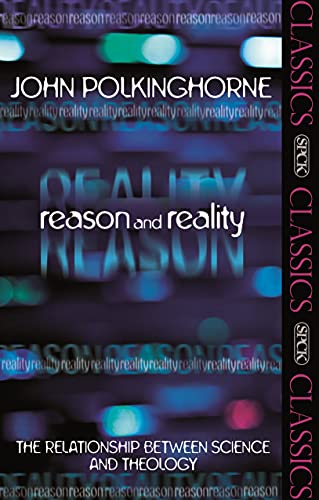
Reason and Reality: The Relationship Between Science and Theology (SPCK Classics)
J**S
a whole other r&r!
Science and theology get a masterly mix here by a foremost authority. "Reason and Reality" brings together essays where Polkinghorne pursues width and depth in academic and high level reading. Natural philosophy, rational enquiry, reason and rationale alongside rich questions abounding in this chewy read! It closes with thorough reference notes, a further detailed bibliography and detailed indexing, complete this work. The result is a convincing, deeply satisfying interpretation of the nature and scope of human knowledge, the extent and limits of science, and the rightful place of theology of what Polkinghorne calls science's "cousin under the skin."Perhaps the core achievement of the book is its demonstration of how both science and theology, despite postmodernist skepticism to the contrary, are fundamentally rational in character. Substantial and significant.
E**.
A Dilemma Examined and ?Solved?
I bought this book as a present and understand that the recipient was totally engrossed from cover to cover! He has requested any other titles by the same author on the same subject! Praise indeed!
D**S
The compatibility of science and religion, 4
Reason and Reality: The relationship between science and theology, by John Polkinghorne, SPCK, 1991, 128 ff.The compatibility of science and religion, 4By Howard JonesThis volume is not intended specifically to be a part of the trilogy on science and religion by John Polkinghorne, KBE, FRS, that began with One World, though it is a continuation of the same theme - that the findings of science do more to support the notion of God than contradict it. This was precisely the intention of the early 17th century `natural philosophers' like Newton when they established the laws of the universe - to reveal the beauty and intricacies of God's handiwork in Creation. Polkinghorne sees a similarity between science and theology in that both `have to speak of entities which are not directly observable.' This book of eight quite self-contained essays is based largely on a series of lectures that the author was invited to give.We open with a philosophical discussion on the nature of Rational Inquiry. I would disagree with the author's (and Torrance's) view that there is any meaningful comparison between discovery in science and revelation in theology: the former involves reproducible sensory observation and reason, the latter, imagination. Only when we get down to the level of quarks, gluons and strings and comparable unobservables do we enrol the use of imagination in science, and even there the reasoning is subject to verification by others. This is not so with revelation.Chapter 2 on Rational Discourse pursues this theme of the veracity of revelation by a discussion of models and theories in science and religion, and Chapter 3 on The Nature of Physical Reality continues the theme, and includes mathematical models. There is an interesting discussion here on determinism and randomness in Nature, following the theme of Jacques Monod's Chance and Necessity. Chapter 4 on Reason and Revelation stretches the science/theology comparison by maintaining that faith is needed too by the scientist - faith that there is a pattern in the universe to be discovered. Surprisingly, the Oxford chemist Peter Atkins is described as a fideist - faith presumably in the scientific method, as Atkins is known to be a passionate atheist and detractor of religion. Martin Gardner's view of religious belief as `unsupported by logic or science' is also criticised. Chapter 5 suggests that The Use of Scripture is as metaphor, as opposed to the literality demanded by fundamentalists. Chapter 6, Cross-Traffic, continues the science and theology comparison while Chapter 7 gives us the current scientific world-view in Quantum Questions. Chapter 8 on The Fall deals with what Polkinghorne describes as the most difficult piece of theology to reconcile with science.This is a fascinating book, more challenging than its predecessors. It ends with reference Notes, a further reading Bibliography and an Index.Dr Howard A. Jones is the author of The Thoughtful Guide to God (2006) and The Tao of Holism (2008), both published by O Books of Winchester, UK. One World: Interaction of Science and Theology
Trustpilot
1 week ago
1 week ago