
DOWNLOAD THE APP


Customer Services
Copyright © 2025 Desertcart Holdings Limited
DOWNLOAD THE APP
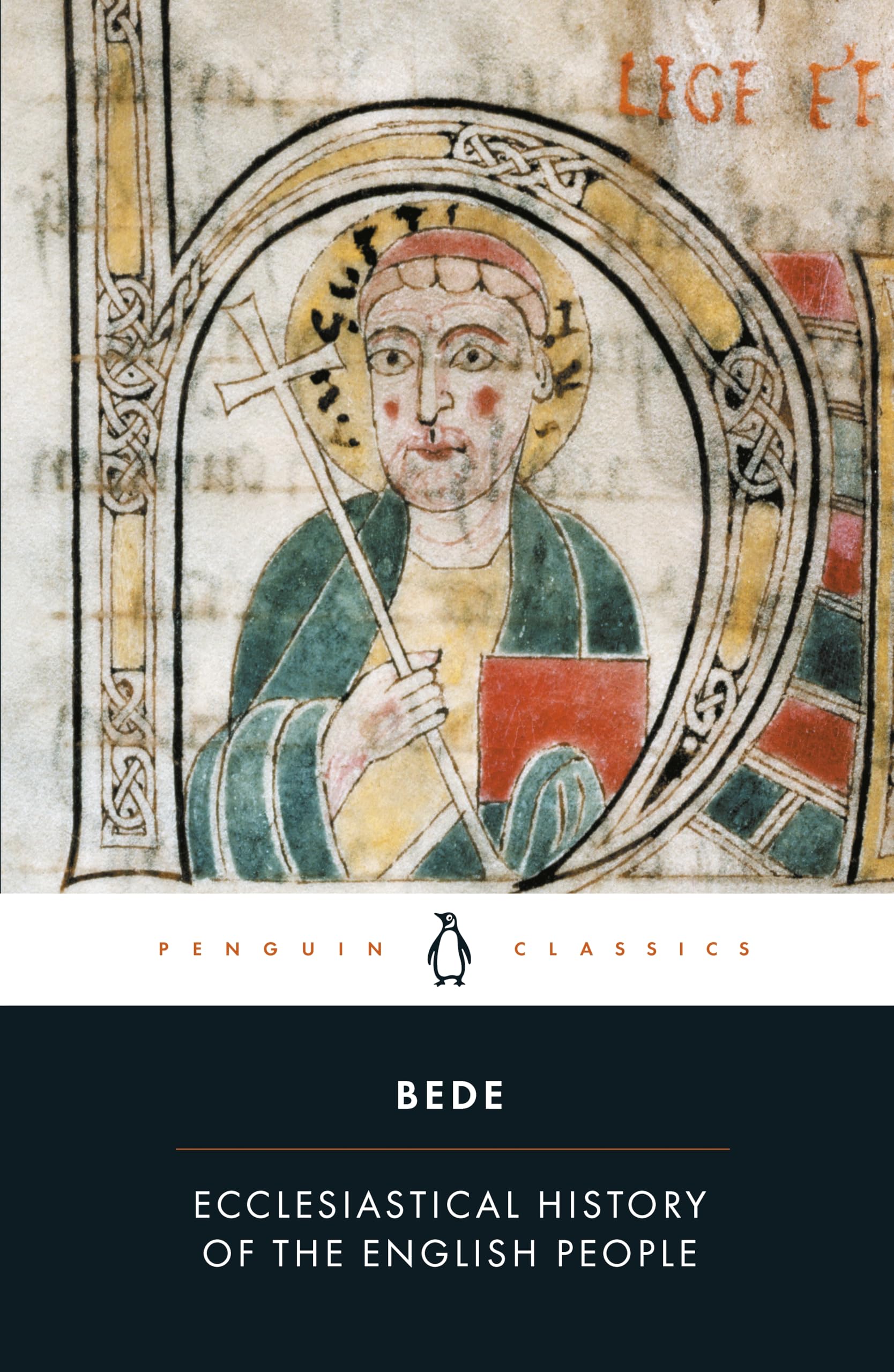
Ecclesiastical History of the English People (Penguin Classics) [Bede, Latham, Ronald, Farmer, D. H., Sherley-Price, Leo, Farmer, D. H.] on desertcart.com. *FREE* shipping on qualifying offers. Ecclesiastical History of the English People (Penguin Classics) Review: Important work, good translation - In this work, Bede set out to write the history Christianity in Britain. It covers the Roman invasions of Britain, the coming of the Anglo-Saxons, the conversion to Christianity, the rise and fall of the Arian and Pelagian heresies in England, and various historical events as they relate to the development of Christianity in England. The discussions of the Roman period are likely taken from other histories. This is not a general history of England (for that, you want to also read The Anglo-Saxon Chronicle as that work contains more material of general historical interest). Bede's work is fascinating, despite its narrow focus, for a couple of reasons. First, he provides a window into the view of the religious values of Anglo-Saxon England and it is interesting to compare this work with Orkneyinga Saga: The History of the Earls of Orkney (Penguin Classics) and The Journey Through Wales and The Description of Wales (Penguin Classics) , both of which provide additional views into the religious sentiments of the Middle Ages. Secondly, he provides one of only a few early histories of the arrival of the Anglo-Saxons. I found the translation to be quite accessible and easy to read, though in a few places it probably could have done with a few more footnotes. For example, Bede's insistence that the main ethnic groups in Britain were the Irish, the Welsh, the Picts, and the English makes sense if you realize that the Scots were considered Irish, and indeed that "Scotia Major" was a name for Ireland, but if you don't have this background it is a bit confusing. All in all these were minor problems however and did not overly detract from reading the work. This is one of the primary sources for studying early Anglo-Saxon history. Review: Ian Myles Slater on: Bede in Various Guises - Just in case desertcart software jumbles up reviews of different editions, I am here reviewing (primarily) the paperback and Kindle editions of the Penguin Classics book of “Ecclesiastical History of the English People,” by Bede (also known as the Venerable Bede), translated with notes by Leo Sherley-Price, as revised by R.E. Latham, and revised and expanded by D.H. Farmer. This translation originally appeared under the more explanatory title of “The History of the English Church and People,” translated with annotations by Sherley-Price alone. There is another recent translation, also titled “The Ecclesiastical History of the English People,” with some additional material. It was originally published with a Latin text, and is now available, somewhat revised, from Oxford World’s Classics, likewise available in paperback and Kindle editions, and expanded with supplementary texts. (I intend to review it separately.) The present, enlarged, Penguin edition is (as on the desertcart page, and the book’s title page, although not the cover) titled in full “Ecclesiastical History of the English People: With Bede’s Letter to Egbert and Cuthbert’s Letter on the Death of Bede.” Penguin also offers a volume of translations of other works, under the title of “The Age of Bede” (originally published in shorter form as “Lives of the Saints,” and expanded and revised several times). In its fullest form it contains Bede’s “Life of St. Cuthbert” and his “Lives of the Abbots” (of his home monastery), besides other early documents. I have reviewed “The Age of Bede” (and also the “Lives of the Saints” edition) separately. Again, this is available in both paperback and Kindle formats. Bede’s “Historia Ecclesiastica Gentis Anglorum” is the primary (although not quite the only) source for the early history of the Angles and Saxons (and the somewhat mysterious Jutes) in “Dark Age” Britain, composed from oral tradition and written sources in the early eighth century (completed in 731). The main emphasis is on their conversion to Christianity (and especially to the Roman variety), and the establishment of monasteries, convents, and the dioceses of the Church, with kings being rated pretty much according to their perceived piety. The British — meaning the Welsh — don’t come off very well, since, in Bede’s eyes, they seem to have been more concerned with getting rid of the Anglo-Saxon invaders than saving their souls. However, Bede had to admit that there were English Christians *before* the Roman Church took a hand in missionary endeavors, and his general acknowledgement of the role of the Irish Church may not account for it. Bede also slides over the role of the British, such as St. Patrick, in converting the “pagan” Irish to the True Faith to begin with. (This pro-Roman approach presented a problem to post-Reformation scholars in England, evident at least as late as the nineteenth century.) The Church-centered approach (Celtic/Insular or Roman) was probably natural to Bede, who spent pretty much his life (possibly from early childhood) in a monastery. It was also something he would have learned from earlier Christian writers, notably Eusebius, a contemporary of the Emperor Constantine, who also wrote an “Ecclesiastical History” (which is now our main source for the early history of the Church from Apostolic times onwards). So far as I can tell, the Penguin translation was the one most likely to be used by students and ordinary readers for almost half of the twentieth century, and probably longer. As noted, it has not always been quite the same book: it originally appeared in 1955, was reprinted with revisions in 1965, revised again in 1968, and revised and expanded in 1990. It is this last edition of it that is available in Kindle (as well as paperback). Both paperback and hardcover copies of older versions are sometimes available from dealers, sometimes under the older “History of the English Church…” title. For those already familiar with Bede, and wondering only whether to buy the Kindle edition of the Penguin translation (which is quite good as a translation), there is good news. It is quite thoroughly hyperlinked, including the chapter titles and the index, and cross-references, in addition to the end-notes. (Unlike the Oxford World’s Classics translation’s Kindle edition, which is sadly lacking in hyperlinks, except to the end-notes; a pity, since I prefer its translation and notes.) At least on a Kindle app, the maps and genealogical trees of various dynasties of Anglo-Saxon rulers are legible — although for some reason these do not appear at all when I use the Cloud Reader, instead. (I assume it will work equally well on an actual Kindle. [Additional note; I've checked, and it does.]) desertcart lists this as a 2003 edition, but the copyright page indicates no revisions after 1990; presumably the reference is to one of the re-printings, as it is too early to be the date of the Kindle release itself. (I’ll discuss some other options at the end of this review.) The desertcart listing for this translation gives the author as “Bede the Venerable.” I won’t say that this is an incorrect rendering of *Beda Venerabilis,* but he is more commonly known as “the Venerable Bede.” (Or, according to that reliable source of *truly* memorable English history, “1066 and All That,” he is *really* known as The Venomous Bead.) The main point of the “Venerable” designation seems to be that he is, to quote the Merriam-Webster Dictionary, “a person recognized by Roman Catholics as having attained the lowest of three degrees of sanctity.” (Anglican usage is different, referring to different ranks of clergy, and not relevant here.) However, a number of desertcart listings of other editions (and some of those editions) describe him as “St. Bede,” which is correct, but not the usual way of referring to him, even in the Middle Ages. Various confused appellations also appear on desertcart listings (and elsewhere), such as “Bede, Venerable, the,” and “St. Bede the Venerable” (which is clearer, but, at best, redundant). In an extreme case, he has become twins: “Bede (author), Saint the Venerable (author).” The honorific name of “the Venerable” is often said to be derived directly from the inscription on his tomb in Durham Cathedral: HIC SUNT IN FOSSA BEDAE VENERABILIS OSSA, or, “Here are buried the bones of the Venerable Bede.” However, this may reflect an already established usage. In any case, he is often cited simply as “Bede,” with the assumption that of course the reader knows who is being referred to. Using it alone confuses search engines a bit, since there are a handful of modern writers whose name includes “Bede” — fortunately, these are mostly easily recognized, and it is the variations of his title which can trip one up. Bede (Baeda, or Beda, c.672-735), although recognized as a Saint, never had much of a following in that role: possibly because his Saint’s Day coincided with that of already prominent saints, possibly because the community that ultimately possessed his relics preferred to emphasize an older saint of their own (Cuthbert), rather than promote a rival. In any case, he was so regarded in the North of England, and there were stories told elsewhere purporting to explain why he was not a saint. He is the only Englishman to be recognized by the Catholic Church — in 1899! — as an official “Doctor of the Church” — Anselm of Canterbury shares the title, but he was a transplanted Italian who became Archbishop of Canterbury under the Normans. Fortunately, “Dr. Bede” has not (so far — I think) shown up on desertcart, or elsewhere on-line, to add to the possible confusion! (Bede is also the only Englishman to appear in Dante’s “Divine Comedy,” but that does not give rise to a variant of his name….) Bede’s status as a model of piety and scholarship may have originally rested on his carefully orthodox Scripture commentaries, popular in his own time and thereafter (and recently beginning to appear in English translations), and his devotional and technical writings (such as those on how to compute to the date of Easter according to the Roman usage). However, the “Ecclesiastical History” was also recognized as important from an early date — as witnessed by copies sent to or made on the Continent, as well as in Britain — despite its seemingly insular concerns. It survives from the early Middle Ages in an impressive number of manuscripts; enough to warrant a Wikipedia article listing them (and later ones, too; there are about 160 altogether): quite apart from the article on Bede himself, another specifically on the “Ecclesiastical History,” and an article on Bede’s works in general. As a mark of the importance given to the “History” in England, there was in the late ninth century an abridged translation into Old English (Anglo-Saxon) — which scholars used to associate with Alfred the Great (d. 899), although this connection is now discounted. (Its rendering of Bede’s story of the herdsman Caedmon’s sudden — “miraculous” — ability to compose Anglo-Saxon poetry on Christian themes is a staple of textbooks of Old English.) The 1930 Loeb Classical Library bilingual edition, in print and available in many libraries, uses as the base text of its translation a considerably more “recent” English translation, an early Elizabethan(!) rendering, “History of the Church in England,” by Thomas Stapleton. This translation, from 1565, admittedly, sounds great, but often is harder to follow than necessary. It took the Catholic side in Reformation controversies, but, if, as has been suggested, the translator was specifically hoping to influence Elizabeth I in favor of the Catholic Church, he doesn’t seem to have realized that she was a fine Latinist, and could read Bede for herself if she wanted to, thank you…. (Annoyingly, since the Loeb version of this translation seems to have been revised, it is problematic for students of sixteenth-century English, who might have an actual use for it.) As to other translations, a number of inexpensive Kindle editions are available using nineteenth-century translations, notably the revision of a still older work by the industrious, but not wholly reliable, J.A. Giles. His 1847 translation was a revision of a 1723 version by J. Stevens. Giles himself was further revised in 1907 by A.M. Sellar, who had the advantage of Charles Plummer’s excellent edition of the text, with a valuable commentary (1896). (Giles produced his own edition, which is not well-regarded). Unfortunately, Sellar's version still sounds old-fashioned without being really eloquent. It is used in some Kindle editions by itself, and in two Kindle editions it appears with a Latin text of the “History.” There are also some hard-copy editions on desertcart which may use L. C. Jane’s 1903 “Temple Classics” translation. (This may be available on-line, too, in hypertext and pdf format.) Dent, the original publisher, later used it for a 1910 “Everyman’s Library” edition of the “Ecclesiastical History.” It too was a revision of the Giles translation. However, the Everyman's Library edition included translations by J. Stevenson of Bede's "Life of Saint Cuthbert" and "Lives of the Abbots" (originally published 1870). Two Everyman editions (one a 1963 reissue with a new Introduction) are available from the Internet Archive (archive.org), along with several other old translations. (WorldCat, interestingly enough, gives the author of the Temple Classics edition as “Bede, the Venerable Saint.”) For those interested in Bede’s original Latin text, there are several alternatives. desertcart lists one as “Bede: The Ecclesiastical History of the English People in Latin + English (SPQR Study Guides Book 20)” a Kindle book which is titled on its cover “Historia Ecclesiastica Gentis Anglorum: Latin + English + Vocabulary,” as by St. Bede (second edition, 2013). The “Study Guide” consists of a Latin text (source edition unspecified; one hopes it is Plummer), an English translation (by A.M. Sellar), and vocabulary lists. These lists follow each chapter, which are presented first in Latin and then in English, so those trying to use the Latin text don’t have to go far for help. (This is the standard format for Paul Hudson’s SPQR Study Guides, and is also used for Greek, rather than Latin, texts. The “Study Guides” are also available for iBook.) The Latin and Sellar's English translation, but not the vocabulary lists, are included, with much other Latin literature, in the expanded edition of Hudson’s app “SPQR,” which is available for iOS (Apple) and, more recently, for Android. What may be the same Latin text, and is certainly the same translation, can also be found in another Kindle edition, “Complete Historical Works of the Venerable Bede (Illustrated),” in the Delphi Ancient Classics series (Book 45). This Delphi collection also contains translations of a few of Bede’s shorter works, and some whose attribution is dubious, perhaps justifying “The Complete” part of their title, but it does not include the year-by-year Chronicles he attached to two of his other works (on reckoning dates and times; one of these is included in the Oxford World’s Classics translation). It does not contain anything dedicated to assisting the reader with the Latin text, beyond presenting it by itself and in a chapter-by-chapter dual-text arrangement (much like Hudson’s). Hudson’s edition is, therefore, probably the best inexpensive choice, in digital format, for those who actually want to try Bede’s Latin (generally considered excellent, and very clear), or who need to have a Latin text available to check references. Even less expensive, but more intimidating, is a pdf version of Charles Plummer's classic 1896 edition (both volumes, text and commentary), also available from archive.org. (There are other formats, but the conversion tends to mess up the text.) For those studying Latin, and not interested in Bede as an historian, another alternative is F.W. Garforth’s 2004 collection of excerpts from the Latin text, as “Bede’s Historia Ecclesiastica.”















| Best Sellers Rank | #50,322 in Books ( See Top 100 in Books ) #33 in England History #176 in History of Christianity (Books) #197 in Christian Church History (Books) |
| Customer Reviews | 4.8 out of 5 stars 435 Reviews |
C**S
Important work, good translation
In this work, Bede set out to write the history Christianity in Britain. It covers the Roman invasions of Britain, the coming of the Anglo-Saxons, the conversion to Christianity, the rise and fall of the Arian and Pelagian heresies in England, and various historical events as they relate to the development of Christianity in England. The discussions of the Roman period are likely taken from other histories. This is not a general history of England (for that, you want to also read The Anglo-Saxon Chronicle as that work contains more material of general historical interest). Bede's work is fascinating, despite its narrow focus, for a couple of reasons. First, he provides a window into the view of the religious values of Anglo-Saxon England and it is interesting to compare this work with Orkneyinga Saga: The History of the Earls of Orkney (Penguin Classics) and The Journey Through Wales and The Description of Wales (Penguin Classics) , both of which provide additional views into the religious sentiments of the Middle Ages. Secondly, he provides one of only a few early histories of the arrival of the Anglo-Saxons. I found the translation to be quite accessible and easy to read, though in a few places it probably could have done with a few more footnotes. For example, Bede's insistence that the main ethnic groups in Britain were the Irish, the Welsh, the Picts, and the English makes sense if you realize that the Scots were considered Irish, and indeed that "Scotia Major" was a name for Ireland, but if you don't have this background it is a bit confusing. All in all these were minor problems however and did not overly detract from reading the work. This is one of the primary sources for studying early Anglo-Saxon history.
I**R
Ian Myles Slater on: Bede in Various Guises
Just in case Amazon software jumbles up reviews of different editions, I am here reviewing (primarily) the paperback and Kindle editions of the Penguin Classics book of “Ecclesiastical History of the English People,” by Bede (also known as the Venerable Bede), translated with notes by Leo Sherley-Price, as revised by R.E. Latham, and revised and expanded by D.H. Farmer. This translation originally appeared under the more explanatory title of “The History of the English Church and People,” translated with annotations by Sherley-Price alone. There is another recent translation, also titled “The Ecclesiastical History of the English People,” with some additional material. It was originally published with a Latin text, and is now available, somewhat revised, from Oxford World’s Classics, likewise available in paperback and Kindle editions, and expanded with supplementary texts. (I intend to review it separately.) The present, enlarged, Penguin edition is (as on the Amazon page, and the book’s title page, although not the cover) titled in full “Ecclesiastical History of the English People: With Bede’s Letter to Egbert and Cuthbert’s Letter on the Death of Bede.” Penguin also offers a volume of translations of other works, under the title of “The Age of Bede” (originally published in shorter form as “Lives of the Saints,” and expanded and revised several times). In its fullest form it contains Bede’s “Life of St. Cuthbert” and his “Lives of the Abbots” (of his home monastery), besides other early documents. I have reviewed “The Age of Bede” (and also the “Lives of the Saints” edition) separately. Again, this is available in both paperback and Kindle formats. Bede’s “Historia Ecclesiastica Gentis Anglorum” is the primary (although not quite the only) source for the early history of the Angles and Saxons (and the somewhat mysterious Jutes) in “Dark Age” Britain, composed from oral tradition and written sources in the early eighth century (completed in 731). The main emphasis is on their conversion to Christianity (and especially to the Roman variety), and the establishment of monasteries, convents, and the dioceses of the Church, with kings being rated pretty much according to their perceived piety. The British — meaning the Welsh — don’t come off very well, since, in Bede’s eyes, they seem to have been more concerned with getting rid of the Anglo-Saxon invaders than saving their souls. However, Bede had to admit that there were English Christians *before* the Roman Church took a hand in missionary endeavors, and his general acknowledgement of the role of the Irish Church may not account for it. Bede also slides over the role of the British, such as St. Patrick, in converting the “pagan” Irish to the True Faith to begin with. (This pro-Roman approach presented a problem to post-Reformation scholars in England, evident at least as late as the nineteenth century.) The Church-centered approach (Celtic/Insular or Roman) was probably natural to Bede, who spent pretty much his life (possibly from early childhood) in a monastery. It was also something he would have learned from earlier Christian writers, notably Eusebius, a contemporary of the Emperor Constantine, who also wrote an “Ecclesiastical History” (which is now our main source for the early history of the Church from Apostolic times onwards). So far as I can tell, the Penguin translation was the one most likely to be used by students and ordinary readers for almost half of the twentieth century, and probably longer. As noted, it has not always been quite the same book: it originally appeared in 1955, was reprinted with revisions in 1965, revised again in 1968, and revised and expanded in 1990. It is this last edition of it that is available in Kindle (as well as paperback). Both paperback and hardcover copies of older versions are sometimes available from dealers, sometimes under the older “History of the English Church…” title. For those already familiar with Bede, and wondering only whether to buy the Kindle edition of the Penguin translation (which is quite good as a translation), there is good news. It is quite thoroughly hyperlinked, including the chapter titles and the index, and cross-references, in addition to the end-notes. (Unlike the Oxford World’s Classics translation’s Kindle edition, which is sadly lacking in hyperlinks, except to the end-notes; a pity, since I prefer its translation and notes.) At least on a Kindle app, the maps and genealogical trees of various dynasties of Anglo-Saxon rulers are legible — although for some reason these do not appear at all when I use the Cloud Reader, instead. (I assume it will work equally well on an actual Kindle. [Additional note; I've checked, and it does.]) Amazon lists this as a 2003 edition, but the copyright page indicates no revisions after 1990; presumably the reference is to one of the re-printings, as it is too early to be the date of the Kindle release itself. (I’ll discuss some other options at the end of this review.) The Amazon listing for this translation gives the author as “Bede the Venerable.” I won’t say that this is an incorrect rendering of *Beda Venerabilis,* but he is more commonly known as “the Venerable Bede.” (Or, according to that reliable source of *truly* memorable English history, “1066 and All That,” he is *really* known as The Venomous Bead.) The main point of the “Venerable” designation seems to be that he is, to quote the Merriam-Webster Dictionary, “a person recognized by Roman Catholics as having attained the lowest of three degrees of sanctity.” (Anglican usage is different, referring to different ranks of clergy, and not relevant here.) However, a number of Amazon listings of other editions (and some of those editions) describe him as “St. Bede,” which is correct, but not the usual way of referring to him, even in the Middle Ages. Various confused appellations also appear on Amazon listings (and elsewhere), such as “Bede, Venerable, the,” and “St. Bede the Venerable” (which is clearer, but, at best, redundant). In an extreme case, he has become twins: “Bede (author), Saint the Venerable (author).” The honorific name of “the Venerable” is often said to be derived directly from the inscription on his tomb in Durham Cathedral: HIC SUNT IN FOSSA BEDAE VENERABILIS OSSA, or, “Here are buried the bones of the Venerable Bede.” However, this may reflect an already established usage. In any case, he is often cited simply as “Bede,” with the assumption that of course the reader knows who is being referred to. Using it alone confuses search engines a bit, since there are a handful of modern writers whose name includes “Bede” — fortunately, these are mostly easily recognized, and it is the variations of his title which can trip one up. Bede (Baeda, or Beda, c.672-735), although recognized as a Saint, never had much of a following in that role: possibly because his Saint’s Day coincided with that of already prominent saints, possibly because the community that ultimately possessed his relics preferred to emphasize an older saint of their own (Cuthbert), rather than promote a rival. In any case, he was so regarded in the North of England, and there were stories told elsewhere purporting to explain why he was not a saint. He is the only Englishman to be recognized by the Catholic Church — in 1899! — as an official “Doctor of the Church” — Anselm of Canterbury shares the title, but he was a transplanted Italian who became Archbishop of Canterbury under the Normans. Fortunately, “Dr. Bede” has not (so far — I think) shown up on Amazon, or elsewhere on-line, to add to the possible confusion! (Bede is also the only Englishman to appear in Dante’s “Divine Comedy,” but that does not give rise to a variant of his name….) Bede’s status as a model of piety and scholarship may have originally rested on his carefully orthodox Scripture commentaries, popular in his own time and thereafter (and recently beginning to appear in English translations), and his devotional and technical writings (such as those on how to compute to the date of Easter according to the Roman usage). However, the “Ecclesiastical History” was also recognized as important from an early date — as witnessed by copies sent to or made on the Continent, as well as in Britain — despite its seemingly insular concerns. It survives from the early Middle Ages in an impressive number of manuscripts; enough to warrant a Wikipedia article listing them (and later ones, too; there are about 160 altogether): quite apart from the article on Bede himself, another specifically on the “Ecclesiastical History,” and an article on Bede’s works in general. As a mark of the importance given to the “History” in England, there was in the late ninth century an abridged translation into Old English (Anglo-Saxon) — which scholars used to associate with Alfred the Great (d. 899), although this connection is now discounted. (Its rendering of Bede’s story of the herdsman Caedmon’s sudden — “miraculous” — ability to compose Anglo-Saxon poetry on Christian themes is a staple of textbooks of Old English.) The 1930 Loeb Classical Library bilingual edition, in print and available in many libraries, uses as the base text of its translation a considerably more “recent” English translation, an early Elizabethan(!) rendering, “History of the Church in England,” by Thomas Stapleton. This translation, from 1565, admittedly, sounds great, but often is harder to follow than necessary. It took the Catholic side in Reformation controversies, but, if, as has been suggested, the translator was specifically hoping to influence Elizabeth I in favor of the Catholic Church, he doesn’t seem to have realized that she was a fine Latinist, and could read Bede for herself if she wanted to, thank you…. (Annoyingly, since the Loeb version of this translation seems to have been revised, it is problematic for students of sixteenth-century English, who might have an actual use for it.) As to other translations, a number of inexpensive Kindle editions are available using nineteenth-century translations, notably the revision of a still older work by the industrious, but not wholly reliable, J.A. Giles. His 1847 translation was a revision of a 1723 version by J. Stevens. Giles himself was further revised in 1907 by A.M. Sellar, who had the advantage of Charles Plummer’s excellent edition of the text, with a valuable commentary (1896). (Giles produced his own edition, which is not well-regarded). Unfortunately, Sellar's version still sounds old-fashioned without being really eloquent. It is used in some Kindle editions by itself, and in two Kindle editions it appears with a Latin text of the “History.” There are also some hard-copy editions on Amazon which may use L. C. Jane’s 1903 “Temple Classics” translation. (This may be available on-line, too, in hypertext and pdf format.) Dent, the original publisher, later used it for a 1910 “Everyman’s Library” edition of the “Ecclesiastical History.” It too was a revision of the Giles translation. However, the Everyman's Library edition included translations by J. Stevenson of Bede's "Life of Saint Cuthbert" and "Lives of the Abbots" (originally published 1870). Two Everyman editions (one a 1963 reissue with a new Introduction) are available from the Internet Archive (archive.org), along with several other old translations. (WorldCat, interestingly enough, gives the author of the Temple Classics edition as “Bede, the Venerable Saint.”) For those interested in Bede’s original Latin text, there are several alternatives. Amazon lists one as “Bede: The Ecclesiastical History of the English People in Latin + English (SPQR Study Guides Book 20)” a Kindle book which is titled on its cover “Historia Ecclesiastica Gentis Anglorum: Latin + English + Vocabulary,” as by St. Bede (second edition, 2013). The “Study Guide” consists of a Latin text (source edition unspecified; one hopes it is Plummer), an English translation (by A.M. Sellar), and vocabulary lists. These lists follow each chapter, which are presented first in Latin and then in English, so those trying to use the Latin text don’t have to go far for help. (This is the standard format for Paul Hudson’s SPQR Study Guides, and is also used for Greek, rather than Latin, texts. The “Study Guides” are also available for iBook.) The Latin and Sellar's English translation, but not the vocabulary lists, are included, with much other Latin literature, in the expanded edition of Hudson’s app “SPQR,” which is available for iOS (Apple) and, more recently, for Android. What may be the same Latin text, and is certainly the same translation, can also be found in another Kindle edition, “Complete Historical Works of the Venerable Bede (Illustrated),” in the Delphi Ancient Classics series (Book 45). This Delphi collection also contains translations of a few of Bede’s shorter works, and some whose attribution is dubious, perhaps justifying “The Complete” part of their title, but it does not include the year-by-year Chronicles he attached to two of his other works (on reckoning dates and times; one of these is included in the Oxford World’s Classics translation). It does not contain anything dedicated to assisting the reader with the Latin text, beyond presenting it by itself and in a chapter-by-chapter dual-text arrangement (much like Hudson’s). Hudson’s edition is, therefore, probably the best inexpensive choice, in digital format, for those who actually want to try Bede’s Latin (generally considered excellent, and very clear), or who need to have a Latin text available to check references. Even less expensive, but more intimidating, is a pdf version of Charles Plummer's classic 1896 edition (both volumes, text and commentary), also available from archive.org. (There are other formats, but the conversion tends to mess up the text.) For those studying Latin, and not interested in Bede as an historian, another alternative is F.W. Garforth’s 2004 collection of excerpts from the Latin text, as “Bede’s Historia Ecclesiastica.”
T**E
Mandatory read for an historian of the English speaking people
The Venerable Bede is a "must have" book for anyone who aspires to know the history of the early English people. Monk, student, ardent believer and keen observer of his world, Bede speaks to us from an era that would otherwise be essentially dark. The Anglo-Saxon world kept nothing in writing. Centuries go by in which the scholar is forced to depend on archaeology and intuition to deduce truth. Venerable Bede is a sharp point of light for those who would know the era. Writing in roughly 731, at about sixty years of age, he takes a scatter gun approach to the world around him. Each of his chapters is short, matter of fact, and unblinking. Is he omniscient? No. But he can be depended upon to tell the truth as he sees it. His core theme is Christianity as the unifying force of Britain, and he never misses a chance to show us a miracle or explain a conversion or applaud the good works of a monarch. Through it all he is unselfconsciously giving us the history of a people, his people, and speaking to us from an era that defines the term "Dark Ages." This is a work along the lines of Gregory of Tours History of the Franks. It is, as I've said, an essential piece of reading for all who would know the era.
G**M
Must reading for British history.
This is an amazing book. Penquin publishes the best annotated versions of everything and this is no exception.
J**S
"The First English History"
The Venerable Bede, priest and monk of Jarrow, well educated in Greek, Hebrew, and Latin, documented the first history of the English nation, and in doing so earned the noble appellation "Father of English history." It is interesting that the first English history is not a secular, but an ecclesiastical one, brimming with tales of saints, nuns, miracles, and portents. The work begins with a succint backround of Britain under Roman dominion, up to a more detailed account of Britain under the rule of Kentish and Anglo-Saxon kings; it ends nearly around Bede's own times(early 700's). Some important letters are preserved within from Gregory the Great, which show how the young church in England corrisponded with the Church of Rome, and how many ethical and doctrinal matters were solved during the young Church's growth. Unlike many of Bede's contemporaries, his narrative is never dull; and although he remains quite uncritical, the stories he tells are always charming and eloquent. This is a great source to understand the Christianization of Europe...it is a must have.
G**R
Standard edition
It’ a standard edition. No problems.
D**R
Essential!
For the casual researcher, the person who sees something referenced again and again, get your own copy of Bede's work. This is excellent material. Seller is fast and reliable. The book is in brand new condition. Lovin' it!!
G**E
A Classic and a Must for Early English History
What can one say about this book other than it is a Classic and provides a great deal on information of England. A must for the Historian and a good read for this interested in the rich and diverse history of that wonderful isle.
Trustpilot
2 weeks ago
1 month ago