🔌 Power your future with smart solar IoT innovation!
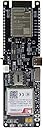
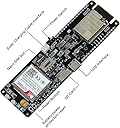
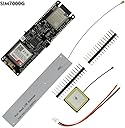
The Solar Charge Development Board with ESP32-WROVER-B chip combines 16MB Flash and 8MB PSRAM memory with WiFi, BLE, and 2G/NB-IoT connectivity. Featuring multiple peripheral interfaces and an integrated 18560 battery holder, this module is engineered for versatile, solar-powered IoT applications. Note: SIM7000G supports 2G/NB-IoT but not 4G.


| RAM | PSRAM |
| Wireless Type | 802.11b |
| Brand | LILYGO |
| Series | CH9102F 16MB |
| Item model number | T-SIM7000G |
| Operating System | FreeRTOS |
| Item Weight | 2.46 ounces |
| Product Dimensions | 4.37 x 1.46 x 0.79 inches |
| Item Dimensions LxWxH | 4.37 x 1.46 x 0.79 inches |
| Number of Processors | 2 |
| Manufacturer | LILYGO® |
| ASIN | B099RQ7BSR |
| Date First Available | July 19, 2021 |
A**N
Seems well made, some unexpected issues though...
OK, First off it works as advertised. The modem is a little odd though, it only supports a couple of flavours of IOT protacol when in 3G mode, as opposed to being fully 3G compatible, as far as I can tell. The documentation does actually say this but I am willing to bet that most people will see the 3G allong withn the band compatibility in the spec and fail, as I did, to realise that this is not a general purpose 3G compatible module. On GPRS it works fine. This is. or at least will be, an issue in the UK as GSM/GPRS is being phased out and the magour networks do not appear to be adopting the IOT centric alternatives that thid device is capable of handling in the 3G domain. I am no expert here... Look carefyully at the spec, this is just a warning. The other odd thing is the maximum solar input voltage, rated a 6V, with an absolute max of 6.3V, it is quite a bit shy of a the open circuit voltage of a typical small solar panel you might slect to get pMax at a little below the upper charging voltage of an 18650. There will be options out there but this design choice makes selection much more of a pain than it needs to be. Odd The other, frankly maddning, thing is that the board cant be programmed, with the onboard USB at least, whilst the SD card is plugged in, Why, who thought that was a good plan? OTA with the SD in place seems fine. Other than that I am very happy with the unit and would buy one again provided that the speciffic circumstances of its use case were not affected by the shortcomings. In general the board seems solid and capable and having so much on one PCB is good in a dev environment. As a production device... I am not convinced, I think seperate modules would likely be more flexible but it would depend on what you were doing I guess.
L**R
L'idée était -en fonction de la mort annoncée de la '2G', de remplacer des modules modem ne travaillant qu'en 2G (SIM800L, …) par des modules '4G' dans des applications IoT. L'objectif : recevoir et interprêter des SMS pour agir sur de la domotique en absence de connexion internet. SMS: Quand il s'ait d'émettre on trouve quelques exemples utilisables (Arduino IDE). Pour ce qui est de recevoir des SMS, je n'ai pas trouvé d'exemples opérationnels : - les bibliotèques usuelles (TinyGSM, …) ne traitent pas ce sujet; - aucun exemple complet exploitable - semble-t-il - même en commandes AT. Lacune qui rend excessivement difficile, sinon impossible l'exploitation de ce module À écarter pour l'instant, le travail de recherche s'avérant fastidieux et en finale - pour l'instant -improductif. Une immense déception qui ne pourra être comblé que quand le fabricant ajoutera dans ses exemples ce genre d'utilisation. [Edit 2023-04-23 :] Pour ceux qui désirent une connexion 4G, il vaut mieux envisager les cartes à base de A7670E ou - moins adaptées A7670A, voire la série des A7600x. En france, il faut privilégier les cartes offrant les connectivités LTE-FDD B3, B20 (4G les plus classiques pour les opérateurs nationaux). Le LTE-TDD peut être utile si on envisage un usage plus large que l'hexagone. En tous les cas, la consultation des datasheet (site de SIMCom) permet de lever le doute - en particulier sur les bandes de fréquences gérées en LTE (→4G)
M**T
Let's get one detail straight. The vendor claims that it doesn't work with LTE networks. This is...misleading. If you're talking 4G and 5G? YEAH. It's not capable of anything other than IoT-NB, Cat-M1 (Hint...), and GSM (2G, largely shut down...) for it's connectivity. It's not fast, nor is it intended to be. If your provider does IoT-NB service, this will work nicely. If your provide does LTE Cat-M1 (M2M, narrowband service), it will work nicely as well. The statement that it does not do LTE needs to be dropped by LillyGo- it causes them a problem. It means people won't use their product with a KORE SuperSIM. Which you should rather very much DO. It's using a SIM7000G, _Global_ modem. Works largely worldwide- paired with a KORE SuperSIM, you can have your IOT device work just about anywhere there's, "M2M Cell Service." One proviso. It doesn't do IoT-NB service, the competing answer. If you have one of those providers and an IoT-NB SIM go right on ahead. If you were going to use KORE's SuperSIM or something like Verizon as your provider, go right on ahead with confidence. As long as their M2M service uses Iot-NB OR LTE Cat-M1, you can use this product for your project. That handled and done, how is this as a device. If you can handle the bit of Chonky length introduced by their choice of a 18650 class Lithium rechargeable cell, there's little to NOT like there. ESP32. Development is possible with Arduino, PlatformIO, MicroPython, and more. Fairly high performance dual core microcontroller with 2.5 GHz WiFi, Bluetooth, decent SPI/I2C/GPIO support. Does LTE-M1 data sensibly and...fairly easily...all things considered. SMS is _possible_ but requires your provider _provisioning_ this for you in your SIM for the unit. (Need to have a convo with KORE/Twilio people about the SuperSIM...need SMS directly that simply goes to 1-3 locations, mostly delivering a message to the deistred number as a Mission Critical aspect. Internet's not reliable for this...) Deep Sleep capabilities. Competing devices don't do this right now due to COVID induced supply chain problems. Only real drawback is that, like MOST of the actual plays in IoT, it's less "novice friendly" and has somewhat less than stellar documentation overall- but you'll find yourself thanking yourself down the line for it. It's looking like a solid performer overall to my project- prototype will be able to be done...now that I figured out how the LTE modem actually worked within the device- which is a bit counterintuitive for modems up the Foodchain in the 4G/5G space.
C**N
A priori, se ve una placa de desarrollo muy interesante al tener wifi, bluetooth GPS, GPRS, LTE… Sin embargo en la práctica la documentación y los ejemplos de uso no abundan y en cierto modo se ha quedado obsoleta. Si la piensas usar para MQTT sobre TLS, es un verdadero infierno. Recomiendo comprar la versión que lleva una TSIM 7600, con un juego de comandos AT mayor.
C**S
An sich funktioniert es. Allerdings gibt es hier ein Designfehler meiner Meinung nach. Wenn die Akku Zelle auf eine kritische niedrige Spannung zu läuft, kann es sein das jegliche ESP sicherheitsfunktionen ausgehebelt werden. Hier fehlt meiner Meinung nach ein Controller der die Spannung überwacht und den ESP zum herunterfahren zwingt. Schwierig zu debuggen. Ohne Akku seit 12 Monaten hunderte im Feld. Ohne Probleme. Wir haben die Dinger in EpoxyHarz vergossen.
P**N
Snabb leverans och bra förpackad
Trustpilot
1 day ago
3 weeks ago