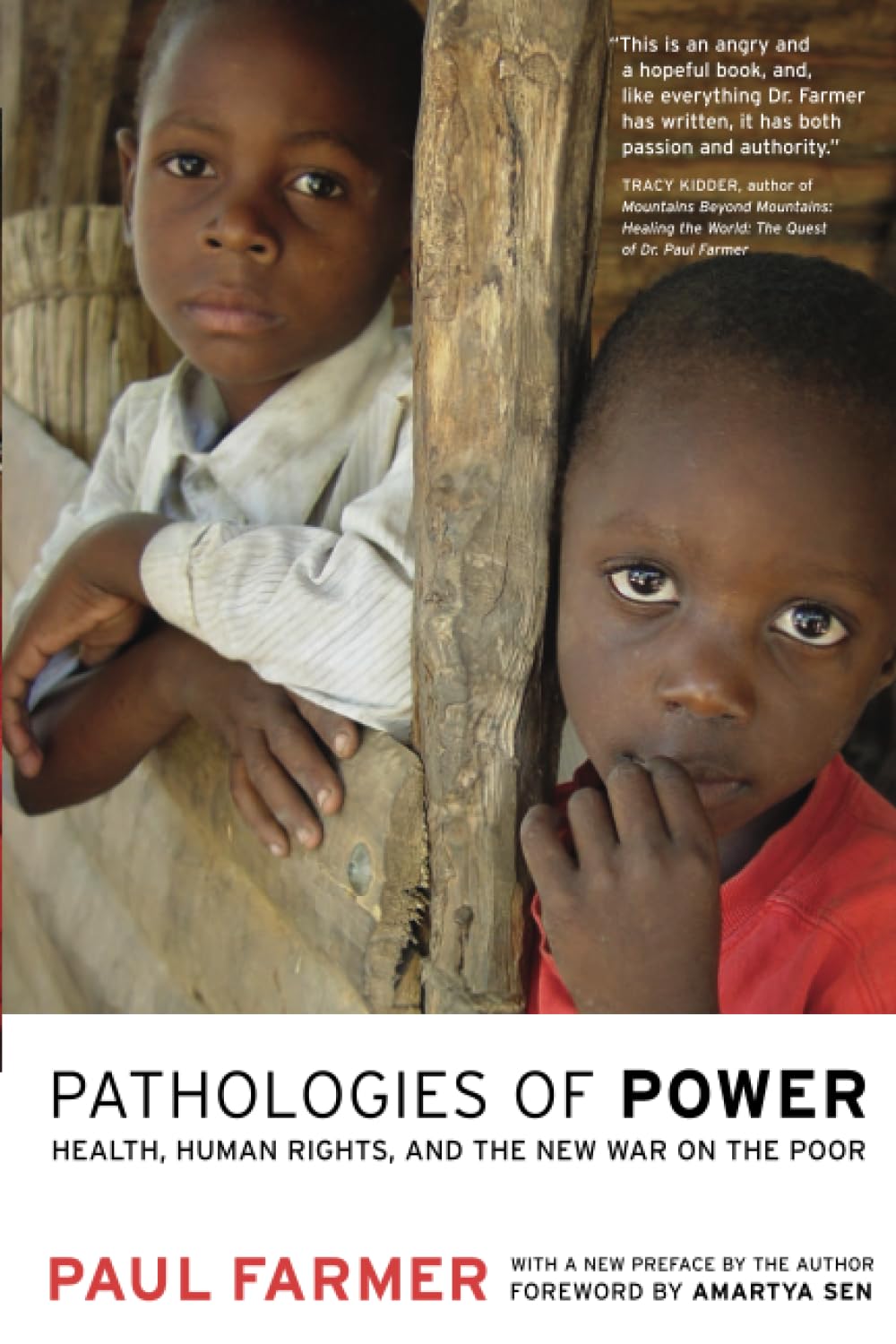
desertcart.com: Pathologies of Power: Health, Human Rights, and the New War on the Poor (Volume 4) (California Series in Public Anthropology): 9780520243262: Paul Farmer, Amartya Sen: Books Review: Take Two Aspirin and Read This Book - Paul Farmer's "Pathologies of Power" will probably give you a headache, undoubtedly cause sleep disturbance, and very likely turn your stomach. In short, it will make you sick. But if you are well enough to read this and rich enough to consider purchasing the book, you are better off than the "disposable millions" whose lives he illuminates and honors in this indictment of global public health as-we-know-it. In this passionate and well-researched treatise, a world-class physician takes his own disciplines of medicine and anthropology to task for failing to ask the right questions. Then, noting that the U.S. pharmaceutical industry is the most profitable industry in the most affluent country in the world, he blows through its defense of those extraordinary profits like a gust of fresh air. A similarly searing deconstruction of health policymakers' rationale for "cost-effectiveness" and their elite argot of oppression reveals a blame-the-victim mentality that plagues the world and explains why, in the midst of unprecedented wealth, over 40 million Americans are without health insurance of any kind. And that is just the beginning. While Farmer's hospital in Haiti, Zanmi Lasante, is not the only hospital to successfully combat the forces of poverty and disease in that country (Hôpital Albert Schweitzer in the Artibonite Valley predates Farmer's project by nearly three decades), his twenty-year presence in Central Haiti has resulted in a deep understanding of how structural violence on a global scale is a leading cause of disease and death among the world's poor, wherever they may live. Drawing on case-study examples from Haiti, South America, Cuba, Siberia, and the United States, he deftly illustrates why tuberculosis deaths, which he describes as 95 percent curable with inexpensive medication developed many years ago, "occur almost exclusively among the poor, whether they reside in the inner cities of the United Stated or in the poor counties of the Southern Hemisphere." Addressing the growing trend of multi-drug resistant strains of TB, Farmer discusses "tuberculosis as punishment" in the world's prison populations and delivers a wake-up call to those who might consider themselves immune from this, and other, infectious diseases. In his critique of the commodification of healthcare, Farmer speaks of "orphan drugs" drugs that are simply not developed because they are needed by people who cannot pay for them, the sale of organs by those without resources to those with money, and the equally revolting multi-million dollar compensation packages of pharmaceutical company CEOs and managed care executives. In the midst of this catalog of inequity, he wonders why medical ethics courses in American schools of medicine focus so narrowly on the "quandaries of the fortunate" like whether or not to refuse a particular technology or whether or not to leave a loved one in a prolonged coma when millions are condemned to death or disease before they learn to walk. Even the World Health Organization (WHO) does not escape his critical analysis: "... the language of social injustice is increasingly absent from public health parlance," he notes. Farmer is one of those remarkable doctors working in remote places who, somehow, finds the energy to look up from his daily workload and ponder the underlying causes of the suffering he treats. Furthermore, he writes about it in the brisk and engaging prose of an investigative reporter and brings provocative interdisciplinary voices of others---Gustavo Gutiérrez, Paolo Freire, Cornel West, Amartya Sen, Jon Sobrino, Nancy Scheper-Hughes, to name a few---to bear on his march toward social justice. His ideas are radical, in part, because they are simple and based on an equitable distribution of health, regardless of wealth. Bringing the observe, judge, act methodology of liberation theology to bear on global public health, Farmer advocates a "preferential option" for the poor, a redefinition of medicine as a healing profession (as opposed to medicine-as-commerce), and a new understanding of healthcare as a basic human right, for all. Toward the end of a chapter entitled "Listening for Prophetic Voices," Farmer distills his argument into a call to action: "We thus find ourselves at a crossroads: healthcare can be considered a commodity to be sold, or it can be considered a basic social right. It cannot comfortably be considered both of these at the same time. This, I believe, is the great drama of medicine at the start of this century. And this is the choice before all people of faith and good will in theses dangerous times." Pathologies of Power is a lucid and alarming statement from a fearless physician. It speaks truth to power and it speaks for the destitute sick. Take two aspirin, lie down, and read the book. In spite of its consciousness-raising side effects, this may be the beginning of a cure for what ails the world. Review: Human Rights - What a great textbook. We humans can do so much more for each other and this book will help you open up your eyes. Read it!
| Best Sellers Rank | #164,611 in Books ( See Top 100 in Books ) #129 in General Anthropology #153 in Health Care Delivery (Books) #183 in Sociology of Class |
| Customer Reviews | 4.6 out of 5 stars 240 Reviews |
P**N
Take Two Aspirin and Read This Book
Paul Farmer's "Pathologies of Power" will probably give you a headache, undoubtedly cause sleep disturbance, and very likely turn your stomach. In short, it will make you sick. But if you are well enough to read this and rich enough to consider purchasing the book, you are better off than the "disposable millions" whose lives he illuminates and honors in this indictment of global public health as-we-know-it. In this passionate and well-researched treatise, a world-class physician takes his own disciplines of medicine and anthropology to task for failing to ask the right questions. Then, noting that the U.S. pharmaceutical industry is the most profitable industry in the most affluent country in the world, he blows through its defense of those extraordinary profits like a gust of fresh air. A similarly searing deconstruction of health policymakers' rationale for "cost-effectiveness" and their elite argot of oppression reveals a blame-the-victim mentality that plagues the world and explains why, in the midst of unprecedented wealth, over 40 million Americans are without health insurance of any kind. And that is just the beginning. While Farmer's hospital in Haiti, Zanmi Lasante, is not the only hospital to successfully combat the forces of poverty and disease in that country (Hôpital Albert Schweitzer in the Artibonite Valley predates Farmer's project by nearly three decades), his twenty-year presence in Central Haiti has resulted in a deep understanding of how structural violence on a global scale is a leading cause of disease and death among the world's poor, wherever they may live. Drawing on case-study examples from Haiti, South America, Cuba, Siberia, and the United States, he deftly illustrates why tuberculosis deaths, which he describes as 95 percent curable with inexpensive medication developed many years ago, "occur almost exclusively among the poor, whether they reside in the inner cities of the United Stated or in the poor counties of the Southern Hemisphere." Addressing the growing trend of multi-drug resistant strains of TB, Farmer discusses "tuberculosis as punishment" in the world's prison populations and delivers a wake-up call to those who might consider themselves immune from this, and other, infectious diseases. In his critique of the commodification of healthcare, Farmer speaks of "orphan drugs" drugs that are simply not developed because they are needed by people who cannot pay for them, the sale of organs by those without resources to those with money, and the equally revolting multi-million dollar compensation packages of pharmaceutical company CEOs and managed care executives. In the midst of this catalog of inequity, he wonders why medical ethics courses in American schools of medicine focus so narrowly on the "quandaries of the fortunate" like whether or not to refuse a particular technology or whether or not to leave a loved one in a prolonged coma when millions are condemned to death or disease before they learn to walk. Even the World Health Organization (WHO) does not escape his critical analysis: "... the language of social injustice is increasingly absent from public health parlance," he notes. Farmer is one of those remarkable doctors working in remote places who, somehow, finds the energy to look up from his daily workload and ponder the underlying causes of the suffering he treats. Furthermore, he writes about it in the brisk and engaging prose of an investigative reporter and brings provocative interdisciplinary voices of others---Gustavo Gutiérrez, Paolo Freire, Cornel West, Amartya Sen, Jon Sobrino, Nancy Scheper-Hughes, to name a few---to bear on his march toward social justice. His ideas are radical, in part, because they are simple and based on an equitable distribution of health, regardless of wealth. Bringing the observe, judge, act methodology of liberation theology to bear on global public health, Farmer advocates a "preferential option" for the poor, a redefinition of medicine as a healing profession (as opposed to medicine-as-commerce), and a new understanding of healthcare as a basic human right, for all. Toward the end of a chapter entitled "Listening for Prophetic Voices," Farmer distills his argument into a call to action: "We thus find ourselves at a crossroads: healthcare can be considered a commodity to be sold, or it can be considered a basic social right. It cannot comfortably be considered both of these at the same time. This, I believe, is the great drama of medicine at the start of this century. And this is the choice before all people of faith and good will in theses dangerous times." Pathologies of Power is a lucid and alarming statement from a fearless physician. It speaks truth to power and it speaks for the destitute sick. Take two aspirin, lie down, and read the book. In spite of its consciousness-raising side effects, this may be the beginning of a cure for what ails the world.
C**E
Human Rights
What a great textbook. We humans can do so much more for each other and this book will help you open up your eyes. Read it!
R**F
Positive Review
In Pathologies of Power Dr. Farmer has provided critical evidence of health care as it is effected by social and global inequalities. He discusses cases regarding AIDS and the Haitian Boat Refugees, structural violence in Haiti and Mexico, multi-drug resistant TB in Russia, community based health projects in Chiapas, amongst other reflections on relevant cases and history. The book makes a forceful argument for the need to integrate health and human rights to improve the livelihoods of marginalized people. Professor Farmer recommends the following to complement present efforts to achieve the new health and human rights agenda: make health and healing the symbolic core of the agenda, make provision of services central to the agenda, establish new research agendas, achieve independence from powerful governments and bureaucracies, assume a broader educational mandate, and secure more resources for health and human rights. Furthermore, Dr. Farmer has provided evidence showing that the implementation of the said recommendations saved lives, improved healthcare outcomes, and positively impacted the lives of the sick and marginalized.
A**N
should be required reading for politicians
This is another excellent book from Farmer, critiquing health disparities as related to globalization. Or at least that's my perspective. Farmer draws on his extensive knowledge and fieldwork in Haiti in all the books I've read by him, so this one is no exception. That said, the book is still unique and not a repeat/rehash of prior work as is so very common. I wish I could get more people to read books like this, which very logically point out that social Darwinism is bs, and power rules the world. This is a great critique and discussion of globalization, health, and human rights. I wish we could convince our current administration to put this on their list of required readings...
L**T
Political Structural Violence is allowed by denying healthcare to the poor.
I like everything about this book. It should be mandatory for every Medical student, History, Sociology, Psychology, Snd Political Science student. Structural violence is a new important phrase that I learned meaning if a country denies people with pre-existing medical conditions that as a form of violence because it leads to death by structure of politics. Also if the poor cannot afford medical care which is a human right that is a form of structural violence.
C**R
ATeaching Resource Like No Other
Paul Farmer is well known in the anthropological world as well as within the christian world. He works to make social issues known to the greater public for the greater good. Through his own work in Haiti, South America, and Russia, he illustrates the turmoil prevalent in our world. He writes in an easy style that makes what he is trying to convey, easy to digest. He shares with the reader situations and circumstances where he has tried to make a difference. His books, and this one in particular, are excellent teaching resources for any of the social sciences
A**N
Undergraduate Required Text
A phenomenal read, I was required to complete this ethnology for a 200-level Cultural Anthropology course that emphasized the concepts of ethnocentrism, cultural relativism, and structural violence. This text is a life-changer if you let it be. Read it for school. Read it in your spare time. Just read it- you will be glad you did.
F**1
A way of life
This is a philosophy, a way of life, ethical living. If you don't give any of your money to charity, move on.
Trustpilot
3 weeks ago
2 months ago