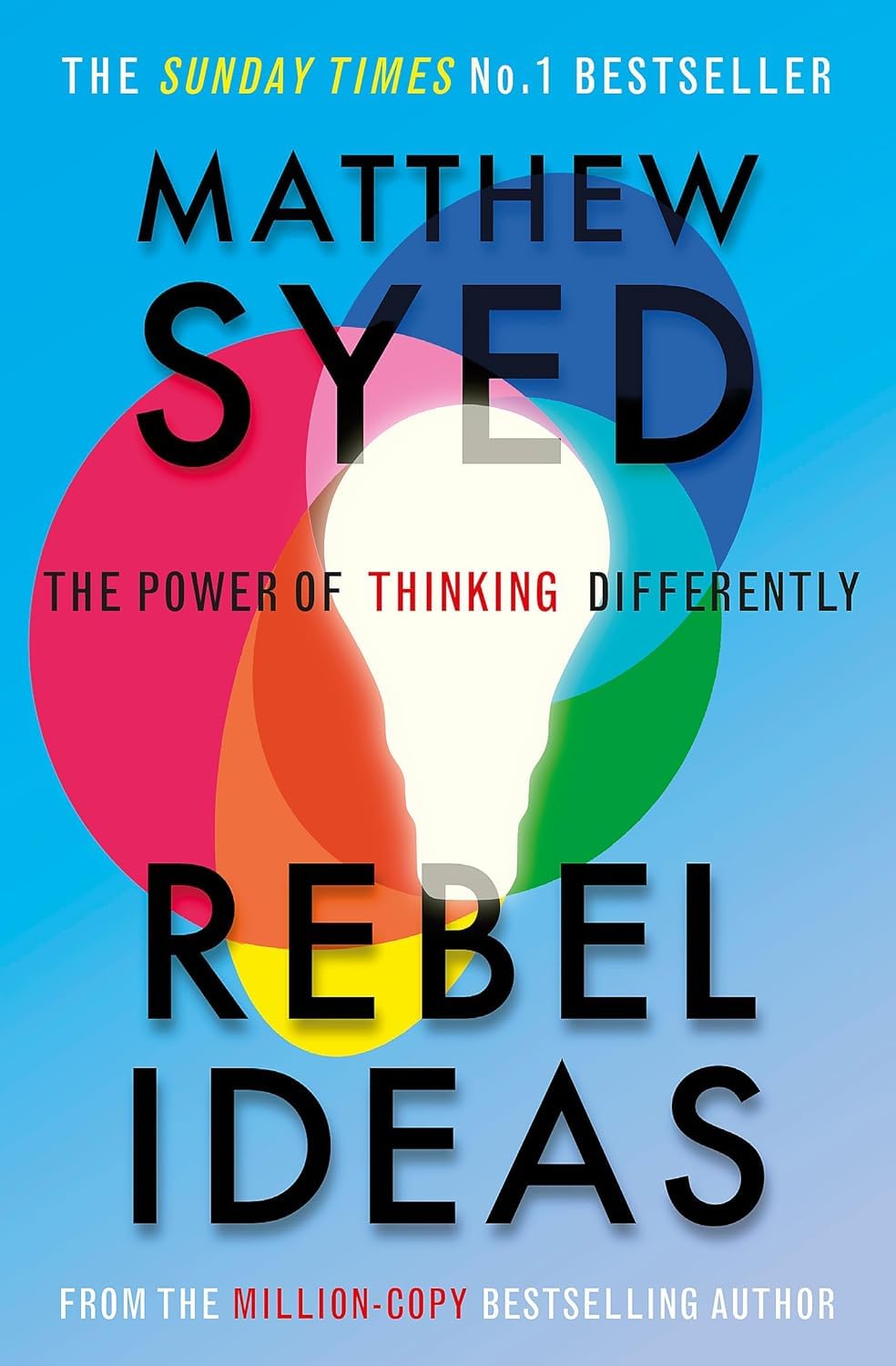
Buy John Murray Publishers Ltd Rebel Ideas: The Power of Diverse Thinking by Syed, Matthew, Ltd, Matthew Syed Consulting online on desertcart.ae at best prices. ✓ Fast and free shipping ✓ free returns ✓ cash on delivery available on eligible purchase. Review: Two heads are better than one. Or four heads are better than two. Or a hundred heads are better than fifty. Or a thousand heads are better than five hundred. This is the basic message of this excellent book. Having written and published books on the importance of high-quality practice and training in achieving success, especially in sports and the arts, and the benefits gained by learning from failure, Syed now tackles a subject that is clearly close to his heart: diversity. The argument of Rebel Ideas is that the solving of a complex problem can sometimes only be achieved by assembling a group consisting of different-minded people and then getting the group to work on the difficulty using each individual's particular talents to provide some part of the solution. By combining different perspectives, insights and thought processes, sometimes even the most challenging of obstacles can be overcome. The diversity that Syed refers to in this book isn't racial or gender diversity: it's what he calls cognitive diversity, i.e. diversity in the way a problem is looked at, the usefulness of any pre-existing knowledge of the problem and the thought processes that could be used to solve the problem. Sometimes this does involve gender and racial diversity: in the book Syed gives a couple of examples where a woman and a Muslim man provided missing insights that aided the solutions of two difficult tasks. They were able to see things that white middle-class men couldn't. But this book is mainly about the importance of bringing together people who think differently. The book opens with Syed retelling the dreadful tale of the 9/11 hijackings and explaining just why the CIA, whose job it was to detect and prevent such a terrible atrocity, pathetically failed the United States. Its agents and analysts were almost exclusively white, Ivy-League educated, Christian, American-born citizens. These people had failed to anticipate or appreciate the deadly threat of Bin Laden and al-Qaeda because they had a massive collective blind spot when it came to understanding the mindset and capabilities of the terrorists. Crucial insights and enlightening alternative perspectives could only be provided by people who came from a world that was closer to that of the bad guys. A lack of diversity had led to an awful tragedy. At the end of the book Syed tells the encouraging story of how, in later years, a Muslim CIA member was crucial in identifying and assessing the dangers posed by a key al-Qaeda member. That terrorist was subsequently eliminated in a drone attack, probably saving many lives. Cognitive diversity worked. But this book explores the usefulness of diversity in solving many different types of problems, from political and social to scientific and sporting ones. Syed himself had first-hand experience of the benefits of cognitive diversity when he was asked to be part of a team that was tasked with explaining why the England soccer team had so badly and consistently under-performed over the last half-century. The group were deliberately made up of people who were not ex-soccer players or managers; instead people from the world of table-tennis (Syed), Rugby, the British Army, the high-tech business world and cycling were assembled. The idea was simple and clear: if you want to solve a complex problem then you need people from the outside who can provide fresh and diverse perspectives, insights and thought processes. Groups of people who all think in the same way (whom Syed disparagingly referes to as "clones") often fail to solve problems, and sometimes make them worse. Syed also explores the barriers to cognitive diversity, the main one being hierarchy. In business organisations in particular, diverse opinions are often either drowned out or not even aired because of the fear of conflict with people higher up in the food chain. In the book Syed tells the tragic story of the 1996 Mount Everest disaster, which could have been avoided had lower-ranking members of the climb spoken up and shared their knowledge. By keeping quiet they helped cause a catastrophe that was avoidable. Homophily is another obstacle to effective cognitive diversity. Our natural tendency to want to associate with people who look like, think like and act like we do can deprive us of the benefits of diversity. This was the main reason why the CIA was stuffed with the same type of people, and look what happened there. My favourite chapter of the book was "Beyond Average". It explained the subtle but beautiful point that although we live in a world where everybody is trying to average everybody and everything out, there's no such thing as average. Each one of us is unique. But by adjusting and making allowances for our various differences maximum performances can be attained from each one of us. Our uniqueness can be positively employed. The section on how modern research is proving that each one of us requires our own specifically tailored diet was very interesting. The chapter on innovation was also very interesting too. Recombination is a process where two or more branches of science are combined to produce dynamic and fresh ideas and inventions. This is the essence of cognitive diversity: people bringing different ideas together and creating something original. The book ends with Syed contending that the massively elevated rate of human evolution compared to other creatures on this planet is the result of this cognitive diversity: that humans had the unique ability to share both genes and knowledge. That's why we have such large and developed brains. I don't agree with him: there are plenty of other socially tight-knit animals on this earth that haven't developed huge intellects, and many of them have been around a lot longer than we have. The reason why only mankind is so smart is probably the greatest mystery of this world. But I absolutely loved this book. Syed does here exactly what he did with Bounce and Black-Box Thinking: he provides a stimulating and thought-provoking argument concerning an important facet of human existence. This was a very interesting read. If you are involved in the management of a business or organisation then you may find this book very useful. Its ideas were extremely refreshing. Review: Extremely informative and insightful. The need for creative and diverse thinking comes to the fore, but also the essential role of challenge and accountability for power. Truly successful endeavours need an approach that unites strong leadership with the ability to be challenged, improved, and nuanced, a quality many leaders sadly lack. I was struck by the details and examples presented. As a journalist from a prestigious university, Matthew Syed writes well, persuasively and in an accessible manner. His points are startling, insightful, and forced me to confront my own stereotypes and assumptions about leadership, sterile ideas, and other comfortably held intellectual positions. I highly recommend.
| Best Sellers Rank | #77,386 in Books ( See Top 100 in Books ) #207 in Business Communication & Psychology #227 in Creativity #329 in Business Management & Leadership |
| Customer reviews | 4.6 4.6 out of 5 stars (1,880) |
| Dimensions | 16.4 x 3.2 x 23.6 cm |
| Edition | 1st |
| ISBN-10 | 1473613914 |
| ISBN-13 | 978-1473613911 |
| Item weight | 530 g |
| Language | English |
| Print length | 320 pages |
| Publication date | 10 September 2019 |
| Publisher | John Murray Publishers Ltd |
B**Y
Two heads are better than one. Or four heads are better than two. Or a hundred heads are better than fifty. Or a thousand heads are better than five hundred. This is the basic message of this excellent book. Having written and published books on the importance of high-quality practice and training in achieving success, especially in sports and the arts, and the benefits gained by learning from failure, Syed now tackles a subject that is clearly close to his heart: diversity. The argument of Rebel Ideas is that the solving of a complex problem can sometimes only be achieved by assembling a group consisting of different-minded people and then getting the group to work on the difficulty using each individual's particular talents to provide some part of the solution. By combining different perspectives, insights and thought processes, sometimes even the most challenging of obstacles can be overcome. The diversity that Syed refers to in this book isn't racial or gender diversity: it's what he calls cognitive diversity, i.e. diversity in the way a problem is looked at, the usefulness of any pre-existing knowledge of the problem and the thought processes that could be used to solve the problem. Sometimes this does involve gender and racial diversity: in the book Syed gives a couple of examples where a woman and a Muslim man provided missing insights that aided the solutions of two difficult tasks. They were able to see things that white middle-class men couldn't. But this book is mainly about the importance of bringing together people who think differently. The book opens with Syed retelling the dreadful tale of the 9/11 hijackings and explaining just why the CIA, whose job it was to detect and prevent such a terrible atrocity, pathetically failed the United States. Its agents and analysts were almost exclusively white, Ivy-League educated, Christian, American-born citizens. These people had failed to anticipate or appreciate the deadly threat of Bin Laden and al-Qaeda because they had a massive collective blind spot when it came to understanding the mindset and capabilities of the terrorists. Crucial insights and enlightening alternative perspectives could only be provided by people who came from a world that was closer to that of the bad guys. A lack of diversity had led to an awful tragedy. At the end of the book Syed tells the encouraging story of how, in later years, a Muslim CIA member was crucial in identifying and assessing the dangers posed by a key al-Qaeda member. That terrorist was subsequently eliminated in a drone attack, probably saving many lives. Cognitive diversity worked. But this book explores the usefulness of diversity in solving many different types of problems, from political and social to scientific and sporting ones. Syed himself had first-hand experience of the benefits of cognitive diversity when he was asked to be part of a team that was tasked with explaining why the England soccer team had so badly and consistently under-performed over the last half-century. The group were deliberately made up of people who were not ex-soccer players or managers; instead people from the world of table-tennis (Syed), Rugby, the British Army, the high-tech business world and cycling were assembled. The idea was simple and clear: if you want to solve a complex problem then you need people from the outside who can provide fresh and diverse perspectives, insights and thought processes. Groups of people who all think in the same way (whom Syed disparagingly referes to as "clones") often fail to solve problems, and sometimes make them worse. Syed also explores the barriers to cognitive diversity, the main one being hierarchy. In business organisations in particular, diverse opinions are often either drowned out or not even aired because of the fear of conflict with people higher up in the food chain. In the book Syed tells the tragic story of the 1996 Mount Everest disaster, which could have been avoided had lower-ranking members of the climb spoken up and shared their knowledge. By keeping quiet they helped cause a catastrophe that was avoidable. Homophily is another obstacle to effective cognitive diversity. Our natural tendency to want to associate with people who look like, think like and act like we do can deprive us of the benefits of diversity. This was the main reason why the CIA was stuffed with the same type of people, and look what happened there. My favourite chapter of the book was "Beyond Average". It explained the subtle but beautiful point that although we live in a world where everybody is trying to average everybody and everything out, there's no such thing as average. Each one of us is unique. But by adjusting and making allowances for our various differences maximum performances can be attained from each one of us. Our uniqueness can be positively employed. The section on how modern research is proving that each one of us requires our own specifically tailored diet was very interesting. The chapter on innovation was also very interesting too. Recombination is a process where two or more branches of science are combined to produce dynamic and fresh ideas and inventions. This is the essence of cognitive diversity: people bringing different ideas together and creating something original. The book ends with Syed contending that the massively elevated rate of human evolution compared to other creatures on this planet is the result of this cognitive diversity: that humans had the unique ability to share both genes and knowledge. That's why we have such large and developed brains. I don't agree with him: there are plenty of other socially tight-knit animals on this earth that haven't developed huge intellects, and many of them have been around a lot longer than we have. The reason why only mankind is so smart is probably the greatest mystery of this world. But I absolutely loved this book. Syed does here exactly what he did with Bounce and Black-Box Thinking: he provides a stimulating and thought-provoking argument concerning an important facet of human existence. This was a very interesting read. If you are involved in the management of a business or organisation then you may find this book very useful. Its ideas were extremely refreshing.
C**N
Extremely informative and insightful. The need for creative and diverse thinking comes to the fore, but also the essential role of challenge and accountability for power. Truly successful endeavours need an approach that unites strong leadership with the ability to be challenged, improved, and nuanced, a quality many leaders sadly lack. I was struck by the details and examples presented. As a journalist from a prestigious university, Matthew Syed writes well, persuasively and in an accessible manner. His points are startling, insightful, and forced me to confront my own stereotypes and assumptions about leadership, sterile ideas, and other comfortably held intellectual positions. I highly recommend.
H**S
Item received in good condition. Thank you!
A**A
sehr interessant und aktuell
P**P
Easy to j derstamd and provides many insights
Trustpilot
3 days ago
2 weeks ago