
DOWNLOAD THE APP


Customer Services
Copyright © 2025 Desertcart Holdings Limited
DOWNLOAD THE APP


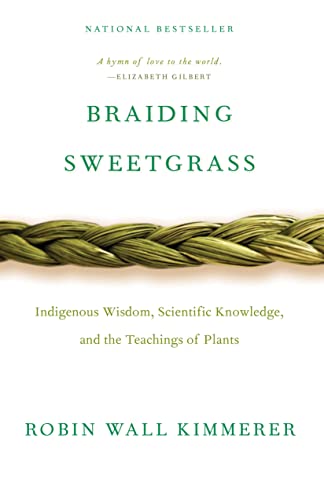


Braiding Sweetgrass: Indigenous Wisdom, Scientific Knowledge and the Teachings of Plants : Kimmerer, Robin Wall: desertcart.ae: Books Review: Braiding Sweetgrass is one of the most profoundly moving and illuminating books I’ve read in a long time. Kimmerer is a distinguished professor of Environmental Biology and an enrolled member of the of the Potawatomi Nation, a northern tribe whose ancestral lands are around the Great Lakes. Broken treaties with the US Government finally forced them to move to Indian Territory in Oklahoma. Sweetgrass is translated as the “sweet smelling hair of Mother Earth” and represent the union of mind, body and spirit. In the preface, Kimmerer describes the book as “a braid of stories to heal our relationship with the world.” She weaves together science, spirt and story “that can be medicine for our broken relationship with earth.” Each chapter is to be savored and read slowly. Her prose is achingly beautiful, moving me to tears of wonder as she describes the interrelationship of various plants, such as the brilliant symbiosis of 'The Three Sisters,' beans, squash and corn. Or – the amazing life cycle of the pecan tree or the many uses of cattails; who knew? I was also moved to tears of grief when she describes the horrible legacy of the Indian Boarding Schools in the late 1800’s. The schools were a form of cultural genocide, but the stories, wisdom and knowledge of native lifeways went underground and endured, a testament to the resiliency of native peoples. The basic premise of the book is reciprocity and an ‘I – Thou’ relationship with all of creation, to borrow a phrase from Martin Buber. The land gives back to us when we care for the land. Plants, animals, insects, etc. – are all ‘family,’ and one is much less likely (or at least, think twice) about inflicting harm when the relationship is personal, heartfelt and genuine. Gratitude is the other overarching theme, which is strongly rooted in Native cultures. She describes the Thanksgiving Address of the Haudenosaunee Confederacy, which begins a school day or before an important meeting. It is gratitude directed to all of the earth’s species on land and water (including water itself.) The entire address can take up to an hour, as thanks is bestowed upon each element. Each segment ends with “Now our minds are one.” If you don’t read the book, I recommend looking up the Thanksgiving Address. It can be shortened to incorporate into a daily gratitude practice. In my view, this book is a masterpiece of ecological, historical non-fiction. It is inspiring and hopeful; a call to action. As Kimmerer says…”we are the ones who will bend to the task of putting things back together to rekindle the flames of the sacred fire to begin the rebirth of a nation.” Review: Es un libro bellísimo
| Best Sellers Rank | #2,547 in Books ( See Top 100 in Books ) #1 in Cultural & Ethnic Studies #2 in Botany & Plants #2 in Plant Ecology |
| Customer reviews | 4.8 4.8 out of 5 stars (12,712) |
| Dimensions | 13.97 x 2.79 x 21.34 cm |
| Edition | First Paperback |
| ISBN-10 | 1571313567 |
| ISBN-13 | 978-1571313560 |
| Item weight | 517 g |
| Language | English |
| Print length | 408 pages |
| Publication date | 24 September 2015 |
| Publisher | Milkweed Editions |
V**C
Braiding Sweetgrass is one of the most profoundly moving and illuminating books I’ve read in a long time. Kimmerer is a distinguished professor of Environmental Biology and an enrolled member of the of the Potawatomi Nation, a northern tribe whose ancestral lands are around the Great Lakes. Broken treaties with the US Government finally forced them to move to Indian Territory in Oklahoma. Sweetgrass is translated as the “sweet smelling hair of Mother Earth” and represent the union of mind, body and spirit. In the preface, Kimmerer describes the book as “a braid of stories to heal our relationship with the world.” She weaves together science, spirt and story “that can be medicine for our broken relationship with earth.” Each chapter is to be savored and read slowly. Her prose is achingly beautiful, moving me to tears of wonder as she describes the interrelationship of various plants, such as the brilliant symbiosis of 'The Three Sisters,' beans, squash and corn. Or – the amazing life cycle of the pecan tree or the many uses of cattails; who knew? I was also moved to tears of grief when she describes the horrible legacy of the Indian Boarding Schools in the late 1800’s. The schools were a form of cultural genocide, but the stories, wisdom and knowledge of native lifeways went underground and endured, a testament to the resiliency of native peoples. The basic premise of the book is reciprocity and an ‘I – Thou’ relationship with all of creation, to borrow a phrase from Martin Buber. The land gives back to us when we care for the land. Plants, animals, insects, etc. – are all ‘family,’ and one is much less likely (or at least, think twice) about inflicting harm when the relationship is personal, heartfelt and genuine. Gratitude is the other overarching theme, which is strongly rooted in Native cultures. She describes the Thanksgiving Address of the Haudenosaunee Confederacy, which begins a school day or before an important meeting. It is gratitude directed to all of the earth’s species on land and water (including water itself.) The entire address can take up to an hour, as thanks is bestowed upon each element. Each segment ends with “Now our minds are one.” If you don’t read the book, I recommend looking up the Thanksgiving Address. It can be shortened to incorporate into a daily gratitude practice. In my view, this book is a masterpiece of ecological, historical non-fiction. It is inspiring and hopeful; a call to action. As Kimmerer says…”we are the ones who will bend to the task of putting things back together to rekindle the flames of the sacred fire to begin the rebirth of a nation.”
C**A
Es un libro bellísimo
M**N
Una mezcla de botánica, filosofía vital de los indios americanos y vivencias de una madre. Para leer poco a poco.
A**X
This is a really beautiful book that made me feel so much more in touch with the world around me. Highly recommend.
A**I
I am still reading this wonderful book, which has already given me a sense of belonging. Every immigrant should read it, because no matter how other people treat you, Mother Nature is always there to make you feel at home and nourish your body and soul. Learn from THE NATIVES about the natives. What people there have planted and grow, what their relationship with nature is like, what the plants are called in their language. What connects us all and makes us feel related to each other is NATURE. I hope that after reading this book, people will be as grateful and appreciative as I am. It reminds you of your true instincts and makes you feel like a normal person who wants to pick berries and sit in the sun. At the same time, I have underlined the scientific information so that I can come back to it, and I thank the author for her gift of education and her gentle reminder.
Trustpilot
3 weeks ago
5 days ago