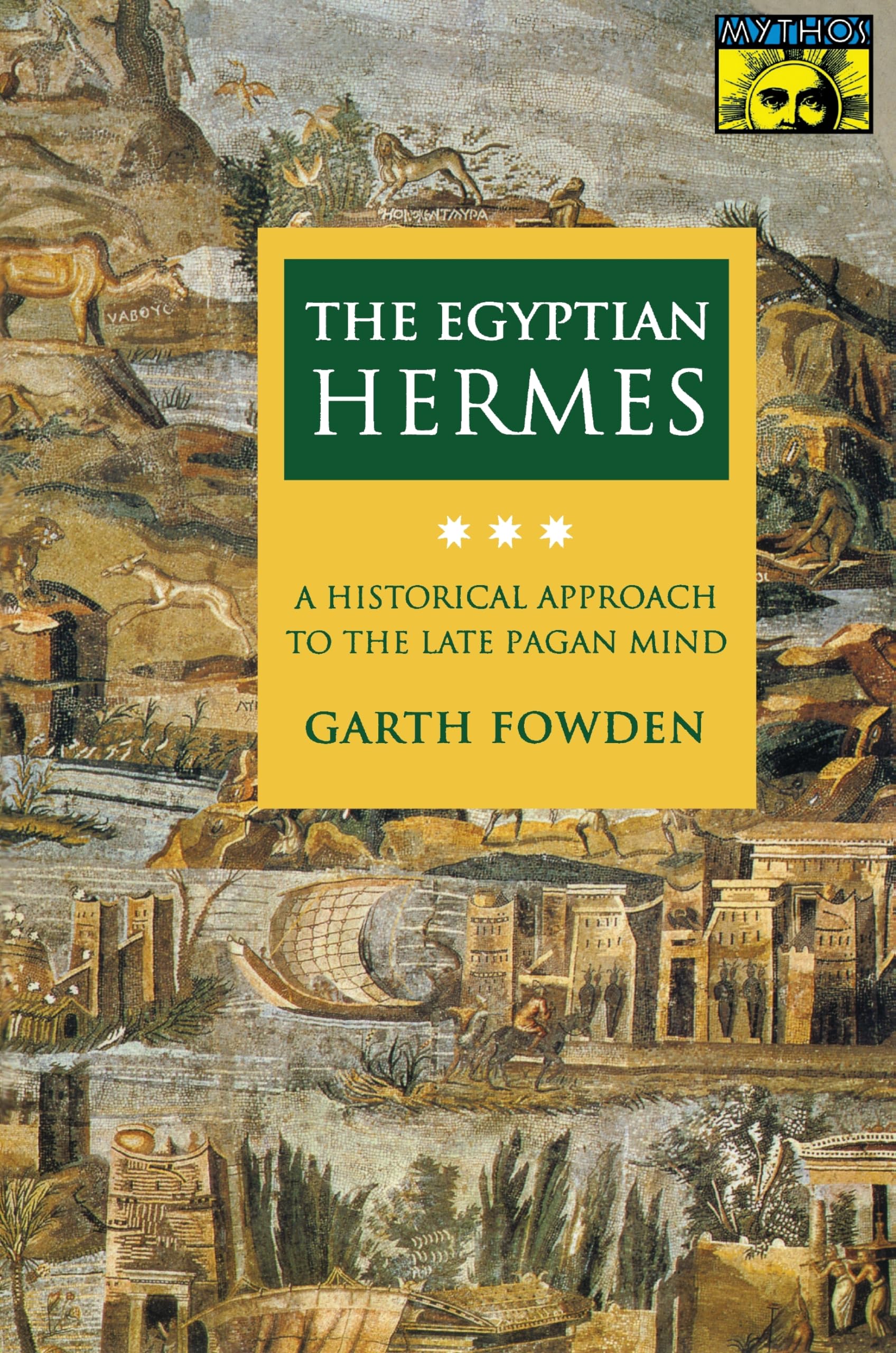
The Egyptian Hermes: A Historical Approach to the Late Pagan Mind
A**D
Good study of Hermes/Thoth
Who is Hermes? Who is Thoth? Questions, questions. A great historical study of this enigmatic personality. Fairly readable and full of lots of interesting tidbids and information.
D**S
Possibly the most informative book on Hermetism
The Egyptian Hermes is a very concise and rich analysis of the Hermetic mysteries in late Antiquity. Fowden draws parallels between the Hermetic system and other esoteric philosophies and movements of the time, like Iamblichus' Neoplatonic theurgy, the Magical Papyri, and Gnostic literature. The result is a brilliant scholarly work, that is possibly the most valuable survey of the Hermetic movement written so far. Fowden's writing style is a bit convoluted at times, and the beginning student may have some difficulty absorbing all the information on the first read, but aside from that this book is a work of genius. Fowden's book, plus a good translation of the Hermetica (like those of Walter Scott, Brian Copenhaver or Clement Salaman), is all the reader will need to begin a serious study of Hermetism.
C**H
A seminal work (for academics)
Fowden, as a writer, is admittedly no model of lucidity; at the same time, he is writing for academics, and is thus able to compress a huge amount into a small space. If you are not used to academic prose, you will find this book very difficult; it would also help if you know a certain amount about the reception of the Hermetica in 19th and 20th century historiography, and perhaps a bit about the late Classical era.At the same time, this book has been reprinted for a reason: it's the single most important historical argument about the Hermetica. For a long time, the Hermetica were understood to be purely Greek, essentially Hellenic misappropriations of pseudo-Egyptian ideas, recast in Neoplatonic style. What Fowden does is to show that these texts do have an important base within the dying Egyptian traditions of their day.For non-specialists, this may seem like small potatoes. But it changes everything. If you have read Frances Yates, for example, she argued that these texts were grotesquely misread by Ficino and the Renaissance tradition, on three counts: (1) they thought the texts were really, really ancient, more or less contemporary with Moses; (2) they thought the texts were Egyptian, not Greek; and (3) they thought the texts were really about magic (and not philosophy). Now there's no question that the Hermetica are from 1st-2d century Alexandria, but they are _not_ simply Greek; they are, in a sense, Egyptian formulations that draw on the then-influential Greek modes of philosophical thought. Furthermore, it means that the texts we usually think of as the Hermetic Corpus can and should be correlated with the PGM (the Greek Magical Papyri and their Demotic associates), changing the whole character of the texts by giving them a wildly different literary and ritual context. In other words, the Renaissance got the dating wrong, but in many respects got the rest more or less right; as a result, Fowden's book not only changes the way we read the Hermetica in their Alexandrian context, but also how we make sense of the Renaissance magical revival (Ficino, Pico, Agrippa, Bruno, etc.).If, having read this review, you think, "Who cares?" then this book is certainly not for you. If you think, "Wow! That's fascinating," then this is essential. I have seen the odd quibble with small points in Fowden's arguments, but I have not seen any serious attack on the main thrust of the book. Considering when it was first written, that's extraordinary.But you do need to be comfortable with academic prose.
C**R
Reopening the Hermetic Case
During the Renaissance, one of the works which attracted a great deal of attention was a collection of Egyptian manuscripts purporting to teach a spiritual philosophy dating back thousands of years, to pre-Christian, pre-Hellenistic, Pharoanic ages- the Hermetica. These works, despite their popularity in the revival of classical learning of the 15th century, didn't find their way into the Western canon and have since been dismissed as fantasies of late antiquity, of interest to Theosophists and other spurious mystics, but of little general interest in the history of ideas. Most of this can be laid at the feet of Isaac Casaubon, the 16th century philologist who dated the composition of the Hermetica to no earlier than the 3rd century AD (and whose son, Meric, would later publish denunciations of hermetic sage and Elizabethan court astrologer John Dee), which seemed to close the book on the Hermetica as, at best, a spurious set of neoplatonic allegories with no real historical substance.In the 20th century, Garth Fowden- spurred on by modern archaelogical findings and document recoveries, reopens the case with The Egyptian Hermes: A Historical Approach to the Late Pagan Mind. In this book he lays out the case that the Hermetica are authentic documents of intellectual cults that existed in Egypt during late antiquity, and represented an attempt by Greek and classically-taught Egyptian intellectuals to find a reconcilliation between the Platonic tradition and traditional Egyptian cults. Relating and comparing the work of classical Neoplatonists, Christians and Gnostics, Fowden determines that the Hermetic tradition represented a paralell phenomenon to all of these, but one rooted in an encounter between two fundamentally different words- the Roman-Hellenistic world of late antiquity, with its cosmopolitanism, and the insular, ultra-conservative world of the Egyptian interior, which met in Alexandria.
Trustpilot
1 month ago
4 days ago