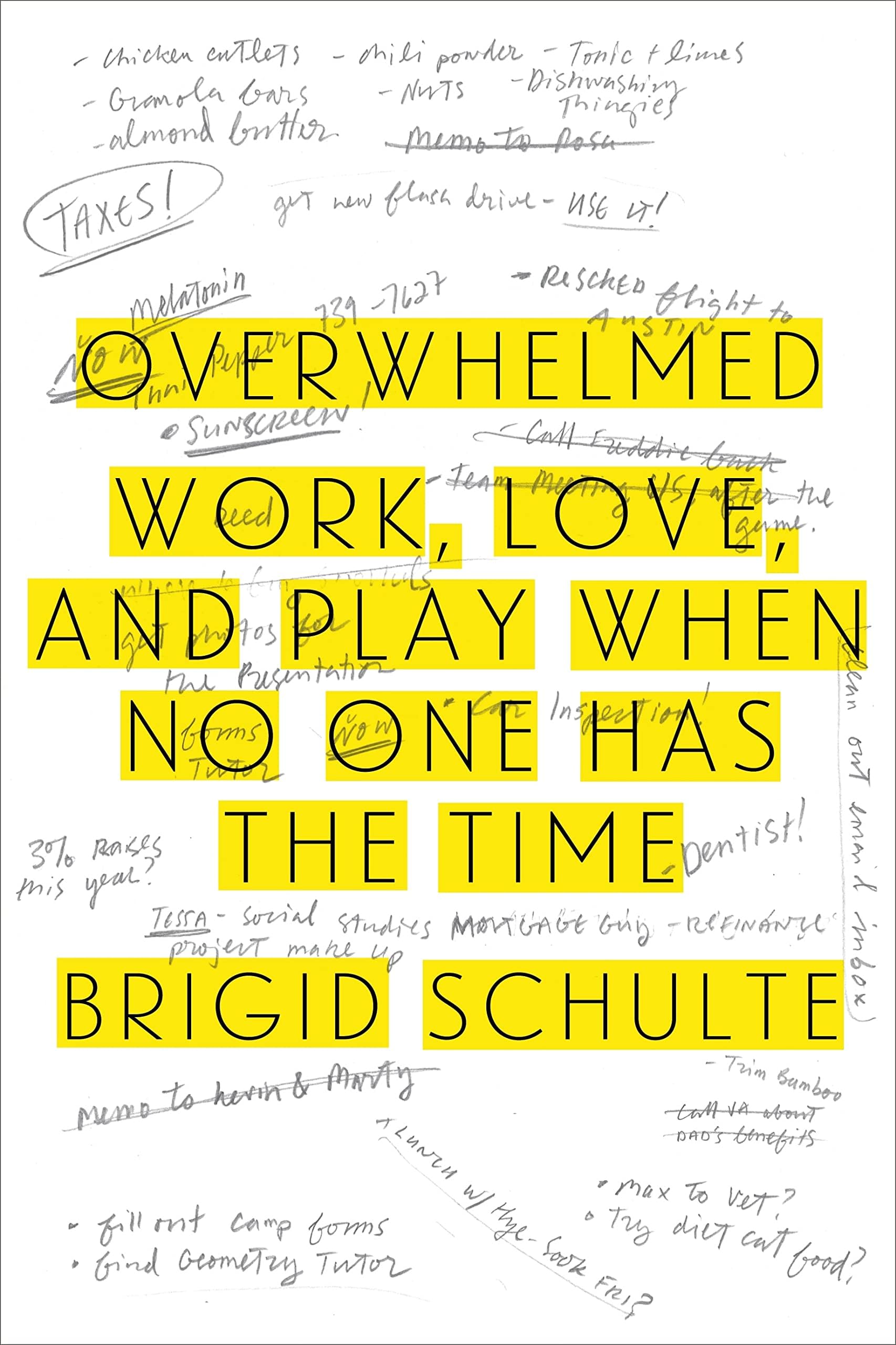


Overwhelmed: Work, Love, and Play When No One Has the Time [Schulte, Brigid] on desertcart.com. *FREE* shipping on qualifying offers. Overwhelmed: Work, Love, and Play When No One Has the Time Review: This book had a huge impact on my life - As soon as I saw the title I knew I wanted to read it. Overwhelmed is just the beginning of what I have been feeling lately and I have been really struggling to get a handle on it all. Schulte's book is divided into three parts. The first part on "Time Confetti" really captured for me what I have been feeling a lot of lately. Reading it, it all seemed so obvious. While the details of time confetti in their parts were not really news to me, Schulte presented the sum of those parts in a way that resonated with me. Reading the first part of the book was comforting because it made me feel like I was not the only one who was feeling this way. Schulte talks about "the sense that life is speeding up at a breakneck pace and that, though they yearn for it, many people can't seem to find an elusive moment of peace." She also talks about "living in an an always-on technological haze [that] leads to mental exhaustion," plus overwork, role overload, "this feeling of never-ending responsibility" and the concept of "contaminated time." Contaminated time describes the mental tape loop phenomenon that is so common for women - your to-do list is always going, the tape is always running in your head, and it causes mental pollution. Then there is the feeling of time pressure caused by the constant switching from one role to the next - mother, wife, worker. My generation has always been told that we can "have it all," but reading Schulte's book just confirmed for me the long held suspicion that the way society is currently structured we just can't do it. The only way we can have it all is if we change what that looks like and if we have a ton of help. Right now society requires ubiquity at work and ubiquity as a parent. Face time and long hours at the office are viewed as essential to success and even to being viewed as a good worker. To be a good parent, both quantity and quality time is required. Our generation spends more time with their kids than any other and yet we still feel like it is not enough and that we should be doing more. Oof! I must admit that after reading the first few chapters I was grumpy and resentful as all get out! Reading all about what a bum steer we get in the modern world, especially women, made me madder than a cut snake. Underpinning all of this is the culture we live in. To be "busy" is now a status symbol. Leisure time is misunderstood and viewed as idleness, slothful and frivolous. When we do fit in leisure, Americans in particular, make it purposive leisure like exercising. Then there is the guilt because we all think we should be working more. In our culture, leisure equals laziness. I must say that the notion of hard work is so ingrained in me that I fight the idea of leisure as valuable at some level too. We tell our kids, work first then play. The problem is we never seem to get to the play part. That is partly because we own our own businesses and also because of the season of life we are in. There are not a lot of days off with little kids in the house. We talk about how we need a break, we talk about how the best ideas come to us in the shower, while exercising or in the car during our commutes, but we do not seem to take the next logical step and program more of that time into our daily lives because it is valuable in itself. Schulte quotes leisure researcher Ben Hunnicutt in describing leisure in its purest sense as "being open to the wonder and marvel of the present." "The wonder of now." I know I am most often living my life as a slave to my to-do list. Leisure and the joy of now is just plain missing. Hunnicutt also says "without time to reflect, to live fully present in the moment and face what is transcendent about our lives, we are doomed to live in purposeless and banal busyness....It creates this 'unquiet heart,' as Saint Augustine said, that is ever desperate for fulfillment." And that right there, is when I knew that this book was just what I needed to read, because that is exactly what I have been feeling. My days are filled with purposeless and banal busyness and my heart is indeed unquiet. So, clearly I need to figure out a way to have more leisure time in my day. The fact that I see it as another task to fit on my to-do list, rather than a way of life, is a problem in itself. It reminds me of how when I first moved to the US over 18 years ago I really noticed that when Americans asked, "What do you do?" they mean your job. But in Australia, when someone asks that question they mean, what do you do for fun? (at least that was true of my twenty-something crowd in 1996!) I found Schulte's chapter on "The Incredible Shrinking Brain" fascinating. This chapter talks all about the deleterious effect on the brain that the "busy" way of life has. I especially loved the line "multitasking makes you stupid - dumber than getting stoned." But the information that resonated with me most was on interruptions. It can take five minutes after a mere thirty second interruption to get back on track. The days I work at home, I feel like I am interrupted every fifteen seconds. I never get any "flow" with no interruptions. My time to think is almost always interrupted. I am almost always trying to do multiple things at once - send an email while cooking. Research while fielding toddler requests for snacks etc, etc. It really made me think about what I say when I say I am "busy." I have decided that I am not actually busy at all. Because if I listed everything I need to do in a day I could fit it into a few hours if I had the concentrated time to do it in... or if I worked on ways to manage my time differently. Am I really busy? No. I am rushed. I am distracted. I am exhausted from role overload and shifting between roles and the always-on life of the modern technological world. All of this forces me to make decisions about my time that at are not necessarily rational. This section gave me a lot of ideas on how to make some changes to how I approach my day. Schulte's section on work was interesting but not really applicable to me. Some of the ideas for changes to the workplace are great, but as Schulte herself identified the women who are in the trenches now have no time or energy to fight to make these changes. Likewise the section on life in Denmark was very interesting. It's great that things work so well for the Danes, but it's simplistic to think we can just import those ideas, loaded with all sorts of historical, cultural and national baggage here and marry it with our own unique baggage. Cross-cultural comparisons are almost always interesting, and incredibly difficult to incorporate. One of the things I loved about this book was that it spoke to so much of what I am struggling with in my life right now. It helped me identify the cause of my current disquiet and gave me a lot of ideas on how to deal with that. The chapter on "The Cult of Intensive Motherhood" really spoke to the other half of my worrying: parenting and how we are trying to find an approach that makes sense. Like so many parents out there, our goal is to launch into the world, sensible, compassionate, mindful, fully-functioning, responsible, adults who are able to support themselves. Sounds pretty simple right? Our parents did it just fine, as did numerous generations before them. I will be the first to tell you that I have radically changed my parenting style over the years. With the Bigs I was totally in the intensive motherhood camp. Then we had a big gap (six years) before the Littlies arrived. I would like to attribute the change to wisdom, but honestly it was just sheer numbers. There is no time, no energy, no way you can parent at such an intensive level with five kids. At least I cannot. So, I parent the Littlies much differently. I parent by ear a lot. If there is no screaming and I cannot hear running water I usually assume we are all a-okay. It feels better to parent this way. Maybe I am lazier with five kids and so the laissez-faire approach feels good because it is easy. I actually think it feels good because it is much closer to how we were raised and we can see a difference in the development of our kids because of it. When I agonize with my girlfriends about whatever our current parenting dilemma is, we often console ourselves by saying, "Our parents never worried about this sh*t!" And it's true. I know my parents worried about us in the way that all parents do, but I do not recall them agonizing over choices for us. We were pretty much left to our own devices and it worked out fine. I did not have any after school activities until I was twelve-years old, I do not recall my parents helping me with my homework or reminding me to get it done. I remember my Mum making me an Easter bonnet for the Easter Hat Parade when I was first or second grade and that's it. I had already been thinking that our style should be called "Retro Parenting" and articles like What Would My Mom Do? (Drink Tab and Lock Us Outside) by Jen Hatmaker tell me that I am not alone in wanting to buck how we parent today. Of course, anyone who has seen the projects that kids hand in today know that is harder said than done. Boy oh boy, there are some dedicated parents out there who do some great projects! We have found the need to let teachers know that we expect our kids to do their own work and not have us remind them. But the pull to be completely involved in your child's schooling is intense. School and all the requirements that go with it will continue to be a challenge to navigate, but we are going to try our hardest to put it all on our kids. We may not be able to be as retro as we would like on the school front, but we do have complete control over the activities we enroll in. Maybe I did wise up some when the Littlies came along. I was stressed out driving kids all over creation and more importantly when I stopped yelling at them to get in the car already to go to swimming or soccer or gymnastics or whatever, I noticed that they were stressed too. I noticed that my kids were happiest after school with time to chill, read a book and play outside. When they started telling me that they did not even want to go to some of their activities I was forced to make changes. We cut back to one activity per kid, but we let it creep up again. I can see the difference in my kids when they have too much on, especially when combined with how intensive school is these days. We are looking forward to the summer off from all the schedules and we will be having a long talk in the Fall about just how much we sign up for. It's easy to fall into the full schedule trap. Not only are kids naturally interested in so many things and they want to do them with their friends, but modern parents want their kids to have "every opportunity." I know I have taken this to mean, I don't want them to miss out. I know I mean I don't want my kid to be at a disadvantage in the race that is life. So, when Schulte writes about fear and the apprehension that no one knows the formula for success any more and that this drives a lot of what we do, I found myself nodding in recognition of this very force in my parenting. The idea has been percolating with us for a while that we have it wrong. This book really bought this idea into sharp focus for us. Education is extremely important to us. We want our kids to do well in life. We attribute a lot of our success in life to our academic achievements, but the older we get the more we see that academics are just a starting point and that success in life has much more to do with focus and discipline, plus a passion and interest in what you do. When we bought into the cult of intensive parenting, fear drove us to believe that our kids need to check a lot of boxes to get into the "right" college to have the good life. The push to check those boxes meant that we were motivated by things external to our family, instead of looking at our family and what we need. Signing our kids up for team sports when they loathe them, to check some mythical college admission need was just plain silly. The fact that we even entertained those thoughts when our eldest is eleven is ridiculous in its own right. We have come to the conclusion that we are not signing our kids up for any extra activities unless they ask to do it. Articles like Frank Bruni's How to Survive the College Admissions Madness tell me that you can drive yourself and your kid crazy checking all those boxes and still not get into the college you want. It also tells me it is okay to reject the fear and okay to opt out of doing all that you think you need to do to get your kid into college. The section on raising Gritty Kids really spoke to me on what it is that I want for my kids. Now I need to think long and hard on how to teach, impart, instill grit... but maybe the answer is that we just do less than we are doing now. We just stop doing so much for them. We stop treating them like they are the center of the universe and let them figure it out. As Schulte says, "what this intensive mothering culture tells us is valuable is at discord with what really is valuable: Love your kids. Keep them safe. Accept them as they are. Then get out of their way." If you are still with me (I know this is a long post!) you can tell I got a lot out of this book. But where did all this leave me? First of all, with the simple, but still utterly stunning revelation that time never changes. "There will always and ever be 168 hours in a week. What you can manage are the activities you choose to do in time. And what busy and overwhelmed people need to realize is that you will never be able to do everything you think you need, want, or should do." Well, heck. I felt completely stupid. I have been desperately trying to cram more in, hoping that time will magically stretch to meet me like one of those crazy bags that you can keep shoving stuff into. It's so bloody obvious. Time is constant. I need to choose better. Fortunately the book has given me some ideas on how to do just that. I love the self-assessment that Shulte has come up with for herself: "Am I trying my best? Am I doing things for the right reasons? Do I make those I love feel loved? Am I happy? And then adjust as I go." I think they are an excellent place to start. I need to shed unrealistic expectations about how much I can physically do. I need to make time for leisure and I need to approach how I use my time differently. Now that I have had some time to absorb Overwhelmed I am starting to make some changes. I have made a pledge to spend some time outside every day rain or shine. Not only is the fresh air and change of perspective good for me, but it gets me away from technology and forces me to slow down. I am trying not to multitask - harder than it seems. I am working on a master to-do list where I write everything down so that it is out of the constant brain loop in my head and secure on paper where I can refer to it, thus freeing up my mind to actually think. I have been doing my #100happydays project for more than a year and it seems it was driving me to this point all along - to a place where mindfulness and practicing gratitude keeps me in the now. I am not only going to continue the project for as long as I can, but I am encouraging the kiddos to do it too. James is a much happier boy since he started his own #100happydays project. Aside from taking a photo a day I am just generally trying to practice being mindful. So when Henry asks to sit in my lap while he eats his lunch, I just sit and hold his little body instead of checking email or reading while he eats. I am so glad I am making the effort because there is such sweetness to these little moments when you slow down enough to enjoy them. This is especially true when it is not clear what I am rushing towards. I am dabbling in meditation and trying to write more. The fact that I am even thinking about ways to make life better is a big step in the right direction. I am hopeful that these small changes will spill over into my parenting and our family life in general and help our kids get where they need to be all on their own. Lastly, I am trying to put important stuff on the calendar first and do it like anything else on my list. I have decided that I need to go to yoga, both because of my achy old back, but also because it combines meditation and mindfulness and awareness of the now of my body in all the ways I need. So, the new me goes to yoga every Monday night and I love it. It makes me happy and relaxed and I hope to do it a lot more. Review: Great realistic tips! Focuses a little too much on couples with children. Not as applicable for those without children. - Very well written. Plenty of data and references to back-up what is being said. A pretty quick read. The book is split into focusing on Work, Love and Play, and has specific tips and solutions for resolving "overwhelm" in these different areas. The only critique that I would have, is that it mostly talks about couples with children. Some of the tips do not really apply to couples or single men and women WITHOUT kids. Even with that critique, I still found the book to be quite helpful in re-ordering my work and home life to be less stressful and crazy. Highly recommend for anyone, but especially those recently married or entering a long-term relationship with a partner!
| Best Sellers Rank | #1,706,027 in Books ( See Top 100 in Books ) #153 in Sociology of Marriage & Family (Books) #186 in Workplace Culture (Books) #7,074 in Stress Management Self-Help |
| Customer Reviews | 4.4 4.4 out of 5 stars (645) |
| Dimensions | 6.32 x 1.3 x 9.26 inches |
| Edition | 1st |
| ISBN-10 | 0374228442 |
| ISBN-13 | 978-0374228446 |
| Item Weight | 1.24 pounds |
| Language | English |
| Print length | 368 pages |
| Publication date | March 11, 2014 |
| Publisher | Sarah Crichton Books |
A**Y
This book had a huge impact on my life
As soon as I saw the title I knew I wanted to read it. Overwhelmed is just the beginning of what I have been feeling lately and I have been really struggling to get a handle on it all. Schulte's book is divided into three parts. The first part on "Time Confetti" really captured for me what I have been feeling a lot of lately. Reading it, it all seemed so obvious. While the details of time confetti in their parts were not really news to me, Schulte presented the sum of those parts in a way that resonated with me. Reading the first part of the book was comforting because it made me feel like I was not the only one who was feeling this way. Schulte talks about "the sense that life is speeding up at a breakneck pace and that, though they yearn for it, many people can't seem to find an elusive moment of peace." She also talks about "living in an an always-on technological haze [that] leads to mental exhaustion," plus overwork, role overload, "this feeling of never-ending responsibility" and the concept of "contaminated time." Contaminated time describes the mental tape loop phenomenon that is so common for women - your to-do list is always going, the tape is always running in your head, and it causes mental pollution. Then there is the feeling of time pressure caused by the constant switching from one role to the next - mother, wife, worker. My generation has always been told that we can "have it all," but reading Schulte's book just confirmed for me the long held suspicion that the way society is currently structured we just can't do it. The only way we can have it all is if we change what that looks like and if we have a ton of help. Right now society requires ubiquity at work and ubiquity as a parent. Face time and long hours at the office are viewed as essential to success and even to being viewed as a good worker. To be a good parent, both quantity and quality time is required. Our generation spends more time with their kids than any other and yet we still feel like it is not enough and that we should be doing more. Oof! I must admit that after reading the first few chapters I was grumpy and resentful as all get out! Reading all about what a bum steer we get in the modern world, especially women, made me madder than a cut snake. Underpinning all of this is the culture we live in. To be "busy" is now a status symbol. Leisure time is misunderstood and viewed as idleness, slothful and frivolous. When we do fit in leisure, Americans in particular, make it purposive leisure like exercising. Then there is the guilt because we all think we should be working more. In our culture, leisure equals laziness. I must say that the notion of hard work is so ingrained in me that I fight the idea of leisure as valuable at some level too. We tell our kids, work first then play. The problem is we never seem to get to the play part. That is partly because we own our own businesses and also because of the season of life we are in. There are not a lot of days off with little kids in the house. We talk about how we need a break, we talk about how the best ideas come to us in the shower, while exercising or in the car during our commutes, but we do not seem to take the next logical step and program more of that time into our daily lives because it is valuable in itself. Schulte quotes leisure researcher Ben Hunnicutt in describing leisure in its purest sense as "being open to the wonder and marvel of the present." "The wonder of now." I know I am most often living my life as a slave to my to-do list. Leisure and the joy of now is just plain missing. Hunnicutt also says "without time to reflect, to live fully present in the moment and face what is transcendent about our lives, we are doomed to live in purposeless and banal busyness....It creates this 'unquiet heart,' as Saint Augustine said, that is ever desperate for fulfillment." And that right there, is when I knew that this book was just what I needed to read, because that is exactly what I have been feeling. My days are filled with purposeless and banal busyness and my heart is indeed unquiet. So, clearly I need to figure out a way to have more leisure time in my day. The fact that I see it as another task to fit on my to-do list, rather than a way of life, is a problem in itself. It reminds me of how when I first moved to the US over 18 years ago I really noticed that when Americans asked, "What do you do?" they mean your job. But in Australia, when someone asks that question they mean, what do you do for fun? (at least that was true of my twenty-something crowd in 1996!) I found Schulte's chapter on "The Incredible Shrinking Brain" fascinating. This chapter talks all about the deleterious effect on the brain that the "busy" way of life has. I especially loved the line "multitasking makes you stupid - dumber than getting stoned." But the information that resonated with me most was on interruptions. It can take five minutes after a mere thirty second interruption to get back on track. The days I work at home, I feel like I am interrupted every fifteen seconds. I never get any "flow" with no interruptions. My time to think is almost always interrupted. I am almost always trying to do multiple things at once - send an email while cooking. Research while fielding toddler requests for snacks etc, etc. It really made me think about what I say when I say I am "busy." I have decided that I am not actually busy at all. Because if I listed everything I need to do in a day I could fit it into a few hours if I had the concentrated time to do it in... or if I worked on ways to manage my time differently. Am I really busy? No. I am rushed. I am distracted. I am exhausted from role overload and shifting between roles and the always-on life of the modern technological world. All of this forces me to make decisions about my time that at are not necessarily rational. This section gave me a lot of ideas on how to make some changes to how I approach my day. Schulte's section on work was interesting but not really applicable to me. Some of the ideas for changes to the workplace are great, but as Schulte herself identified the women who are in the trenches now have no time or energy to fight to make these changes. Likewise the section on life in Denmark was very interesting. It's great that things work so well for the Danes, but it's simplistic to think we can just import those ideas, loaded with all sorts of historical, cultural and national baggage here and marry it with our own unique baggage. Cross-cultural comparisons are almost always interesting, and incredibly difficult to incorporate. One of the things I loved about this book was that it spoke to so much of what I am struggling with in my life right now. It helped me identify the cause of my current disquiet and gave me a lot of ideas on how to deal with that. The chapter on "The Cult of Intensive Motherhood" really spoke to the other half of my worrying: parenting and how we are trying to find an approach that makes sense. Like so many parents out there, our goal is to launch into the world, sensible, compassionate, mindful, fully-functioning, responsible, adults who are able to support themselves. Sounds pretty simple right? Our parents did it just fine, as did numerous generations before them. I will be the first to tell you that I have radically changed my parenting style over the years. With the Bigs I was totally in the intensive motherhood camp. Then we had a big gap (six years) before the Littlies arrived. I would like to attribute the change to wisdom, but honestly it was just sheer numbers. There is no time, no energy, no way you can parent at such an intensive level with five kids. At least I cannot. So, I parent the Littlies much differently. I parent by ear a lot. If there is no screaming and I cannot hear running water I usually assume we are all a-okay. It feels better to parent this way. Maybe I am lazier with five kids and so the laissez-faire approach feels good because it is easy. I actually think it feels good because it is much closer to how we were raised and we can see a difference in the development of our kids because of it. When I agonize with my girlfriends about whatever our current parenting dilemma is, we often console ourselves by saying, "Our parents never worried about this sh*t!" And it's true. I know my parents worried about us in the way that all parents do, but I do not recall them agonizing over choices for us. We were pretty much left to our own devices and it worked out fine. I did not have any after school activities until I was twelve-years old, I do not recall my parents helping me with my homework or reminding me to get it done. I remember my Mum making me an Easter bonnet for the Easter Hat Parade when I was first or second grade and that's it. I had already been thinking that our style should be called "Retro Parenting" and articles like What Would My Mom Do? (Drink Tab and Lock Us Outside) by Jen Hatmaker tell me that I am not alone in wanting to buck how we parent today. Of course, anyone who has seen the projects that kids hand in today know that is harder said than done. Boy oh boy, there are some dedicated parents out there who do some great projects! We have found the need to let teachers know that we expect our kids to do their own work and not have us remind them. But the pull to be completely involved in your child's schooling is intense. School and all the requirements that go with it will continue to be a challenge to navigate, but we are going to try our hardest to put it all on our kids. We may not be able to be as retro as we would like on the school front, but we do have complete control over the activities we enroll in. Maybe I did wise up some when the Littlies came along. I was stressed out driving kids all over creation and more importantly when I stopped yelling at them to get in the car already to go to swimming or soccer or gymnastics or whatever, I noticed that they were stressed too. I noticed that my kids were happiest after school with time to chill, read a book and play outside. When they started telling me that they did not even want to go to some of their activities I was forced to make changes. We cut back to one activity per kid, but we let it creep up again. I can see the difference in my kids when they have too much on, especially when combined with how intensive school is these days. We are looking forward to the summer off from all the schedules and we will be having a long talk in the Fall about just how much we sign up for. It's easy to fall into the full schedule trap. Not only are kids naturally interested in so many things and they want to do them with their friends, but modern parents want their kids to have "every opportunity." I know I have taken this to mean, I don't want them to miss out. I know I mean I don't want my kid to be at a disadvantage in the race that is life. So, when Schulte writes about fear and the apprehension that no one knows the formula for success any more and that this drives a lot of what we do, I found myself nodding in recognition of this very force in my parenting. The idea has been percolating with us for a while that we have it wrong. This book really bought this idea into sharp focus for us. Education is extremely important to us. We want our kids to do well in life. We attribute a lot of our success in life to our academic achievements, but the older we get the more we see that academics are just a starting point and that success in life has much more to do with focus and discipline, plus a passion and interest in what you do. When we bought into the cult of intensive parenting, fear drove us to believe that our kids need to check a lot of boxes to get into the "right" college to have the good life. The push to check those boxes meant that we were motivated by things external to our family, instead of looking at our family and what we need. Signing our kids up for team sports when they loathe them, to check some mythical college admission need was just plain silly. The fact that we even entertained those thoughts when our eldest is eleven is ridiculous in its own right. We have come to the conclusion that we are not signing our kids up for any extra activities unless they ask to do it. Articles like Frank Bruni's How to Survive the College Admissions Madness tell me that you can drive yourself and your kid crazy checking all those boxes and still not get into the college you want. It also tells me it is okay to reject the fear and okay to opt out of doing all that you think you need to do to get your kid into college. The section on raising Gritty Kids really spoke to me on what it is that I want for my kids. Now I need to think long and hard on how to teach, impart, instill grit... but maybe the answer is that we just do less than we are doing now. We just stop doing so much for them. We stop treating them like they are the center of the universe and let them figure it out. As Schulte says, "what this intensive mothering culture tells us is valuable is at discord with what really is valuable: Love your kids. Keep them safe. Accept them as they are. Then get out of their way." If you are still with me (I know this is a long post!) you can tell I got a lot out of this book. But where did all this leave me? First of all, with the simple, but still utterly stunning revelation that time never changes. "There will always and ever be 168 hours in a week. What you can manage are the activities you choose to do in time. And what busy and overwhelmed people need to realize is that you will never be able to do everything you think you need, want, or should do." Well, heck. I felt completely stupid. I have been desperately trying to cram more in, hoping that time will magically stretch to meet me like one of those crazy bags that you can keep shoving stuff into. It's so bloody obvious. Time is constant. I need to choose better. Fortunately the book has given me some ideas on how to do just that. I love the self-assessment that Shulte has come up with for herself: "Am I trying my best? Am I doing things for the right reasons? Do I make those I love feel loved? Am I happy? And then adjust as I go." I think they are an excellent place to start. I need to shed unrealistic expectations about how much I can physically do. I need to make time for leisure and I need to approach how I use my time differently. Now that I have had some time to absorb Overwhelmed I am starting to make some changes. I have made a pledge to spend some time outside every day rain or shine. Not only is the fresh air and change of perspective good for me, but it gets me away from technology and forces me to slow down. I am trying not to multitask - harder than it seems. I am working on a master to-do list where I write everything down so that it is out of the constant brain loop in my head and secure on paper where I can refer to it, thus freeing up my mind to actually think. I have been doing my #100happydays project for more than a year and it seems it was driving me to this point all along - to a place where mindfulness and practicing gratitude keeps me in the now. I am not only going to continue the project for as long as I can, but I am encouraging the kiddos to do it too. James is a much happier boy since he started his own #100happydays project. Aside from taking a photo a day I am just generally trying to practice being mindful. So when Henry asks to sit in my lap while he eats his lunch, I just sit and hold his little body instead of checking email or reading while he eats. I am so glad I am making the effort because there is such sweetness to these little moments when you slow down enough to enjoy them. This is especially true when it is not clear what I am rushing towards. I am dabbling in meditation and trying to write more. The fact that I am even thinking about ways to make life better is a big step in the right direction. I am hopeful that these small changes will spill over into my parenting and our family life in general and help our kids get where they need to be all on their own. Lastly, I am trying to put important stuff on the calendar first and do it like anything else on my list. I have decided that I need to go to yoga, both because of my achy old back, but also because it combines meditation and mindfulness and awareness of the now of my body in all the ways I need. So, the new me goes to yoga every Monday night and I love it. It makes me happy and relaxed and I hope to do it a lot more.
E**Y
Great realistic tips! Focuses a little too much on couples with children. Not as applicable for those without children.
Very well written. Plenty of data and references to back-up what is being said. A pretty quick read. The book is split into focusing on Work, Love and Play, and has specific tips and solutions for resolving "overwhelm" in these different areas. The only critique that I would have, is that it mostly talks about couples with children. Some of the tips do not really apply to couples or single men and women WITHOUT kids. Even with that critique, I still found the book to be quite helpful in re-ordering my work and home life to be less stressful and crazy. Highly recommend for anyone, but especially those recently married or entering a long-term relationship with a partner!
D**G
A must read for anyone in the US feeling like there is "too much to do"
I read this with the intention of trying to understand the the work-life balance issue in our society. I work with executives and over-achievers and I think we have a real problem on our hands that is very difficult to manage. Schulte has written an incredibly well-documented book that exceeded my expectations and gave me much more than I was looking for when I purchased it. My goal was to find one or two nuggets of info to help the executives I work with manage their lives more effectively. Often, the question they ask themselves is, "How can I spend more time with my family without sacrificing my need to perform at work at high levels?" First, Schulte helps us understand that this is not a dichotomy. There are many other factors to consider and she goes into some excellent detail on several time use studies as well as the culture and myths we encounter. Next, I was really pleased to read about how the "overwhelm" is managed in some other countries. She spent some time in the Netherlands and some of the people she interviewed were so taken back by the questions because their culture values balance and equality more than ours, it seems. Third, I was dismayed to learn just how backward our society is in treating the birth of a new child. Paid leave for mothers and fathers is abysmal compared to much of the rest of the world. No wonder women feel so much pressure to return to work, quickly, and why so many men take little or no time of in this case. Finally, I really liked the simplicity of looking at Work, Play and Love. If we all honor these areas of our lives, she seems to say, we'll be better off. While I cannot argue with this, it may be the one very small thing I would like to see expanded. To beat the "overwhelm," people need to honor THEIR most cherished values - a constant review of these values makes the daily decisions much easier. Overall, a great book and well worth your time.
B**Y
Must read for stressed working parents!
Admittedly, this is more geared towards working moms than any other group, but I think dads can get some value from it too. I'd love for my husband to read it to gain some additional perspective on the mom's load. It had a bit less approachable tactics for handling the overwhelm than I expected, but did make me feel less alone in it. I think my main takeaway is mindset is everything and it's best to try to let go of control of some of the less important things like a spotless house, etc. I listened on audio book because it was easier to fit it in in the overwhelm and it was well worth it, engaging, had me hooked!
M**A
This is a nifty balance of research, journalistic stories, some personal insights and common sense. Yes, quite US focussed, but I actually enjoyed it- first of all it did give me a little boost that at least I don't have to be in the U.S., and secondly, it was informative and thus more interesting. Perfect book for my soul searching mission to stop my own overwhelm. Enjoyed it more than Ariana Huffington's Thrive for example, or Rubin' Happiness Project. A good, more woman focussed, companion to Dolan's excellent Happiness by Design.
P**Y
Helps to understand
C**I
But long.. Many enriching life stories, experiences. A clean organization of sections. Very powerful lessons to apply in daily life.
A**R
Well researched book about the difficulty to be a guilt free working mum. Many interesting thoughts and definitely comforting to those women who feel overwhelmed from time to time.
Y**O
私の恩師の書いた本です。嬉しいですね。
Trustpilot
1 month ago
1 week ago