
DOWNLOAD THE APP


Customer Services
Copyright © 2025 Desertcart Holdings Limited
DOWNLOAD THE APP
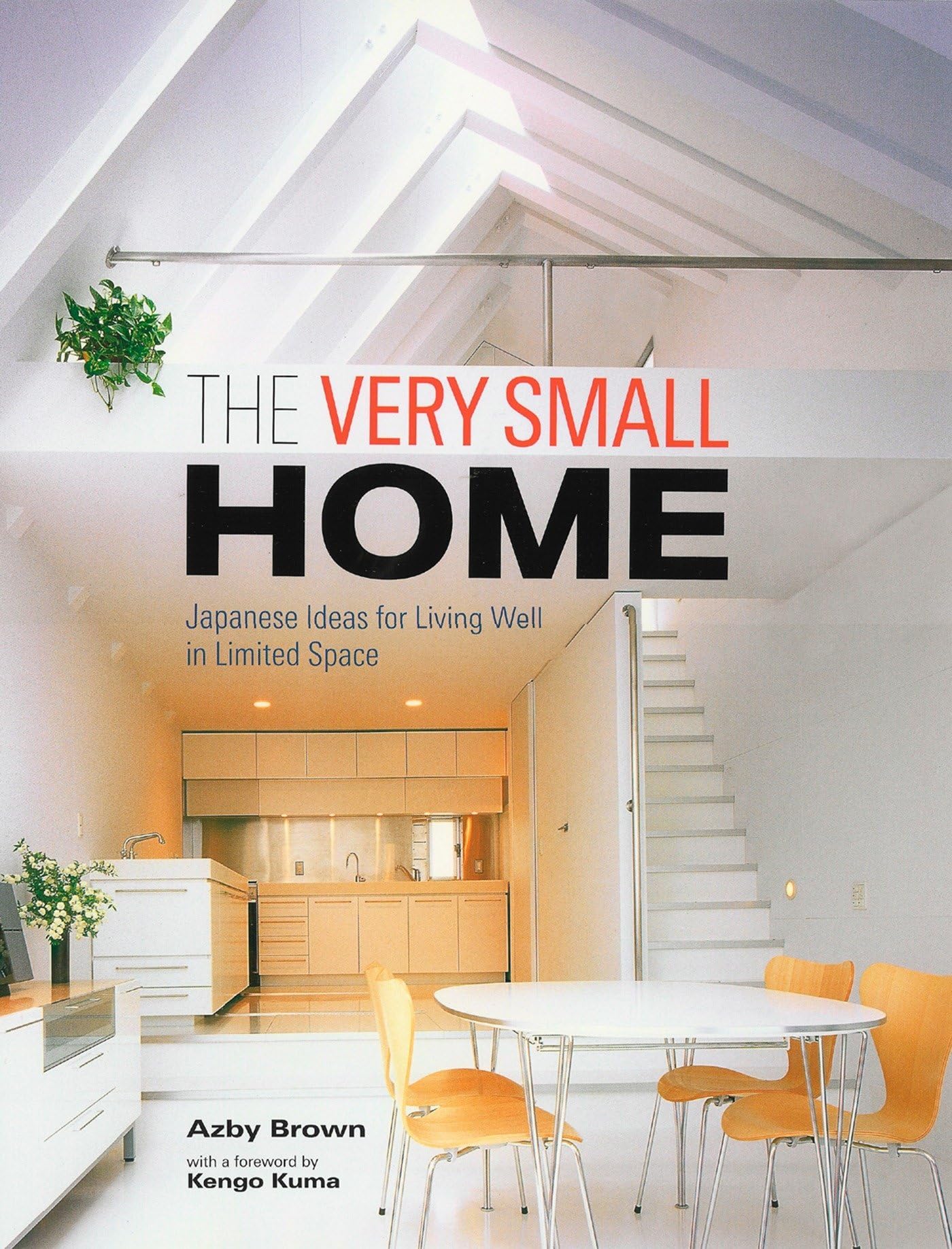
The Very Small Home: Japanese Ideas for Living Well in Limited Space [Brown, Azby, Kuma, Kengo] on desertcart.com. *FREE* shipping on qualifying offers. The Very Small Home: Japanese Ideas for Living Well in Limited Space Review: Fun book, well put together - This is a fun book that can be perused many times without getting tired of it. It is well put together. It features twenty small Japanese houses (including two in the introduction) in the Tokyo area, all of contemporary architecture. There isn't much available land in Tokyo so the architects had to use their imaginations to put everything in a small space. Four pages are devoted to each house, two for photos, one for large 3-D floor plan drawings, and one for the text and a cross section drawing of the different levels or stories. The rooms appear spacious because they are sparsely furnished, as the Japanese value simplicity. Living areas often have only a dining table and chairs and sometimes a couch or a bookcase, and the bedrooms only have space enough for a bed, storage, and sometimes a desk. The kitchens save space with compact appliances that until recently were not made in the USA. And the toilets are usually put in tiny cubicles separate from the bathing area, which has a tub and/or a shower with a curtain but no stall. The tiniest house has a footprint of less than 18' square and only 533 square feet of floor space, including the loft, and a family with two children live there. To bring nature to an urban setting where there isn't a tree in sight, several houses are built around a garden courtyard that also illumines the interior rooms that would otherwise be dark. One house has a separate bathing house with grass growing on its roof and views of a private garden. Another house has all its rooms in a row with sliding glass doors that can be pulled back so every room is open to the small yard, including the bathroom that has no door! Review: Origami you can live in, or at least marvel at... - I LOVE this book! I don't think I could live in most of these houses... But, oh wow, would I love to spend a weekend. In the truest Japanese tradition, these very, very small homes are morsels of perfection. No detail is too small; no corner neglected. Somehow, ancient Japanese design seems modern. So these "modern" homes, in the Japanese context, carry on tradition. My favorite house may be the little gem squeezed into what was a long, narrow driveway. It manages to be private, spacious, light filled and warm, AND incorporate a charming courtyard between the kitchen and traditional bathhouse. There are so many ingenious ideas packed between the covers of this book. If you love architecture or small houses or big houses or live in a house or apartment or refrigerator box (especially the box--it's roughly the size of some of these houses) you may enjoy this book. My main objection to these designs, is that I would require more privacy for the master bedroom. Many of them were open loft types, many of them barely segmented from the children's space. But, I still marveled at these tiny wonders. Some had the aura of cathedrals. Highly recommended.
| Best Sellers Rank | #1,756,572 in Books ( See Top 100 in Books ) #528 in Small Homes & Cottages #1,407 in Residential Architecture #2,277 in Home Design & Construction (Books) |
| Customer Reviews | 4.4 4.4 out of 5 stars (98) |
| Dimensions | 9.35 x 0.61 x 12 inches |
| Edition | Illustrated |
| ISBN-10 | 1568364342 |
| ISBN-13 | 978-1568364346 |
| Item Weight | 2.16 pounds |
| Language | English |
| Print length | 112 pages |
| Publication date | September 14, 2012 |
| Publisher | Kodansha International |
C**E
Fun book, well put together
This is a fun book that can be perused many times without getting tired of it. It is well put together. It features twenty small Japanese houses (including two in the introduction) in the Tokyo area, all of contemporary architecture. There isn't much available land in Tokyo so the architects had to use their imaginations to put everything in a small space. Four pages are devoted to each house, two for photos, one for large 3-D floor plan drawings, and one for the text and a cross section drawing of the different levels or stories. The rooms appear spacious because they are sparsely furnished, as the Japanese value simplicity. Living areas often have only a dining table and chairs and sometimes a couch or a bookcase, and the bedrooms only have space enough for a bed, storage, and sometimes a desk. The kitchens save space with compact appliances that until recently were not made in the USA. And the toilets are usually put in tiny cubicles separate from the bathing area, which has a tub and/or a shower with a curtain but no stall. The tiniest house has a footprint of less than 18' square and only 533 square feet of floor space, including the loft, and a family with two children live there. To bring nature to an urban setting where there isn't a tree in sight, several houses are built around a garden courtyard that also illumines the interior rooms that would otherwise be dark. One house has a separate bathing house with grass growing on its roof and views of a private garden. Another house has all its rooms in a row with sliding glass doors that can be pulled back so every room is open to the small yard, including the bathroom that has no door!
C**R
Origami you can live in, or at least marvel at...
I LOVE this book! I don't think I could live in most of these houses... But, oh wow, would I love to spend a weekend. In the truest Japanese tradition, these very, very small homes are morsels of perfection. No detail is too small; no corner neglected. Somehow, ancient Japanese design seems modern. So these "modern" homes, in the Japanese context, carry on tradition. My favorite house may be the little gem squeezed into what was a long, narrow driveway. It manages to be private, spacious, light filled and warm, AND incorporate a charming courtyard between the kitchen and traditional bathhouse. There are so many ingenious ideas packed between the covers of this book. If you love architecture or small houses or big houses or live in a house or apartment or refrigerator box (especially the box--it's roughly the size of some of these houses) you may enjoy this book. My main objection to these designs, is that I would require more privacy for the master bedroom. Many of them were open loft types, many of them barely segmented from the children's space. But, I still marveled at these tiny wonders. Some had the aura of cathedrals. Highly recommended.
N**N
Awkward Lot Building
A good book, but not as good as his previous book "Small Spaces", which I have just rebought. This book covers beautiful houses on complex small lots, it is not really for me, it is praised by Sarah Susanka who has published work on her exquisite mini mansions, this book is in the same vein. It makes a nice coffee table book, it is perfectly illustrated.
J**Y
Arrived on time.
Really enjoyed the book. Great guide to Japanese design and decor which I enjoy researching.
J**N
Exceptional insights
As I work through the major renovation of my 750 sqft loft I've bought and closely reviewed the design strategies and tricks from about 20 books on small apartments and lofts. Beyond a doubt this book has provided more practical, cost effective insights than any other (also see "Small Lofts"). In particular, this book contains engaged descriptions that go far beyond the typical coffee table book of merely impressive photographs. This book is about the specific challenges found in Japanese home design including air rights issues that I doubt exist in most of the USA, but the solutions to these foreign problems are just as useful here (for solving other challenges) as they are in Japan. I strongly recommend this book!
G**I
a few good ideas
The book presented a few good ideas. Many though are not useful in western residences. Too many vertical spaces. I am looking for horizontal, one-level, living.
T**I
Nice read regarding japanese home design
One of the recommended addons for Living Big in a Tiny House series. It's a nice read that goes through japanese home design mostly. It's where I first understood the concept of garden entrance in an apartment.
A**S
Amazing book, lots of great design ideas
I bought this book to get some ideas for practical use of space in a small house that I was renovating. The houses in this book are all buily on tiny plots of land, yet the Japanese seem to be able to make the very most of very square meter. In particular I like one design enough to try and replicate the entire house at some point in the future, I I can find and purchase the right plot of land. I wish I had read this book before I started work on my current project, instead of reading it in the final stages.
L**C
Esperaba mas del libro, es un poco técnico, yo esperaba que fuese un libro con mas imágenes y que el diseño gráfico fuera mejor
A**E
Eine Sammlung von guten und neuen Ideen, die leider kein deutsche Amt abnehmen würde. Aber sehr anregend und mit nett gezeichneten Skizzen überschaubar, hilfreich und seiner Zeit vorraus. Bei Grundstückspreisen, wie z.B. in Bayern, wird es aber nicht lange dauern, bis sich Vernunft und Ästhetik durchsetzt.
T**S
The offer I submitted for my first flat was accepted a few days ago, and I bought this to celebrate and help plan how my Very Small Home is going to look. The 18 houses are deftly photographed and provide accommodation for a wide variety of households, from young couples to larger families. Some of the designs are truly astonishing; I couldn't help feel a powerful envy not only for the people who live in these meticulously crafted homes, but also for the talented architects who created them. It's apt that the focus here is on Japanese homes, for the challenge of working with limited space yields dazzling instances of creativity, much like haiku poetry. Raised floors to enable underfoot storage, glassed off interior gardens, house-tall curtains that can provide privacy or blow in the breeze to create striking art, and so on. Each dwelling is a gem that I know I'll flip back to marvel at in the future. While there are many little touches in terms of furnishing and storage that I can take away as inspiration, much of the appeal of these houses is in their core architecture - whether it's their basic features, or the way they've been integrated with their environment, like one house with a slanted wall to avoid impinging on the roots of a treasured tree. Because of this, I feel that architects and designers will get more benefit and inspiration than a homeowner hoping to improve their interior design. I sincerely hope this book is well read by the next generation of architects here in the UK and we can finally get some attractive modern buildings on the go.
L**T
I've always loved this book - almost stole it from an Architect friend and hunted down my own copy. Lovely x
J**E
Some great ideas, not sure too many of them work in the UK. Really good to open your mind to the art of possible.
Trustpilot
3 weeks ago
2 weeks ago