We remain fully operational. Our teams are working around the clock to ensure your deliveries continue safely.

DOWNLOAD THE APP


Customer Services
Copyright © 2025 Desertcart Holdings Limited
DOWNLOAD THE APP
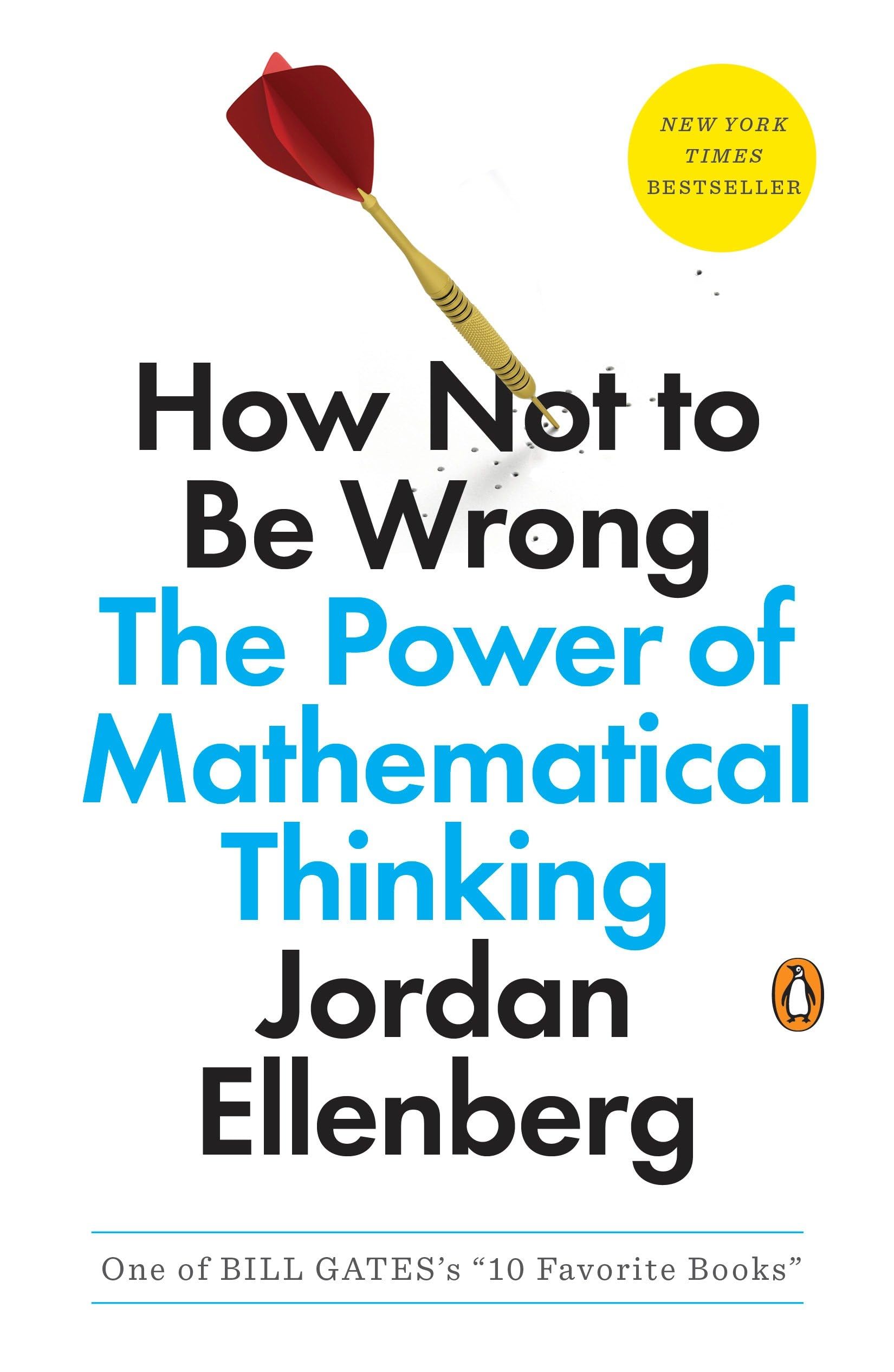
How Not to Be Wrong: The Power of Mathematical Thinking [Ellenberg, Jordan] on desertcart.com. *FREE* shipping on qualifying offers. How Not to Be Wrong: The Power of Mathematical Thinking Review: An Acquired Taste, So Don't Give Up Too Soon! - You'll start reading this book thinking there will be a lot of juicy math on odds vs. utility functions in decision theory, then toss it out in disgust when you find you're reading a snail-paced "lives of the Saints in Probability..." BUT IF you toss it, you'd be WRONG just like the book's title! Ok, I'm with George Box that all models are wrong but some are useful, so in all humility, even if our thinking is n-dimensional and nonlinear, our headlights still don't go out centuries, and the law of unintended consequences will inevitably rear it's fearsome head. So yes, I know I'm gunna be wrong more than right even reading this gem of a book. It gets FUN! As you read on, Jord gets into deeper and deeper math, and most significantly, starts to COMBINE stats, geometry, differential equations, etc. in eclectic, multi-disciplinary fields, which are much more like real life than academic exercises. It is not only math that has a new twist every hour these days, it is the combinations of fields (as in vocations and disciplines, not quantum fields) that is making math more and more relevant. I'm not one to discount the gut, heart, tradition or even intuition, but it really is enlightening to take a little more quant view at our normal evaluations of everyday spin. Yes, the author does have a bit of a left bent, but heck, those are just examples, and you'd have to be pretty emotion driven not to see how easily his logic applies to ANY "position." I see a LOT of tongue in cheek in this book and a LOT of both wonder and just plain great story telling-- please don't pass on this book if you're bright but not necessarily a policy wonk! I've been in school board meetings where one group or another wants to add social justice at the expense of STEM and math, and I just scratch my head. I've seen left proposals to take out intelligent design while adding Islam (??) and right proposals to remove Islam, Darwin and Linear Algebra to add family social values. Hmmm. The folks that criticize this author for being a little too green might consider that he is clearly for adding back a LOT more math in the curricula! Hey, I'm a geek, and only anti-geeks can argue with that! I guarantee that even if you are way right, but smart, you'll thoroughly enjoy this book, and it applies just as clearly to one cause or position as another, and tries to avoid being "dumb" about ANY linear thinking. I'm more into enjoying what you buy here than getting into politics, but because of some of Jordan's controversy, just thought I'd add my 2c that this is well worth reading regardless of your politics, as it is fun and smart. Just give it a chance, it gets better and better faster and faster-- second derivative + -- jounce, jolt, surge etc. stuff. ;=) Enjoy... Review: Interesting but difficult to read - The book is full of interesting mathematical concepts which, according to the author, can be applied in the everyday life. The author enriches the content by adding comprehensive examples and historical accounts of the brilliant mathematicians behind the theories discussed. That makes the book very interesting. However, the book makes one common mistake found in many books about mathematics: the explanation of the mathematical concepts are too short and incomplete to provide a good understanding of them. Maybe, that was the intent of the author. But, that makes the reading very difficult. I've sometime found myself reading some parts of the book over and over, trying to get a minimum understanding of some theories. Anyway, the book has some useful advices about how mathematics can help you not to be wrong in some very important subjects. That by itself makes it worth reading.
| Best Sellers Rank | #47,074 in Books ( See Top 100 in Books ) #7 in Mathematics History #10 in Philosophy of Logic & Language #18 in Applied Mathematics (Books) |
| Customer Reviews | 4.4 4.4 out of 5 stars (5,030) |
| Dimensions | 1.1 x 5.4 x 8.4 inches |
| ISBN-10 | 0143127535 |
| ISBN-13 | 978-0143127536 |
| Item Weight | 2.31 pounds |
| Language | English |
| Print length | 480 pages |
| Publication date | May 26, 2015 |
| Publisher | Penguin Books |
| Reading age | 18 years and up |
P**Z
An Acquired Taste, So Don't Give Up Too Soon!
You'll start reading this book thinking there will be a lot of juicy math on odds vs. utility functions in decision theory, then toss it out in disgust when you find you're reading a snail-paced "lives of the Saints in Probability..." BUT IF you toss it, you'd be WRONG just like the book's title! Ok, I'm with George Box that all models are wrong but some are useful, so in all humility, even if our thinking is n-dimensional and nonlinear, our headlights still don't go out centuries, and the law of unintended consequences will inevitably rear it's fearsome head. So yes, I know I'm gunna be wrong more than right even reading this gem of a book. It gets FUN! As you read on, Jord gets into deeper and deeper math, and most significantly, starts to COMBINE stats, geometry, differential equations, etc. in eclectic, multi-disciplinary fields, which are much more like real life than academic exercises. It is not only math that has a new twist every hour these days, it is the combinations of fields (as in vocations and disciplines, not quantum fields) that is making math more and more relevant. I'm not one to discount the gut, heart, tradition or even intuition, but it really is enlightening to take a little more quant view at our normal evaluations of everyday spin. Yes, the author does have a bit of a left bent, but heck, those are just examples, and you'd have to be pretty emotion driven not to see how easily his logic applies to ANY "position." I see a LOT of tongue in cheek in this book and a LOT of both wonder and just plain great story telling-- please don't pass on this book if you're bright but not necessarily a policy wonk! I've been in school board meetings where one group or another wants to add social justice at the expense of STEM and math, and I just scratch my head. I've seen left proposals to take out intelligent design while adding Islam (??) and right proposals to remove Islam, Darwin and Linear Algebra to add family social values. Hmmm. The folks that criticize this author for being a little too green might consider that he is clearly for adding back a LOT more math in the curricula! Hey, I'm a geek, and only anti-geeks can argue with that! I guarantee that even if you are way right, but smart, you'll thoroughly enjoy this book, and it applies just as clearly to one cause or position as another, and tries to avoid being "dumb" about ANY linear thinking. I'm more into enjoying what you buy here than getting into politics, but because of some of Jordan's controversy, just thought I'd add my 2c that this is well worth reading regardless of your politics, as it is fun and smart. Just give it a chance, it gets better and better faster and faster-- second derivative + -- jounce, jolt, surge etc. stuff. ;=) Enjoy...
K**R
Interesting but difficult to read
The book is full of interesting mathematical concepts which, according to the author, can be applied in the everyday life. The author enriches the content by adding comprehensive examples and historical accounts of the brilliant mathematicians behind the theories discussed. That makes the book very interesting. However, the book makes one common mistake found in many books about mathematics: the explanation of the mathematical concepts are too short and incomplete to provide a good understanding of them. Maybe, that was the intent of the author. But, that makes the reading very difficult. I've sometime found myself reading some parts of the book over and over, trying to get a minimum understanding of some theories. Anyway, the book has some useful advices about how mathematics can help you not to be wrong in some very important subjects. That by itself makes it worth reading.
U**N
Wonderful
This is a wonderful book. I thoroughly enjoyed it. I learned Mathematical, historical and cultural jewels that I very much look forward to contemplating further or delving into. The author is refreshingly forthright in exploring the impediments to Mathematics Education and its appreciation in society at large. He does this from the position of a working Mathematician and educator. A broad array of concepts are covered and their exposition are an intricate weaving of historical events and individuals with current events and instructive toy examples. Wald, Fisher, Pascal, Shannon, Galton, Hilbert and many more appear at varying times. These insights into these individuals was remarkably more complex for the amount of words: strengths and weaknesses of their contributions (and the positions, e.g Galton and eugenics). One of the greatest joys of this book is the discussions are neither superficial nor simplistic. The author starts from the simple and when you think you have digested what is at hand, he add another wrinke and another and enriches your understanding. He supports his case that Mathematics is the extension of common sense. Particularly informative were the discussions of the law of large numbers, lotteries, the concept of regression to the mean. The importance of the role of uncertaintuy in our lives, acknowledging its existence and the value of quantifying marries well with Nate Silvers "The Signal and The Noise" (Silver also discussed in the book). The author discusses the "cult of genius" and the obstacle it creates to recruitment and retention of Mathematicians and the enrichment of other disciplines by Mathematics. This was compelling and struck me and derived from the insights of one who had negotiated the journey (though admittedly a prodigy) as well as tasked with guiding and supporting others through it. There is a lot in this book. It is, however, more than content. It is a challenge to think more deeply about everyday life, about culture, about history and the seeing the "unreasonable effectiveness of Mathematics".
A**D
Slightly torn cover and slightly turned pages.
F**R
It's a very funny book and you don't need very hard knowledge to have fun with it. It is very clear and dealing with various topics from old maths (like pYthagora's theorem) to very early developpments in financial theories. It's very easy to read even for non native English talking people like me. Just buy it !
A**R
This book is very well written and you get stuck on it because of the things explained. As an Italian reader I cannot say it is an easy reading , nevertheless I would recommend it.
G**S
Leitura fluida e esclarecedora.
C**N
This book taught me much more than I expected. I liked very much the appraisal of Cauchy's work and Ellenberg's opinion on genius (and mathematical contests, tangentially). Sometimes the author delves too deeply or baroquely into certain topics, thus some judicious reading is in order. I strongly recommend this book for aspiring mathematicians and patient general readers.
Trustpilot
1 month ago
1 week ago