We remain fully operational. Our teams are working around the clock to ensure your deliveries continue safely.

DOWNLOAD THE APP


Customer Services
Copyright © 2025 Desertcart Holdings Limited
DOWNLOAD THE APP
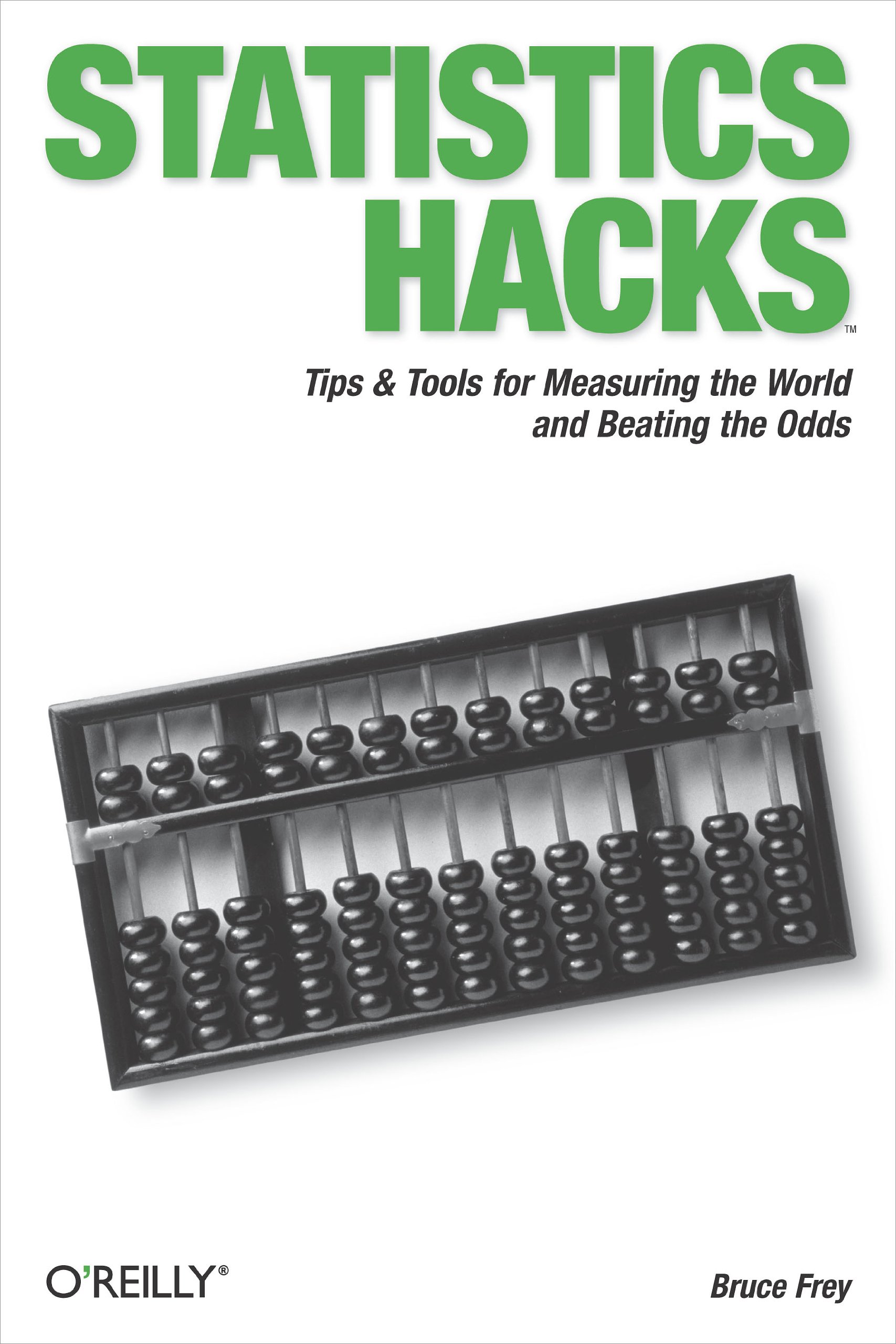
desertcart.com: Statistics Hacks: Tips & Tools for Measuring the World and Beating the Odds: 9780596101640: Frey, Bruce: Books Review: An entertaining and useful book - It's not very easy to use the words "entertaining" and "statistics" in the same sentence, but you can if you're talking about this book. Bruce Frey's collection of tips and tools makes the subject interesting, fun-- even funny-- and most importantly, approachable. It's important to understand that this book is not intended to be a statistics textbook, review, or reference manual. Rather, it is a collection of bite-sized hacks that relate statistical principles to the "real" world. Every hack is illustrated with some example, including many relating to gambling, games, and bar bets. Which properties should you buy in Monopoly? The answer is here, along with an explanation. How many people have to be in a room with you before you can be pretty sure that at least one of them shares your birthday? That's here, too, along with the explanation. Is there a way to predict the winner of a baseball game by listening to about twenty minutes of the middle of it? Yep. If you're looking for an authoritative, comprehensive, serious statistics text, keep shopping. If you're looking for a light but nonetheless very useful explanation/review of how and why statistics work in a real-world context, buy this book. I'm glad I bought it, and I'd do it again. I got more than enough entertainment and utility out of it to justify the expense. Review: Apparently they couldn't be bothered to edit it - I'm not a statistics expert, but in the first 10 pages of this book I've already found two significant errors, the latter of which is particularly horrendous. Either the author is clueless about statistics -- a frightening thought since he supposedly teaches statistics as a professor -- or the editing of this book by statistics-clueful people was basically nonexistent. I'll assume the latter, but either way, this book is a blot on O'Reilly's record. Page 5: "The mean will be close to some scores and far away from some others, but if you add up those distances, you get a total that is as small as possible." Wrong. The mean minimizes the sum of SQUARED distances; the MEDIAN minimizes the sum of the distances. Hand-waving on the next page apologizing for how complicated the formula for the standard deviation is because "there are some mathematical complications with summing distances" would suggest to me that the omission of "squared" on page 5 was not a mere typo or a misguided attempt at simplification. OK, sure, one error like that isn't worth trashing a book over, particularly a book for lay people (albeit those with a technical bent). But check out this howler on page 10: "Additive rule: the probability of any one of several independent events occuring is the *sum* of each event's probability." [Emphasis on "sum" is the book's, not mine.] This isn't just plain wrong; it's cringe-inducingly, forehead-slappingly wrong. The additive rule is for any one of several mutually exclusive events occuring, and independent pretty much implies *not* mutually exclusive (the annoying corner cases being those where some events under consideration are completely impossible anyhow). The rule for one of several independent events occuring is more complicated; for example, the probability of a fair coin coming up "heads" on either its first or second flip is obviously not 1, as the author's statement would ridiculously imply, but rather 3/4. In order to do anything with statistics at all, you absolutely MUST understand the basic concepts of "independent" and "mutually exclusive", or you're doomed from the get-go. The fact that this book is for lay people who might not already be clear on these concepts only makes having such an error in it that much less excusable. If the author can't be bothered to stamp out obvious errors like this in the first 10 pages -- particularly the latter -- I can't be bothered to read the rest of it. Maybe the second edition will be worth glancing at, but I'm not holding my breath. (For one thing, the overall writing style in that first 10 pages wasn't particularly lucid either.)



























| Best Sellers Rank | #2,148,617 in Books ( See Top 100 in Books ) #373 in Mathematical & Statistical Software #920 in Computer Hacking #1,148 in Statistics (Books) |
| Customer Reviews | 3.8 3.8 out of 5 stars (30) |
| Dimensions | 6 x 0.9 x 9 inches |
| Edition | 1st |
| ISBN-10 | 0596101643 |
| ISBN-13 | 978-0596101640 |
| Item Weight | 2.31 pounds |
| Language | English |
| Part of series | Hacks |
| Print length | 356 pages |
| Publication date | June 13, 2006 |
| Publisher | O'Reilly Media |
L**H
An entertaining and useful book
It's not very easy to use the words "entertaining" and "statistics" in the same sentence, but you can if you're talking about this book. Bruce Frey's collection of tips and tools makes the subject interesting, fun-- even funny-- and most importantly, approachable. It's important to understand that this book is not intended to be a statistics textbook, review, or reference manual. Rather, it is a collection of bite-sized hacks that relate statistical principles to the "real" world. Every hack is illustrated with some example, including many relating to gambling, games, and bar bets. Which properties should you buy in Monopoly? The answer is here, along with an explanation. How many people have to be in a room with you before you can be pretty sure that at least one of them shares your birthday? That's here, too, along with the explanation. Is there a way to predict the winner of a baseball game by listening to about twenty minutes of the middle of it? Yep. If you're looking for an authoritative, comprehensive, serious statistics text, keep shopping. If you're looking for a light but nonetheless very useful explanation/review of how and why statistics work in a real-world context, buy this book. I'm glad I bought it, and I'd do it again. I got more than enough entertainment and utility out of it to justify the expense.
S**S
Apparently they couldn't be bothered to edit it
I'm not a statistics expert, but in the first 10 pages of this book I've already found two significant errors, the latter of which is particularly horrendous. Either the author is clueless about statistics -- a frightening thought since he supposedly teaches statistics as a professor -- or the editing of this book by statistics-clueful people was basically nonexistent. I'll assume the latter, but either way, this book is a blot on O'Reilly's record. Page 5: "The mean will be close to some scores and far away from some others, but if you add up those distances, you get a total that is as small as possible." Wrong. The mean minimizes the sum of SQUARED distances; the MEDIAN minimizes the sum of the distances. Hand-waving on the next page apologizing for how complicated the formula for the standard deviation is because "there are some mathematical complications with summing distances" would suggest to me that the omission of "squared" on page 5 was not a mere typo or a misguided attempt at simplification. OK, sure, one error like that isn't worth trashing a book over, particularly a book for lay people (albeit those with a technical bent). But check out this howler on page 10: "Additive rule: the probability of any one of several independent events occuring is the *sum* of each event's probability." [Emphasis on "sum" is the book's, not mine.] This isn't just plain wrong; it's cringe-inducingly, forehead-slappingly wrong. The additive rule is for any one of several mutually exclusive events occuring, and independent pretty much implies *not* mutually exclusive (the annoying corner cases being those where some events under consideration are completely impossible anyhow). The rule for one of several independent events occuring is more complicated; for example, the probability of a fair coin coming up "heads" on either its first or second flip is obviously not 1, as the author's statement would ridiculously imply, but rather 3/4. In order to do anything with statistics at all, you absolutely MUST understand the basic concepts of "independent" and "mutually exclusive", or you're doomed from the get-go. The fact that this book is for lay people who might not already be clear on these concepts only makes having such an error in it that much less excusable. If the author can't be bothered to stamp out obvious errors like this in the first 10 pages -- particularly the latter -- I can't be bothered to read the rest of it. Maybe the second edition will be worth glancing at, but I'm not holding my breath. (For one thing, the overall writing style in that first 10 pages wasn't particularly lucid either.)
D**E
Five Stars
my favorite stats book
W**Y
Interesting Applications of Statistics
In a previous academic life, I was a marketing major. One of the things marketers have to learn is statistics - the art/science of describing the world in terms of numbers and proportions. So I have a background in statistics, however basic, and that helped me in reading this book. The first two sections in Statistics Hacks aren't really hacks; they serve as a basic statistics textbook. If your eyes glaze over at terms like "standard deviation," "correlation coefficient," "Z-scores," etc., you will have a tough time getting through the first 100 pages or so. But don't skip them - they are the foundation that the rest of the book is built on. You won't understand why a lot of the hacks later on in the book work unless you read the first 100 pages, and understanding why is a key to hacking anything, whether it's a computer network, an RC car, or the laws of mathematics and probability. Even if you've got a rudimentary understanding of probability, you will be well-advised to read the first hundred pages, as a refresher course if nothing else. Chapter 3 is where the application begins. Frey teaches us how to understand percentile scores in standardized tests, and how to use a "normal curve" (think bell curve) to predict the future. The normal curve is vital to the rest of the book, so pay close attention to Hack # 25. Frey also teaches us how to establish the reliability of a certain test, how to establish its validity, and what the difference actually is between reliable and valid. We get a hint of the goodies to come in Hack # 33 (Predicting the Length of a Lifetime) and # 34 (Make Wise Medical Decisions). Chapter 4 and 5 will be the most popular chapters in the book, Beating the Odds and Playing Games. Texas Hold 'Em is covered in Hacks # 36 and 37, but Frey also covers roulette (#39) and blackjack (#40). You can even design your own bar bets using principles of statistics. But I think that the most useful hack in the book is Spotting Fake Data (#64). Frey goes into a lot of detail here, and invokes Benford's law quite a bit, but I think that with the amount of statistics that we're confronted with daily, we need to be able to spot fake data, and be able to show why it's fake. Statistics Hacks is not an easy book to read. As I mentioned, if you've got an aversion to math you might want to skip this one. But statistics aren't that hard to understand, and there is a lot of valuable (and potentially profitable) information in this book. Frey set out to make the concepts behind statistical analysis accessible to the average reader, and for the most part I think he has succeeded. I'll let you know more after I win the lottery (Hack #41).
O**R
Dr Frey has written a classic book on statistics. His approach to the subject is refreshingly different from the traditional approach and more rewarding. I recommend one reads and re-reads Chapter 1 to absorb the basics and to understand Dr Frey's extraordinary way of teaching. It has made statistics fun and very enjoyable. Highly recommended.
S**R
I was disappointed with "Statistics Hacks". I hoped it would provide some interesting statistical ideas or methods that I could use. It says it is not a textbook, but I beg to differ. It covers almost exactly the same territory as a standard statistics textbook, but without troubling itself too much with proofs. In addition the (overly familiar) language seems to be aimed at a 10 year-old, which I found irritating. It was not without merit. It provided a good refresher for essential statistical theories.
Trustpilot
1 month ago
2 weeks ago