We remain fully operational. Our teams are working around the clock to ensure your deliveries continue safely.

DOWNLOAD THE APP


Customer Services
Copyright © 2025 Desertcart Holdings Limited
DOWNLOAD THE APP
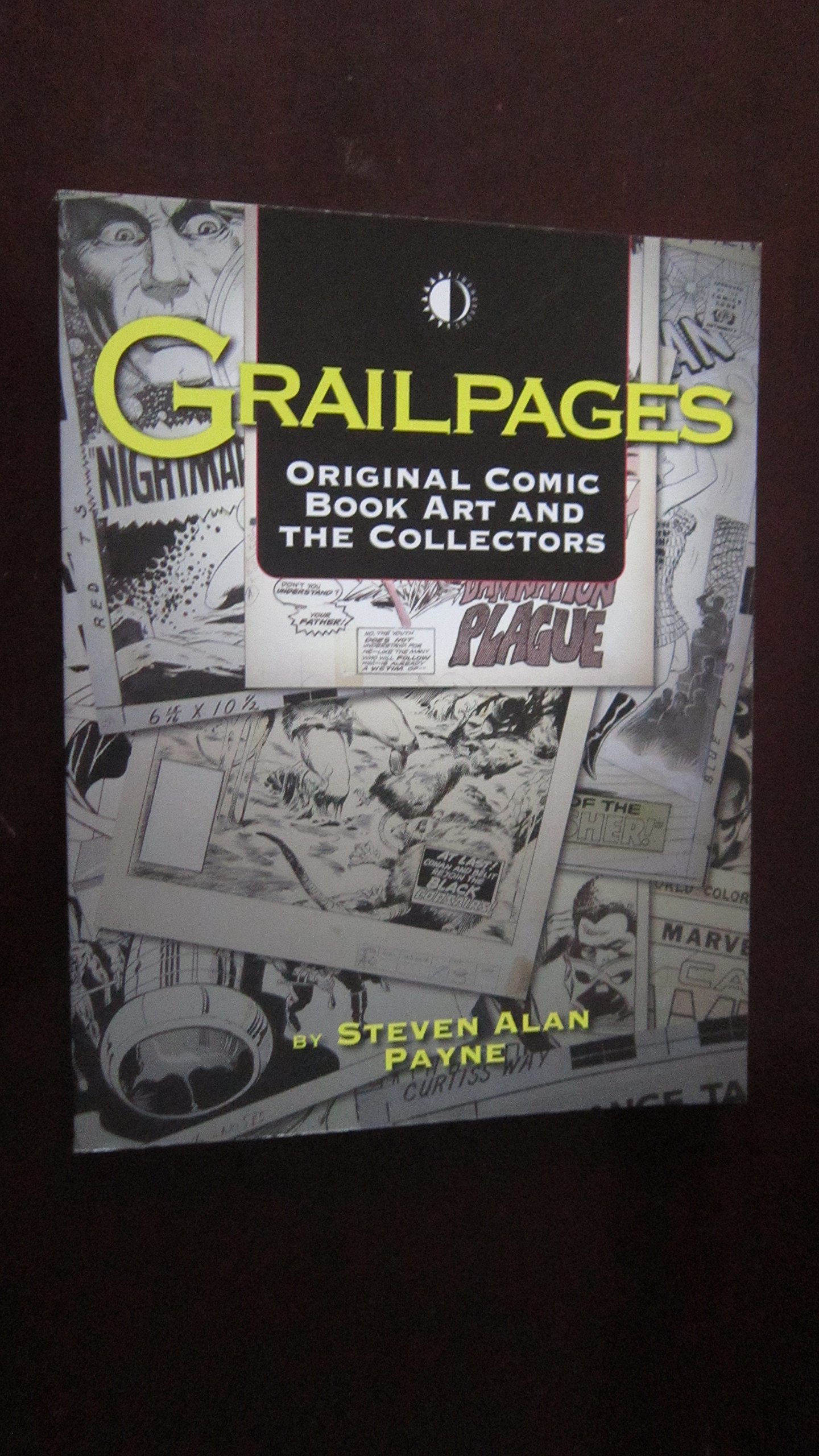
desertcart.com: Grailpages: Original Comic Book Art And The Collectors: 9781605490151: Payne, Steven, Colan, Gene: Books Review: Five Stars - A verry interesend book about comics art colletibles. Review: Like Silver Polish for Antiques - My two Uncles collected comic books in the 60's when they were kids. I inherited this vast collection, which, including my own collection, spans at least thirty years. Grail Pages is a great addition to that collection. I appreciate the history behind comic book creation and I learned how to truly gauge the financial (as well as personal) value of my collection. This book got me back into reading new comics, which I haven't done in years-- and even pick up a few should-be classics for my nephews. Thanks, Steven!
| Best Sellers Rank | #3,078,146 in Books ( See Top 100 in Books ) #534 in Comic & Graphic Novel Literary Criticism #719 in Comics & Graphic Novel History & Prices #81,503 in Graphic Novels (Books) |
| Customer Reviews | 4.2 4.2 out of 5 stars (13) |
| Dimensions | 8 x 1 x 11 inches |
| ISBN-10 | 1605490156 |
| ISBN-13 | 978-1605490151 |
| Item Weight | 15.2 ounces |
| Language | English |
| Print length | 128 pages |
| Publication date | April 7, 2009 |
| Publisher | TwoMorrows Publishing |
| Reading age | 16 years and up |
J**R
Five Stars
A verry interesend book about comics art colletibles.
E**N
Like Silver Polish for Antiques
My two Uncles collected comic books in the 60's when they were kids. I inherited this vast collection, which, including my own collection, spans at least thirty years. Grail Pages is a great addition to that collection. I appreciate the history behind comic book creation and I learned how to truly gauge the financial (as well as personal) value of my collection. This book got me back into reading new comics, which I haven't done in years-- and even pick up a few should-be classics for my nephews. Thanks, Steven!
M**M
Why we collect...
I'm rather new to the whole concept of buying / collecting comic book art, so I was rather intrigued by this book when it was recommended to me by my local shop. Looking for reviews, I came across one from professional comic writer Tony Isabella, who gave it a glowing review. This prompted me to go back and purchase the book. Like most collectors, I'd like to think I have pretty extensive knowledge of the comic book industry as well as a good handle on the history behind some of my favorite books. What I truly enjoyed about Steven Payne's book was the insight into not only the mind of the collector, but also the artist who created the pages. He does a great job of starting with an overview of the hobby, then discussing how much money some pieces have been sold for, and then (what I enjoyed the most) leading into the conversations he had and continues to have with fellow collectors. At the heart of it, all collectors have their stories about the "one book," or that "one page." This is what makes collecting fun. This is what Steven understands, the fun behind the hunt, the fun behind the "find," and also the fun behind making the painful decision of selling a page. I wasn't looking for a "history" on collecting comic book art, I didn't need a lesson as to the how's and why's, what I was looking for was exactly what I found, that being a great collection of thoughts, stories, and interviews with those who found, bought, lost, and penciled these amazing works of art. Lastly, what I admire about Steven is that he wrote about what he enjoys. He took the time to research and write on a topic that hasn't been extensively written about from which you can see the passion he himself has for this hobby. Reading the book, I found myself recollecting my first purchase and my first "hunt." I highly recommend this book to the experienced collector and the novice. It will remind you that the reason we're collecting is that we enjoy and still see it as fun.
M**K
But where's the DC art?
Before I talk about this book here, I'd like to get an observation about Amazon's packaging off my chest. In a word, it's inadequate. My copy was merely inserted with another item in a box too large without buffering materials to thwart sliding or additional cardboard, resulting in cover scratching and bumped corners. This experience has caused me to reconsider whether I want to buy books from Amazon in the future, even at discount. "Grailpages" itself is something I've waited a long time to see, a work devoted to a hobby and pastime that's near and dear to my heart, and apparently to those of lots of other people. I found myself reluctant to put this book down and much of it engrossing, in spite of a couple of problems. For one thing, author Payne has an annoying habit of referring to examples of comic book pages in the copy that aren't available for convenient viewing relative to the descriptions. This happens quite a bit, and becomes frustrating. The writer, himself a collector of original comic book art and a dealer, has interviewed many of the names and personalities I've seen displayed for years on sites like Comicart-L, The Lowry Gallery, and Comicartfans, and shares brief biographies and insights into their collections and thoughts on the hobby. These are the best parts of the text, entertaining and richly threaded with personal anecdotes that shed light on how so many collectors can afford the astronomical costs of these pursuits (and often can't). These are interspersed with the author's observations about collectors and the merits of a couple of the artists whose work is sought avidly and hoarded, sometimes for amounts as high as five figures or more. Unfortunately, some of the wording gets a little stuffy for the subject matter (we ARE, for pity's sake, talking about comic art), with some of the prose so densely overwritten as to be almost impenetrable. Curiously, emphasis runs high and hot and heavy on Marvel art, but DC's is reduced to a virtual footnote, which makes no sense at all and is more than a little strange in historical context. Could Payne find NO DC collectors to interview? The lapse is compounded when a chapter waxes eloquently and gushes over a chosen few independent creators (Los Bros. Hernandez and Dave Sim, basically), but nobody else. Maybe DC collectors and those of other artists are being saved for a sequel? One hopes so.
M**G
Finally! A Study on the Art Trade behind America's Comic Culture.
I was intrigued by the book at a discussion with it's author. If you are interested in art history and America's most popular art-based business, then this book should excite you. So many books exist about how to draw comics but this is the ONLY one about what happens to the art that has been drawn. This is about the actual pages that heroes like Spiderman and Captain America were concieved upon and the people who own them. It's the first museum for the comicbook worlds most notable works of art.
G**E
Collecting Marvel.
142 Marvel originals are shown. 20 from DC. 3 EC comics. And except 3 from Jaime and Gilbert Hernandez and 1 from Dave Sim, no artists from independant publishers. Mainly Marvel of the '60s to late '70s. Same with interviews of the artists. Which is understandable. A) Most of the collectors interviewed belong to a generation who started to read and collect comics at that time. B) The publisher itself (and his readers) are mainly focused on this period. The text is interesting mixing interviews of artists, collectors, writers, and techniques. But when the author tries to see hidden meanings in some art he's just ridiculous (i.e his explanations of the cover of Amazing Spider-Man #68 as a metaphoric image of capitalism against proletariat). Speaking of capitalism, everybody talk a lot about price and how they make money, and sell and buy this and that and how much it costs now and then. The most desappointing point is the quality of repros. Don't expect to see inside the beautiful quality of scans on the cover. The level of quality is just the same as an Essential Marvel. That means an ordinary B&W printing on a cheap paper. As a result, you can't really see the work of inkers, letterer or penciller or read the indications of artists or corrections. All the details which make the price of an artist edition book. But we can't demand more for $16.
P**L
Should have been titled "Collecting the Art of John Romita Sr. and John Buscema"
I will recommend this book through gritted teeth, because it does reproduce a lot of attractive original art, and we can't have too many books of this kind. I do wish that a better and slicker grade of paper had been used, but TwoMorrows obviously opted for mid-quality paper in order to keep the price down. I'd have paid another $10 for better paper, but they presumably know their market. However, the selection bias in favour of Marvel -- and the two above-named artists in particular - is little short of scandalous. My quick page count showed that of the 32 full-page reproductions scattered throughout the book, 28 were of Marvel pages, 3 DC, 1 Fantagraphics (detail of a Jaime Hernandez cover), and ZERO from other publishers.\ Counting both full-page and smaller reproductions, I found 29 pieces by John Buscema and 27 by John Romita, Sr. -- both wonderful illustrators, but grossly overrepresented. (Kirby, Byrne and Colan appear to account for about a dozen each). But NO Alex Toth, almost no Ditko or Wood, no Kubert, no Infantino, no Williamson, no Frazetta (!!), no Kurtzman, no Krigstein, no Jack Cole, no Lee Elias, in fact almost no Golden Age art at all, and very little before 1967 -- basically, the first, formative 30 years of comic book art dumped down the memory hole. No romance, Western, funny animal, teen, crime, nothing from MAD or Classics Illustrated or Archie or Little Lulu. Robert Crumb? Forget it. But LOTS of Spider-Man and Conan. I haven't read the text yet, but skimming through it I can understand what another reviewer meant about 'navel-gazing' ("Though he doesn't consider himself a collector in the technical sense, Steve does harbor original art..."). And there are some embarrassing fanboy passages. ("Many reverse sides of John Buscema's works display sketches that border on complex art, like some version of a Kandinsky". Kandinsky? Please.). One can only hope that TwoMorrows or other publishers will do more justice to the diversity of great comic book art in books to come. In the meantime, we have Heritage's comic art auction catalogues.
A**R
Good book, but not definitive, not thick enough
As others have said, it covers some things and not others. Some artists and not others. So be it. See the bigger picture. It's about the passion of this great genre of art. I've been a professional inker in the past, and a practicing comic artist for 40 years. It's extremely difficult. Wether your fave artist is covered or not, it makes no difference. A book like this can never really be complete enough to please everyone. It's impossible. Just enjoy what you're getting. There aren't any other books like it. I wish it was 4 times as thick. Just when you are getting into it, it ends. So much more could have been done. But no one has ever even attempted another book like this. So enjoy what you're getting. It's better than nothing.
Trustpilot
4 days ago
2 weeks ago