
DOWNLOAD THE APP


Customer Services
Copyright © 2025 Desertcart Holdings Limited
DOWNLOAD THE APP
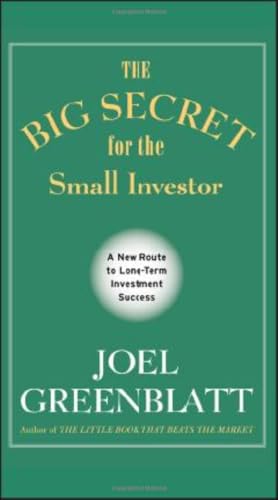
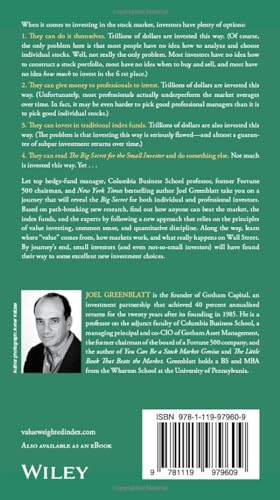


desertcart.com: The Big Secret for the Small Investor - A New Route to Long-Term Investment Success: 0884700310436: Greenblatt, Joel: Books Review: Simple wisdom people just can’t follow through - As it is always the case for Joel’s books, lots of wisdom and plain common sense which would be great for investors and clients - trouble is (thank god for us who do) they don’t practice it. Review: excellent - excellent
| Best Sellers Rank | #182,151 in Books ( See Top 100 in Books ) #121 in Investment Portfolio Management #307 in Stock Market Investing (Books) #515 in Introduction to Investing |
| Customer Reviews | 4.4 4.4 out of 5 stars (194) |
| Dimensions | 5.2 x 0.7 x 8.7 inches |
| Edition | 1st |
| ISBN-10 | 1119979609 |
| ISBN-13 | 978-1119979609 |
| Item Weight | 9.2 ounces |
| Language | English |
| Print length | 160 pages |
| Publication date | April 12, 2011 |
| Publisher | Wiley |
B**O
Simple wisdom people just can’t follow through
As it is always the case for Joel’s books, lots of wisdom and plain common sense which would be great for investors and clients - trouble is (thank god for us who do) they don’t practice it.
J**N
excellent
excellent
I**K
Stop trying to "beat" the market, make it work for you.
The first 90% of the book are a crash course on investing: how to value a business; why most valuations are poor or inadequate; why active money managers will fail—i.e. don't outsource the problem. The last 10% are the solution: why ETFs are the right vehicle; why you should prefer value index funds; why and how different index valuation methods can make all the difference in the funds that you choose. If there is one advice I can offer.. Don't skip the first 90%.
U**S
Ignore if you have the other two JG books
Not enough use from this book. You can be stock market genius is great, Little book that beats the market is good. This is not so much. I think the author wanted to create one for the beginners.
A**S
Bad advice
In the end he recommends 10 ETFs and funds all of which trailed the S&P 500 by about 20% for total returns over the last 10 years.
A**N
Big promises and short on delivery
I was looking forward to reading his value weighted approach. Since he touted throughout the book that this was the best strategy even beating the SP500 index. All the way to the end of this book, he finally listed his website and again I was disappointed that it didn't really show anything of substance. In fact the 20-year comparison from his website was from 1991-2010! I realized the book was published back in 2011. But what happened since that time? Was there no update beyond 2011? The website has a copyright year of 2019, so at least it was maintained until that time.
I**R
Not enough bang for your buck
Too repetitive. Too much beating around the bushes, so much that it seems that the author just wrote enough words to make what could've been a long decent article into a wasting-time chapters. Don't get me wrong, I admire and follow Greenblatt's work but this book could have been way shorter without missing the essential message, which is buy Value Weighted Index ETFs because they are better than market cap indexes and saves us from a lot of trouble. I don't understand why people want to stretch so much a simple idea in order to write an entire book about it, instead of just writing a good, interesting and not-boring article.
A**R
Every investor should read this book. First, because Greenblatt is a wonderful writer. Second, because in this book he explains that although he believes in tenet of value investing ("figure out the value of something, then pay a lot less"), in practice this is somewhere between extremely difficult and impossible - at least, for a single company. The key way to value a company is to sum all of the expected earnings over its lifetime, then discount these back to current dollars. But this is essentially a load of guesses; worse, tiny changes in our guesses can result in wildly different estimates of value. We could use alternative methods of valuation e.g. relative value, but these have equally fatal flaws. So if you are value investor, and have lots of books telling you invest in single stocks via cashflow calculations - you really should bin those books and stop "investing" this way (my conclusion, not his). Because you're "investing" based on guesses, which means you're "investing" using luck. If you are investing in funds where the fund manager does these calculations for you, you are also being unsound because these funds are also investing using luck, because the professional fund manager has to make the same guesses. He also tells us that indexes based on market cap will systematically buy too much of overpriced stocks, and too little of underpriced stocks; so really we should be using equal weight indexes rather than market cap indexes. You'll have to read the book to find out his "secret" for the small investor i.e. how to solve the riddle of how to do value investing without buying stocks based on guesses wrapped up as precision calculations; and how to do better than just buying a market-cap index (S&P, Nasdaq, FTSE, ...). But be warned about the dangers of valuing companies. Maybe this explains the genius of Warren Buffett, as he clearly does know how to value individual companies.
J**L
You're better off by buying a Vanguard fund than by buying this book which is a piece of unreliable fluff. To suggest to the reader to buy a "value weighted fund" which is supposedly outperforming the cap-weighted S&P over time (spoiler alert: wishful thinking as it did not over the last 10 years) is mildly irritating if not misleading. The rest of the book's message is simple: don't trade, if you don't know what you're doing and if you think you do, you're wrong. This is probably good advice for newbies but then again newbies to the markets and investing wouldn't know who Greenblatt was in the first place. I was expecting better, Mr. Greenblatt... How disappointing. Two stars for some minor bits of eternal wisdom.
H**A
Simply, I liked it. Different to his previous books, market genius and the little book that beats the market (blue book). Explains why hedge funds and investment managers, or ETFs continue to underperform long term minded investors. It all goes back to ben graham and dodd's ideas, it seems.
G**C
Der Mann weiß wovon er spricht!
D**S
Great content in a small amount of pages. Reads very easily!
Trustpilot
2 weeks ago
1 month ago