Buy anything from 5,000+ international stores. One checkout price. No surprise fees. Join 2M+ shoppers on Desertcart.
Desertcart purchases this item on your behalf and handles shipping, customs, and support to Brazil.
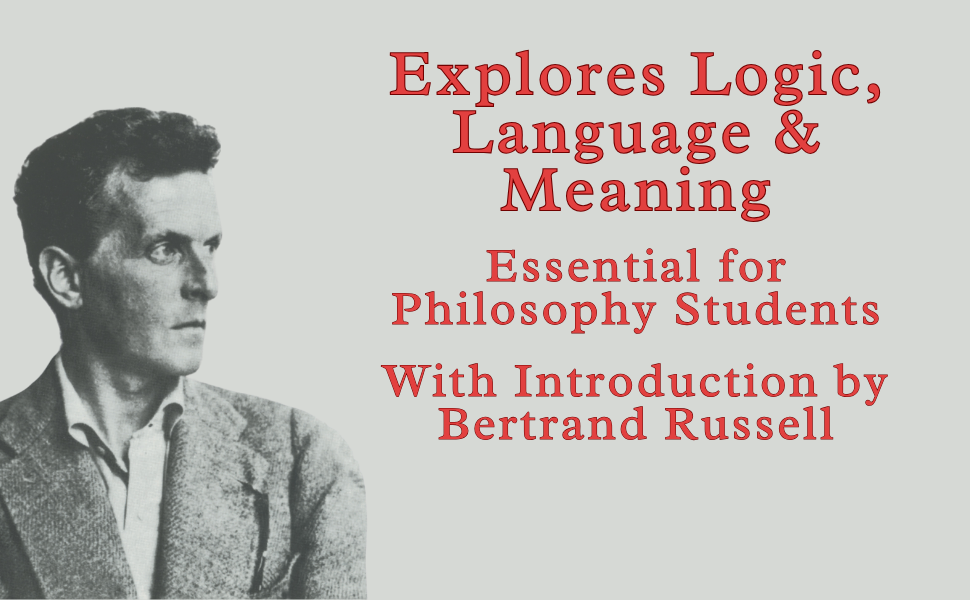
In proclaiming philosophy as a matter of logic rather than of metaphysics, Ludwig Wittgenstein created a sensation among intellectual circles that influenced the development of logical positivism and changed the direction of 20th-century thought. Unlock the brilliance of one of the most influential philosophical works of the 20th century with Tractatus Logico-Philosophicus by Ludwig Wittgenstein. This groundbreaking text redefines how we think about language, logic, and the very nature of philosophy itself. Beginning with the principles of symbolism and the necessary relations between words and objects, the author applies his theories to various branches of traditional philosophy, illustrating how mistakes arise from the inappropriate use of symbolism and the misuse of language. After examining the logical structure of propositions and the nature of logical inference, he discusses the theory of knowledge, principles of physics and ethics, and aspects of the mystical. Authored by Ludwig Wittgenstein, one of the greatest thinkers of the modern era. Provides a revolutionary perspective on the role of philosophy as an activity rather than a theory. Explores the relationship between words, symbols, and the objects they represent. Includes a definitive English translation supervised by the author himself. Contains a masterful introduction by Bertrand Russell, placing the text in historical and intellectual context. Discusses foundational topics such as the logical structure of propositions, ethics, and the mystical. Clear and precise language that makes intricate ideas approachable for readers. Inspires deep reflection and critical thinking on language and logic, presenting a deeper understanding of how language shapes human thought. Don't miss the opportunity to own a piece of intellectual history. Tractatus Logico-Philosophicus is essential reading for anyone passionate about language, logic, or philosophy. Add it to your collection today, and start your journey into Wittgenstein's extraordinary insights! Review: Fast shipping. Great Product. - Fast shipping. Great Product. Review: Challenging But Very Moving - This is a book that everyone interested in philosophy and intellectual history should read. LW is the most significant philosopher of the 20thc and this is the only book that he published in his lifetime. Since his views changed somewhat between the Tractatus and Philosophical Investigations you have to begin here. His basic argument here is that “the facts in logical space are the world,” and that to say something meaningful rather than nonsensical (which carries no sarcastic overtones) we must speak and write “in logical space”. Colloquial speech is far too slippery and problematic, but the majority of philosophy is cast in such speech and, thus, in LW’s view, addresses ‘problems’ that aren’t problems at all. Hence, his purpose is to liberate us from our concerns with regard to those problems. As he famously concludes, “Whereof one cannot speak, thereof one must be silent.” In another context he compares our liberation to that of a fly that has entered a bottle seeking sweetness and been trapped there. His role is to let the fly out of the bottle. The text is, by turns, very difficult and very exhilarating. Approximately 20% of the argument involves the use of mathematics and symbolic logic. LW is at pains to respond to the arguments of Frege, Russell, Moore and Whitehead and unless one is immersed in that literature, LW’s comments are a tough go. (A knowledge of Kant and especially Hume is also a must.) At the same time he can move from the staccato propositions of the analytic philosopher to the rhetoric of Pascal: “Skepticism is not irrefutable, but palpably senseless, if it would doubt where a question cannot be asked.” “We feel that even if all possible scientific questions be answered, the problems of life have still not been touched at all. Of course there is then no question left, and just this is the answer.” “There is indeed the inexpressible. This shows itself; it is the mystical.” While the book is very challenging it is also very moving. LW’s portion of the text is also very brief, less than 100 pp. This is a reprint of the 1922 Ogden translation, with a preface by Bertrand Russell and the index from the 1955 printing. Highly recommended. (I also strongly recommend Ray Monk’s book, How to Read Wittgenstein, and his biography, Ludwig Wittgenstein: The Duty of Genius.)

| Best Sellers Rank | #81,979 in Books ( See Top 100 in Books ) #31 in Philosophy of Logic & Language #80 in Modern Western Philosophy |
| Customer Reviews | 4.5 out of 5 stars 440 Reviews |
N**N
Fast shipping. Great Product.
R**Z
Challenging But Very Moving
This is a book that everyone interested in philosophy and intellectual history should read. LW is the most significant philosopher of the 20thc and this is the only book that he published in his lifetime. Since his views changed somewhat between the Tractatus and Philosophical Investigations you have to begin here. His basic argument here is that “the facts in logical space are the world,” and that to say something meaningful rather than nonsensical (which carries no sarcastic overtones) we must speak and write “in logical space”. Colloquial speech is far too slippery and problematic, but the majority of philosophy is cast in such speech and, thus, in LW’s view, addresses ‘problems’ that aren’t problems at all. Hence, his purpose is to liberate us from our concerns with regard to those problems. As he famously concludes, “Whereof one cannot speak, thereof one must be silent.” In another context he compares our liberation to that of a fly that has entered a bottle seeking sweetness and been trapped there. His role is to let the fly out of the bottle. The text is, by turns, very difficult and very exhilarating. Approximately 20% of the argument involves the use of mathematics and symbolic logic. LW is at pains to respond to the arguments of Frege, Russell, Moore and Whitehead and unless one is immersed in that literature, LW’s comments are a tough go. (A knowledge of Kant and especially Hume is also a must.) At the same time he can move from the staccato propositions of the analytic philosopher to the rhetoric of Pascal: “Skepticism is not irrefutable, but palpably senseless, if it would doubt where a question cannot be asked.” “We feel that even if all possible scientific questions be answered, the problems of life have still not been touched at all. Of course there is then no question left, and just this is the answer.” “There is indeed the inexpressible. This shows itself; it is the mystical.” While the book is very challenging it is also very moving. LW’s portion of the text is also very brief, less than 100 pp. This is a reprint of the 1922 Ogden translation, with a preface by Bertrand Russell and the index from the 1955 printing. Highly recommended. (I also strongly recommend Ray Monk’s book, How to Read Wittgenstein, and his biography, Ludwig Wittgenstein: The Duty of Genius.)
G**M
Be logical! Clarify! Elucidate!
Wittgenstein’s Tractatus Logico-Philosophicus is a fine example of “ordinary language” philosophy and, as such, its goal—similar to that of logical positivism—is to help us think and express ourselves more clearly. The “language of everyday life” (3.323) is partly, when not completely, to blame for our "confusions" (3.324) because “very often” words have different meanings in different contexts and, even in any one context, “very often” words have different meanings for different people (3.323). Wittgenstein encourages us to logically clarify our thoughts; to elucidate; to “make clear and delimit sharply the thoughts which [“very often”] are, as it were, opaque and blurred” (4.112). Be logical! Clarify! Elucidate! There is much to be gained from this book, even if the sections in which he uses symbolic logic and truth tables are skimmed or skipped.
D**L
A tough, yet mind-bending look into the object of philosophy through linguistics.
In Tractatus Logico-Philosophicus, Wittgenstein “deals with the problems of philosophy and shows … that the method of formulating these problems rests on the misunderstanding of the logic of our language.” Hence, the author demonstrates that the solution to most philosophic problems becomes a critical method of linguistic analysis. Tractatus begins with ontology and the state of affairs of the world is described. From there the book deals largely with the question of how language works and how it can describe the world accurately. Many forms of language (e.g. names and propositions) reflect different objective parts of reality (e.g. objects and facts). Logic is then discussed as it pertains to tautologies, contradictions and propositions. From this claim stems the conclusion that that the laws of science are not logical “laws,” but a means that we use to express reality—hence, science does not in fact explain our world but merely describes it. Although the author embraces logic, he ironically ventures into the mystical on many occasions. Some of such highlights of Tractatus Logico-Philosophicus include the proposal that most philosophical propositions are senseless (4.003), the relativity of “free” will and the lack of inner necessity of causality (5.1362), and the inability to recognize either the truth or falsehood from non-logical propositions. Wittgenstein brilliantly elaborates on widely accepted, yet wholly non-certain, everyday happenings (6.363II to 6.372) and clarifies that all ethics is transcendental (6.42I). In effect, the author posits that morality is in fact objective because subjective morality stems from happenstance, and is therefore meaningless. All potential readers should be acutely aware that this book is a very, very tough read. You may find yourself taking several minutes to read through one short page and then several hours to digest what it is you in fact just read. Either way, Tractatus Logico-Philosophicus is a terse, powerful, enigmatic and notable in its ability to whisk the dormant imagination into shape. The intellectual ramifications of being able to fully grasp and comprehend the material are limitless.
A**S
The Hubris of a Genius
Imagine being in your twenties and believing that you’ve solved all the problems of philosophy. You would have to have a lot of hubris, genius or both. Ludwig Wittgenstein was, whatever his psychological makeup, precisely such a man. Born to an incredibly wealthy family, he renounced his inheritance and devoted himself to the life of the mind. Much of his first masterpiece was written while a gardener at a monastery. He loved the peace and solitude enough that he asked if he could become a monk despite being an atheist. His solution to the most profound questions of man caused a revolution in academic philosophy that reverberates to this day. Essentially, he held that the human mind can only make pictures of reality through the modicum of words. Language then refers to materiality or is meaningless. Questions like, “Is the true necessarily beautiful?” were solved not by saying that they were a mystery but that they betrayed a flaw in reckoning the power of the mind which reveals itself in nonsensical language. It is only the physical sciences that can reach the truth and so the task of philosophy was simply to render science service to make certain that its hypotheses and theories were correctly articulated. While Wittgenstein himself came to see the Tractatus as gravely mistaken, its genius was recognized by Bertrand Russell and he was granted a seat at Cambridge to continue his philosophical investigations. Because of its relative simplicity it is an ideal text to introduce collegians to analytic philosophy. Like many other classics, the Tractatus’s flaws do not relegate it to oblivion. Its influence on modern thought cannot be exaggerated. Highly recommended to those interested in the Western philosophic tradition.
U**M
WTH !
I am giving the book five stars, but Amazon get no star at all !!!! It is amazing and unbelievable ! When decided to buy the book I specifically searched for the Pears and McGuinness translation. I looked at all the available versions here and looked inside every book to make sure that I am not making a mistake. I landed on this version, looked closely inside the book and saw the name "Pears and McGuinness" as the translators and even read the entire vignette at the end of the book to read about their praiseworthy work ! To my surprise and dismay, when the book arrived, in good condition and prompt though, they had sent me the Ogden version !!!!!! .....What the hell Amazon ?! Either update the sample or sent the right order ! .........Really really disappointed. I might as well go and buy something which I don not need at eBay to simply make your rival a little richer and conversely you a little bit poorer ! or less rich !
P**N
Know what you're getting into
This thin volume is just a series of numbered assertions. Internalize each one or what follows is unintelligible. This is one of those "my way or the highway" philosophy books and I just didn't see Wittgenstein's system as that groundbreaking or effort-worthy. Logical positivism leaves me gasping for oxygen. Back to the lock with you, Nessie! I found it more rewarding to return to Kant's Critique of Pure Reason. Not an easy read but you can tell the man cared a teeny tiny bit about his readers.
M**T
His best known work
Knowing what logic is, one must cast aside the ladder itself. His best known work, the Tractatus is a unique and astonishing rebuttal to that most vital of tools in human reason, logic itself. Using reason, Wittgenstein was able to deduce that reason itself was an intractable problem to justify, one that would forever chase its own tail down a hallway of echoed tautologies. Piece by Piece Wittgenstein tears away at the structure of logical positivism, leaving it mortally wounded and desperately clinging to life. Though it is our finest tool, the Tractatus reveals to us that logic is not God's calculus, but a trap that ensnares and limits our very thoughts. This book is a linguistic revelation, one that will surely rock the western world for many years to come.
Ã**¦
good
very colourful. Nice story and beautiful hardcover
C**N
INOVADOR
O filósofo austríaco, LUDWIG WITTGENSTEIN, preocupou-se com a linguagem e centralizou os seus estudos na comunicação realizada entre os seres humanos. Afinal, o que discrimina o ser humano de um computador, de um carro ou de um animal irracional? É a comunicação. Constitui até hoje uma obra que se destaca no universo filósofico.
J**.
Un clásico!
Aunque este fue un regalo para otra persona, destaca la simpleza y profundidad del pensamiento del autor. En lo particular me gusta su linea de pensamiento para entender y aprehender lo básico del ser humano.
Z**F
Never Judge A Book By Its Cover
Every page will enlighten you more and more. It teaches you not only 'What To Think', but more importantly 'How To Think'!
J**Y
LOGICO
GOOD
Trustpilot
2 months ago
1 month ago