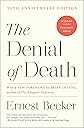

Desertcart purchases this item on your behalf and handles shipping, customs, and support to Brazil.
Winner of the Pulitzer prize in 1974 and the culmination of a life's work, The Denial of Death is Ernest Becker's brilliant and impassioned answer to the "why" of human existence. In bold contrast to the predominant Freudian school of thought, Becker tackles the problem of the vital lie -- man's refusal to acknowledge his own mortality. In doing so, he sheds new light on the nature of humanity and issues a call to life and its living that still resonates more than twenty years after its writing. Review: Classic, Thought Provoking - Not so much about death, rather about dysfunctions in life and reviewing the works of other great philosophers and psychologists of 19th & 20th century. It is an easy read, not necessarily easily digestable (or concievable). Its definitely not a self help book, instead it might just force you to rethink happiness, fear, arousal, hope, imagination, scizophrenia, homosexuality, perversions, etc. 👍🏼 Its a classic. Review: The meaning of life can be found in an onion ! - The Denial of Death by Ernst Becker is a book I had wanted to read for quite some time, and it leaves a lasting impression. If someone truly wants to understand what life is about, this is a strong candidate. In the end, one realises that there is nothing at the core—like peeling an onion—but knowing this in depth changes a person far more than living without that awareness. Best for: Psychology / philosophy readers Those exploring meaning of life Not ideal for: Casual readers Those looking for practical solutions A few concepts that are interesting Human nature & heroism Narcissism + self-esteem create the desire to outlive oneself Sibling rivalry feels more real than cooperation Socialisation itself is painful Terror of death We admire those who face death; symbols and customs help us cope The modern lack of belief systems creates its own difficulty Morbidity may simply be reality realised too early Fear helps avoid death; repression helps us live Repression & maturity Repression is necessary and even creative Maturity is a form of accepting defeat (self-deception) Dual nature: to live vs to transcend Human condition “We are worms… but think like kings” The mind seeks transcendence while the body imposes limitation Man is an animal aspiring to become a “God” Child development The child tries to conquer death The mother is the first world, which the child later tries to control There is no perfect upbringing—only self-creation Character traits are “secret psychosis” Spectrum: Normal (controlled illusion) → Creative → Neurotic → Psychotic Philosophy integration Strong link between psychology, theology, and philosophy Freud aligns closely with this thinking Kierkegaard provides a powerful bridge Core paradox of humans Want peace vs want truth Want individuality vs want belonging Individuality within finitude Transference and characters Transference is a question of courage vs cowardice Humans try to belong to a larger system while still exceeding it The dual nature of human effort is clearly visible True transcendence is surrender (rare) Psychosis is the inability to deceive oneself What I did not like Religion analysis feels incomplete (especially from a Hinduism perspective) Over-focus on death → at times feels one-dimensional Question remains: can the mind stay focused on death continuously? Final takeaway Humans survive through illusions, repression, and meaning systems Truth is uncomfortable → life requires some level of denial Not about solving the paradox → but living within it
| Best Sellers Rank | #3,285 in Books ( See Top 100 in Books ) #17 in Philosophy (Books) #29 in Psychology (Books) #71 in Health, Fitness & Nutrition |
| Customer Reviews | 4.4 out of 5 stars 3,227 Reviews |
D**N
Classic, Thought Provoking
Not so much about death, rather about dysfunctions in life and reviewing the works of other great philosophers and psychologists of 19th & 20th century. It is an easy read, not necessarily easily digestable (or concievable). Its definitely not a self help book, instead it might just force you to rethink happiness, fear, arousal, hope, imagination, scizophrenia, homosexuality, perversions, etc. 👍🏼 Its a classic.
S**T
The meaning of life can be found in an onion !
The Denial of Death by Ernst Becker is a book I had wanted to read for quite some time, and it leaves a lasting impression. If someone truly wants to understand what life is about, this is a strong candidate. In the end, one realises that there is nothing at the core—like peeling an onion—but knowing this in depth changes a person far more than living without that awareness. Best for: Psychology / philosophy readers Those exploring meaning of life Not ideal for: Casual readers Those looking for practical solutions A few concepts that are interesting Human nature & heroism Narcissism + self-esteem create the desire to outlive oneself Sibling rivalry feels more real than cooperation Socialisation itself is painful Terror of death We admire those who face death; symbols and customs help us cope The modern lack of belief systems creates its own difficulty Morbidity may simply be reality realised too early Fear helps avoid death; repression helps us live Repression & maturity Repression is necessary and even creative Maturity is a form of accepting defeat (self-deception) Dual nature: to live vs to transcend Human condition “We are worms… but think like kings” The mind seeks transcendence while the body imposes limitation Man is an animal aspiring to become a “God” Child development The child tries to conquer death The mother is the first world, which the child later tries to control There is no perfect upbringing—only self-creation Character traits are “secret psychosis” Spectrum: Normal (controlled illusion) → Creative → Neurotic → Psychotic Philosophy integration Strong link between psychology, theology, and philosophy Freud aligns closely with this thinking Kierkegaard provides a powerful bridge Core paradox of humans Want peace vs want truth Want individuality vs want belonging Individuality within finitude Transference and characters Transference is a question of courage vs cowardice Humans try to belong to a larger system while still exceeding it The dual nature of human effort is clearly visible True transcendence is surrender (rare) Psychosis is the inability to deceive oneself What I did not like Religion analysis feels incomplete (especially from a Hinduism perspective) Over-focus on death → at times feels one-dimensional Question remains: can the mind stay focused on death continuously? Final takeaway Humans survive through illusions, repression, and meaning systems Truth is uncomfortable → life requires some level of denial Not about solving the paradox → but living within it
M**A
Nice read so far
Been months now and yet I have not finished the book. However, what I have covered so far is a great addition to my knowledge
K**R
Nothing
A very well written critique of freudian philosophy and highly coherent with eastern philosophy.
F**A
Superb, life changing book
It's worth its price in gold. Good quality for at this price range.
G**R
Good 👍🏼
Every should read books like this atleast once
T**L
book which compels you to re read again and again
Quality and thickness of paper could have been far better, not suitable to carry while traveling page may tear off easily if not handled carefully. :-Content wise a very dense subject handled with layman in mind couldn't have been better or simpler. This book gives far bigger horizon to subjectivity and it's duality of it's existence. Not a typical "proverbial" existential manuscript in any way. Ties down the whole organic nature of which we as a species are an part of it, branched out radically to even contemplate our real place. One of my most re read books over the period of three years. An accidental discovery
P**.
Paper is albeit thin, but it's a good read
The condition in which it arrived was decent, the paper is really thin so mind that too.
N**D
The book quality is good
My lowe starts is on the author not the sold product... Topic abit out dated
T**A
A Monumental Book.
Becker's Pulitzer Prize-winning work addresses the fundamental drive of the human condition, delving into societal institutions, pathologies, and irrational behaviors. In his exploration, Becker presents a profound psychological argument for the pan-cultural religious impetus compelling individuals to merge with a beyond while also seeking individual distinction. He astutely illustrates the illusory nature of seemingly secular cultures, shedding light on the structural similarities they share with outgrown religious beliefs. Embedded within his argument is the rejection of truth as a highly valued principle in statecraft, compelling readers to reconsider their perception of societal realities. Through a three-part exploration, Becker skillfully navigates the complex human dilemma, offering a detailed outline of the problem, common solutions, and an incisive analysis of society through this framework. The fundamental struggle faced by humans, according to Becker, stems from a unique dichotomy that only humans grapple with. This symbolic identity places individuals in an existential dilemma; they are both capable of comprehending abstract concepts, such as infinity and atoms, yet they must confront the objectively meaningless nature of their lives and the prospect of their eventual demise. Becker suggests that one aspect of the fear of life lies in the overwhelming awe, fear, and incomprehensibility that comes with existence. In confronting the complexity of one's own existence, there arises a fear of being insignificant, leading to a struggle to find meaning in an incomprehensible world. These dual fears of life and death contribute to the heroic urges that Becker describes, urging individuals to strive for transcendence and create their own sense of significance even in the face of potential meaninglessness. One of the qualities of Man that fascinated Becker was how we have an instinctive sense to "be good." But what is goodness? The twin urges of Agape and Eros are a reflection of Man's pursuit of transcendence and individual significance. Agape is the reflex against the impermanence from death, seeking meaning through merging with an ultimate beyond. On the other hand, Eros is the reflex against the insignificance from life, striving for uniqueness and importance. This concept explains the dual motivations behind human behavior and the innate drive to create distinctions between Good and Evil in order to carve out meaning in the world. Both Agape and Eros enable us to navigate the complexities of existence by providing a sense of direction and cultivating individual greatness. However, there's a profound tension in this process as these twin urges can often be antagonistic to each other. In Becker’s view, character defenses, represented by identity and narrative, assist in giving individuals the sense of control and unique identity essential for functioning in the world. Becker also discusses the use of transference objects as a way for individuals to find grounding and direction in the complexities of life. These objects provide a source of identification and direction, helping individuals navigate the overwhelming awe, wonder, and fear that existence often brings. Both character defenses and transference objects serve as coping mechanisms to grapple with the terrifying dilemma of human existence. Becker’s view on how cultural elements play a role in our lives is insightful and intriguing. He discusses the concept of leaders as transference objects, emphasizing how the crowd's fascination with leaders highlights the hypnosis of power and the desire to merge with omnipotence. Beyond leaders, he delves into the idea of lovers as transference objects, explaining how romantic interests take on the role of encapsulating power, immortality, and the designator of good and evil. In both these cases, Becker demonstrates how cultural elements serve as symbolic structures fulfilling the innate human urge for heroism through Agape and Eros. This comprehensive analysis provides a deeper understanding of how individuals seek meaning and significance within cultural dynamics. Becker’s analysis of the effectiveness and benefits of religion highlights how it directly addresses the problem of transference by expanding awe and terror to the cosmos where they belong. It provides a framework that takes the problem of self-justification and removes it from the objects near at hand, allowing individuals to lean on powers that truly support and do not oppose them. However, the failures of modernity as outlined by Becker point out that globalization and analytical ability have rendered people cynical, depriving them of the ability to have faith. The diversity in ideology poses a threat to heroism, and it becomes disheartening to see 'authorities who are equally unimpeachable hold opposite views.' Becker's comparison of cultural heroes and societal outcasts sheds light on the existential dichotomy faced by those who venture into the realm of creativity. His contention that artists and societal outcasts are only separated by a small degree of "talent" implies that creativity and madness share a connectedness. Conferring cultural heroes with creative genius, Becker's analysis illustrates how the innovators who attempt to furnish an entirely new meaning to creation and history shoulder the weight of justifying previous and potential alternative meanings alone. As a result, the burden of fabricating one's own religion, as argued by Becker, leads to a hypervigilant state, facing the fear that no beyond can prevent creatives from exhausting every bit of themselves in the artistic process.
A**E
Really uplifting book
I am terrified of dying and I don't understand why no one else seems to think about it as much as I do. It's because they're all working on their, 'immortality projects' as Becker calls them. Like earning lots of money and having kids you feel more and more immortal. But you're not. You're just doing everything to try and ignore the fact that soon you will cease to exist and nothing you're doing now will mean anything to anyone!
O**.
Very academic tone
A little tough to get into but extremely insightful, and a valuable read. Well worth your time.
C**D
Un'opera fondamentale di un grande antropologo
Un'opera fondamentale di un grande antropologo e, nel suo ambito, forse tra i libri di maggior rilievo della seconda metà del XX secolo. Sebbene le argomentazioni principali non siano del tutto nuove, scrittori “esistenzialisti” (un'etichetta terribile) come Kierkegaard e Heidegger hanno sempre sottolineato l'importanza di riconoscere, accettare e abbracciare la realtà della propria finitudine, Becker porta questo tema in profondo territorio psicologico (Sigmund Freund, Otto Rank, Norman O. Brown), presentandolo al contempo in un linguaggio molto accessibile: Più cerchiamo di esorcizzare la morte dai nostri pensieri coscienti, più essa torna a perseguitarci, sia come individui che come società, sotto forma di comportamenti dannosi, violenza, dipendenza e un senso generale di disperazione e vuoto.
Trustpilot
5 days ago
1 month ago