Buy anything from 5,000+ international stores. One checkout price. No surprise fees. Join 2M+ shoppers on Desertcart.
Desertcart purchases this item on your behalf and handles shipping, customs, and support to Brazil.
⚡ Your pocket-sized electronics lab—power, precision, and open-source freedom!
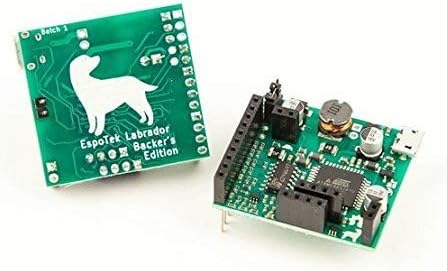
The EspoTek Labrador is a compact, open-source USB device that converts Windows, Mac, Linux, Android, or Raspberry Pi systems into a versatile electronics lab. Featuring a 2-channel 750ksps oscilloscope, 2-channel 1MSPS arbitrary waveform generator, 2-channel 3MSPS logic analyzer with serial decoding, multimeter, and adjustable power supply, it offers professional-grade tools in a portable, affordable package beloved by makers and engineers alike.
| ASIN | B07CVB7ZJG |
| Best Sellers Rank | #186,084 in Industrial & Scientific ( See Top 100 in Industrial & Scientific ) #82 in Lab Oscilloscopes |
| Brand | EspoTek |
| Brand Name | EspoTek |
| Color | Green |
| Compatible Devices | PC (Windows/Mac/Linux), Raspberry Pi, Android device |
| Customer Reviews | 4.2 out of 5 stars 171 Reviews |
| Item Weight | 20 Grams |
| Manufacturer | EspoTek |
| Measurement Type | Multimeter |
| Min. Operating Voltage | 4.5 Volts |
| Minimum Operating Voltage | 4.5 Volts |
| Model | ETL-001 |
| Part Number | ETL-001 |
| Power Source | Corded Electric |
| Specification Met | Open Source |
| Style | Compact |
| Style Name | Compact |
K**D
USB scope.
Cheap scope for my computer. Needed a presentation display of an audio waveform. Did its job.
J**N
Perfect solution for casual circuit hobbyists needing an oscilloscope
The Labrador is really cleverly engineered. I love being able to analyze waveform outputs of circuits I’m tinkering with. As a hobbyist, I wasn’t prepared to invest many hundreds of dollars (or more) in a scope. But, utilizing an existing computer for processing and display, and mass producing the chip brings the price here to $30, which is amazing. It certainly meets all my needs as a casual user. I put the chip in a simple plastic box, and connected leads for 2 scope inputs, 1 waveform generator, plus a common ground, plus the USB (which communicates with the computer and also provides power). I had a slight hangup, which turned out to be a bad micro usb cable. Some do power but not data, so watch out for that. A better quick start guide would be appreciated. It’s actually so simple to set up that it can be mildly confusing, which sounds strange, but is true — I wanted to connect more wires, but most of the pins were not needed in a simple application, and power comes over the USB, as mentioned before. Software installation was easy. I would like to see a way to save your settings between sessions in the software. Great job!
G**.
It does the job, but the Android app is buggy and the accuracy is a bit suspect.
This is a handy little lab instrument for those who have no other instruments, or perhaps to use in a demonstration. It works as advertised, no surprises, and is worth the money. I had some issues with getting slightly but noticeably different measurements off of the two oscilloscope channels, and voltage measurements didn't agree with my DMM by a small but noticeable degree. I also noticed that the pins on the board didn't align correctly with either of the two brands of protoboard that I tried it on; the board would fit but the two power pins had to be bent to fit well enough. This issue didn't prevent me from using the board, however. I had hoped that this device would be well supported on Android, but apparently that's an abandoned platform for the Labrador. The app routinely crashed and had noticeable lag when entering commands. Hopefully, the Windows, Mac, and Linux software is better, but I haven't tried those yet.
M**K
Great Value for Hobbyists
The headlines here are the price and size. It’s cheaper and smaller than essentially anything else on the market. The performance specs are modest, but sufficient for many basic hobbyist/enthusiast applications. There’s enough bandwidth and input range to handle audio/sound/music and slow serial data links (UART, i2c, i2s etc). Easily integrates with breadboards which makes it great for prototyping. The software (and hardware!) is open source and cross platform. Another review complained about there being no Linux support, but this is incorrect: there is a Linux AppImage in the same place as the Windows and MacOS binaries. Additionally there is a script for installing on Raspberry Pi and instructions on building from source. Documentation is limited, but sufficient. The host software itself can take a little getting used to, especially if used to more traditional test equipment, but gets the job done and is par for the course for USB test equipment. This isn’t a one size fits all solution, but is great for what it is and at a price that can’t be beat. Those looking for a more polished product with a similar niche but fewer quirks would probably be interested in the Analog Discovery. It’s more powerful with a better ‘out of the box’ experience, but at 10x the price. The Labrador punches above its weight. It’s not a professional tool, but great for the DIY crowd.
S**S
Cannot use this device, it won't calibrate
I have read all the documentation on Github, and watched multiple videos on Youtube about the calibration process. This unit will NOT finish the initial calibration routine for the oscilliscope. It will display an initial reading of roughly 1.6 V, then freeze up and not read any further input unless the program is closed and re-opened. It will read roughly zero volts on either or both channels when grounded, but as soon as you click on the "ground to usb shield" prompt, the input trace freezes. The debug screen show it reading 1.6 volts, regardless of where the probes are placed. Frozen. I tried different USB cables, tried different USB ports, bought better jumpers, sent the unit back for a replacement, and uninstalled and re-installed the software. No matter what the trace freezes when you try to move into the actual calibration of the unit. The Github error reporting doesn't show any issues in the past, and a search of the web doesn't turn up any issues like this. I am running Windows 10 on a lower end ASUS laptop, so there shouldn't be any issues. I am frustrated, as this looks to be a wonderful solution for makers, but if it won't work, the second one is going back, and I will have to "wing it" or burn components when I build. You can burn a lot of resistors and capacitors before you hit $30...
A**I
A powerful two-probe oscilloscope in a tiny package!
I needed an easy way to monitor the GPIO ports one of my solutions in a way that I could capture it, analyze it, and share it with my team. A bench top oscilloscope with the same set of features was an expense that I just couldn't afford at the moment, so I looked at the hand-held solutions. While there were many that seemed to have many of the features, I liked the quality of the build, the small size and weight for portability, the fact that it's both an open-source hardware and an open source software solution the best! It even works with my Apple MBPro! I picked up a package of probe wires and I was well on my way. Setup and calibration was incredibly simple, and removed all the noise I was worried about. I first tested the ability to generate waveforms to validate and verify functionality. Satisfied, I setup the probes on my Pi GPIO ports that I needed to monitor. The accuracy was perfect! I have already used many of the features that I could only get in a bench oscilloscope. In fact, there are features I haven't even tried yet, like the logic analyzer. I can't wait to print a case to help protect it and take it with me when I travel. Get one. You won't be disappointed!
S**O
Super useful, super small, super affordable
I've had it for 2 hours and it's already been put to work. Very much a "plug-and-play" device as well. While it doesn't quite have the feature set or resolution of a $400 PicoScope, it comes amazingly close for an order of magnitude less money. The 2 oscilloscope inputs and separate signal generator outputs, plus the ability to generate a custom output waveform really put it over the top for me. Already ordered a few BNC connectors and a small project box so I can take this with me whenever I travel for work... seems like we always need a 'scope when there isn't one around. It's going to be very helpful for troubleshooting assorted instrumentation. The software is also very straightforward to setup and use once you get the hang of the shortcuts. Overall great little product.
V**R
Not a Device You Can Depend Upon
For $30 I do not want to be too harsh but the problem is when you pack all of these features into one item, you end up with something that does everything poorly and nothing well. There were significant issues with the oscilloscope function having an offset you cannot calibrate. I could not get the signal generator to work. And the logic analyzer is locked to the preset values in the application, meaning it cannot be modified for the specific signal you're trying to look at. When this first released almost a decade ago it would be a fun novelty for sure but in 2026 it needs a serious update. A V2 coming in at the $50-100 range would be great.
Trustpilot
3 weeks ago
2 days ago