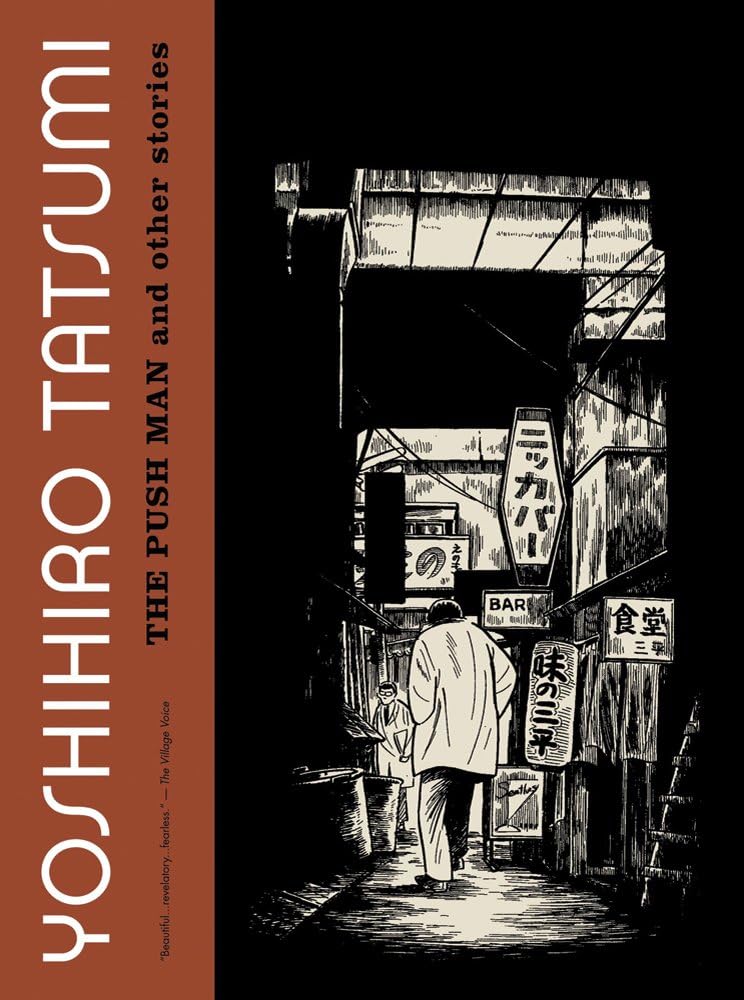
The Push Man and Other Stories
Product ID: 6875560
Desertcart purchases this item on your behalf and handles shipping, customs, and support to Brazil.
Thirty years before the advent of the literary graphic novel movement in the United States, Yoshihiro Tatsumi created a library of comics that draw parallels to modern prose fiction and today's alternative comics. The stories collected in The Push Man are simultaneously haunting, disturbing, and darkly humorous. A lone man travels the country, projecting pornographic films for private individuals while attempting to maintain a normal home life. The lives of two men become intertwined when one hires the other to observe his sexual escapades through a telescope. An auto mechanic's obsession with a female TV personality turns fatal after a chance meeting between the two Review: Great storytelling and glimpses of the Japanese society - Before I read the book, I had no idea who Yoshihiro Tatsumi is. He has been called "the grandfather of Japanese alternative comics" and he certainly deserves it. The Push Man and Other Stories is a collection of short stories previously published in Japanese, now translated and reformatted for the western audience by Adrain Tomine. In each story, Yoshihiro Tatsumi looks at a different facet of Japanese society. The main character is always a man filled with restrained angst, going about their daily jobs, ending with a solemn note. Every tale is filled with some form of sexuality -- sex, abortion, prostitution, etc. In the story "The Push Man", we're introduced to the pusher, whose job is to get commuters into packed trains by pushing them in. One day, he helped a lady whose clothes were torn from the pushing. They spent the night together and she invited him to her place the next day. The story ends with her sisters pushing each other away to get him. In "Telescope", a disabled guy committed suicide after being paid to watch someone else have sex. In "Test Tube", a sperm donor can't stop thinking about his recipient and eventually forced himself onto her. You can see that there are no happy endings here. The storytelling is masterly. Every story is told in a darkly comic style, short dialogues and cleanly laid out panels. Even without text, the stories will be easy to understand. Yoshihiro Tatsumi has a way of dissecting his characters, providing a very raw look at their hard and unforgiving life. The 16 stories are short. I like short if it means leaving the reader wanting more* at the end. It's highly recommended but certainly not for everyone. (More pictures are available on my blog. Just visit my desertcart profile for the link.) Review: You made it this far - Gripping. Like potato chips you can't just have one. Savage, shocking, tender, at times morbidly hilarious. These are incredible short works by a master of story-telling. If you are even reading this review, that means you have gotten this far already. Buy this, borrow this, read these somehow. They will only enrich your life.
| Best Sellers Rank | #1,719,305 in Books ( See Top 100 in Books ) #127 in Drawn & Quarterly Comic & Graphic Novels #31,172 in Manga Comics & Graphic Novels |
| Customer Reviews | 4.7 out of 5 stars 123 Reviews |
P**A
Great storytelling and glimpses of the Japanese society
Before I read the book, I had no idea who Yoshihiro Tatsumi is. He has been called "the grandfather of Japanese alternative comics" and he certainly deserves it. The Push Man and Other Stories is a collection of short stories previously published in Japanese, now translated and reformatted for the western audience by Adrain Tomine. In each story, Yoshihiro Tatsumi looks at a different facet of Japanese society. The main character is always a man filled with restrained angst, going about their daily jobs, ending with a solemn note. Every tale is filled with some form of sexuality -- sex, abortion, prostitution, etc. In the story "The Push Man", we're introduced to the pusher, whose job is to get commuters into packed trains by pushing them in. One day, he helped a lady whose clothes were torn from the pushing. They spent the night together and she invited him to her place the next day. The story ends with her sisters pushing each other away to get him. In "Telescope", a disabled guy committed suicide after being paid to watch someone else have sex. In "Test Tube", a sperm donor can't stop thinking about his recipient and eventually forced himself onto her. You can see that there are no happy endings here. The storytelling is masterly. Every story is told in a darkly comic style, short dialogues and cleanly laid out panels. Even without text, the stories will be easy to understand. Yoshihiro Tatsumi has a way of dissecting his characters, providing a very raw look at their hard and unforgiving life. The 16 stories are short. I like short if it means leaving the reader wanting more* at the end. It's highly recommended but certainly not for everyone. (More pictures are available on my blog. Just visit my Amazon profile for the link.)
R**N
You made it this far
Gripping. Like potato chips you can't just have one. Savage, shocking, tender, at times morbidly hilarious. These are incredible short works by a master of story-telling. If you are even reading this review, that means you have gotten this far already. Buy this, borrow this, read these somehow. They will only enrich your life.
A**Y
10 Years After Buying...
I bought this sometime between 2008 and 2010 and read it then, I've come back to it every now and then to reread and it has been one of the most personally impactful pieces of media that I have consumed in my life. I believe I read this at the right time in my life when I most impressionable and I don't want to oversell it. But this book is special and when I think about it it still leaves a very distinct and mystifying impression on me.
R**L
Gekiga short stories: very good, not yet mastrful.
This first Drawn & Quaterly (lavish, beautiful hardcover) compilation of Yoshihiro Tatsumi's work, edited by Adrian Tomine, consists of 16 short stories, originally published in 1969. Most of them are very short, just 8 pages long, and appeared in a magazine called 'Gekiga-Young'. Two longer stories at the end of the volume are more in line with what we will find in the two later books of stories from 1970 ('Abandon the Old in Tokyo') and 1971-1972 ('Goodbye'). An alternative title for this book could be 'The worst jobs in the world'. This is a list of occupations of the protagonists of these stories (all men): * Factory worker * Porn movies projectionist (when porn was yet illegal) * Garbage incinerator operator * Massage parlor ad-man (i mean, the guy walking the street with a placard saying 'Massage Parlor / Open 10 AM - 5 PM') * University lab intern / sperm donor * Pimp * Push man (one who pushes passengers into crowded rush-hour subway trains) * Sewer maintenance worker * Handicapped & unemployed peeping tom * Contract killer * Auto mechanic * Office clerk * Disinfector (one that cleans & disinfects phones) * Factory worker * Seal authentificator at an insurance company * ... and we don't know the job of the man in the last story, 'My Hitler', if he has one. Also, for the women, we get quite a few bar hostesses. As you can see, Tatsumi's work depicts the underbelly of the affluent urban Japanese society of the economic boom of the 60s, dealing with themes of existential alienation and sexual frustration. His focus is always humanist, he's not a Marxist toting party line slogans about the woes of the proletariat. He is direct and physical, yet elliptical and poetic at the same time. I am heavily reminded of Shohei Imamura's movies of the same period, like Criterion's 'The Pornographers' and the box-set 'Pigs, Pimps, & Prostitutes'. Now the bad news. Reading this book in one sitting can be a rather monotone affair. The stories, while good when taken on their own, tend to be very much alike when taken all together. I don't know to what extent this is Tatsumi's fault (being rather one-noted in the year 1969, certainly the 8-page limit didn't help either) or Adrian Tomine's fault (in not choosing two or three stories that diverged from the common pattern.) Certainly the stories in later volumes are more varied in setting, structure and subject matter, as well as having some women protagonists, too. We must also remember that the natural habitat for this stuff is a bi-weekly manga magazine, not a "graphic novel". Another qualm is the "Westernized" left-to-right format, that plays havoc with the original page layout. Hey, publishers, I've been reading manga in the original Japanese format for years now, and my head have not exploded yet, it's a myth! Despite these shortcoming this is a must read for all Gekiga aficionados, or adult (as in grown-up) comics readers in general. Or, even more in general, for readers of good literature.
J**E
Most of the stories in this book aren't nice. After the first couple of stories
Most of the stories in this book aren't nice. After the first couple of stories, you start to feel the wincing in your face as you start a new one. They are very well illustrated and the storytelling is what makes you read every single one of them. It definitely makes me want to read his other work.
N**Y
Great stories
this is a very weird book. but i mean that in the nicest way possible. very entertaining short read. looking forward to the rest of the series coming in the mail!
J**E
Five Stars
Great dark short stories, not your typical manga.
A**L
Great Stories
Great Book!
M**E
Sur le net et introuvable ailleurs.
Ben c'est un livre... alors je suis content de le lire. L'envoi est impeccable, soigné et rapide pour un envoi aussi lointain.
S**E
Slices of Japanese 20th century life
Yoshihiro Tatsumi's "The Push Man" is a collection of 8 page stories detailing the lives of young people in working class areas of a nameless city. As usual with Tatsumi's work the stories are highly imaginative, well drawn, and utterly compelling to read. Once you pick up the book you won't put it down until you've finished. Then you'll go back and re-read some of the more haunting stories. The themes are of betrayal, isolation, revenge, sacrifice, and loneliness. It isn't the most cheerful of books! That said, a lot of the stories will stay with you. "Piranha" follows a factory worker deliberately having his arm chopped off for the insurance money, giving the money to his cocktail waitress girlfriend, who leaves him after he can't take more of her abuse and grabs her arm, thrusting it into his piranha tank. "Bedridden" features a mysterious girl in a bed who is apparently the perfect sex slave. Yet each of her "masters" ends up dead. "The Push Man" follows a train worker/student whose job is to push people onto the trains, literally cramming them in so they'll all fit, until one day he gets swallowed by the crowd himself. There are a lot of 8 page stories in the 200 page book so I won't go into all of them. Unwanted pregnancies, cheating partners, confused and desperate young men, are all explored in the book. There are a couple of longer pieces included as well. The artwork is fantastic, in particular the opening pages to the stories which is usually a page long illustration of a shadowy part of a city. Tatsumi does a brilliant job of capturing urban life in Japan albeit slightly dated with massive TVs and a lack of computers, it's fascinating to see how familiar the stories are and how fresh they read despite being decades old. The freshness of the stories reflects the high quality storyteller and artist that is Tatsumi and I loved this book like all the others the brilliant Drawn & Quarterly have been steadily putting out over the last 5 years. An excellent comic book by an incredible artist.
C**A
Muito interessante o tema, ótima qualidade de mangá
O estilo inovador do Sr. Tatsumi é incrível.O tema do mangá é adulto no sentido de temas complexos que podem ser vividos e certamente são, por muitas pessoas.O contexto é a sociedade japonesa, mas há algo na abordagem desse mangaká que é universal: nossa complexidade e ao mesmo tempo, superficialidade. A leitura é inovadora com relação à tradição dos mangás, pois a leitura é na forma ocidental.(Faz parte do estilo do autor.) O material do miolo é de muito boa qualidade, a arte e material da capa são lindos.Há uma parte na capa mais lisa e outra em textura comum, bem agradável ao toque. Para quem lê em inglês, esse mangá é um exemplar único cheio de ótimas lições.Recomendo muitíssimo.
C**O
O pai do gekiga.
Tatsumi é um autor impressionante, sendo este volume definitivamente voltado para um público mais maduro. Na ausência de interesse demonstrado pelas editoras nacionais, há as edições importadas, que possuem um ótimo acabamento, apesar da leitura ocidental (ao menos nos volumes dessa coleção). Contém 9 histórias, com destaque para as emblemáticas "Hell" e "Just a Man".
J**T
A genius at work
After reading his autobiography I thought I'd try his work. It is easy to see why the man is do revered. Fascinatingly he is not influenced by the genre he created, instead his influence came from watching the working class men in the inner city around him as well as the seedy crime stories from the newspaper. It makes his work an absolute contrast to the innocence of the man which makes the stories more absorbing. The stories are like snapshots of lives that tell large stories and are absolute genius
Trustpilot
2 months ago
2 days ago