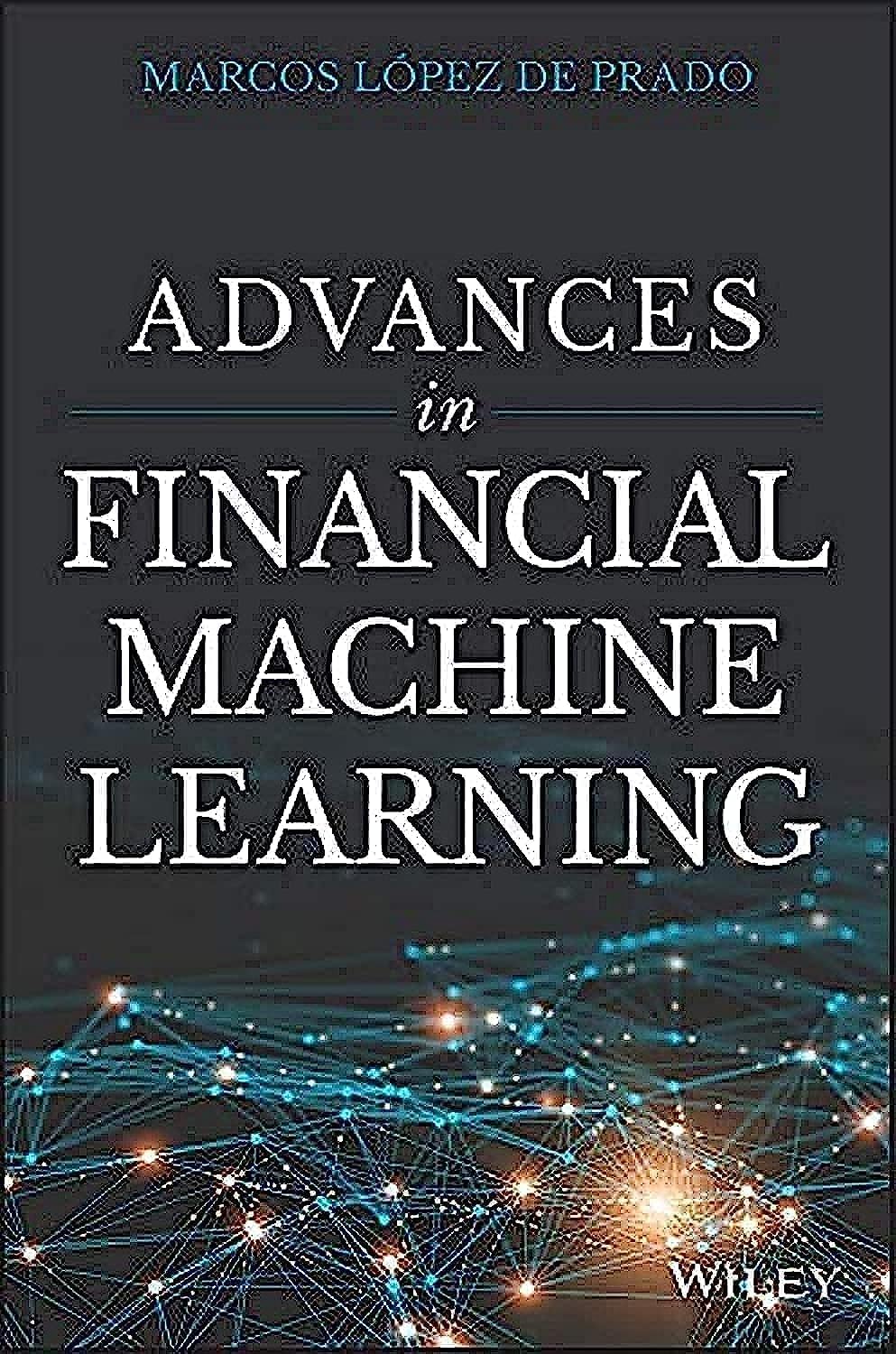

Advances in Financial Machine Learning
Product ID: 62827306
Buy anything from 5,000+ international stores. One checkout price. No surprise fees. Join 2M+ shoppers on Desertcart.
Desertcart purchases this item on your behalf and handles shipping, customs, and support to Brazil.
Buy Advances in Financial Machine Learning 1 by Lopez de Prado, Marcos (ISBN: 9781119482086) from desertcart's Book Store. Everyday low prices and free delivery on eligible orders. Review: Transforming Quantamental Finance with a Structured Framework and Collaborative Paradigm - Marcos López de Prado’s Advances in Financial Machine Learning is an exceptional guide that bridges the gap between academia and industry. Co-authored with experts like Simon and Alexander Lipton, the book is a testament to López de Prado’s decades of experience in quantitative finance. It offers a unique blend of practicality and structured insights, making it a vital resource for professionals and academics alike. What truly sets this book apart is its meticulous structure and systematic approach. The content is divided into clear sections that build upon one another, starting with foundational concepts of data analysis and advancing to sophisticated modelling, backtesting, and feature extraction. López de Prado avoids unnecessary complexity, focusing instead on presenting a robust framework that readers can adapt to their specific needs. Each chapter is designed to address real-world challenges, creating a seamless learning experience. Chapter 22 is particularly noteworthy, as it introduces the high-performance computational methods pioneered at Berkeley Lab. This chapter not only highlights the importance of advanced hardware and software in modern finance but also showcases the meta-strategy paradigm—a collaborative approach inspired by Berkeley’s structured research model. By emphasizing team-based problem-solving and interdisciplinary strategies, López de Prado reinforces the value of organized frameworks over ad-hoc methodologies. Horst Simon’s and Alexander Lipton’s contributions enrich the book with additional perspectives, ensuring it appeals to a broad audience. Together, the authors provide a roadmap for navigating the complexities of machine learning in finance while remaining grounded in practical, actionable insights. In summary, Advances in Financial Machine Learning is a groundbreaking book that combines a strong theoretical foundation with a pragmatic focus on implementation—an essential read for anyone looking to thrive in the rapidly evolving world of quantitative finance. Whether you’re a seasoned professional or a curious academic, this book is a must-have addition to your library. Review: Highly practical and reliable information - For those looking to learn machine learning techniques that deliver reliable results in finance, this book is ideal. In particular, the HRP algorithm delivers exceptional results.


| Best Sellers Rank | #38,534 in Books ( See Top 100 in Books ) #4 in Business Investments #7 in Machine Theory (Books) #210 in Investing (Books) |
| Customer Reviews | 4.4 4.4 out of 5 stars (681) |
| Dimensions | 6.3 x 1.2 x 9.2 inches |
| Edition | 1st |
| ISBN-10 | 1119482089 |
| ISBN-13 | 978-1119482086 |
| Item Weight | 1.46 pounds |
| Language | English |
| Print length | 400 pages |
| Publication date | February 21, 2018 |
| Publisher | Wiley |
D**N
Transforming Quantamental Finance with a Structured Framework and Collaborative Paradigm
Marcos López de Prado’s Advances in Financial Machine Learning is an exceptional guide that bridges the gap between academia and industry. Co-authored with experts like Simon and Alexander Lipton, the book is a testament to López de Prado’s decades of experience in quantitative finance. It offers a unique blend of practicality and structured insights, making it a vital resource for professionals and academics alike. What truly sets this book apart is its meticulous structure and systematic approach. The content is divided into clear sections that build upon one another, starting with foundational concepts of data analysis and advancing to sophisticated modelling, backtesting, and feature extraction. López de Prado avoids unnecessary complexity, focusing instead on presenting a robust framework that readers can adapt to their specific needs. Each chapter is designed to address real-world challenges, creating a seamless learning experience. Chapter 22 is particularly noteworthy, as it introduces the high-performance computational methods pioneered at Berkeley Lab. This chapter not only highlights the importance of advanced hardware and software in modern finance but also showcases the meta-strategy paradigm—a collaborative approach inspired by Berkeley’s structured research model. By emphasizing team-based problem-solving and interdisciplinary strategies, López de Prado reinforces the value of organized frameworks over ad-hoc methodologies. Horst Simon’s and Alexander Lipton’s contributions enrich the book with additional perspectives, ensuring it appeals to a broad audience. Together, the authors provide a roadmap for navigating the complexities of machine learning in finance while remaining grounded in practical, actionable insights. In summary, Advances in Financial Machine Learning is a groundbreaking book that combines a strong theoretical foundation with a pragmatic focus on implementation—an essential read for anyone looking to thrive in the rapidly evolving world of quantitative finance. Whether you’re a seasoned professional or a curious academic, this book is a must-have addition to your library.
T**L
Highly practical and reliable information
For those looking to learn machine learning techniques that deliver reliable results in finance, this book is ideal. In particular, the HRP algorithm delivers exceptional results.
M**S
Excellent book.
Excellent book. Compact and conscise. The author is very knowledgable and does a very good at explaining many advanced subjects. The book is addressed to practiotioners and includes (compact) python code snippets for most algorithms and methods discussed. Although it covers a lot of material, the author managed to concentrate on the essentials, which resulted in a good of very reasonable size. It is mostly a self-sufficient book (assuming the reader has some background in mathematics and finance) and the author provides plenty of references for anyone wishing to explore a subject in more detail. Excellent!
R**L
Very practical book. Would be amazing to have a solutions manual.
This is a great book with a lot of practical tips. I found the questions at the end of every chapter quite a good way to think about improvements to the algorithms. It would be super useful if there were a solution manual for the questions.
R**E
Excellent work
I did already a lot of research about machine learning in trading myself, before the book was published. When reading the book, a few items confirmed my own experience/lessons learned and a few other topics were real eye openers. Marcos not only explains in his book what are the things that work but also why they work. I had to read a few topics twice to fully absorb it. The book is for an 'advanced' audience and strongly recommended if you are serious about the topic.
B**M
Literature guide at best
Edit: you're better off reading the author slides for his course in Cornell about the same topic (slides are on SSRN) if you'd like to learn this stuff. Better yet, try rewriting the code in the book in a clear way and use real data for your experiments. My gripe with De Prado is that, while he may be a genial scientist (?) and/or portfolio manager, the book seemed to have been written in a rushed and/or deliberately obscure way. If you have eons to spare, you will learn some useful tricks here. I'd love a follow-up version of this book where: 1. the code is up-to-date 2. the code can be found on a repository (e.g. Github/Colab) 3. more real-life examples (perhaps showing the performance of funds using similar strategies) Academically this is an interesting text, but I feel like the literature is a bit misguiding. To be fair, true alpha is never to be found on a textbook, but I'd love to see less equations and more explanations. Perhaps that's a project for the reader... Edit: (after 3 months studying and replicating the code in the book) Various people like Ernie Chan, and Hudson&Thames have built businesses out of this book. So, for the experienced quant, some proverbial light bulbs may switch on. While I like a lot of Lopez-Prado's (LP) thinking, this book is disappointing. Too many self-references, very unclear Python code, and poor explanation of the main ideas. As a pedagogical experiment it failed fast. Perhaps it serves well as a guide book to the author published paper -- but for that I think his website and slides is a MUCH better option. Suggestion: - hire a better editor: important concepts and formulas and code need to be highlighted - consult with ML practitioners on coding best practices, and provide code support to the book. Otherwise don't bother adding code samples to the book at all. I recommend the reader to try to reimplement LP's code themselves to only find themselves scratching their heads not long after - calling a book advanced is not an excuse for making it readable - it lacks reproducible numerical examples and colour schemes Bought it and I'm returning it to Amazon. Not a good book on HTF, nor ML.
A**ー
This book explains about a lot of important tips about how to use machine learning technique in financial data. I tried to use machine learning for my fund managing but I didn't notice about some important tips in this book. Now I'm really excited to use these important technique for analyze the stock data.
C**E
Excelente livro. Aborda de forma profunda o tema. Recomendo a leitura. Realize os exercícios práticos e se aprofunde no assunto. Vale a pena.
J**O
This book opens your eyes over the world of algoritmic trading. I'm giving a course of trading and it gives another point of view. I've found very interesting the approach using machine learning in a different way, threading very carefully to prevent errors that are usual, and others that are not as easy to spot when using statistics for this type of problems. Highly recommended lecture but it's a little dense, so you will be looping over the same chapter and when you break the loop, you can find some insight in after chapters.
"**"
Written for data scientists and financial professionals, not for beginners. Very insightful.
M**L
Per chi si interessa di machine learning e algoritmi per la finanza è davvero un libro ottimale. Insegna molte cose utili dal pretrattamento dei dati all'analisi dei risultati per evitare di finire in algoritmi che non funzionano. Insegna a ragionare su misure di riferimento diverse dalle classiche candele dell'analisi tecnica in modo da aver dati molto più digeribili per algoritmi di automazione.
Trustpilot
2 months ago
2 months ago