
Buy anything from 5,000+ international stores. One checkout price. No surprise fees. Join 2M+ shoppers on Desertcart.
Desertcart purchases this item on your behalf and handles shipping, customs, and support to Brazil.
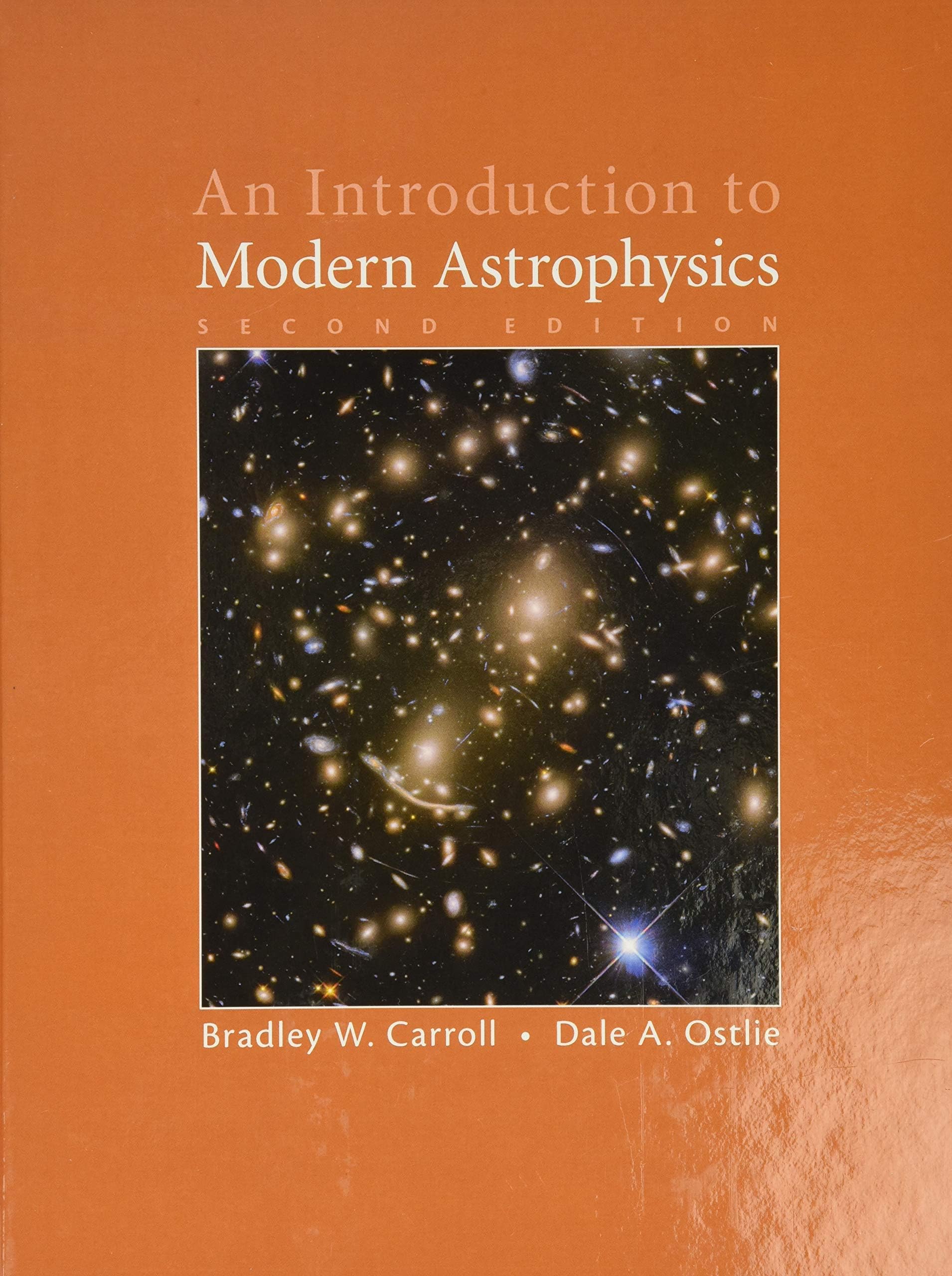
An Introduction to Modern Astrophysics is a comprehensive, well-organized and engaging text covering every major area of modern astrophysics, from the solar system and stellar astronomy to galactic and extragalactic astrophysics, and cosmology. Designed to provide students with a working knowledge of modern astrophysics, this textbook is suitable for astronomy and physics majors who have had a first-year introductory physics course with calculus. Featuring a brief summary of the main scientific discoveries that have led to our current understanding of the universe; worked examples to facilitate the understanding of the concepts presented in the book; end-of-chapter problems to practice the skills acquired; and computational exercises to numerically model astronomical systems, the second edition of An Introduction to Modern Astrophysics is the go-to textbook for learning the core astrophysics curriculum as well as the many advances in the field. Review: Serious Students of Astrophysics: This Should Be in Your Library - I am a graduate student (2008) with a BA degree in geoscience/astronomy. I have had Carroll and Ostlie's (C-O) "An Introduction to Modern Astrophysics" or as we students referred to it: "Bob" (for Big Orange Book) both first and second editions, for over 10 years and I find that I consult it often: e.g. when I get stuck on a concept such as spectral line-widths or absorption line wings and depths. The math is there and can be intimidating, but folks, you can't learn the phenomena behind the things you see in telescopes or hear on the news unless you know a bit of math! A normal introductory astronomy textbook just does not have the depth of explanation that C-O 2ed has. Great things about this book: 1.) It is pretty complete giving a bit of historical insight into astronomy all the way through Celestial Dynamics, the Solar System, Galaxies and the Universe, Cosmology plus modern Lambda Cold Dark Matter (CDM), the current consensus model of the universe's structure and possible fate. 2.) The physics are covered in-line in the text meaning, contextually and in an applied manner. An example is the Radiative Processes (bound-bound, bound-free, free-free, and Electron-scattering are covered in Chapter 9 applied to opacity in stellar atmospheres. This is the best way for astronomers to learn the supporting physics as opposed to the author just throwing out the theory with its arcane math as an "exercise for the student" to apply!. 3.) The authors have given consistent ongoing support for the text on a website with errata, supporting diagrams as download-able .jpegs, plus all of the data (constants, planetary info, etc) in download-able datafiles. I just applied over 100 corrections for typos that the authors have collected on the second edition! This one feature is worth the price of the text and it wasn't cheap! I have to say that, in my many years as a student of science, that "An Introduction to Astrophysics, 2Ed" is almost unique in its ongoing support of the text with errata corrections. 4.) Be warned: there are no trivial problems at the ends of the chapters in my experience. No "plug and chug" calculations. I have learned there is a solutions manual and I am working on acquiring that. The problems start at a challenging level for first year graduate astrophysics students and go up from there. You might not get an answer after working for some hours on these problems, but you will learn a lot in the process! In summary, there is no text I have found of comparable scope, written with more effective pedagogical technique, and with more lasting value for the serious astrophysics student than "An Introduction to Modern Astrophysics, 2nd Ed" by Carroll and Ostlie. Review: Excellent - Any instructor who has used the first edition of this book can attest to its fine quality of presentation and its didactic power. The second edition continues this tradition, and in addition offers more material that reflects the many discoveries and developments in astrophysics that have taken place since the first edition. The observational tools in astronomy have become even more refined over the years since the first edition along with computing power, and these two facts combined with a robust community of theoreticians have pushed the limits of astrophysical knowledge. This book is of course a sizable one, and this reviewer did not read it in its entirety, but instead focused on those sections that addressed the new developments since the first edition. One of the interesting topics that are discussed in the book whose explanation was not found in the first edition is that of gamma ray bursts. After a brief historical discussion of their first detection, the authors address the question as to the origin of the bursts, i.e. whether galactic or extragalactic. They perform some rudimentary calculations that show how energetic the bursts must be if they were located in the solar system or from a distant galaxy. Early thinking on the cause of gamma ray bursts associated them with neutron stars, but the authors explain the problems with this explanation, and most interestingly, give arguments that support the assertion that there is an edge to the distribution of the gamma sources. Clever observational techniques resulted in the conclusion that gamma ray bursts are extragalactic. The `collapsar' and `supranova' models of gamma ray bursts are discussed, but the discussion is way too brief for those who want the in-depth details of these models. However the authors give up-to-date references for readers who want to dig deeper. From a perusal of these references it is apparent that the supranova model has gained the most popularity at the present time, even though some of the observations cannot as yet be reconciled with this model. Another topic of great current interest is that of dark matter, which is discussed in the last chapter of the book, and which the authors describe as one of the most important theoretical issues in cosmological astrophysics. This discussion is also short, but references are given, and its inclusion since the first edition reflects the theoretical interest. The paucity of experimental evidence for the candidates of dark matter has stymied theoretical developments, with most of the effort devoted to putting bounds on the candidates, such as axions and weakly interacting massive particles. No doubt this book will continue to be used in the classroom in years to come, and new discoveries will be included in future editions. With the CERN collider coming on line in the next few years, everyone interested will see the interplay between high-energy physics and astrophysics. The collider will give the theoretical astrophysical community new bounds on cosmological quantities, and in fact may open up whole new lines of research, all of it exciting, and proof positive that the twenty-first century is the most exciting time to be alive.
| Best Sellers Rank | #92,945 in Books ( See Top 100 in Books ) #6 in Astronomy & Astrophysics #114 in Astrophysics & Space Science (Books) |
| Customer Reviews | 4.7 out of 5 stars 396 Reviews |
D**S
Serious Students of Astrophysics: This Should Be in Your Library
I am a graduate student (2008) with a BA degree in geoscience/astronomy. I have had Carroll and Ostlie's (C-O) "An Introduction to Modern Astrophysics" or as we students referred to it: "Bob" (for Big Orange Book) both first and second editions, for over 10 years and I find that I consult it often: e.g. when I get stuck on a concept such as spectral line-widths or absorption line wings and depths. The math is there and can be intimidating, but folks, you can't learn the phenomena behind the things you see in telescopes or hear on the news unless you know a bit of math! A normal introductory astronomy textbook just does not have the depth of explanation that C-O 2ed has. Great things about this book: 1.) It is pretty complete giving a bit of historical insight into astronomy all the way through Celestial Dynamics, the Solar System, Galaxies and the Universe, Cosmology plus modern Lambda Cold Dark Matter (CDM), the current consensus model of the universe's structure and possible fate. 2.) The physics are covered in-line in the text meaning, contextually and in an applied manner. An example is the Radiative Processes (bound-bound, bound-free, free-free, and Electron-scattering are covered in Chapter 9 applied to opacity in stellar atmospheres. This is the best way for astronomers to learn the supporting physics as opposed to the author just throwing out the theory with its arcane math as an "exercise for the student" to apply!. 3.) The authors have given consistent ongoing support for the text on a website with errata, supporting diagrams as download-able .jpegs, plus all of the data (constants, planetary info, etc) in download-able datafiles. I just applied over 100 corrections for typos that the authors have collected on the second edition! This one feature is worth the price of the text and it wasn't cheap! I have to say that, in my many years as a student of science, that "An Introduction to Astrophysics, 2Ed" is almost unique in its ongoing support of the text with errata corrections. 4.) Be warned: there are no trivial problems at the ends of the chapters in my experience. No "plug and chug" calculations. I have learned there is a solutions manual and I am working on acquiring that. The problems start at a challenging level for first year graduate astrophysics students and go up from there. You might not get an answer after working for some hours on these problems, but you will learn a lot in the process! In summary, there is no text I have found of comparable scope, written with more effective pedagogical technique, and with more lasting value for the serious astrophysics student than "An Introduction to Modern Astrophysics, 2nd Ed" by Carroll and Ostlie.
D**N
Excellent
Any instructor who has used the first edition of this book can attest to its fine quality of presentation and its didactic power. The second edition continues this tradition, and in addition offers more material that reflects the many discoveries and developments in astrophysics that have taken place since the first edition. The observational tools in astronomy have become even more refined over the years since the first edition along with computing power, and these two facts combined with a robust community of theoreticians have pushed the limits of astrophysical knowledge. This book is of course a sizable one, and this reviewer did not read it in its entirety, but instead focused on those sections that addressed the new developments since the first edition. One of the interesting topics that are discussed in the book whose explanation was not found in the first edition is that of gamma ray bursts. After a brief historical discussion of their first detection, the authors address the question as to the origin of the bursts, i.e. whether galactic or extragalactic. They perform some rudimentary calculations that show how energetic the bursts must be if they were located in the solar system or from a distant galaxy. Early thinking on the cause of gamma ray bursts associated them with neutron stars, but the authors explain the problems with this explanation, and most interestingly, give arguments that support the assertion that there is an edge to the distribution of the gamma sources. Clever observational techniques resulted in the conclusion that gamma ray bursts are extragalactic. The `collapsar' and `supranova' models of gamma ray bursts are discussed, but the discussion is way too brief for those who want the in-depth details of these models. However the authors give up-to-date references for readers who want to dig deeper. From a perusal of these references it is apparent that the supranova model has gained the most popularity at the present time, even though some of the observations cannot as yet be reconciled with this model. Another topic of great current interest is that of dark matter, which is discussed in the last chapter of the book, and which the authors describe as one of the most important theoretical issues in cosmological astrophysics. This discussion is also short, but references are given, and its inclusion since the first edition reflects the theoretical interest. The paucity of experimental evidence for the candidates of dark matter has stymied theoretical developments, with most of the effort devoted to putting bounds on the candidates, such as axions and weakly interacting massive particles. No doubt this book will continue to be used in the classroom in years to come, and new discoveries will be included in future editions. With the CERN collider coming on line in the next few years, everyone interested will see the interplay between high-energy physics and astrophysics. The collider will give the theoretical astrophysical community new bounds on cosmological quantities, and in fact may open up whole new lines of research, all of it exciting, and proof positive that the twenty-first century is the most exciting time to be alive.
D**D
Well worth the cost!
I am very pleased with my copy of BOB. It arrived early and in perfect condition (Thank you "Smart Student"). I have by no means read the book from cover to cover, but intend to use it as a reference. The treatment of some subjects is a little brief, but how much will fit into 1278 pages, plus extensive appendices and index? I often use formulas and equations without going back to derive them. This text is excellent when I wish to do so. Some theoretical predictions have been verified observationally since 2007 (e.g. short gamma ray bursts and the utility of multimessenger astronomy), but I keep my smartphone handy for internet updates. I studied steller atmospheres as a grad student back in the "dark ages" and am very pleased with the updated refresher course. I recommend this work without reservation.
B**M
Excellent reference and good text book
The authors did an excellent job in providing a well detailed and broad overview of astrophysics. This is a big book, but flows well and will provide the interested reader with a solid understanding of the basic concepts and details of the subject area. As a textbook, it is very good, but not quite excellent. A few more examples in the text would be appropriate. Also, the problem sets need some work. A good problem set should start with simple problems based on chapter topics and build on them slowly. This text tends to jump around and generally begins with fairly in depth problems rather than starting with a simple foundation and building slowly. Hopefully, the authors will work on this in the next edition. Overall, this is a wonderfully written text on the broad variety of concepts associated with astrophysics and astronomy.
R**E
Massive -- Everything You Want to Know About Astrophysics
The contents of this massive work cover every aspect of astrophysics, from the origin of the universe to its ultimate fate, and everything in between. The planets and solar system, stellar formation, dark matter, gravitational lensing, galaxy formation and evolution, bound systems, on and on and on, but you get the point. Truly comprehensive; you wonder how they were able to compile all the material and present it in such a professional fashion. Newly updated, which is important since astronomy changes so rapidly. No wonder the "BOB" (Big Orange Book) is so widely used at the best colleges and universities. However, not for the beginner. Bring all your chem, physics, and math tools -- you'll need them to enjoy fully this great text.
J**S
Must-read for Undergraduate Astronomers
The ultimate compilation of the theories and mathematics of Astrophysics. An incredible text that showcases the study of Astrophysics in a way that any undergraduate with a reasonably strong background in Calculus can read. (Note: Reasonably strong background in Calculus = passed three semesters of Calculus covering derivatives, integrals, and methods of integration in multiple variables). Each chapter provides sources and reference material for any students interested in reading professional papers on the subject. A must read textbook for any undergraduate-level course in Astrophysics.
W**R
Massive Book with Width and depth in the subject matter
Our class covered most of the book in one semester. But this book is so inclusive that we really needed 3 or more semesters to finish. Unfortunately, astrophysics is taught at my university in just one semester. there is so much material that one can keep the book and work through it over several years.
D**E
Excellent conditions, great book
I ordered a copy of the book used but it’s good as new. The book was assigned for my astrophysics class (as I’m an astrophysics major) and it seems to be a quite recognized book and the most standardized astrophysics book around for these courses. It is certainly a must have in your personal library; it’s great reference.
C**N
G
A great tutorial: complete, accurate and well written! Good for beginners, useful as a consulting tool for professionals. To be included in your personal library..
A**S
Bought as a gift
Receiver was quite happy with it, nothing more to say
M**Z
Excelente libro, pero con un defecto.
En sí, el libro me gusta mucho, pero una parte del índice está separada.
A**I
Best book on the area
Excellent textbook that absolutely changed the way I see the world
A**Y
Excellent pick-it-up/find-it-out reference book
Having entered my third year BSc in Astrophysics specialising in Quantum Mechanics, I decided I urgently needed more of my own “library” type resources - particularly now my second year maths methods module is out the way (so I can actually understand all those partial derivative symbols!). So far it’s surprised me which books I splashed-out on that have been useful, and which ones have just sat collecting dust. This is the book I keep going back to every single time - it’s excellent! My only gripe really is that it’s quite cumbersome in hardback form, although at well over a thousand pages you get a lot of bang for your buck here, so hardly worth complaining. Definitely get this one if you’re an undergraduate studying astronomy/cosmology - I highly doubt you’ll regret it!
Trustpilot
2 weeks ago
1 day ago