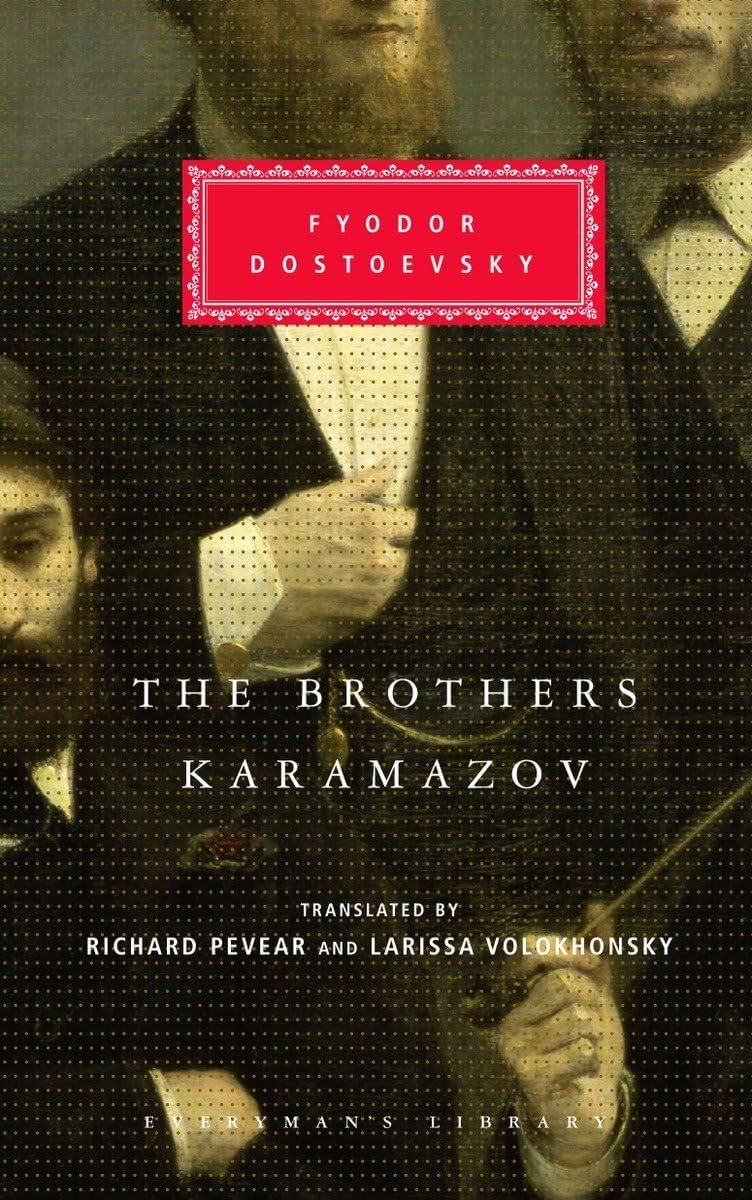
The Brothers Karamazov: Introduction by Malcolm Jones
Product ID: 5791845
Buy anything from 5,000+ international stores. One checkout price. No surprise fees. Join 2M+ shoppers on Desertcart.
Desertcart purchases this item on your behalf and handles shipping, customs, and support to Brazil.
Dostoevsky’s greatest novel is a story of murder told with hair-raising intellectual clarity and a feeling for the human condition unsurpassed in world literature. Fyodor Dostoevsky’s final novel, published just before his death in 1881, chronicles the bitter love-hate struggle between a larger-than-life father and his three very different sons. The author's towering reputation as one of the handful of thinkers who forged the modern sensibility has sometimes obscured the purely novelistic virtues—brilliant characterizations, flair for suspense and melodrama, instinctive theatricality—that made his work so immensely popular in nineteenth-century Russia. This award-winning translation by Richard Pevear and Larissa Volokhonsky—the definitive version in English—magnificently captures the rich and subtle energies of Dostoevsky’s masterpiece. With an introduction by Malcolm Jones. Everyman's Library pursues the highest production standards, printing on acid-free cream-colored paper, with full-cloth cases with two-color foil stamping, decorative endpapers, silk ribbon markers, European-style half-round spines, and a full-color illustrated jacket. Everyman’s Library Classics include an introduction, a select bibliography, and a chronology of the author's life and times. Review: Binging with Dostoevsky's 'Breaking Bad.' The Brothers Karamazov just the right challenging read for a long winter's months - More than 50 years after I first read 'The Brothers Karamzov' while in high school (my existential phase, which became more than a phase), I re-read it as a part of our successful "read the classics" program with my wife in December 2014. And the novel, read through a second time (and possibly more closely than the first time) "holds up" amazingly -- although it stands in stark contrast to much of what is around nowadays in both form and content. After all, a novel where some paragraphs are three or four pages long is not about to get to the top of today's Best Seller lists. But it's worth the time and effort Dostoevsky demands. His characters are complex and provide some insights into the worlds of pre-Revolutionary Russia that would be lost to history had Dostoevsky not taken on this massive "psychological" novel. The challenges faced by the three Karamatzov brothers (and their half brother) may seem unusual today. After all, nearly 150 years of modernity have passed since the patrimony in the family Karamazov caused the three brothers -- Alexi, Ivan, and Dimitri -- to face the various insults and injuries put upon them by their monstrous father. And as close readers realize, it is the fourth brother who has the most to be angry about, because he was the product of the rape of a girl from the town by the elder Karamazov. A crime novel, a "psychological" novel, and series of meditations that helped give rise to 20th Century "existentialism" -- and in some ways a proto-feminist meditation, "The Brothers Karamazov" challenges the reader, in the most intelligent ways. The novel could be a 21st Century soap opera that could stretch for years (decades perhaps) just based on the panoply of characters presented to the reader. But if a novel is also to be judged based on the fulfillment of its "minor" characters, then here, too, Dostoevsky has triumphed. Despite the fact that none of the female characters is one of the leading characters, a half dozen of the women in the novel could easily be featured in a long-running HBO series. I can almost picture the reviews five years hence, when a bunch of "bingers" compare "The Brothers Karamazov" to "Breaking Bad," "The Sopranos," or the immortal "The Wire" (which I have compared to the great Russian novels). A 21st Century genre could perhaps revive this masterpiece of the 19th. Dostoevsky still holds second place in my heart to the great novels of Tolstory (I taught "Anna Karenina" to Chicago high school students for several years, always with great satisfaction to both the students and myself; and I always wished I could teach "War and Peace" -- but there just wasn't time). And I don't know if we are up to the challenge of going through "Crime and Punishment," "The Idiot," and "The Possessed" as closely as we did "The Brothers Karamazov" as the cold weather began here in Chicago. But the effort was well worth it. (Even though I had to read a Carl Haisson novel in the middle of the long march through Dostoevsky to take a breather). And you have to wonder how Dostoevsky would have written that sequel to the story of the Karamazovs, the one he was outlining after the publication of the story of Alexi, Dimitri, and Ivan. But he died, as to all great artists, and we don't have to worry, I hope, about someone taking up the next generation of the works of one of the world's great novelists the way some lesser novelists, from Ian Fleming to Margaret Mitchell, have been... Review: The Question of Life - I first read The Brothers Karamazov in college over twenty years ago. Since then I have read it perhaps five or six times and have never wanted it to end. Reading it over the years has been a unique experience in itself as with each read I see myself identifying with a different brother. In college (I was in the seminary at the time) I identified strongly with Alyosha. I later became rather skeptical and saw a lot of Ivan expressing itself in my thoughts. Then I experienced a period of great personal moral failure and came to be good friends with Dmitri. Although, as the narrator himself says, Alyosha is the hero of the story, it is Dmitri I love the most. Having associated so much with these characters I only pray to God that I never encounter within myself the demonic Fyodor. Dmitri is a sinner yes, but he is driven by an immature, undirected love (Eros seeking Agape as Pope Benedict XVI would say - Deus Caritas Est). Fyodor on the other hand is Eros incarnate with no reference to or belief in Agape. He is lost. Alyosha is Agape seeking to express itself through Eros. And so as the story unfolds Dmitri and Alyosha are drawn to discover themselves in each other. This is why for Dostoevsky Alyosha rather than Dmitri is the hero. Alyosha is a Christ figure - Agape coming down from on high into the world of Eros and liberating Eros from bondage to itself so that its affections can be true. The two "fathers" in the story, Fyodor Karamazov and Father Zosima, are the characters Dmitri and Alyosha in the absolute. They are the antithesis of each other - the flesh and the spirit. In Dmitri and Alyosha they find a resolution and form the true man who is Christ, the God-Man. So much for the meaning of the story. The story itself is just as great as its meaning. As much as I loathe Fyodor, he is undoubtedly one of the most excellent characters I have encountered in literature. He he he! Yes, and the intricacies of the plot and not a single word being lost or unaccounted for. The smallest detail is of the most significance! I firmly believe a work such as this is greater and involves more genius than any work of science. It is certainly more beautiful and a lot more fun! I cannot understand those who complain of the book's length. Its length is perfect. Dostoevsky's prejudices are perfect. His mistakes are perfect! I know there are many great works of literature I have never come across because now and then I do encounter another. At times I wonder if there is one that will move me more deeply than The Brothers Karamazov. No doubt I'll die wondering.
| Best Sellers Rank | #154,643 in Books ( See Top 100 in Books ) #1,993 in Psychological Fiction (Books) #3,535 in Classic Literature & Fiction #8,611 in Literary Fiction (Books) |
| Customer Reviews | 4.6 out of 5 stars 1,267 Reviews |
G**T
Binging with Dostoevsky's 'Breaking Bad.' The Brothers Karamazov just the right challenging read for a long winter's months
More than 50 years after I first read 'The Brothers Karamzov' while in high school (my existential phase, which became more than a phase), I re-read it as a part of our successful "read the classics" program with my wife in December 2014. And the novel, read through a second time (and possibly more closely than the first time) "holds up" amazingly -- although it stands in stark contrast to much of what is around nowadays in both form and content. After all, a novel where some paragraphs are three or four pages long is not about to get to the top of today's Best Seller lists. But it's worth the time and effort Dostoevsky demands. His characters are complex and provide some insights into the worlds of pre-Revolutionary Russia that would be lost to history had Dostoevsky not taken on this massive "psychological" novel. The challenges faced by the three Karamatzov brothers (and their half brother) may seem unusual today. After all, nearly 150 years of modernity have passed since the patrimony in the family Karamazov caused the three brothers -- Alexi, Ivan, and Dimitri -- to face the various insults and injuries put upon them by their monstrous father. And as close readers realize, it is the fourth brother who has the most to be angry about, because he was the product of the rape of a girl from the town by the elder Karamazov. A crime novel, a "psychological" novel, and series of meditations that helped give rise to 20th Century "existentialism" -- and in some ways a proto-feminist meditation, "The Brothers Karamazov" challenges the reader, in the most intelligent ways. The novel could be a 21st Century soap opera that could stretch for years (decades perhaps) just based on the panoply of characters presented to the reader. But if a novel is also to be judged based on the fulfillment of its "minor" characters, then here, too, Dostoevsky has triumphed. Despite the fact that none of the female characters is one of the leading characters, a half dozen of the women in the novel could easily be featured in a long-running HBO series. I can almost picture the reviews five years hence, when a bunch of "bingers" compare "The Brothers Karamazov" to "Breaking Bad," "The Sopranos," or the immortal "The Wire" (which I have compared to the great Russian novels). A 21st Century genre could perhaps revive this masterpiece of the 19th. Dostoevsky still holds second place in my heart to the great novels of Tolstory (I taught "Anna Karenina" to Chicago high school students for several years, always with great satisfaction to both the students and myself; and I always wished I could teach "War and Peace" -- but there just wasn't time). And I don't know if we are up to the challenge of going through "Crime and Punishment," "The Idiot," and "The Possessed" as closely as we did "The Brothers Karamazov" as the cold weather began here in Chicago. But the effort was well worth it. (Even though I had to read a Carl Haisson novel in the middle of the long march through Dostoevsky to take a breather). And you have to wonder how Dostoevsky would have written that sequel to the story of the Karamazovs, the one he was outlining after the publication of the story of Alexi, Dimitri, and Ivan. But he died, as to all great artists, and we don't have to worry, I hope, about someone taking up the next generation of the works of one of the world's great novelists the way some lesser novelists, from Ian Fleming to Margaret Mitchell, have been...
M**E
The Question of Life
I first read The Brothers Karamazov in college over twenty years ago. Since then I have read it perhaps five or six times and have never wanted it to end. Reading it over the years has been a unique experience in itself as with each read I see myself identifying with a different brother. In college (I was in the seminary at the time) I identified strongly with Alyosha. I later became rather skeptical and saw a lot of Ivan expressing itself in my thoughts. Then I experienced a period of great personal moral failure and came to be good friends with Dmitri. Although, as the narrator himself says, Alyosha is the hero of the story, it is Dmitri I love the most. Having associated so much with these characters I only pray to God that I never encounter within myself the demonic Fyodor. Dmitri is a sinner yes, but he is driven by an immature, undirected love (Eros seeking Agape as Pope Benedict XVI would say - Deus Caritas Est). Fyodor on the other hand is Eros incarnate with no reference to or belief in Agape. He is lost. Alyosha is Agape seeking to express itself through Eros. And so as the story unfolds Dmitri and Alyosha are drawn to discover themselves in each other. This is why for Dostoevsky Alyosha rather than Dmitri is the hero. Alyosha is a Christ figure - Agape coming down from on high into the world of Eros and liberating Eros from bondage to itself so that its affections can be true. The two "fathers" in the story, Fyodor Karamazov and Father Zosima, are the characters Dmitri and Alyosha in the absolute. They are the antithesis of each other - the flesh and the spirit. In Dmitri and Alyosha they find a resolution and form the true man who is Christ, the God-Man. So much for the meaning of the story. The story itself is just as great as its meaning. As much as I loathe Fyodor, he is undoubtedly one of the most excellent characters I have encountered in literature. He he he! Yes, and the intricacies of the plot and not a single word being lost or unaccounted for. The smallest detail is of the most significance! I firmly believe a work such as this is greater and involves more genius than any work of science. It is certainly more beautiful and a lot more fun! I cannot understand those who complain of the book's length. Its length is perfect. Dostoevsky's prejudices are perfect. His mistakes are perfect! I know there are many great works of literature I have never come across because now and then I do encounter another. At times I wonder if there is one that will move me more deeply than The Brothers Karamazov. No doubt I'll die wondering.
R**Y
My Favorite Book from my Favorite Publisher
First things first. I love the Everyman's Library. The light yellow pages. The cloth cover. The sewn binding (no glue). The silk bookmark. The smell. Yes, the smell of the paper is the most important part. The first thing I always do with an Everyman edition when I've opened up the box is stick my nose deep into an open page and inhale. Then I chase my wife around, telling her she has to breath this in, this fantastic aroma; she looks at me like I'm crazy. No other publisher makes books that smell like the Everyman's Library. I could never read this book on a Kindle or on paperback. It just wouldn't feel true. Beautiful thoughts deserve a beautiful home. When my college mentor held up a worn copy of The Brothers Karamozov by Dostoevsky, he promised me that this book would either transform me into a deeply religious individual or turn me into an atheist. I was intrigued. In my first reading I sensed something happening to me; I was drawn along a funny, strange fantasy which washed over me without my wholly understanding what was going on. The characters spoke in long speeches, almost Shakespearean. Alyosha, the novice monk and hero, races from scene to scene, saving his brothers and his father from catastrophe, but he's never quite fast enough. What begins in the humorously absurd turns dark and even grotesque as the father is discovered beaten to death and the eldest son, Dimitri, is immediately suspected as the culprit. Both father and son were in pursuit of the same women, and their rivalry had escalated into violence before. The most important part of the book for me, though, is the interchange between Ivan, the atheist intellectual and Alyosha, the faithful Christian. Ivan rebels against God and the senseless suffering in the world, especially the chapter entitled "The Grand Inquisitor," and Alyosha listens in horror, unable to defend his point of view. Jesus failed mankind, Ivan says, because the common man is incapable of faith. He needs to be compelled to salvation, but Jesus wouldn't compel us, so salvation is only available to a few. When the Grand Inquisitor, the man responsible for burning the thousands of heretics in Spain, confronts Jesus with his failings, Jesus only looks on him with silent compassion. It's a powerful scene, and I read the rest of the novel as Alyosha's attempt to grapple with the vision of his brother. This is not the faint hearted; it's mammoth length, difficult language, and unfamiliar Slavic names demand careful attention. But the honest, diligent reader will feel the ground shift under him, and nothing will be the same. This book changed me. I am now on my fifth reading and have lost my innocent faith in God's love, and developed a deeper, more nuanced and profound relationship with the Divine.
M**A
Good
This is fully a philosophy book about religion and family not really a novel. Still it was enjoyable and I would 100% reread certain chapters
G**L
Transcendent.
These Russians really know how to tackle the big issues in literature. I started with Solzenitsyn's Day in the Life, then did War and Peace, then Crime and Punishment, and most recently, The Brothers Karamazov, and I have to say that I am much the better for reading these books. Phew, I thought War and Peace was good (and it was), but the Brothers Karamazov locks horns with the problems we face as human beings, wrestles them to the ground, exposes us for the weak, sinful things that we are, then gives us hope. Principally (to me, anyhow), the novel was about the problem of overthrown authority. God and the church were starting to be questioned as the ultimate authority, and the air in Russia at the time was begining to move towards reform, begining to become modern. Its themes are just as relevant today as they were for Dostoyevsky's time, and there are several passages in "The Russian Monk" chapter that were profoundly prophetic of the problems of modern society- if you replace some words with modern equivelents you have a very good picture of the USA today. Isolation of the individual, invented needs, the problem of freedom- these are some of the things Dostoyevsky tries to tackle. Several chapters are masterpieces enclosed within the work itself, 'Pro and Contra,' 'A Little Demon,' 'The Russian Monk' the chapter where Mrs Kholaklova (spelling) professes her lack of faith to the Elder Zosima, the chapter that focuses on the relationship between Snegiyrov and Illyushin, his son, showing how children lose their innocence and become indoctrinated into this harsh adult world- with bad consequences when violence is present. And of course, there is the 'Grand Inquisitor' chapter. Wow. WOW. Had to read that three times before I think I got everything in it, but I think if every human being on Earth read 'The Grand Inquisitor' 'The Russian Monk' and then 'The Speech at the Stone' we would all be very much the better for it. eh, just read the whole thing while you're at it. Dostoyevsky's conclusion seems to be that faith will be the ultimate healing salve for all humanity- once everybody realizes the stupidity of everything other then selfless, active love, we shall all move forward and life shall be paradise. We've had 120 years or so more progress towards it since Dostoyevsky wrote it, but it looks like we're still not doing very well (thank you very much Ms Ayn Rand). Dostoyevsky provides enough sustenence for people with less ardent faith to continue on- one of the characters, Rakitin, says 'Man kind will find the strength to live for virtue wether or not he believes in the immortality of the soul.' The Devil, in the chapter where he has a conversational duel with Ivan, mocks this idea as 'most charming.' Each of the primary characters- Alyosha, Ivan, Dmitry, and Fyodor Pavlovich, is a guide to a certain way of living. Alyosha the christ-man, Ivan the intellectual skeptic (Raskolnikov mk II), Dmitry the noble savage, and Fyodor Pavlovich as the great sinner. Each character has his own climax in the book, and everybody should be able to identify with at least one of the characters, or find that they may be 10% Dmitry, 50% Ivan, and 40% Alyosha. This should be an exceptional book for any young person trying to figure out what the heck life is all about. There's some good stuff between those covers- Dostoyevsky has a very deep understanding of human nature. So in closing, whatever your beliefs are, don't eat the pineapple compote, and don't take the earthly loaves.
C**A
The Great Book
This is the great book -- so much so that I've read it several times at different points in my life. On earlier readings in my youth, I was struck with the brilliance of Ivan Karamazov and his ability to anticipate and articulate the great philosophical movements of the 20th century. Dostoyevsky is remarkable because he can give the devil his due, with strong characters who embrace visions opposing his own conservative brand of Christian philosophy. On this reading, though, it is clear to me that Dostoyevsky exposes the essential shabbiness of Ivan's thinking. Ivan is the one who is most like Fyodor, observes Smerdyakov. I suppose this is so because he can't transcend his passions, which are in his case intellectual. It is no accident that the devil appears in this book as the shabby poor relation. Evil is both powerful and pathetic. Alyosha's speech at the end of the novel is such a pure and warm spirited evocation of optimism and virtue as to be unlike anything Dostoyevsky ever wrote. It is a beautiful a speech as there is in literature, rivaled perhaps only by Gabriel's musings at the end of Joyce's "The Dead." I've only read the Constance Garnett translation in the past. This translation is quite good and more appealing to the modern reader -- free of the Victorian prudery of Garnett.
F**Y
A Great Novel, Not an Easy Book to Read, Required My Full Attention
I really liked "The Brothers Karamazov". It is the final novel of Fyodor Dostoevsky. Mister Dostoevsky is my personal favorite Russian Author. I have read numerous Russian Novels by numerous authors including Tolstoy, but I am far from an expert. The novel is quite lengthy and does not have modern, conversational American English easy flow to it. I had to take breaks to keep my concentration and read lighter work to let my brain rest. This novel is a philisophical novel. It is not an easy read. Dostoevsky is a very sophisticated thinker and writer. There are some lengthy discourses that required my full attention. I can't help but wonder if some of these lengthy discourses influenced Ayn Rand. I am specifically thinking of John Galt's speech in "Atlas Shrugged". I have read most of Fyodor Dostoevsky's fiction in the order of their publication. I am glad that I did that, as I could relate much of his earlier works to this, his final novel. I think that the three Dostoevsky works that this book reminded me most of were "Crime and Punishment", "The Idiot", and "Notes from The Underground". In summary, I really enjoyed this novel and am very glad to have read it. It is lengthy and sophisticated. It required my full attention. I was glad that I read his other works first. This novel is excellent, but will not suit the taste of every modern reader. No matter how much I appreciated the novel, in truth I would need a good reason to read it again. Thank You...
B**N
Read this ASAP
Best book I’ve ever read by an unmeasurable margin, this translation is particularly helpful for me to keep everything straight. The binding is classy and the paper is beautiful, the book is done beautifully and the treatment of this masterpiece is appropriate to say the least!
B**L
One of the greatest ever
One of the best ever written. The storytelling is just amazing, although some parts where characters just keep on rambling on about religion can be a bit tiresome. But reading the book is a very rewarding experience. I'd rank this above Crime and Punishment, but just below Anna Karenina and War and Peace. I simultaneously read the e-book of Michael Katz's translation and this physical book which is the Pevear/Volokhonsky translation. You can't go wrong with either versions. They're both better than the Garnett translation. The quality of the Everyman's Library edition is very good, certainly for the price. Just be warned that the leters are on the small side. For those interested, there's a Youtube channel (Mosfilm) showing Soviet era movies, and one of them is the 1968 film version of this book.
S**U
Great Book
Excellent book!
R**L
Excellent book
I really enjoyed this long work of Dostoevsky's, and despite the length, it did not feel like a chore to finish. There was a heavy emphasis on Christian philosophy, with great insight into different characters' psychological perspectives. I particularly enjoyed (and reread multiple times) The Grand Inquisitor chapter and Ivan's conversation with the Devil. If you have difficulty reading small text, avoid this book! It is beautiful in every other way: the cover, binding, paper, etc., but the text was the smallest of the Everyman's Library books I have read thus far. Overall, an excellent book, my #1 fiction book to date!
ジ**ト
商品説明が適当すぎる気が…
書籍版Richard Pevear&Larissa Volokhonskyバージョン「カラマーゾフの兄弟」の「その他のフォーマット」からKindle版に飛んで購入したのだが、いざKindle版を購入してみるとコンスタンス・ガーネット版であった。 にもかかわらずKindle版の商品説明欄の「抜粋」は上記リチャード・ピビア&ラリサ・ボロホンスキの文章と全く同じままである。これではカスタマーが間違っても仕方ないのではあるまいか。 それどころか、他の英訳版もほとんどおんなじ商品説明である。これでは、一体全体どれがどの英訳なのか、判断がつかない。 「カラマーゾフの兄弟」には数種類の英訳があるのだが、どうもKindle版はコンスタンス・ガーネット版らしい。だが商品説明の「抜粋」は別の英訳(リチャード・ピビア&ラリサ・ボロホンスキ)のものなので紛らわし過ぎる。 それぞれ、ちゃんと訂正してほしい。せめて訳者名だけでも明記してほしいところ。
M**K
One of the greatest novels of all time - overwhelming!
This novel is undoubtedly one of the greatest novels ever written. It is impossible to "review" this masterpiece - it MUST be read!
Trustpilot
3 weeks ago
3 days ago