Desertcart purchases this item on your behalf and handles shipping, customs, and support to Brazil.
🔆 Charge smarter, live greener — power your future with Victron Energy!
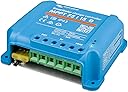
The Victron Energy SmartSolar MPPT 75V 15A charge controller is a compact, Bluetooth-enabled solar regulator designed for 12/24V systems. It features ultra-fast maximum power point tracking to maximize energy harvest, supports synchronized multi-controller setups, and offers intelligent load management to extend battery life. With real-time monitoring via the VictronConnect app and UL1741 certification, it delivers professional-grade, reliable solar charging for modern renewable energy setups.

| ASIN | B075NQQRPD |
| Best Sellers Rank | #6,422 in Patio, Lawn & Garden ( See Top 100 in Patio, Lawn & Garden ) #3 in Renewable Energy Controllers |
| Brand | Victron Energy |
| Brand Name | Victron Energy |
| Color | Blue |
| Customer Reviews | 4.7 out of 5 stars 5,750 Reviews |
| Display Type | LED or minimal display |
| Included Components | Victron Energy SmartSolar MPPT 75V 15 amp 12/24-Volt Solar Charge Controller (Bluetooth) |
| Item Dimensions L x W x H | 4.7"L x 2.1"W x 1.8"H |
| Item Highlight | Bluetooth Charge Controllers for Solar Panels, Certified to UL1741 |
| Item Type Name | Victron Energy SmartSolar MPPT 75V 15 amp 12/24-Volt Solar Charge Controller (Bluetooth) |
| Item Weight | 0.58 kg |
| Manufacturer | Victron Energy |
| Material | Plastic |
| Material Type | Plastic |
| Model | MPPT 75|15 |
| Number of Items | 1 |
| Operating Temperature | 60 °C |
| Part Number | SCC075015060R |
| Product Dimensions | 4.7"L x 2.1"W x 1.8"H |
| UPC | 703774384979 |
| Unit Count | 1 count |
| Voltage | 24 volts |
| Warranty Description | Warranty |
D**S
Know what you need before you buy! This worked for me.
Solar energy is a great way to have back-up power for your home or for your RV. Solar isn't super complicated, but there are a lot of things you need to know to make the best purchases. Solar charges (like the Victron) come in both PWM and MPPT. PWM are significantly less expensive, but may fit your needs. MPPT is a better option, and this very affordable Victron unit is a fantastic entry-level charge controller. It's 75/15 name refers to the maximum volts it will accept/use from your solar array, and the 15 amps it can accept/use. The Victron Smart Solar 75/15 can handle up to 300 watts of solar panels wired in series or parallel. In series, that's about 68 volts max, well within tolerances, or 16.5 amps max which will be capped at 15 amps. Truth is, except for perfect sun and panel angle, you're not likely to hit the 16.5 amps. Still, that's not bad! A great part of the Victron 75/15 design is that it has bluetooth built in, so don't need to shell out extra for a dongle. Note: if you want this, look for the "Smart Solar," if it doesn't say this, you'll need a dongle. The size of this unit is just excellent; I bought it for my DIY powerstation. It works great, giving me nearly the full 100 watts from my Renogy solar panels under ideal conditions. For the money (about $65 at the time of purchase) it's simple enough for the beginners, or strong enough to manage a modest RV. Cons: It uses small, flat-head screws, so you'll need a small "pocket" screwdriver to make the connections. The input for the wires is pretty small. I had a ferrule kit, so I was able to insert 12 AWG with no trouble. I don't know how you'd easily get 10 AWG (somewhat standard for solar) but what I had worked and I'm happy.
D**.
Excellent charge controller
This is an excellent charge controller, loaded with features, very compact, very reliable. The ability to use an app to track the solar metrics extends beyond just that capability. In my case (as a software developer and electronics tinkerer type person), I'm using an ESP32 module (about $6) to capture the Bluetooth broadcast data from the charge controller and upload it to my website, where I can easily monitor the solar performance of my camper remotely. I'm using the VictronBLE ESP32 library with additional code to upload the data to my web server. This charge controller supports around 200 Watts of solar if your battery(s) are 12 V, and around 400 Watts if your battery(s) are 24 V (15 A x 12 V = 180W, 15 A x 24 V = 360 W, however since the charge voltage is a little higher than your battery voltage, it is right around 200 W and 400 W). I'm running 400 Watts of solar (2 x 200 W) with a 12 V battery, so the charge controller can really only make use of about half of my maximum solar power. However, the upside is that on a cloudy day when the panels cannot produce their full power, having double the solar results in double the wattage (IE if one panel can only produce 30 watts on a very overcast day, then I get 60 watts with double the panels). The charge controller handles this just fine - it only allows up to the 15A to flow even if the panels can produce more. I highly recommend this controller. If you don't understand the relationship between the amperage of the controller, the battery voltage, and the wattage, then use AI or research it yourself a little. It isn't too complex. Essentially for this controller, the 75V is the maximum solar voltage it can handle (and that is determined by the properties of your solar panels, and whether you have then in serial or parallel combinations), 15A is the maximum amperage it can send to a battery or load, and 12/24 means it works with both 12V and 24V battery setups.
T**N
Travel Trailer application and some explanation of the data you'll be getting
I purchased a couple 100W Renogy panels for our travel trailer as dry camping opens up a lot of sites for us and I don’t like firing up the generator unless I have to. The panels are deployed on folding stands which is really the only way to get them in the sun in the wooded campgrounds we frequent. I used them the first weekend with the PWM controller that came with the kit. It blinked nicely at me, but even with a voltmeter added to our control panel inside the camper there wasn't really a way to see what was going on. I started looking at adding monitors with shunts, but things start getting rather involved for my particular setup. At home in the off-season the camper is covered and plugged into shore power to keep the batteries up. I realized a few things. First, I’m paying for electricity to charge the batteries when I have two solar panels in a box. Second, the on-board inverter/charger is OK for maintaining batteries, but really lacks the ability to keep them at a full charge as they hover around 13.4-13.6 volts regardless of battery condition and with no temperature compensation. Third, to charge the batteries requires the battery kill switch to be on, meaning I’m also powering gas and carbon monoxide detectors and who knows what other parasitic loads in the camper. Not a monetary issue but things without power on them can’t cause unforeseen issues. I had originally fallen prey to the argument that you’re better off buying another panel vs. paying for an MPPT controller. That works on paper but I realized that I’ll set out 2 panels, but I will never set out 3 or 4. That meant the Victron SmartSolar 75/15 would work nicely and the cost was within my threshold of pain. The need for a separate monitor was also negated. Installation was easy as I was just replacing the PWM controller. My setup is a couple of group 24 lead acid deep cycle batteries with around 160ah. Power is brought into the storage bay of my travel trailer with 4/0 wiring where it splits off to a 3000/6000 pure sine inverter. The Victron is wired into the 4/0 cables which are only about 18” away with 10 gauge cabling. The Zamp plug that came with the camper was replaced with a 10 gauge wire unit, and the 20’ of Renogy cable going to the panels is 10 gauge. The storage bay isn’t heated so it’s within a few degrees of the batteries which are on the tongue. After doing an update the unit automatically selected 12v and the default charge setting was for deep cycle gel batteries. I was initially a little worried that there wasn’t a specific setting for lead acid batteries but the parameters of this option are apparently fine from what I can gather. Equalization is off by default. After installation I zipped the camper cover back up all I have to do now is walk by and log in to see what’s going on, no need to unzip/unlock or interrupt my nap when we’re actually camping to check our state of charge. The attached screenshots were for the first few days. I’m only using one 100W panel as I felt this would be sufficient. The battery bank was at 90% charge the first day (see handy chart) and I was pleased to see that it got fully charged but concerned that my 100W panel was only putting out 35W in full sun. A 100W panel is going to max out somewhere around 70W in the northern hemisphere on the best day in the summer and this was in January, the lowest amount of available solar energy (insolation) of the year. The following days were even worse until I understood that Pmax isn’t your panel’s peak wattage, it’s the peak that the controller will draw from the panel as it manipulates current and voltage to get what it wants. You’re not going to see a Pmax that resembles the published output of your panels unless you have a big load on them (or drained batteries) and maybe not then. This is a layman’s explanation, but if it keeps you from thinking you have a bad panel or connection it’s worth the keystrokes. Of the following three January days the first was sunny, the next was cloudy and the next was rain. The Victron doesn’t care, it still pulled plenty of voltage out of the panel and quickly went into float. It’s like a honey badger. Perhaps more interesting will be what happens when a live load is applied (such as when we’re actually camping and using power). Toggling the electric tongue jack gets an immediate response from the controller as it ramps up to offset what you’re using, then it goes back to putting the battery back to the state of charge that it wants. Comparisons between PWM and MPPT controllers are made in somewhat of a vacuum, you can spend hours reading them. In the real world of RV use the MPPT probably offers more advantages than published. On cloudy and rainy days MPPT wins, but though it’s hard to quantify it also wins when you have partial sun exposure due to your location. I love wooded/private campsites. Most examples use a sunny day with no loads and the PWM can do what the MPPT does, it just takes longer. Let’s say I’m fully charged by noon and at 4pm I decide to take a shower (water pump, exhaust fan, lights). Which one will have a chance of recovering the batteries given the limited amount of remaining daylight? Exactly.
A**R
Well Made, Works Well, Good App
I use this charge controller between a solar panel and a battery. The panel is a single 120-Watt 12/24-Volt unit with a maximum (open circuit) voltage of 33.7 V. The battery is a pair of 12-Volt lead-acid batteries wired in series to make 24V. It appears to be working well. It charges and maintains the batteries at about 25.8 Volts. The controller is easy to wire and set up. The iPhone app took some fiddling around to get going - a couple extra minutes that may have been my fault. Once up and running the app connects the phone to the controller via Bluetooth over a modest distance, maybe 10 yards. The app shows charge current, panel voltage, charge power, and battery voltage. The controller is compact and appears to be solidly made. I would buy another if I have the need.
C**R
Great charge controller for the price
Works great on my Redodo LiFePO4 12v battery. Tops it off with the 200w solar panels connected to it. Great to see the BT function as I can monitor how my battery is charging and what the percentage is.
M**N
Silent and cool at full load
The 75-15 units work great and stay cool under full load. They work as advertised. That said, the 15A output limit doesn't give you much at 12V (200W) or 24V (400W) (my battery system is 24V LFP), and I made the mistake of undersizing the charge controller against my solar which runs 500W+ in full sun. Hence why I was able to make the comment about them staying cool under full load :-). So I recommend buying the SmartSolar MPPT 100-20 instead of the 75-15. The price point is still very good and those 5 extra amps can make a difference. Plus the 75-15 is limited to 24V battery systems while the 100-20 gives you the flexibility to move to a more powerful 48V battery system in the future. I also have two 100-20's. When maxed out at 20A they generally clock in at 60C and don't go much higher, so not as cool as the 75-15's. But the 100-20's are far more capable, and can handle 12/24/48V without issue. A low speed fan is all it takes to keep them in a nice comfort zone while pushing 20A to the battery. I'm running 70V VOC and 80V VOC (roughly) strings with no issues into these controllers, so the input amps and losses are very low. Thus the charge controllers are limited only by the output amps. The control and programming features are great. I've used the load output directly and the virtual load output (basically a relay control output) as well. There are a few quirks with the direct load output, it can't handle surges at all really, even short ones. The battery profile is completely customizable and output amps can be limited. I actually used one of my 75-15 charge controllers as a high-efficiency level shifter going from a 24V battery to a small 12V battery at one point using the customization to limit the current. -- It would be nice if the "load output" could handle more current and capacitive inflow currents on start. I have used the load output on 24V systems at around 15A without issue driving resistive loads. But just like the Victron battery-protect stuff, these FET-switched load outputs cheap-out on components and just aren't very capable despite the rating. It would be nice if Victron could improve on them but I won't subtract a star since it isn't really the primary function for the charge controller and the virtual-load output works quite well. In fact, one can use the actual load output to switch certain other FET power switches, (or relays, or contactors) very quickly since they are capable of decent gate currents verses VE TX port. So there is versatility here that I like.
L**Z
This charge controller replaces my 75/10
I purchased a pair of 100 watt panels and the Victron 75/10 charge controller. They are installed on my work truck to charge a 100AH battery that is connected to a 3KW sine inverter. I got the new upgrades installed on Feb 20th and within a week I had already reached the 10 amp peak output from the controller and still had more output available from my panels. I didn't even know about the 75/15 at the time and especially that it was only about $10 more. If I had known I would have just gotten the 75/15 from the start. It was easy to swap out and setup since I had just done the same thing a week ago. The Bluetooth output has about the same range, limited to about 30 feet and my system is in a metal box which limits it even more. Sure would be nice if it had a longer range. My Victron Energy Smart Battery Sense bluetooth range is much better. The 75/15 charge controller so far has worked nearly flawlessly. Minor idiosyncrasies have been noticed but nothing to really complain about. The controller reassess the power point about every 10 minutes. You can notice it in a steady sunshine condition when it all of a sudden searches the power point. It shows up in the Trend graph also as a small downward spike in the power output of the panels. I haven't maxed out the controller with my 200 watts of panels yet. But I've gotten a peak of 189 watts from them in March with the sun still lower in the sky with summer still far away when the sun will be high in the sky and be much more in orientation of the panels that are basically laid flat and parallel to the ground on the top of my work truck boxes. The recorded information is very nice. You can go back a couple days or up to a month to look at what the system was doing. I do however notice that the Power Graph of the panel watts does short you of peaks. Today I had the 189 watt peak which did show up when I looked at the Trend charge within minutes of it happening. But after the day was over I went back and the peak output was only 157 watts which is a little disappointing and one of the quirks I had spoken of. The History for the day shows that the peak was 186 watts which is much closer to the 189 watts I observed on the screen. Really wanted to see 190 watts but just after that peak the clouds came in and the output was about 50 watts the rest of the day. All in all it is a fine charge controller and I would likely stay within the system if I was to put something more permanent elsewhere than my truck.
S**O
A better solar charger.
I recently installed two 100 watt Renogy solar panels on top of my RV trailer, along with a Renogy 30 amp PWM controller with a bluetooth dongle. The panels work fine, the Renogy SCC (Solar Charge Controller) not so fine. The bluetooth app is broken, crashes frequently, and is mostly a waste of money. While the Renogy SCC did it's job, the performance on cloudy/shaded days was inadequate. With a PWM SCC, you must run your panels in parallel. You cannot fully charge a battery with 13 volts available (cloudy day in trees) from the PWM SCC, no matter what the amps is. With the panels in series, that 13 volts would now be 26 volts. So I ordered the Victron SmartSolar 75/15 MPPT controller with built in Bluetooth. With an MPPT controller, you have the option to run your panels in series or parallel. Running my panels in series doubles available voltage (up to around 40 volts, which the SCC converts excess voltage to the appropriate voltage (12 or 24 volts) and current (amps) to charge your batteries. This SCC handles this nicely. The unit was delivered in brand new condition. I was surprised how small it is. There are three LED indicator lights on the front. You cannot flush mount this device. I installed this inside a wall with a vent pipe, and ran my wires out the top of the RV via the vent exit. Where I mounted inside the wall, I used a tin lid against the wood. The instructions say to mount the unit on a non-combustible surface. I stacked two washers between the wall and tin, offering a better way to dissipate heat from the back of the device. If you look closely at the picture, you can see what I did. Then I made a facade cover with a small "peep hole" to quick view the LED's. These LED's are quite bright, some people tape over them. I would try a black felt tip marker to try and dim things first. There is no way to flush mount this unit. You cannot use wire bigger than 10 AWG. Some claim 10 AWG is too big, but that just isn't so. Just don't mangle the wire ends and they'll fit. But there is a better way, read below. What I do is to "tin" the wire ends. Strip off 1/2 inch of wire, give a slight twist to keep the strands tight. With a good soldering iron, solder the wire end, making sure the solder flows evenly. Not too much or you'll end up with a "fat" end that won't fit in the lugs. You might practice this with a piece of wire, but once done correctly you have a superior connection. Then after inserting the end into the lug, tighten snuggly, then loosen, the re-tighten. Each time the lug will screw down a little tighter as the lug "worms" into the wire end. I'll do this at least 10-15 times, until the lug is snug and secure. Be careful to not over tighten and strip the lug. Use cable restraints. Once the battery is connected, hook up the PV array. I cover my solar panels with some plywood (or some cardboard) to turn down the open voltages while I connected those, which for two 100 watt panels in series is over 40 volts in bright sun and could shock you. I also installed a disconnect switch for the PV panels, next to that is the inverter remote switch. Your battery must be connected first, then connect the PV array. The one weak area of this device is the manual. It comes with a tiny booklet that is difficult to read. You can download the PDF version from Victron's website. Some of the info is sketchy and in not so plain English. For some info you need to install another app called Victron Toolkit. This offers explanations of the various blinking LED functions. The built in Bluetooth requires an app called Victron Connect(I have an Android Nokia smartphone) for reading power outputs, managing battery charging profiles, etc. The app was downloaded and installed without issue. With the app installed and paired to my phone, the app quickly upgraded the firmware for the SCC. Once this was done, the app works very well. I can walk about 40 feet away and can still stay connected, which is about normal for Bluetooth devices. Again, the app is well done and works well. The manual has some odd English to explain some of the functions. I'll try to explain in "plain English" as I see it. When you first hook up the SCC, the manual says 5+ volts from the PV panels over the Battery volts is needed to be "operational" (According to the manual). I would expect the unit to be "operational" when I bought it brand new out of the box. What this really means is this; "When the controller sees 5 or more volts from the PV (solar panels) above the battery volts, it turns on the charger. When the PV volts drops to 1 volt or less then the battery volts, it turns off the charger. You can tell if the SCC is on and charging with a steady blue(or yellow or green, depending on SOC(State Of Charge)) LED, or off with a blinking blue LED every 2-3 seconds. When not charging, you can still use the Bluetooth. As the day progresses the LED's will turn to yellow (absorption mode) to green (float mode) depending on clouds and trees, and of course electrical use. With my panels hooked up in series, mine starts up right about the crack of dawn and is charging in bulk mode with a steady blue LED. With the ability to turn off charging, I have notice right off my battery is still > 80% SOC (state of charge) when it restarts in the morning, even with the propane sensor on (my only parasitic load when parked). I like the Bluetooth app. It gives you complete control over battery settings and you can use just about any type of battery including lithium. The app also has a handy history function that is very useful. Some people complain about the range of communication with the Bluetooth. Mine functions like any Bluetooth, about 40 feet of range and that is that. Even with the SCC inside a tin covered RV and me outside, it works fine. I hope someone reads this before going with a PWM charger. For a few more bucks you can have a superior solar system. But for the somewhat lacking manual, I have no cons for this device. I have also ordered the Bluetooth battery temperature and voltage monitoring device for better charging. My batteries are outside the RV while the SCC is inside, this can skew charging parameters. https://www.amazon.com/gp/product/B07RTYGMBD/ref=ppx_yo_dt_b_asin_title_o01_s00?ie=UTF8&psc=1 I use two Duracell 78 ah AGM Ultra group 24 batteries along with a 1200/2400 watt inverter, so far this is working out well. This device has load outputs. For the average RV person setting up a simple solar system, this can be ignored. Run your 12 volts supply from the battery as it was originally wired. UPDATE July 1st, 2021: I have recently added two more Renogy 100 watt compact solar panes to the other two, making a total of four. To get these to work on the Victron 75/15 Smartsolar charger, I created two groups of two panels in series, then connected the two groups in parallel. Any other way would be over the rated amps or volts (depending on how the panels are connected. This setup delivers to the battery 15 amps @ 13.6 volts (float), which is as high as it can go. Volts remain the same as the original setup with two panels in series, about 43 volts. I just get double the amps. If I want to get the maximum amps I need to buy the next size up, the MPPT 100/20 controller. As it is now with four 100 watt panels, the charge controller works very well. With 4 panels connected, it turns on quite a bit before sunrise. The extra panels are very helpful in shade or cloudy days(or both). And when the sun shines, the output is strong.
R**L
Perfecto
Funcionamiento perfecto.
S**M
un prodotto eccellente
Provato quasi tutte le funzioni del Victron e devo dire che funziona tutto alla perfezione. Il collegamento wifi e l'app sono semplicissime da utilizzare e abbastanza complete anche in termini di statistiche. Il prodotto sembra robusto fatto di buoni materiali. La morsettiera e' vermente fatta bene e ben dimensionata per il mio 15A. Le impostazioni del caricatore, tutte impostabili con app in wifi, sono veramete elementari, il voltaggio della batteria la riconosce automaticamente e per ciascuna tipologia e' tutto preimpostato ma se si vuole si possono cambiare i parametri. E' un MPPT al 100%, infatti aggiusta la potenza assorbita in funziona di quella massima disponibile. La corrente erogata a carico da servire (load + batteria) e' maggiore di quella in ingresso da FV ed a tensione inferiore (12 o 24v) come deve essere per un Buck converter. La gestione del carico funziona bene sia in termini di programmazione sia in termini di gestione della potenza. Provato varie situazioni (ad esempio Potenza FV > e < di quella richiesta da carico e dal caricabatteria etc). Funziona veramente bene, come un orologio, un prodotto semplice ma professionale che non crea sorprese. Ho letto di molti MPPT che si comportano in modo strano nella gestione del carico. Ad esempio ho letto di caricatori che non gestiscono correttamente attivazione/disattivazione carico a seguito transizione giorno notte, notte giorno e giorno notte (hai detto niente!!! da buttare) o altre situazioni strane. Non ha ventola e quindi e' silenziosissimo ed io non sono riuscito a farlo scaldare fino a 80W assorbiti. Il prodotto e' eccellente ma ha un lato negativo, il costo che non e' proprio economico soprattutto per correnti da 20a in su. Comunque se non volete problemi e non volete andare a caccia di problemi ve lo consiglio vivamente, io non mi addentrerei in caricatori MPPT da 100A che costano pochissimo, anzi, ve li regalano addirittura, il perche' lo scoprereste certamente in seguito.
M**L
Great device
Excellent device. Glad I bought it to work with my solar system.
İ**M
Mppt
Bu işin en iyisi yıllardır kullanılanıyorum
J**I
Very good
Perfect works very well easy to install.
Trustpilot
4 days ago
2 weeks ago