



Eats, Shoots and Leaves: A Hilarious Guide to English Grammar and Punctuation Rules
Product ID: 49157387
Buy anything from 5,000+ international stores. One checkout price. No surprise fees. Join 2M+ shoppers on Desertcart.
Desertcart purchases this item on your behalf and handles shipping, customs, and support to Brazil.
Buy Eats, Shoots and Leaves: A Hilarious Guide to English Grammar and Punctuation Rules by Truss, Lynne (ISBN: 9780007329069) from desertcart's Book Store. Everyday low prices and free delivery on eligible orders. Review: Brilliant, helpful and fun! - Brilliant book and such an entertaining read that allows safe passage through the minefield of punctuation! I would recommend this book to anyone who wishes to improve their English and still have fun. Review: Very enjoyable and educational - An absolute delight of a book. Lynne has managed to take a rather dull and tedious subject — that of punctuation — and made it interesting and fun to learn. Yes, it can come across as nothing but a curmudgeon having a rant, but it’s an intelligent curmudgeon having an amusing rant that is very educational. We are now in an age where the written word is being used more than any other time in history to communicate; most people barely talk any more, preferring to text, or email, rather than pick up the phone or visit in person. At no other time in history has the correct meaning and interpretation of the written word been more important, while punctuation, which gives the meaning and interpretation to the written word, is so utterly neglected and misunderstood. Yes, punctuation is important, and while some of it is art, a lot of it is not: … is there any art involved in using the apostrophe? No. Using the apostrophe correctly is a mere negative proof: it tells the world you are not a thicko. Whether or not you think your punctuation could use a little housekeeping, this is a fun and interesting book to read and you will learn a few things while reading it: well worth it!


| ASIN | 0007329067 |
| Best Sellers Rank | 23,273 in Books ( See Top 100 in Books ) 19 in History of Books 26 in Grammar, Structure & Syntax 32 in Vocabulary Reference |
| Customer reviews | 4.4 4.4 out of 5 stars (3,872) |
| Dimensions | 19.71 x 1.45 x 13 cm |
| ISBN-10 | 9780007329069 |
| ISBN-13 | 978-0007329069 |
| Item weight | 416 g |
| Language | English |
| Print length | 224 pages |
| Publication date | 1 Oct. 2009 |
| Publisher | HarperCollins |
C**S
Brilliant, helpful and fun!
Brilliant book and such an entertaining read that allows safe passage through the minefield of punctuation! I would recommend this book to anyone who wishes to improve their English and still have fun.
5**M
Very enjoyable and educational
An absolute delight of a book. Lynne has managed to take a rather dull and tedious subject — that of punctuation — and made it interesting and fun to learn. Yes, it can come across as nothing but a curmudgeon having a rant, but it’s an intelligent curmudgeon having an amusing rant that is very educational. We are now in an age where the written word is being used more than any other time in history to communicate; most people barely talk any more, preferring to text, or email, rather than pick up the phone or visit in person. At no other time in history has the correct meaning and interpretation of the written word been more important, while punctuation, which gives the meaning and interpretation to the written word, is so utterly neglected and misunderstood. Yes, punctuation is important, and while some of it is art, a lot of it is not: … is there any art involved in using the apostrophe? No. Using the apostrophe correctly is a mere negative proof: it tells the world you are not a thicko. Whether or not you think your punctuation could use a little housekeeping, this is a fun and interesting book to read and you will learn a few things while reading it: well worth it!
S**A
A great book
This is by far one of the most interesting books I have read of late. It's humours, insightful and it managed to keep my attention (almost) all the way through. However the last chapter really bothers me. The author blames electronic media for the bad language usage we see every day and I simply don't understand why. I know many older people who are out of touch with technology who have some of the worst written language skills I have ever seen. On the other hand there is me. I failed English at school! But since then I have been educated through the internet thanks to the 'grammar Nazis'. Heck, I'm still learning to this day and I know I'm not alone. I also recall a paragraph where she mocks the creator of emoticons, making him out to be an insipid fool who doesn't know what a colon is for. However the first emoticon appeared way back in 1982 thanks to one Scott E Fahlman. If you're interested in why he came up with the concept simply use google (or an engine of your choice). Despite this I do highly recommend this book. It is (apart from the last chapter) excellent.
R**D
Grammar !
An enjoyable read and useful tips on English grammar while still giving a smile.
R**N
Very clever, but not as wonderful as some believe
I have huge admiration for Lynne Truss and for what she has accomplished with this book. She has provoked a debate about the written English language which will serve it well, and has stimulated many thousands of people to actually care about what they are writing and how they are writing it. I expected to love the book, but was surprised by how difficult it was to enjoy. The problem is not in the meat of the book, the middle section, which is all about the history, evolution and use of popular punctuation. That's the best bit of it and is thoroughly informative and good reading. The opening chapters are the major issue; Lynne hectors and rants and has a good old moan about how awful everything is. Frankly, it's hard going even if you are a perfect punctuator. For someone who has learned a little grammar the hard way, by picking it up as I go along and by figuring out the rules from well-written examples, I found it all rather oppressive. 15 years ago I was one of those people who didn't know where on earth to put an apostrophe, and it was hard not to feel vaguely insulted and rather embarrassed by the opening section's torrent of scorn and outrage. If you persevere then you'll be rewarded by the middle sections which are much more fun, more fact-based, and as a result are more educational. The end, again, slithers back into a rant against modern communication and a gloomy, miserable outlook that we're all doomed, laddy, to use emoticons and thus forsake the elegance of language itself. Lynne says that this is not a textbook, nor a grammatical guide, and she recommends several other books for people who really want to know more about the hard rules (and soft rules) of written English. "Eats, Shoots and Leaves..." is not such a book. It's an entertainment. It's probably most rewarding for those folk who enjoyed a "proper" education and who can smugly agree with every word Lynne says (probably without having to put those rules into practise very often). For anyone who has experienced an education in the UK's comprehensive system in the last 25 years, this isn't a particularly helpful or inspiring volume. Try something like the Sunday Times "Wordpower" guide instead; which is full of concise information and which isn't full of judgmental comment. Must try harder?
D**E
Absolutely essential for a Creative Writer
As the chairman of a writing group, I keep lending my copy to newish members who need a bit of guidance; and then it never comes back! So, I have to buy another copy when some new member is clearly going to need it. Which I then re-read and laugh at all the jokes before lending it out again. The recent furore about the impending disappearance of the semi-colon is nothing new. It was raging when this book was written twenty years ago; and I still use that piece of punctuation.
C**E
I always punctuate my text messages and have a panic attack when I’ve sent one off without putting a full stop at the end of it; in fact, I’ve been called a grammar Nazi, which is one reason why I loved this book ! However, it’s not only because of Ms Truss’s straightforward and witty way of clarifying – as far as possible - the rules of punctuation in English that I enjoyed it so much, but also because of all the bits about its (punctuation's) history and development through the ages; from the Bible via Greek choruses, medieval illuminators, Venetian printers, Shakespeare and “Lady Chatterley’s Lover” to James Thurber almost coming to blows with his editor (and lots of hilarious snippets, jokes and anecdotes in between). I never knew that the things I had detested forever were called the Oxford comma and the double possessive; now I know (but I still detest them); I’ve fallen in love with the semicolon [and am probably over-using it (or “overusing” it ?)]; and I know I’ll never be using asterisks or angle brackets to show emphasis. In summary : a very funny book on a deadly serious subject. P.S. I wish it had an index !
J**A
buen libro! me llego en buen estado, aunque es mas pequeño de lo que pense parece una edicion de bolsillo.
S**U
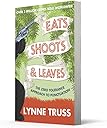
This is a great fun book, and I really enjoyed reading it. It has been a while since I laughed so hard. Wait, should I have said, "This is a great, fun book"? When do we use Mrs. Comma? The author writes, "Punctuation has been defined many ways. Some grammarians use the analogy of stitching: punctuation as the basting that holds the fabric of language in shape. Another writer tells us that punctuation marks are the traffic signals of language: they tell us to slow down, notice this, take a detour, and stop." (p. 7). Punctuation can alter the sense of a string of words. Take the following example: A woman, without her man, is nothing. A woman: without her, man is nothing. The use of punctuation is like fashion; it has its moments. One day it might be fashionable to use a semi-colon; another day it might not! Wait a second! Did I use my punctuation right? Should there have been a semi-colon after the word semi-colon? What a conundrum! And talking of semi-colons, did you know that colon in Greek means a limb (hence part of a strophe. A strophe is the first of two movements made by a chorus during the performance of a choral ode, but you all knew that, didn't you)? So a semi-colon is a half limb. But wait a minute, does apostrophe come from strophe or the other way round? Or maybe there is no relation whatsoever? Open your dictionaries! Did you know that women use exclamation marks more than men! Wait, I really meant to put a question mark! Did you know that most punctuation marks were invented by the early printers? Punctuation can render the written word into the way we talk. For example, poses between words, marking thoughts... How about punctuation in text messages? Do any of us bother putting them? And how about in emails or while chatting on the internet, how do we use punctuation? Who invented the smileys and for what reason? Smileys are made of punctuation marks. For example, :-) is a smiley meaning a smiling face. Smileys are made of punctuation marks. Funny enough, I was looking for the plural of smiley (which I thought to be smilies) and could not find the word in either the Oxford or the Webster dictionary. I, however, was able to find it in the Collins and the American Heritage dictionary. I wonder why that is?! Hey, was that a correct usage of punctuation?!!!!! Here's a nice fact: a few years ago, the average age of email users was 20. It is now 30, and climbing. More and more of us are using email to communicate with each other, and more and more of us are at a loss of how to use punctuation properly, if any. Just look at all the punctuation mistakes I have made in this short review (please don't count the grammatical errors!!!!!). This is a book you will love reading, and you will find yourself with a smile on your face. This book does not intend to teach you. Rather, it informs you! Did you say women use exclamation marks more often than men? The title of the book came about from a dictionary definition of panda. According to the author, the dictionary defined panda as a bear-like animal that eats, shoots and leaves. On the cover of the book, you actually see a panda on a ladder erasing the comma after eats. The sentence should have correctly read, `a bear-like animal that eats shoots and leaves.' Well, no one is perfect. (I keep wondering whether I am using punctuation correctly. What hath this book done to me? I mean to me!!!!!) I highly recommend the audio version of this book as well. In fact, the book is based on the audio version. Throughout the audio you will hear interviews with punctuation professionals and secret societies with the sole goal of correcting punctuation mistakes. Really, no kidding! Well, maybe not that secret. One such society has as its goal to correct apostrophe mistakes. For example, its or it's? They actually write letters to editors and store owners (is that owner's?) making them aware of the correct usage of this infamous punctuation mark. Some store owners actually change their signposts to reflect the correct usage. But many don't. Amazing! Who said all secret societies are bad? Here's a fact: The English language first picked up the apostrophe in the 16th century. The word in Greek means "turning away", and hence "omission" or "elusion". In classical texts, it was used to mark dropped letters, as in t'cius for "tertius" (p. 37). O, before I forget, here's a useful insight: The American and British editions of this book use punctuation differently! Wait, before I go, here's another thought: hopefully the author won't read my review and use me as an example of how horrible my punctuation is!!!!!!!!!!!!!!!!!!
C**R
Lynne Truss a su allier pertinence du propos et humour. Ce livre s'adresse donc à tous : du dilettante qui veut passer un bon moment au linguiste qui peut y trouver un bon point de départ avant d'amorcer des recherches plus approfondies.
A**R
If you love spelling, proper grammar and words used well get this primer on punctuation. It's useful but also quite funny.
Trustpilot
5 days ago
1 week ago