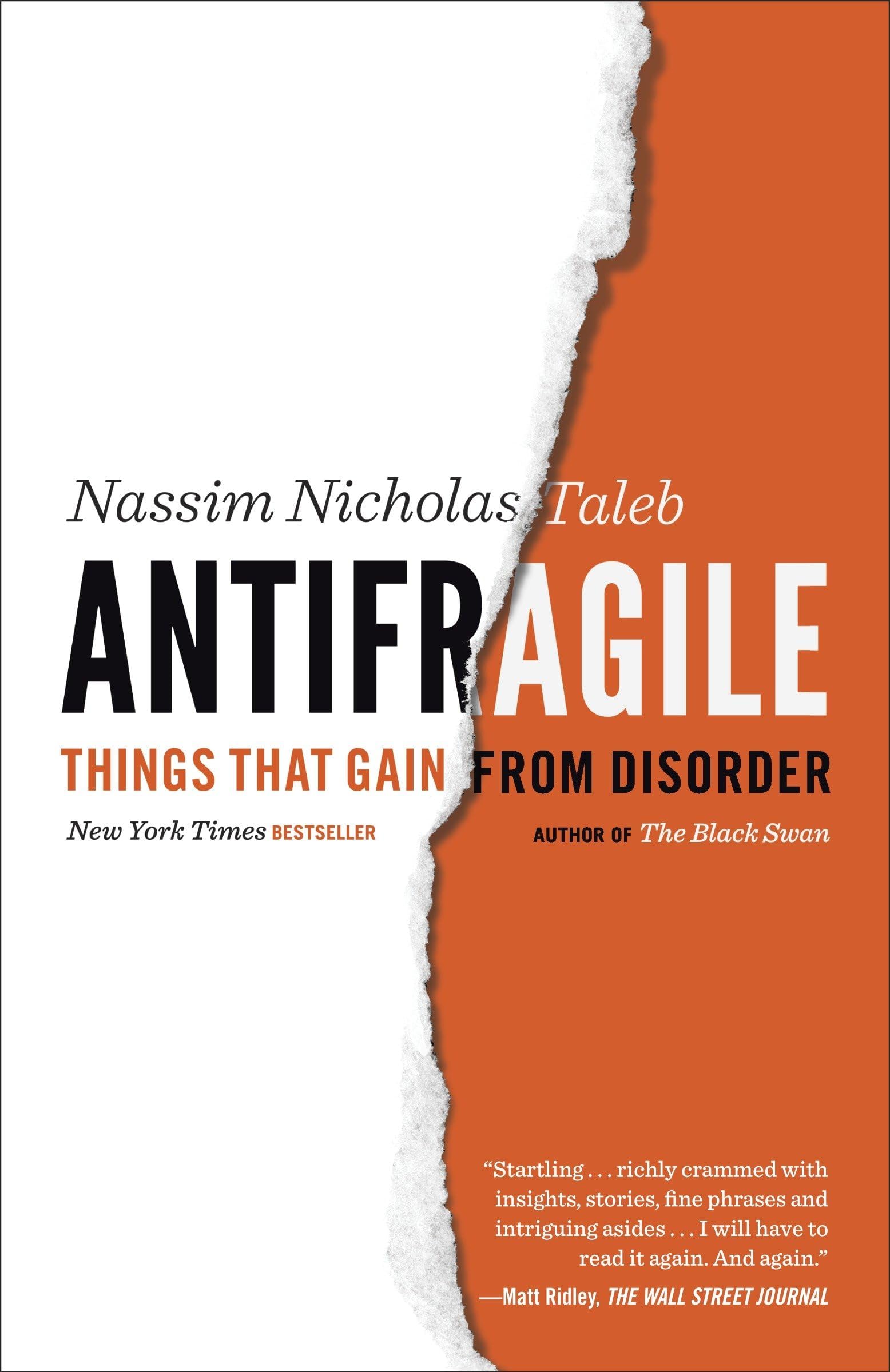
Antifragile: Things That Gain from Disorder (Incerto)
Product ID: 1704904
Buy anything from 5,000+ international stores. One checkout price. No surprise fees. Join 2M+ shoppers on Desertcart.
Desertcart purchases this item on your behalf and handles shipping, customs, and support to Brazil.
NEW YORK TIMES BESTSELLER • Antifragile is a standalone book in Nassim Nicholas Taleb’s landmark Incerto series, an investigation of opacity, luck, uncertainty, probability, human error, risk, and decision-making in a world we don’t understand. The other books in the series are Fooled by Randomness, The Black Swan, Skin in the Game, and The Bed of Procrustes . Nassim Nicholas Taleb, the bestselling author of The Black Swan and one of the foremost thinkers of our time, reveals how to thrive in an uncertain world. Just as human bones get stronger when subjected to stress and tension, and rumors or riots intensify when someone tries to repress them, many things in life benefit from stress, disorder, volatility, and turmoil. What Taleb has identified and calls “antifragile” is that category of things that not only gain from chaos but need it in order to survive and flourish. In The Black Swan, Taleb showed us that highly improbable and unpredictable events underlie almost everything about our world. In Antifragile, Taleb stands uncertainty on its head, making it desirable, even necessary, and proposes that things be built in an antifragile manner. The antifragile is beyond the resilient or robust. The resilient resists shocks and stays the same; the antifragile gets better and better. Furthermore, the antifragile is immune to prediction errors and protected from adverse events. Why is the city-state better than the nation-state, why is debt bad for you, and why is what we call “efficient” not efficient at all? Why do government responses and social policies protect the strong and hurt the weak? Why should you write your resignation letter before even starting on the job? How did the sinking of the Titanic save lives? The book spans innovation by trial and error, life decisions, politics, urban planning, war, personal finance, economic systems, and medicine. And throughout, in addition to the street wisdom of Fat Tony of Brooklyn, the voices and recipes of ancient wisdom, from Roman, Greek, Semitic, and medieval sources, are loud and clear. Antifragile is a blueprint for living in a Black Swan world. Erudite, witty, and iconoclastic, Taleb’s message is revolutionary: The antifragile, and only the antifragile, will make it. Praise for Antifragile “Ambitious and thought-provoking . . . highly entertaining.” — The Economist “A bold book explaining how and why we should embrace uncertainty, randomness, and error . . . It may just change our lives.” — Newsweek Review: Embrace Optionality and Don't Drink Orange Juice - Nassim Taleb's "Antifragile" is one of the most engaging books I've read in years. You should almost certainly make time for it. But if you can't, here is a top-of-mind recap (summarizations asterisked, with further impressions to follow). *Like the porcelain teacup, that which is fragile is harmed by volatility. That which is robust holds up and is thus 'volatility neutral'. That which is 'antifragile' actually benefits from volatility's presence. *The antifragility property only exists up to a point (e.g. modest physical stressors can be good for one's health via triggering the healing and building response - immodest physical stressors, not so much). *Time is the ultimate tester (and breaker) of all things - as such, time equates to volatility. Mother Nature is the master of incremental advancement (biological and societal evolution) through multi-dimensional long run trial and error (serendipitous random tinkering). Fragility in the parts often commutes to heightened antifragility for the system as a whole (e.g. individual humans are fragile, but the gene pool is not; individual restaurants are fragile, but the restaurant business is not). *True sophistication is shunning attempts to predict or "know" in favor of respect for the limits of knowledge, coupled with wariness of hidden risks and a habit of enlightened tinkering. *Academia deliberately misinterprets the evidence: Wealth and prosperity beget institutions of higher learning, not the other way round. Countries get rich and then build universities - universities do not help countries get rich. Real world practitioners have embedded knowledge that theorizers wrongly take post-hoc credit for (the "lecturing birds how to fly" effect). *Many "Soviet-Harvard" type errors come via disregard of time gaps - the delayed distribution of hidden costs and consequences (mistaking absence of evidence for evidence of absence). Those who suffer from neomania - love of the new - arrogantly assume we can improve on designs we don't truly understand, even when nature has taken centuries, or even millennia, to perfect what clearly works. *The barbell strategy, in which a small percentage of assets are concentrated in high risk, high reward investments, with a majority of assets in ultra-conservative safe harbor cash equivalents, is vastly superior to the higher-than-acceptable risk, lower-than-acceptable reward proposition of the muddled middle. (If you load up on a "respectable" multi-billion market cap blue chip stock, you might get badly harmed by an asbestos lawsuit or market crash, but your odds of substantial upside are zero). *Because existence is such a non-linear phenomenon - e.g. our hunter gatherer ancestors did not get an "average" or "balanced" nutritional intake each day, but rather feasted on some occasions and fasted on others - it bears out that Mother Nature (and thus our ancient biological systems) have intrinsically adapted to this nonlinearity, and even found ways to benefit from it (moderate level stressors strengthen the bones and muscles, random fluctuations in air pressure intake can benefit the lungs etc.). *Key directives: 1) Don't be a sucker; 2) Don't be a turkey. *Iatrogenics, literally interpreted "from a physician," refers to the unintended harm (bad side effects) resulting from ill-conceived attempts to heal, e.g. recommending marginal back surgery with greater likely downside than upside. Due to the presence of iatrogenics, low level treatments should generally be avoided (too much risk of downside relative to a small problem), while greater intervention risks should be taken in the event of serious illness (via higher likelihood benefits will outweigh costs). *The principle of "via negativa" suggests that, in terms of taking action, subtraction often trumps addition because it is so hard to improve on nature's time-tested original (without dilutive side effects). Infant mortality and life-saving surgery aside, the simple exhortation to stop smoking (give up cigarettes) has had more positive health impact than virtually all "modern medicine" advances of the 20th century. *Optionality is the property of asymmetric upside (preferably unlimited) with correspondingly limited downside (preferably tiny). Optionality can be found everywhere if you know how to look. That which benefits from randomness (increased potential for upside in the presence of fluctuations) is convex. That which is harmed by randomness, concave. Convexity propositions should be embraced - concave ones, avoided like the plague. *The transfer of fragility from one group to another, e.g. banks capturing the upside of speculative activity, then handing taxpayers the bill via bailouts, is morally reprehensible and should be stamped out. The agency problem can be solved by forcing risk takers to have skin in the game. Entrepreneurs, who take serious risks with their own capital, are the true heroes of modern society. *It is not necessarily better to be wealthy than poor. Beyond a certain point, the property of being wealthy (owning "stuff") morphs from antifragile to fragile (via increased anxiety, expectations / obligations, banal social commitments etc). *Reconsider eating apples and oranges, let alone drinking their concentrated juice, as the sweetness of such is man made - the high sugar content of modern fruit is the result of intensive breeding, with no thought as to what natural (much lower) sugar content ratios our ancient biological systems are adapted to. There is more, but that's the stuff that stuck with me... Re, gestalt impressions of the book, I will risk offending Taleb (not a hard thing to do) by drawing parallels to two other books much enjoyed: "How to Get Rich" by Felix Dennis and "Montaigne: A Life" by Sarah Bakewell. "How to Get Rich" - an excellent read with an awful title - is a funny, biting, brutally honest account of how one real world Brit made his pile. Felix Dennis is a self made entrepreneur (net worth upwards of half a billion) who built his publishing empire with guts and street smarts (rather than the more prosaic higher education, technical genius, pedigree connections etc). Antifragile reminded me of HTGR in that Taleb's book is a sort of field guide for approaching the entrepreneurial world, with the noble goal of getting one's share of "f- you money" to be set for life and thus free. Roughly speaking, the entrepreneur should behave as follows: Be humble, tenacious, and doggedly experimental; don't trust in experts or academic theory; don't think you know more than you do; and aggressively seek asymmetric payoffs with unlimited potential upside. Antifragile further reminded me of "Montaigne: A Life" - another wonderful, wonderful book - in that Taleb, like Montaigne centuries before him, articulates an attractively wide-ranging philosophy encompassing "how to live" almost in total. This is a notable accomplishment. Taleb's message resonates deeply with yours truly for three reasons: First, I was already well exposed to, and predisposed to, the benefits of optionality and asymmetric payoffs; second, I have access to older role models and relatives who have well exploited these (more than one to the tune of $100MM+); and third, because my own business and entrepreneurial life is built around optionality to an extreme degree. (As traders and poker players, we constantly seek out asymmetric upside with defined and limited downside; to give an example, Taleb's discussion of concavity, the undesirable inverse of convexity, is the rough poker equivalent of negative implied odds.) One can clearly see, however, why there would be a large contingent of "sour grapes" individuals who would take Antifragile as a bitter pill, given the preponderance of fragile career paths where upside is capped and volatility only introduces downside (standard journalism one of these?). When one has traded in one's freedom, and possibly one's moral and intellectual integrity, for life in a cage with a trap door, it can be maddening to read about the unfortunate realities of such! I do not mean to sound like a Taleb fanboy, though it feels contrarian to praise him at this point - given how popular it is for the snarky literary mainstream to dogpile on NNT's quirks and "cut down the tall poppy" as the Aussies say. Unjustified spray hose arrogance - the type that assumes "I have X credential or pedigree, so I know everything" - is one thing, and certainly deserves light ridicule. Expert-level confidence with defined limits, expressed in a particular domain and earned through excellence, is another. This helps explain why, though I generally detest pomposity, Taleb's prickliness and high-mindedness do not grate. Unlike charlatans and snobbish academics, he is arrogant for acceptable reasons (within a clearly defined domain), with an admirable willingness to make enemies. In conclusion, just as the runaway success of "Black Swan" was something of a black swan, "Antifragile" is, all in all, an antifragile tour de force. Review: After the Black Swan, Taleb strikes again with Antifragile - Here's probably one of the toughest review I ever had to write and I am not sure it is a good one, even if the topic I am addressing is great and important. But it's been a challenge to summarize what I learnt: Nicholas Nassim Taleb gives in this follow-up to the Black Swan a very interesting analysis of how the world can be less exposed to Black Swans, not by becoming more robust only, but by becoming antifragile, i.e. by benefiting from random events. His views include tensions between the individual and the groups, how distributed systems are more robust than centralized ones, how small unites are less fragile than big ones. This does not mean Taleb is against orgamizations, governments or laws as too little intervention induces totally messy situations. It is about putting the cursor at the right level. Switzerland represents for Taleb a good illustration of good state organizations with little central government, a lot of local responsibility. He has similar analogies for the work place, where he explains that an independent worker, who knows well his market, is less fragile to crises than big corporations and their employees. One way to make systems less fragile is to put some noise, some randomness which will stabilize them. This is well-known in science and also in social science. Just remember Athens was randomly nominating some of its leaders to avoid excess! Now let me quote the author. These are notes only but for serious reviews, visit the author's website, fooledbyrandomness. First Taleb is, as usual, unfair but maybe less than in the Black Swan. Here is an example: "Academics (particularly in social science) seem to distrust each other, [...] not to mention a level of envy I have almost never seen in business... My experience is that money and transactions purify relations; ideas and abstract matters like "recognition" and "credit" warp them, creating an atmosphere of perpetual rivalry. I grew to find people greedy for credentials nauseating, repulsive, and untrustworthy." [Page 17] Taleb is right about envy and rivalry but wrong in saying it is worse in academia; I think it is universal! In politics for example. But when money is available, maybe rivalry counts less than where there is little. Now a topic close to my activity: "This message from the ancients is vastly deeper than it seems. It contradicts modern methods and ideas of innovation and progress on many levels, as we tend to think that innovation comes from bureaucratic funding, through central planning, or by putting people through a Harvard Business School class by one Highly Decorated Professor of Innovation and Entrepreneurship (who never innovated anything) or hiring a consultant (who never innovated anything). This is a fallacy - note for now the disproportionate contribution of uneducated technicians and entrepreneurs to various technological leaps, from the Industrial Revolution to the emergence of Silicon Valley, and you will see what I mean." [Page 42] [Extreme and unfair again, even if not fully wrong!] "The antifragility of some comes necessarily at the expense of the fragility of others. In a system, the sacrifices of some units - fragile units, that is, or people - are often necessary for the well-being of other units or the whole. The fragility of every start-up is necessary for the economy to be antifragile, and that's what makes, among other things, entrepreneurship work: the fragility of the individual entrepreneurs and their necessarily high failure rate". [Page 65] What surprised me later is that Taleb shows that this is true of restaurants (not many succeed) as much as of high-tech start-ups. So it is not only about the uncertainty of new markets, but about uncertainty above all. Mathematics of convexity I have to admit Taleb is not easy to read. Not because it is complex (sometimes his ideas are pure common sense), but because it is dense with different even if consistent ideas. The book is divided in 25 chapters, but also in 7 books. In fact, Taleb insists on it, he might have written 7 different books! Even his mathematics is simple. His definition of convexity is a little strange though I found it interested (I teach convex optimization, and you might not know, it was the topic of my PhD!). Jensen inequality is interesting [Pages 342, 227 - Jensen was an amateur mathematician!]- the convex transformation of a mean is less or equal than the mean after convex transformation. Again individual (concave, we die) vs. collective (convex, antifragile, benefits from individual failures). So risk taking is good for collectivity if with insurance mechanisms. Risk taking + insurance vs. speculation with no value added. An example of a short and deep idea: "Decision making is based on payoffs, not knowledge". [Page 337] "Simply, small probabilities are convex to errors of computation. One needs a parameter, called standard deviation, but uncertainty about standard deviation has the effect of making the small probabilities rise. Smaller and smaller probabilities require more precision in computation. In fact small probabilities are incomputable, even if one has the right model - which we of course don't." [Taleb fails to mention Poincare yet he quoted him in the Black Swan, but whatever.] A visible tension between individual and collective interests Quotes again: "What the economy, as a collective, wants [business school graduates] to do is not to survive, rather to take a lot, a lot of imprudent risks themselves and be blinded by the odds. Their respective industries improve from failure to failure. Natural and nature-like systems want some overconfidence on the part of the individual economic agents, i.e., the overestimation of their chances of success and underestimation of the risks of failure in their business, provided their failure does not impact others. In other words, they want local, but not global overconfidence". [...] In other words, some class of rash, even suicidal, risk taking is healthy for the economy - under the conditions that not all people take the same risks and that these risks remain small and localized. Now, by disrupting the model, as we will see, with bailouts, governments typically favor a certain class of firms that are large enough to require being saved in order to avoid contagion to other businesses. This is the opposite of healthy risk taking; it is transferring fragility from the collective to the unfit. [...] Nietzsche's famous expression "what does not kill me makes me stronger" can be easily implemented as meaning Mithridatization or Hormesis but it may also mean "what did not kill me did not make me stronger, but it spared me because I am stronger than others; but it killed others and the average population is now stronger because the weak are gone". [...] This visible tension between individual and collective interests is new in history. [...] Some of the ideas about fitness and selection are not very comfortable to this author, which makes the writing of some sections rather painful - I detest the ruthlessness of selection, the inexorable disloyalty of Mother Nature. I detest the notion of improvement thanks to harm to others. As a humanist, I stand against the antifragility of systems at the expense of individuals, for if you follow the reasoning, this makes us humans individually irrelevant. " [Pages 75-77] A National Entrepreneur Day "Compare the entrepreneurs to the bean-counting managers of companies who climb the ladder of hierarchy with hardly ever any real downside. Their cohort is rarely at risk. My dream - the solution - is that we would have a National Entrepreneur Day, with the following message: Most of you will fail, disrespected, impoverished, but we are grateful for the risks you are taking and the sacrifices you are making for the sake of the economic growth of the planet and pulling others out of poverty. You are the source of our antifragility. Our nation thanks you." [Page 80] Local distributed systems, randomness and modernity "You never have a restaurant crisis. Why? Because it is composed of a lot of independent and competing small units that do not individually threaten the system and make it jump from one state to another. Randomness is distributed rather than concentrated." [Page 98] "Adding a certain number of randomly selected politicians to the process can improve the functioning of the parliamentary system." [Page 104] "Modernity is the humans' large-scale domination of the environment, the systematic smoothing of the world's jaggedness, and the stifling of volatility and stressors. We are going into a phase of modernity marked by the lobbyist, the very, very limited liability corporation, the MBA, sucker problems, secularization, the tax man, fear of the boss..." [Page 108] "Iatrogenics means literally "caused by the healer". Medical error still currently kills between three times (as accepted by doctors) and ten times as many people as car accidents in the United States, it is generally accepted that harm from doctors - not including risks from hospitals germs - accounts for more deaths than any single cancer. Iatrogenics is compounded by the "agency problem" which emerges when one party (the agent) has personal interested that are divorced from those of the one using his services (the principal). An agency problem is present with the stockbroker and medical doctor whose ultimate interest is their own checking account, not your financial and medical health." [Pages 111-112] Theories and intervention. "Theories are super-fragile outside physics. The very designation "theory" is even upsetting. In social science, we should call these constructs "chimeras" rather than theories. [Now you understand why Taleb has many enemies.] A main source of the economic crisis started in 2007 in the Iatrogenics of the attempt by [...] Alan Greenspan to iron out the "boom-bust" cycle which caused risks to go hide under the carpet. The most depressing part of the Greenspan story is that the fellow was a libertarian and seemingly convinced of the idea of leaving systems to their own devices; people can fool themselves endlessly. [...] The argument is not against the notion of intervention; in fact I showed above that I am equally worried about under-intervention when it is truly necessary. [...] We have a tendency to underestimate the role of randomness in human affairs. We need to avoid being blinded to the natural antifragility of systems, their ability to take care of themselves and fight our tendency to harm and fragilize them by not giving them a chance to do so. [...] Alas, it has been hard for me to fit these ideas about fragility within the current US political discourse. The democratic side of the US spectrum favors hyper-intervention, unconditional regulation and large government, while the Republican side loves large corporations, unconditional deregulation and militarism, both are the same to me here. Let me simplify my take on intervention. To me it is mostly about having a systematic protocol to determine when to intervene and when to leave systems alone. And we may need to intervene to control the iatrogenics of modernity - particularly the large-scale harm to the environment and the concentration of potential (though not yet manifested) damage, the kind of thing we only notice when it is too late. The ideas advanced here are not political, but risk-management based. I do not have a political affiliation or allegiance to a specific party; rather, I am introducing the idea of harm and fragility into the vocabulary so we can formulate appropriate policies to ensure we don't end up blowing up the planet and ourselves." [Pages 116-118] "To conclude, the best way to mitigate interventionism is to ration the supply of information. The more data you get, the less you know." [Page 128] "Political and economic "tail" events are unpredictable and their probabilities are not scientifically measurable." [Page 133] The barbell strategy and optionality "The Barbell strategy is a way to achieve anti-fragility, by decreasing downside rather than increasing upside, by lowering exposure to negative Black Swans. So just as Stoicism is the domestication, not the elimination, of emotions, so is the barbell a domestication, not the elimination, of uncertainty." [Page 159] "It is a combination of two extremes, one safe and one speculative, deemed more robust than a monomodal strategy. In biological systems, the equivalent of marrying an accountant and having an occasional fling with a rock star; for a writer, getting a stable sinecure and writing without the pressures of the market. Even trial and error are a form of barbell." [Glossary page 428] "The strength of the computer entrepreneur Steve Jobs was precisely in distrusting market research and focus groups - those based on asking people what they want - and following his own imagination, his modus was that people don't know what they want until you provide them with it." [Page 171] "America's asset is simply risk taking and the use of optionality, the remarkable ability to engage in rational forms of trial and error, with no comparative shame in failing, starting again and repeating failure. In modern Japan, by contrast, shame comes, with failure, which causes people to hide risks under the rug, financial or nuclear." "Nature does a California-style "fail early" - it has an option and uses it. Nature understands optionality effects better than humans. [...] The idea is voiced by Steve Jobs in a famous speech: "Stay hungry, stay foolish." He probably meant "Be crazy but retain the rationality of choosing the upper bound when you see it." Any trial and error can be seen as the expression of an option, so long as one is capable of identifying a favorable result and exploiting it." [Page 181] "Option is a substitute for knowledge- actually I don't understand what sterile knowledge is, since it is necessarily vague and sterile. So I make the bold speculation that many things we think are derived by skill come largely from options, but well-used options, much like Thales's situation [who had an option with olive presses - pages 173-174] rather than from what we claim to be understanding." [Page 186] Taleb is skeptical with experts, with anyone believing in a linear model academia -> applied science ->practice ("lecturing birds how to fly"); he believes in tinkering, heuristics, apprenticeship, and makes again many enemies for free! He claims the jet engine, financial derivatives, architecture, medicine were first developed by practitioners and then theorized by scientists, not invented or discovered by them. Tinkering vs. research "There has to be a form of funding that works. By some vicious turn of events, governments have gotten huge payoffs from research, but not as intended - just consider the Internet. It is just that functionaries are too teleological in the way they look for things and so are large corporations. Most large companies, such as Big Pharma, are their own enemies. Consider blue sky research, whereby grants and funding are given to people, not projects, and spread in small amounts across many researchers. It's been reported that in California, venture capitalists tend to back entrepreneurs, not ideas. Decisions are largely a matter of opinion, strengthened with who you know. Why? Because innovations drift, and one needs flâneur-like abilities to keep capturing the opportunities that arise. The significant venture capital decisions were made without real business plans. So if there was any analysis, it had to be of a backup, confirmatory nature. Visibly the money should go to the tinkerers, the aggressive tinkerers who you trust will milk the option." [Page 229] "Despite the commercial success of several companies and the stunning growth in revenues for the industry as a whole, most biotechnology firms earn no profit." [Page 237] [Optionality again] "(i) Look for optionality; in fact, rank things according to optionality, (ii) preferably with open-ended, not closed-ended, payoffs; (iii) do not invest in business plans but in people, so look for someone capable of changing six or seven times over his career, or more (an idea that is part of the modus operandi of the venture capitalist Marc Andreessen); one gets immunity from the backfit narratives of the business plan by investing in people. Make sure you are barbelled, whatever that means in your business." [Page 238] "I did here just debunk the lecturing-Birds-How-to-Fly epiphenomenon and the "linear model", suing simple mathematical properties of optionality. There Is no empirical evidence to support the statement that organized research in the sense it is currently marketed leads to great things promised by universities. [Cf also Peter Thiel lamentations about the promise of technologies] Education is an institution that has been growing without external stressors; eventually the thing will collapse." [A conclusion to book IV, page 261] Why is fragility non linear? "For the fragile, the cumulative effect of small shocks is smaller than the single effect of an equivalent single large shock. For the antifragile, shocks bring more benefits (equivalently, less harm) as their intensity increases (up to a point)." Via negativa "We may not need a name for or even an ability to express anything. We may just say something about what it is not. Michelangelo was asked by the pope about the secret of his genius, particularly how he carved the statue of David. His answer was: It's simple, I just remove everything that is not David." [Page 302-304] [...] "Charlatans are recognizable in that they will give you positive advice. Yet in practice, it is the negative that's used by the pros. One cannot really tell if a successful person has skills, or if a person with skills will succeed - but we can pretty much predict the negative, that a person totally devoid of skills will eventually fail." [...] "The greatest - most robust - contribution to knowledge consist in removing what we think is wrong. We know a lot more what is wrong than what is right. Negative knowledge is more robust to error than positive knowledge. [...] Since one small observation can disprove a statement, while millions can hardly confirm it [The Black Swan!], disconfirmation is more rigorous than confirmation. [...] Let us say that, in general, failure (and disconfirmation) are more informative than success and confirmation." [Funnily, I remember the main critics against my book were the lack of [positive] proposal in the end. I should have said there we many about what not to do!] "Finally, consider this modernized version in a saying from Steve Jobs: "People think focus means saying yes to the thing you've got to focus on. But that's not what it means at all. It means saying no to the hundred other good ideas that there are. You have to pick carefully. I'm actually as proud of the things we haven't done as the things I have done. Innovation is saying no to 1,000 things." [Page 302-304] Less is more "Simpler methods for forecasting and inference can work much, much better than complicated ones. "Fast and frugal" heuristics make good decisions despite limited time. First extreme effects: there are domains in which the rare event (good or bad) plays a disproportionate share and we tend to be blind to it. Just worry about Black Swan exposures and life is easy. There may not be an easily identifiable cause for a large share of the problems, but often there is an easy solution, sometimes with the naked eye rather than the use of the complicated analyses. Yet people want more data to solve problems." [Page 305-306] "The way to predict rigorously is to take away from the future, reduce from it things that do not belong to the coming times. What is fragile will eventually break, and luckily we can easily tell what is fragile. Positive Black Swans are more unpredictable than negative ones. Now I insist on the via negativa method of prophecy as being the only valid one." [Page 310] "For the perishable, every additional day in the life translates into a shorter additional life expectancy. For the non perishable, every additional day may imply a longer life expectancy. On general, the older the technology, the longer it is expected to last. I am not saying that all technologies do not age, only that those technologies that were prone to aging are already dead." [Page 319] "How can we teach children skills for the twenty-first century, since we do not know which skills will be needed? Effectively my answer would make them read the classics. The future is in the past. Actually there is an Arabic proverb to that effect: he who does not have a past has no future." [Page 320] [As can be read later in the book Taleb does not like the Bay Area culture. And it is no coincidence, it is a region with nearly no past, nearly no history, but it certainly help it create Silicon Valley innovations...] "If you have an old oil painting and a flat screen television, you will never mind changing the television, not the painting. Same with an old fountain pen and the latest Apple computer; [Taleb is really cautious with modernity and innovation, even if a user of it. With architecture, he has similar concerns. Again he prefers tradition to aggressive modernity. Same with the metric system vs. old methods] Top-down is usually irreversible, so mistakes tend to stick, whereas bottom-up is gradual and incremental, with creation and destruction along the way, thought presumably with a positive slope." [Pages 323-24] "So we can apply criteria of fragility and robustness to the handling of information - the fragile in that context is, like technology, what does not stand the test of time. [...] Books that have been around for ten years will be around for ten more; books that have been around for two millennia should be around for quite a bit of time. [...] The problem in deciding whether a scientific result or a new "innovation" is a breakthrough, that is, the opposite of noise, is that one needs to see all aspects of the idea - and there is always some opacity that time, and only time, can dissipate." [Page 329] "Now, what is fragile? The large, optimized, overreliance on technology, overreliance on the so-called scientific method instead of age-tested heuristics." "By issuing warnings based on vulnerability - that is, substractive prophecy - we are closer to the original role of the prophet: to warn, not necessarily to predict, and to predict calamities if people don't listen." Ethics "Under opacity and complexity, people can hide risks and hurt others. Skin in the game is the only true mitigator of fragility. We have developed a fondness for neomanic complication over archaic simplicity. [...] The worst problem of modernity lies in the malignant transfer of fragility and antifragility from one party to the other, with one getting the benefits, the other one (unwittingly) getting the harm, with such transfer facilitated by the growing wedge between the ethical and the legal. Modernity hides it especially well. It is of course an agency problem." [Page 373] [You can/should have a look at table 7, page 377] "In traditional societies, a person is only respectable and as worthy as the downside he (or, more, a lot more, than expected, she) is willing to face for the sake of others." [Page 376] "I want predictors to have visible scars on their body from prediction errors, not distribute these errors to society." [Page 386] [Don Quixote was already the sign of the end of the heroism, of the ethical behavior. Taleb's models are Malraux and Ralph Nader - "the man is a secular saint" [Page 394]. His enemies Thomas Friedman, Rubin and Stieglitz] [Is "skin in the game" the only way? The only solution? What about transparency?] About Science "Science must not be a competition; it must not have rankings - we can see how such a system will end up blowing up. Knowledge must not have an agency problem. One doctoral student once came to tell me that he believed in my ideas of fat tails and my skepticism of current methods of risk management, but that it would not help him get an academic job. "It's what everybody teaches and uses in papers" he said. Another student explained that he wanted a job at a good university, so he could make money testifying as an expert witness - they would not buy my idea on robust risk management because "everyone uses these textbooks". [Page 419] [So true!] Conclusion "All I want is to remove the optionality, reduce the antifragility of some at the expense of others. It is simple via negativa. [...] The golden rule: "Don't do unto others what you don't want them to do to you". [...] Everything gains or loses from volatility. Fragility is what loses from volatility or uncertainty. [...] Time is volatility. Education in the sense of the formation of the character, personality, and acquisition of true knowledge, likes disorder; label-driven education and educators abhor disorder. Innovation is precisely something that grains from uncertainty." [Pages 420-22] "It so happens that everything nonlinear is convex, concave or both. [...] We can build Black-Swan-protected systems thanks to detection of concavity, [...] and with a mechanism called convex transformation, the fancier name for the barbell. [...] Distributed randomness (as opposed to the concentrated type) is a necessity." [General comments] Taleb sometimes gives the feeling of contradictions: marketing is bad, but Steve Jobs is great; barbell strategy and optionality is great, but isn't it about risks and downsides transferred to others [Isn't Thales a pure speculator?], cigarettes are bad but traditions are good. Also this love of tradition makes people with more background at ease to take risks with barbell strategy; but what about the poor with nothing to lose? Benefits might statistically go to those who already have... [It reminds the story told by J.-B. Doumeng: It is a millionaire who recounts his difficult beginnings: "I bought an apple 50 cents, I polished it to shine and I sold it for one franc. With this, I bought two apples 50cts, I carefully polished and I sold them 2 Fr after a moment, I could buy a cart to sell my apples and then I made a big inheritance..."] You now know why it has been a challenge. A very strange, dense, fascinating book, but if you like these concepts, you must read Antifragile. In fact you must read the Black Swan first, if you have not and if you like it, I am sure you will read Antifragile.


| Best Sellers Rank | #5,744 in Books ( See Top 100 in Books ) #8 in Stock Market Investing (Books) #12 in Business Decision Making #13 in Decision-Making & Problem Solving |
| Customer Reviews | 4.5 out of 5 stars 8,249 Reviews |
M**R
Embrace Optionality and Don't Drink Orange Juice
Nassim Taleb's "Antifragile" is one of the most engaging books I've read in years. You should almost certainly make time for it. But if you can't, here is a top-of-mind recap (summarizations asterisked, with further impressions to follow). *Like the porcelain teacup, that which is fragile is harmed by volatility. That which is robust holds up and is thus 'volatility neutral'. That which is 'antifragile' actually benefits from volatility's presence. *The antifragility property only exists up to a point (e.g. modest physical stressors can be good for one's health via triggering the healing and building response - immodest physical stressors, not so much). *Time is the ultimate tester (and breaker) of all things - as such, time equates to volatility. Mother Nature is the master of incremental advancement (biological and societal evolution) through multi-dimensional long run trial and error (serendipitous random tinkering). Fragility in the parts often commutes to heightened antifragility for the system as a whole (e.g. individual humans are fragile, but the gene pool is not; individual restaurants are fragile, but the restaurant business is not). *True sophistication is shunning attempts to predict or "know" in favor of respect for the limits of knowledge, coupled with wariness of hidden risks and a habit of enlightened tinkering. *Academia deliberately misinterprets the evidence: Wealth and prosperity beget institutions of higher learning, not the other way round. Countries get rich and then build universities - universities do not help countries get rich. Real world practitioners have embedded knowledge that theorizers wrongly take post-hoc credit for (the "lecturing birds how to fly" effect). *Many "Soviet-Harvard" type errors come via disregard of time gaps - the delayed distribution of hidden costs and consequences (mistaking absence of evidence for evidence of absence). Those who suffer from neomania - love of the new - arrogantly assume we can improve on designs we don't truly understand, even when nature has taken centuries, or even millennia, to perfect what clearly works. *The barbell strategy, in which a small percentage of assets are concentrated in high risk, high reward investments, with a majority of assets in ultra-conservative safe harbor cash equivalents, is vastly superior to the higher-than-acceptable risk, lower-than-acceptable reward proposition of the muddled middle. (If you load up on a "respectable" multi-billion market cap blue chip stock, you might get badly harmed by an asbestos lawsuit or market crash, but your odds of substantial upside are zero). *Because existence is such a non-linear phenomenon - e.g. our hunter gatherer ancestors did not get an "average" or "balanced" nutritional intake each day, but rather feasted on some occasions and fasted on others - it bears out that Mother Nature (and thus our ancient biological systems) have intrinsically adapted to this nonlinearity, and even found ways to benefit from it (moderate level stressors strengthen the bones and muscles, random fluctuations in air pressure intake can benefit the lungs etc.). *Key directives: 1) Don't be a sucker; 2) Don't be a turkey. *Iatrogenics, literally interpreted "from a physician," refers to the unintended harm (bad side effects) resulting from ill-conceived attempts to heal, e.g. recommending marginal back surgery with greater likely downside than upside. Due to the presence of iatrogenics, low level treatments should generally be avoided (too much risk of downside relative to a small problem), while greater intervention risks should be taken in the event of serious illness (via higher likelihood benefits will outweigh costs). *The principle of "via negativa" suggests that, in terms of taking action, subtraction often trumps addition because it is so hard to improve on nature's time-tested original (without dilutive side effects). Infant mortality and life-saving surgery aside, the simple exhortation to stop smoking (give up cigarettes) has had more positive health impact than virtually all "modern medicine" advances of the 20th century. *Optionality is the property of asymmetric upside (preferably unlimited) with correspondingly limited downside (preferably tiny). Optionality can be found everywhere if you know how to look. That which benefits from randomness (increased potential for upside in the presence of fluctuations) is convex. That which is harmed by randomness, concave. Convexity propositions should be embraced - concave ones, avoided like the plague. *The transfer of fragility from one group to another, e.g. banks capturing the upside of speculative activity, then handing taxpayers the bill via bailouts, is morally reprehensible and should be stamped out. The agency problem can be solved by forcing risk takers to have skin in the game. Entrepreneurs, who take serious risks with their own capital, are the true heroes of modern society. *It is not necessarily better to be wealthy than poor. Beyond a certain point, the property of being wealthy (owning "stuff") morphs from antifragile to fragile (via increased anxiety, expectations / obligations, banal social commitments etc). *Reconsider eating apples and oranges, let alone drinking their concentrated juice, as the sweetness of such is man made - the high sugar content of modern fruit is the result of intensive breeding, with no thought as to what natural (much lower) sugar content ratios our ancient biological systems are adapted to. There is more, but that's the stuff that stuck with me... Re, gestalt impressions of the book, I will risk offending Taleb (not a hard thing to do) by drawing parallels to two other books much enjoyed: "How to Get Rich" by Felix Dennis and "Montaigne: A Life" by Sarah Bakewell. "How to Get Rich" - an excellent read with an awful title - is a funny, biting, brutally honest account of how one real world Brit made his pile. Felix Dennis is a self made entrepreneur (net worth upwards of half a billion) who built his publishing empire with guts and street smarts (rather than the more prosaic higher education, technical genius, pedigree connections etc). Antifragile reminded me of HTGR in that Taleb's book is a sort of field guide for approaching the entrepreneurial world, with the noble goal of getting one's share of "f- you money" to be set for life and thus free. Roughly speaking, the entrepreneur should behave as follows: Be humble, tenacious, and doggedly experimental; don't trust in experts or academic theory; don't think you know more than you do; and aggressively seek asymmetric payoffs with unlimited potential upside. Antifragile further reminded me of "Montaigne: A Life" - another wonderful, wonderful book - in that Taleb, like Montaigne centuries before him, articulates an attractively wide-ranging philosophy encompassing "how to live" almost in total. This is a notable accomplishment. Taleb's message resonates deeply with yours truly for three reasons: First, I was already well exposed to, and predisposed to, the benefits of optionality and asymmetric payoffs; second, I have access to older role models and relatives who have well exploited these (more than one to the tune of $100MM+); and third, because my own business and entrepreneurial life is built around optionality to an extreme degree. (As traders and poker players, we constantly seek out asymmetric upside with defined and limited downside; to give an example, Taleb's discussion of concavity, the undesirable inverse of convexity, is the rough poker equivalent of negative implied odds.) One can clearly see, however, why there would be a large contingent of "sour grapes" individuals who would take Antifragile as a bitter pill, given the preponderance of fragile career paths where upside is capped and volatility only introduces downside (standard journalism one of these?). When one has traded in one's freedom, and possibly one's moral and intellectual integrity, for life in a cage with a trap door, it can be maddening to read about the unfortunate realities of such! I do not mean to sound like a Taleb fanboy, though it feels contrarian to praise him at this point - given how popular it is for the snarky literary mainstream to dogpile on NNT's quirks and "cut down the tall poppy" as the Aussies say. Unjustified spray hose arrogance - the type that assumes "I have X credential or pedigree, so I know everything" - is one thing, and certainly deserves light ridicule. Expert-level confidence with defined limits, expressed in a particular domain and earned through excellence, is another. This helps explain why, though I generally detest pomposity, Taleb's prickliness and high-mindedness do not grate. Unlike charlatans and snobbish academics, he is arrogant for acceptable reasons (within a clearly defined domain), with an admirable willingness to make enemies. In conclusion, just as the runaway success of "Black Swan" was something of a black swan, "Antifragile" is, all in all, an antifragile tour de force.
H**T
After the Black Swan, Taleb strikes again with Antifragile
Here's probably one of the toughest review I ever had to write and I am not sure it is a good one, even if the topic I am addressing is great and important. But it's been a challenge to summarize what I learnt: Nicholas Nassim Taleb gives in this follow-up to the Black Swan a very interesting analysis of how the world can be less exposed to Black Swans, not by becoming more robust only, but by becoming antifragile, i.e. by benefiting from random events. His views include tensions between the individual and the groups, how distributed systems are more robust than centralized ones, how small unites are less fragile than big ones. This does not mean Taleb is against orgamizations, governments or laws as too little intervention induces totally messy situations. It is about putting the cursor at the right level. Switzerland represents for Taleb a good illustration of good state organizations with little central government, a lot of local responsibility. He has similar analogies for the work place, where he explains that an independent worker, who knows well his market, is less fragile to crises than big corporations and their employees. One way to make systems less fragile is to put some noise, some randomness which will stabilize them. This is well-known in science and also in social science. Just remember Athens was randomly nominating some of its leaders to avoid excess! Now let me quote the author. These are notes only but for serious reviews, visit the author's website, fooledbyrandomness. First Taleb is, as usual, unfair but maybe less than in the Black Swan. Here is an example: "Academics (particularly in social science) seem to distrust each other, [...] not to mention a level of envy I have almost never seen in business... My experience is that money and transactions purify relations; ideas and abstract matters like "recognition" and "credit" warp them, creating an atmosphere of perpetual rivalry. I grew to find people greedy for credentials nauseating, repulsive, and untrustworthy." [Page 17] Taleb is right about envy and rivalry but wrong in saying it is worse in academia; I think it is universal! In politics for example. But when money is available, maybe rivalry counts less than where there is little. Now a topic close to my activity: "This message from the ancients is vastly deeper than it seems. It contradicts modern methods and ideas of innovation and progress on many levels, as we tend to think that innovation comes from bureaucratic funding, through central planning, or by putting people through a Harvard Business School class by one Highly Decorated Professor of Innovation and Entrepreneurship (who never innovated anything) or hiring a consultant (who never innovated anything). This is a fallacy - note for now the disproportionate contribution of uneducated technicians and entrepreneurs to various technological leaps, from the Industrial Revolution to the emergence of Silicon Valley, and you will see what I mean." [Page 42] [Extreme and unfair again, even if not fully wrong!] "The antifragility of some comes necessarily at the expense of the fragility of others. In a system, the sacrifices of some units - fragile units, that is, or people - are often necessary for the well-being of other units or the whole. The fragility of every start-up is necessary for the economy to be antifragile, and that's what makes, among other things, entrepreneurship work: the fragility of the individual entrepreneurs and their necessarily high failure rate". [Page 65] What surprised me later is that Taleb shows that this is true of restaurants (not many succeed) as much as of high-tech start-ups. So it is not only about the uncertainty of new markets, but about uncertainty above all. Mathematics of convexity I have to admit Taleb is not easy to read. Not because it is complex (sometimes his ideas are pure common sense), but because it is dense with different even if consistent ideas. The book is divided in 25 chapters, but also in 7 books. In fact, Taleb insists on it, he might have written 7 different books! Even his mathematics is simple. His definition of convexity is a little strange though I found it interested (I teach convex optimization, and you might not know, it was the topic of my PhD!). Jensen inequality is interesting [Pages 342, 227 - Jensen was an amateur mathematician!]- the convex transformation of a mean is less or equal than the mean after convex transformation. Again individual (concave, we die) vs. collective (convex, antifragile, benefits from individual failures). So risk taking is good for collectivity if with insurance mechanisms. Risk taking + insurance vs. speculation with no value added. An example of a short and deep idea: "Decision making is based on payoffs, not knowledge". [Page 337] "Simply, small probabilities are convex to errors of computation. One needs a parameter, called standard deviation, but uncertainty about standard deviation has the effect of making the small probabilities rise. Smaller and smaller probabilities require more precision in computation. In fact small probabilities are incomputable, even if one has the right model - which we of course don't." [Taleb fails to mention Poincare yet he quoted him in the Black Swan, but whatever.] A visible tension between individual and collective interests Quotes again: "What the economy, as a collective, wants [business school graduates] to do is not to survive, rather to take a lot, a lot of imprudent risks themselves and be blinded by the odds. Their respective industries improve from failure to failure. Natural and nature-like systems want some overconfidence on the part of the individual economic agents, i.e., the overestimation of their chances of success and underestimation of the risks of failure in their business, provided their failure does not impact others. In other words, they want local, but not global overconfidence". [...] In other words, some class of rash, even suicidal, risk taking is healthy for the economy - under the conditions that not all people take the same risks and that these risks remain small and localized. Now, by disrupting the model, as we will see, with bailouts, governments typically favor a certain class of firms that are large enough to require being saved in order to avoid contagion to other businesses. This is the opposite of healthy risk taking; it is transferring fragility from the collective to the unfit. [...] Nietzsche's famous expression "what does not kill me makes me stronger" can be easily implemented as meaning Mithridatization or Hormesis but it may also mean "what did not kill me did not make me stronger, but it spared me because I am stronger than others; but it killed others and the average population is now stronger because the weak are gone". [...] This visible tension between individual and collective interests is new in history. [...] Some of the ideas about fitness and selection are not very comfortable to this author, which makes the writing of some sections rather painful - I detest the ruthlessness of selection, the inexorable disloyalty of Mother Nature. I detest the notion of improvement thanks to harm to others. As a humanist, I stand against the antifragility of systems at the expense of individuals, for if you follow the reasoning, this makes us humans individually irrelevant. " [Pages 75-77] A National Entrepreneur Day "Compare the entrepreneurs to the bean-counting managers of companies who climb the ladder of hierarchy with hardly ever any real downside. Their cohort is rarely at risk. My dream - the solution - is that we would have a National Entrepreneur Day, with the following message: Most of you will fail, disrespected, impoverished, but we are grateful for the risks you are taking and the sacrifices you are making for the sake of the economic growth of the planet and pulling others out of poverty. You are the source of our antifragility. Our nation thanks you." [Page 80] Local distributed systems, randomness and modernity "You never have a restaurant crisis. Why? Because it is composed of a lot of independent and competing small units that do not individually threaten the system and make it jump from one state to another. Randomness is distributed rather than concentrated." [Page 98] "Adding a certain number of randomly selected politicians to the process can improve the functioning of the parliamentary system." [Page 104] "Modernity is the humans' large-scale domination of the environment, the systematic smoothing of the world's jaggedness, and the stifling of volatility and stressors. We are going into a phase of modernity marked by the lobbyist, the very, very limited liability corporation, the MBA, sucker problems, secularization, the tax man, fear of the boss..." [Page 108] "Iatrogenics means literally "caused by the healer". Medical error still currently kills between three times (as accepted by doctors) and ten times as many people as car accidents in the United States, it is generally accepted that harm from doctors - not including risks from hospitals germs - accounts for more deaths than any single cancer. Iatrogenics is compounded by the "agency problem" which emerges when one party (the agent) has personal interested that are divorced from those of the one using his services (the principal). An agency problem is present with the stockbroker and medical doctor whose ultimate interest is their own checking account, not your financial and medical health." [Pages 111-112] Theories and intervention. "Theories are super-fragile outside physics. The very designation "theory" is even upsetting. In social science, we should call these constructs "chimeras" rather than theories. [Now you understand why Taleb has many enemies.] A main source of the economic crisis started in 2007 in the Iatrogenics of the attempt by [...] Alan Greenspan to iron out the "boom-bust" cycle which caused risks to go hide under the carpet. The most depressing part of the Greenspan story is that the fellow was a libertarian and seemingly convinced of the idea of leaving systems to their own devices; people can fool themselves endlessly. [...] The argument is not against the notion of intervention; in fact I showed above that I am equally worried about under-intervention when it is truly necessary. [...] We have a tendency to underestimate the role of randomness in human affairs. We need to avoid being blinded to the natural antifragility of systems, their ability to take care of themselves and fight our tendency to harm and fragilize them by not giving them a chance to do so. [...] Alas, it has been hard for me to fit these ideas about fragility within the current US political discourse. The democratic side of the US spectrum favors hyper-intervention, unconditional regulation and large government, while the Republican side loves large corporations, unconditional deregulation and militarism, both are the same to me here. Let me simplify my take on intervention. To me it is mostly about having a systematic protocol to determine when to intervene and when to leave systems alone. And we may need to intervene to control the iatrogenics of modernity - particularly the large-scale harm to the environment and the concentration of potential (though not yet manifested) damage, the kind of thing we only notice when it is too late. The ideas advanced here are not political, but risk-management based. I do not have a political affiliation or allegiance to a specific party; rather, I am introducing the idea of harm and fragility into the vocabulary so we can formulate appropriate policies to ensure we don't end up blowing up the planet and ourselves." [Pages 116-118] "To conclude, the best way to mitigate interventionism is to ration the supply of information. The more data you get, the less you know." [Page 128] "Political and economic "tail" events are unpredictable and their probabilities are not scientifically measurable." [Page 133] The barbell strategy and optionality "The Barbell strategy is a way to achieve anti-fragility, by decreasing downside rather than increasing upside, by lowering exposure to negative Black Swans. So just as Stoicism is the domestication, not the elimination, of emotions, so is the barbell a domestication, not the elimination, of uncertainty." [Page 159] "It is a combination of two extremes, one safe and one speculative, deemed more robust than a monomodal strategy. In biological systems, the equivalent of marrying an accountant and having an occasional fling with a rock star; for a writer, getting a stable sinecure and writing without the pressures of the market. Even trial and error are a form of barbell." [Glossary page 428] "The strength of the computer entrepreneur Steve Jobs was precisely in distrusting market research and focus groups - those based on asking people what they want - and following his own imagination, his modus was that people don't know what they want until you provide them with it." [Page 171] "America's asset is simply risk taking and the use of optionality, the remarkable ability to engage in rational forms of trial and error, with no comparative shame in failing, starting again and repeating failure. In modern Japan, by contrast, shame comes, with failure, which causes people to hide risks under the rug, financial or nuclear." "Nature does a California-style "fail early" - it has an option and uses it. Nature understands optionality effects better than humans. [...] The idea is voiced by Steve Jobs in a famous speech: "Stay hungry, stay foolish." He probably meant "Be crazy but retain the rationality of choosing the upper bound when you see it." Any trial and error can be seen as the expression of an option, so long as one is capable of identifying a favorable result and exploiting it." [Page 181] "Option is a substitute for knowledge- actually I don't understand what sterile knowledge is, since it is necessarily vague and sterile. So I make the bold speculation that many things we think are derived by skill come largely from options, but well-used options, much like Thales's situation [who had an option with olive presses - pages 173-174] rather than from what we claim to be understanding." [Page 186] Taleb is skeptical with experts, with anyone believing in a linear model academia -> applied science ->practice ("lecturing birds how to fly"); he believes in tinkering, heuristics, apprenticeship, and makes again many enemies for free! He claims the jet engine, financial derivatives, architecture, medicine were first developed by practitioners and then theorized by scientists, not invented or discovered by them. Tinkering vs. research "There has to be a form of funding that works. By some vicious turn of events, governments have gotten huge payoffs from research, but not as intended - just consider the Internet. It is just that functionaries are too teleological in the way they look for things and so are large corporations. Most large companies, such as Big Pharma, are their own enemies. Consider blue sky research, whereby grants and funding are given to people, not projects, and spread in small amounts across many researchers. It's been reported that in California, venture capitalists tend to back entrepreneurs, not ideas. Decisions are largely a matter of opinion, strengthened with who you know. Why? Because innovations drift, and one needs flâneur-like abilities to keep capturing the opportunities that arise. The significant venture capital decisions were made without real business plans. So if there was any analysis, it had to be of a backup, confirmatory nature. Visibly the money should go to the tinkerers, the aggressive tinkerers who you trust will milk the option." [Page 229] "Despite the commercial success of several companies and the stunning growth in revenues for the industry as a whole, most biotechnology firms earn no profit." [Page 237] [Optionality again] "(i) Look for optionality; in fact, rank things according to optionality, (ii) preferably with open-ended, not closed-ended, payoffs; (iii) do not invest in business plans but in people, so look for someone capable of changing six or seven times over his career, or more (an idea that is part of the modus operandi of the venture capitalist Marc Andreessen); one gets immunity from the backfit narratives of the business plan by investing in people. Make sure you are barbelled, whatever that means in your business." [Page 238] "I did here just debunk the lecturing-Birds-How-to-Fly epiphenomenon and the "linear model", suing simple mathematical properties of optionality. There Is no empirical evidence to support the statement that organized research in the sense it is currently marketed leads to great things promised by universities. [Cf also Peter Thiel lamentations about the promise of technologies] Education is an institution that has been growing without external stressors; eventually the thing will collapse." [A conclusion to book IV, page 261] Why is fragility non linear? "For the fragile, the cumulative effect of small shocks is smaller than the single effect of an equivalent single large shock. For the antifragile, shocks bring more benefits (equivalently, less harm) as their intensity increases (up to a point)." Via negativa "We may not need a name for or even an ability to express anything. We may just say something about what it is not. Michelangelo was asked by the pope about the secret of his genius, particularly how he carved the statue of David. His answer was: It's simple, I just remove everything that is not David." [Page 302-304] [...] "Charlatans are recognizable in that they will give you positive advice. Yet in practice, it is the negative that's used by the pros. One cannot really tell if a successful person has skills, or if a person with skills will succeed - but we can pretty much predict the negative, that a person totally devoid of skills will eventually fail." [...] "The greatest - most robust - contribution to knowledge consist in removing what we think is wrong. We know a lot more what is wrong than what is right. Negative knowledge is more robust to error than positive knowledge. [...] Since one small observation can disprove a statement, while millions can hardly confirm it [The Black Swan!], disconfirmation is more rigorous than confirmation. [...] Let us say that, in general, failure (and disconfirmation) are more informative than success and confirmation." [Funnily, I remember the main critics against my book were the lack of [positive] proposal in the end. I should have said there we many about what not to do!] "Finally, consider this modernized version in a saying from Steve Jobs: "People think focus means saying yes to the thing you've got to focus on. But that's not what it means at all. It means saying no to the hundred other good ideas that there are. You have to pick carefully. I'm actually as proud of the things we haven't done as the things I have done. Innovation is saying no to 1,000 things." [Page 302-304] Less is more "Simpler methods for forecasting and inference can work much, much better than complicated ones. "Fast and frugal" heuristics make good decisions despite limited time. First extreme effects: there are domains in which the rare event (good or bad) plays a disproportionate share and we tend to be blind to it. Just worry about Black Swan exposures and life is easy. There may not be an easily identifiable cause for a large share of the problems, but often there is an easy solution, sometimes with the naked eye rather than the use of the complicated analyses. Yet people want more data to solve problems." [Page 305-306] "The way to predict rigorously is to take away from the future, reduce from it things that do not belong to the coming times. What is fragile will eventually break, and luckily we can easily tell what is fragile. Positive Black Swans are more unpredictable than negative ones. Now I insist on the via negativa method of prophecy as being the only valid one." [Page 310] "For the perishable, every additional day in the life translates into a shorter additional life expectancy. For the non perishable, every additional day may imply a longer life expectancy. On general, the older the technology, the longer it is expected to last. I am not saying that all technologies do not age, only that those technologies that were prone to aging are already dead." [Page 319] "How can we teach children skills for the twenty-first century, since we do not know which skills will be needed? Effectively my answer would make them read the classics. The future is in the past. Actually there is an Arabic proverb to that effect: he who does not have a past has no future." [Page 320] [As can be read later in the book Taleb does not like the Bay Area culture. And it is no coincidence, it is a region with nearly no past, nearly no history, but it certainly help it create Silicon Valley innovations...] "If you have an old oil painting and a flat screen television, you will never mind changing the television, not the painting. Same with an old fountain pen and the latest Apple computer; [Taleb is really cautious with modernity and innovation, even if a user of it. With architecture, he has similar concerns. Again he prefers tradition to aggressive modernity. Same with the metric system vs. old methods] Top-down is usually irreversible, so mistakes tend to stick, whereas bottom-up is gradual and incremental, with creation and destruction along the way, thought presumably with a positive slope." [Pages 323-24] "So we can apply criteria of fragility and robustness to the handling of information - the fragile in that context is, like technology, what does not stand the test of time. [...] Books that have been around for ten years will be around for ten more; books that have been around for two millennia should be around for quite a bit of time. [...] The problem in deciding whether a scientific result or a new "innovation" is a breakthrough, that is, the opposite of noise, is that one needs to see all aspects of the idea - and there is always some opacity that time, and only time, can dissipate." [Page 329] "Now, what is fragile? The large, optimized, overreliance on technology, overreliance on the so-called scientific method instead of age-tested heuristics." "By issuing warnings based on vulnerability - that is, substractive prophecy - we are closer to the original role of the prophet: to warn, not necessarily to predict, and to predict calamities if people don't listen." Ethics "Under opacity and complexity, people can hide risks and hurt others. Skin in the game is the only true mitigator of fragility. We have developed a fondness for neomanic complication over archaic simplicity. [...] The worst problem of modernity lies in the malignant transfer of fragility and antifragility from one party to the other, with one getting the benefits, the other one (unwittingly) getting the harm, with such transfer facilitated by the growing wedge between the ethical and the legal. Modernity hides it especially well. It is of course an agency problem." [Page 373] [You can/should have a look at table 7, page 377] "In traditional societies, a person is only respectable and as worthy as the downside he (or, more, a lot more, than expected, she) is willing to face for the sake of others." [Page 376] "I want predictors to have visible scars on their body from prediction errors, not distribute these errors to society." [Page 386] [Don Quixote was already the sign of the end of the heroism, of the ethical behavior. Taleb's models are Malraux and Ralph Nader - "the man is a secular saint" [Page 394]. His enemies Thomas Friedman, Rubin and Stieglitz] [Is "skin in the game" the only way? The only solution? What about transparency?] About Science "Science must not be a competition; it must not have rankings - we can see how such a system will end up blowing up. Knowledge must not have an agency problem. One doctoral student once came to tell me that he believed in my ideas of fat tails and my skepticism of current methods of risk management, but that it would not help him get an academic job. "It's what everybody teaches and uses in papers" he said. Another student explained that he wanted a job at a good university, so he could make money testifying as an expert witness - they would not buy my idea on robust risk management because "everyone uses these textbooks". [Page 419] [So true!] Conclusion "All I want is to remove the optionality, reduce the antifragility of some at the expense of others. It is simple via negativa. [...] The golden rule: "Don't do unto others what you don't want them to do to you". [...] Everything gains or loses from volatility. Fragility is what loses from volatility or uncertainty. [...] Time is volatility. Education in the sense of the formation of the character, personality, and acquisition of true knowledge, likes disorder; label-driven education and educators abhor disorder. Innovation is precisely something that grains from uncertainty." [Pages 420-22] "It so happens that everything nonlinear is convex, concave or both. [...] We can build Black-Swan-protected systems thanks to detection of concavity, [...] and with a mechanism called convex transformation, the fancier name for the barbell. [...] Distributed randomness (as opposed to the concentrated type) is a necessity." [General comments] Taleb sometimes gives the feeling of contradictions: marketing is bad, but Steve Jobs is great; barbell strategy and optionality is great, but isn't it about risks and downsides transferred to others [Isn't Thales a pure speculator?], cigarettes are bad but traditions are good. Also this love of tradition makes people with more background at ease to take risks with barbell strategy; but what about the poor with nothing to lose? Benefits might statistically go to those who already have... [It reminds the story told by J.-B. Doumeng: It is a millionaire who recounts his difficult beginnings: "I bought an apple 50 cents, I polished it to shine and I sold it for one franc. With this, I bought two apples 50cts, I carefully polished and I sold them 2 Fr after a moment, I could buy a cart to sell my apples and then I made a big inheritance..."] You now know why it has been a challenge. A very strange, dense, fascinating book, but if you like these concepts, you must read Antifragile. In fact you must read the Black Swan first, if you have not and if you like it, I am sure you will read Antifragile.
A**T
A Brief Summary and Review
*A full executive summary of this book is available here: An Executive Summary of Nassim Nicholas Taleb's 'Antifragile: Things That Gain From Disorder' The concept of fragility is very familiar to us. It applies to things that break when you strike or stretch them with a relatively small amount of force. Porcelain cups and pieces of thread are fragile. Things that do not break so easily when you apply force or stress to them we call strong or resilient, even robust. A cast-iron pan, for instance. However, there is a third category here that is often overlooked. It includes those things that actually get stronger or improve when they are met with a stressor (up to a point). Take weight-lifting. If you try to lift something too heavy, you'll tear a muscle; but lifting more appropriate weights will strengthen your muscles over time. This property can be said to apply to living things generally, as in the famous aphorism `what doesn't kill you makes you stronger'. Strangely, we don't really have a word for this property, this opposite of fragility. For author Nassim Nicholas Taleb, this is a major oversight, for when we look closely, it turns out that a lot of things (indeed the most important things) have, or are subject to, this property. Indeed, for Taleb, all that lives, and all the complex things that these living things create (like societies, economic systems, businesses etc.) have, or must confront this property in some way. This is important to know, because understanding this can help us understand how to design and approach these things (and profit from them), and failing to understand it can cause us to unwittingly harm or even destroy them (and be harmed by them). So Taleb has taken it upon himself to name and explore this curious property and its implications; and in his new book `Antifragile: Things That Gain from Disorder' Taleb reports on his findings. As the title would suggest, what Taleb has found is that most complex systems not only gain from small stressors, but they are designed to gain more when these stressors are distributed irregularly, or randomly. This point is more difficult to accept because we tend to dislike disorder and randomness. Disorder can be frightening, because unpredictable, and is therefore not something that we readily welcome. So what we often do is attempt to remove the random and disorderly from our systems (and eliminate the shocks), and thus make them smooth. For example, we may try to take the boom and bust out of the economy, and instead aim for a gradual upward trend. For Taleb, though, this is a big mistake, because while removing the small shocks in a complex system may create stability for a time, it actually upsets the system and makes it prone to major shocks in the long term. What's more, unlike the small shocks (that refine and improve the system), the major shocks are usually damaging, and can even destroy the system. So removing the small shocks from a complex system doesn't create stability; rather, it creates the illusion of stability. In the economy, for instance, you get a long period of stability followed by a major crash. This phenomenon is not just confined to the economy. Indeed, Taleb maintains that it is the spirit of the age to believe that we can remove the disorder from any system (and eliminate the shocks), and render it orderly, smooth and predictable. We are almost always mistaken in this, and end up creating systems that are prone to major damage and even outright destruction (in Taleb's language, we `fragilize' these systems). We call the damaging and destructive episodes Black Swan events (Taleb himself coined the term). Better it would be by far, Taleb argues, to accept and even welcome a certain amount of disorder, randomness and jaggedness in our lives and systems, and put ourselves in a position to profit from the unpredictable, rather than eradicate it. On this last point, Taleb maintains that it is indeed possible to profit from the unpredictable (without having to actually predict any specific thing--which is next to impossible in the realm of the complex anyway). We simply need to recognize what systems are fragile (and therefore prone to collapse), and what systems are antifragile (and therefore prone to grow stronger from stressors), and get out of the way of the former, and put our faith in the latter. This applies not only to large, overarching systems like corporations, economic systems and political societies, but our own bodies and minds. Taleb presents a very intriguing position, and offers up some very interesting evidence in support of it (though at times we may wonder whether he is resorting to the same kind of cherry-picking of information that he accuses others of). Also, Taleb has a lot to say, and a bone to pick, so his style often comes across as arrogant--even bombastic (think Nietzsche). Some will like this, while others will be annoyed (I didn't mind it, but did not think it truly added anything for the most part). Also, Taleb jumps around and repeats himself often. This was more objectionable to me than his style, but ultimately I think the content rose well above this, and I truly enjoyed the book, and think it deserves a read. A full executive summary of the book is available here: An Executive Summary of Nassim Nicholas Taleb's 'Antifragile: Things That Gain From Disorder'
M**N
Evolution And The Dangers Of Stress-Free Living
A writer knows he's made it when a term he's invented becomes a popular idiom. Even people with no idea who Nassim Taleb is will use "Black Swan" in sentences today to describe an unpredicted event that shakes the world. Taleb coined that term in the title of his last book, and with "Antifragile" now he's come up with another word probably destined to get stuck in our lexicon with the same unnerving tenacity. Taleb has a knack for giving a sudden clear voice to ideas that explain a lot but which heretofore had been floating around formlessly. "Antifragile" is the quality inherent in certain things that not only makes them resistant to disorder but allows them to thrive on it and grow stronger. In Taleb's narrative, most antifragile systems are natural and unconscious, with evolution itself representing the epitome of the antifragility that has allowed life on Earth to progress in the face of natural chaos. Taleb actually devotes most of his effort in this book, however, to talking about the opposite of antifragility. He hates fragility and dislikes the people who cause it. Fragility arises when human beings stop coping pragmatically with the natural stresses in their environment and try to create unnatural carefree bubbles for themselves. Working as a Wall Street trader during the Alan Greenspan era, Taleb observed first-hand the manner in which the legendary Fed chairman responded to every hiccup in the financial markets with heavy doses of liquidity and ever-lower interest rates. Greenspan was lionized at the time for having "tamed" the business cycle and for creating what looked like an endless horizon of smooth business conditions and high investment returns. What he was in fact doing, in Taleb's way of thinking, was to vitiate restorative normal volatility and to lay groundwork for the crash of 2008 and the dismal aftermath with which we're still living today. "Fragilista" is the derisive term that Taleb applies to the human authors of fragility, and he singles out Greenspan as "the greatest Fragilista of all time." Be that as it may, the gentleman has plenty of bad company in this book. Anyone who picks up Antifragile with the idea it's a treatise primarily about market economics, however, is going to be surprised. While his erstwhile profession still provides Taleb with his central metaphors, he has by now moved beyond it and seemingly promoted himself into the ranks of the Great Philosophers. He sprinkles his text with the names of just about every ancient Greek and Roman philosopher and scientist most of us ever heard of, along with those of medieval theologians and various Middle-Eastern authors most of us haven't. While apparently self-taught, Taleb is well-read. Being multi-lingual and having been born in Lebanon, of course, he is unassumingly cosmopolitan, and I don't find his displays of erudition in any way pretentious. It's just that he appears to be one of those writers who, having achieved sufficient renown, doesn't have to pay much attention to editors any more. He rambles self-indulgently at times and takes the reader down many odd diversions, even as he pursues consistent lines of thought. He is interested in biology and nutrition, finding in these fields natural expressions of his central ideas. The talks about the quirky nutritional regimen he applies to his own life, for example. He subjects himself at random intervals to diets of sensitively balanced grains and veggies, hardcore fasting and, occasionally, in his words, "high quantities of fatty red meat". Eschewing theory as he does, he doesn't really try to explain any of this but seems to regard irregular nutritional inputs as key to healthy living. Once again for him, comfortable patterns in life are the enemy of long-range survival. He regards much of modern medical and pharmaceutical science as bunk, prone to overselling marginal benefits and ignoring murderous side effects. He's well-versed in statistical methods, and he slams the research behind it all as being undermined by a combination of misread correlation and the self-interested bias of the medical community. He comes across like a country grandmother in his preference for old-fashioned remedies. Two of his favorite words in this book are (1) "iatrogenic", which refers to harm caused inadvertently by well-meaning doctors, and (2) "hormesis", which refers the body's natural healing power in response manageable levels of toxins or disease-causing agents. These words tie together several of Taleb's diverse threads, and he applies them with caustic vigor in his critiques of both modern medical doctors and Harvard economists in their respective manias for curative intervention. Taleb is hard to place politically. His scorn for central planning and economic intervention in any form would seem to place him squarely on the hard conservative side of the spectrum. However, in his fury against bankers, military interventions, Big Tobacco, Big Pharma and large corporations in general, he sounds like Michael Moore. I suppose that the people he's closest to would be the Libertarians, although I'm sure that he himself would resist even that label. He would point out that the detested Alan Greenspan calls himself a Libertarian, or at least once did. What Taleb really is, in my opinion, is an instinctive anarchist, albeit a gentle one without any violence about him whatsoever. I've seen him interviewed a couple of times, and for all his bookishness, he can come across as willfully and almost proudly inarticulate. For me, he brings to mind a bit the young Bob Dylan, who refused to engage with people he obviously did not respect and was forever parrying their questions with non sequiturs and obscure little parables. People like Dylan and Teleb don't like getting maneuvered into boxes. For all his eccentricities, let there be no mistake about it: Nassim Taleb has one of the more powerful minds at work today in the public domain. Like all original thinkers, he's developing a very small number of core ideas that he circles around repeatedly in an effort to tease out as much meaning as possible. I judge the power of a book largely by the length of time it stays lodged in my consciousness after I put it down. I finished this one a couple of weeks ago and still have not stopped thinking about it. I generally read with a pencil in my hand and underline passages that strike me as particularly cogent expressions of important ideas. Leafing back through my copy of Antifragile, I find many pages where a third of the text is underlined. It's my belief that Taleb has placed his finger here one of the key dynamics that is driving contemporary events in the world: Efforts to micro-manage complex phenomena undermine natural processes and cause systemic breakdowns. For people who can put up with unconventional writing and occasional goofy disconnects, I highly recommend this latest book.
C**S
An original thinker in a land of repackagers
COMMENTARY ON WHY TO READ THE BOOK Before reading further see other fine reviews. This note is commentary to encourage reading the book, not a summary of content. I developed respect for Taleb as an original thinker and believed others would benefit, thus chose to `review'. With a limited number of original thinkers in a world of repackagers, people who can take a blank sheet and formulate new ideas are few. ANTIFRAGILE "Antifragile" is coined, no surprise. Form your own impression but I see "antifragile" as a descriptor for a system/position robust subjected to negative random events while thriving from positive events (... "that only the strong shall thrive; that surely the weak shall perish, and only the fit survive"). A unifying concept in the book is the need to secure an asymmetry of reward/risk, minimizing loss in an uncertain world while capturing the gains from positive occurrences. On the surface this is simple. The challenge is in the execution. STYLE This is not an academic treatise on risk. It is more of a long stream of consciousness, a recitation of thinking and philosophy viewed through the lens of `fragility' (more on this). "The first rule is not to fool yourself, and you are the easiest person to fool." Unlike academia who successfully fooled many with unproven ideas (ideas that can hurt you), Taleb is a pragmatist, a skeptic who seeks evidence and applies `science' to determine what to believe or support. At times Antifragile can feel tedious because of the cascade of stories and references. At these times, I urge stopping and pondering. The book is not lacking in ideas nor insights, despite an unfiltered, sometimes seeming intolerant sounding `voice'. The stories and references are documented, not invented. The unvarnished candor is refreshing. Suggestion for attacking the book ... read the Chapter Summaries and Prologue carefully. Stop and think before proceeding. For those needing a pithy message, read the Conclusion (Chapter 25) next. But ... don't stop reading or you'll miss the experience. Go to Chapter 1. FINANCIAL Of particular note is the criticism resulting from Taleb's scathing dismissal of Modern Portfolio Theory, Efficient Market Hypothesis, and financial theorists. Frankly, I'm shocked that many practical investors would believe MPT and EMH but the ideas have been continuously peddled by the investment community for decades despite the individual investor literature ... David Dremen in Contrarian Investment Strategies (1998), Benoit Mandelbrot in The Misbehavior of Markets. Mandelbrot discovered `fat tails' back to the mid 60's. That Taleb independently drew similar conclusions based on rigorous analysis commends him. Part of the reason these theories were so attractive to academia (mathematics borrowed from physics) is it dealt with symmetric analytical functions. The world is not necessarily symmetric and analytic, much less linear. Taleb makes this clear; everyone should understand. IMPACT ON READERS Antifragile is a book that may split the readership. Those who are `antifragile' in thinking may gain fewer insights but will be enriched by ideas and historical stories. Those whose thinking does not lean antifragile may find ideas strange. The key for the latter will be to suspend judgment, open minds, see with `fresh eyes'. For both there may be the overarching question about re-inventing oneself, adapting to be `antifragile'. The answer lies in personal preferences, interests, and boundary conditions. What are you willing to do and not willing to do? Drive a cab or work as a clerk for an established firm? Life is not a point function with an end state defining `success', enjoyment or even meaning. It's about the journey, not the destination which is common for all. Despite this, counsel offered to achieve antifragility should better protect you from whatever befalls you. SELECTED SECTIONS Planning is an anathema to Taleb who regards it as useless. Much to support this with untold stories of plans gone awry. Safe to say we live in ashes of plans failed. A lateral view may be valid that it is the exercise in thinking, exploring optionality, that has value, not the product. Unknown unknowns remain unknown. ("One who doesn't know and doesn't know that he doesn't know... He will be eternally lost in his hopeless oblivion!") Book VI, "Via Negativa", is thought provoking with a thesis of the importance of `what not to do', and caution as to the fragility of trying to forecast what will be. `What not' has to do with filtering (... subtractive thinking, my first experience 1989 when I realized this was powerful). Strategy execution places a premium on optimal use of resources, not being distracted by trying to do too many things. Sadly, selling this in a large organization invested in retaining all options to avoid making mistakes is challenging. Another interesting topic section is seeing the future, relevant to organizational learning thinking (e.g. Theory U). Taleb is the pragmatist. The last section, Book VII, "The Ethics of Fragility and Antifragility" commands attention. With blistering criticism, actions and people, Taleb condemns the lack of skin in the game. Please read this. VOICE Admittedly, Taleb can be received as a polarizing figure. Evidence of this is in the reviews. As I've suggested, put this aside. This book has significant ideas to impart to the open minded reader.
J**C
Great insights & Climax towards the end although there were some unfair statements to Dr Stiglitz
Like his previous book, there are many extremely unique insights and with so many topics mashed into a single book; it is pretty normal to read the book two or three times (like I did with the Black Swan) in order to fully appreciate the depth of the author's knowledge and the wisdom of the ancients. However, like many reviewers, I too think the author should submit his essays for editing: there are parts that are dryer than usual. So to make it more readable and for the 2nd edition of the book, he should add more satirical jokes or funny thought experiments that lighten the mood (esp. for sub book IV?) The idea of iatrogenics (or harmful side effects from receiving treatments) is interesting (In Chinese Medicine, there's a saying,"medicine carries 30% of poison") Other key insights include Stoicism, skin in the game, and many useful heuristics. In fact, we could "platonize" his key insights into useful checklists! In sum, It's a great read epecially towards the end, and it's fun reading his rants against famous authors/scholars though there are places where I feel pity and a bit unfair to scholars like Mr Stiglitz who in March 2002 (on page 478) published a paper saying that Fannie Mae 's new risk based capital standard: "ON THE BASIS OF HISTORICAL EXPERIENCE, the risk to the government from a potential default on GSE debt is effectively zero" Is this statement really completely wrong? is the author not subjected to hindsight bias? At least 9 months later ,the author in chapter 19 wrote a journalist from NY Times came to him sometime in 2003 concerning about the Fannie Mae problems; Then he wrote "if he (Stiglitz) were a businessman, he would be wiped out and exited the gene pool" That sounds way too harsh and affirmative. I would say the author suffers from overconfidence (in the same way as Stiglitz for his 2002 paper) to assert such an outrageous statement. Does a businessman, if Dr Stiglitz were one, have no optionality to get rid of his exposure or simply sell his stakes when facts and conditions change? Is it fair to insinuate that Dr Stiglitz or all investors back in 2002 would be stupid enough, after conditions obviously had changed by say 2005, to stick with Fannie Mae until it was bailed out? I think you could only argue Dr Stiglitz was overconfident about his assessments but we never knew back then in March 2002 that Alan Greenspan would maintain interest rates at such a low level for so long, and the author only realised the problem sometime in 2003. Talab is correct that Dr Stiglitz didn't see himself potentially as being the Turkey, but everyone makes mistakes based on what information they have, and I presume if Dr Stiglitz were the businessman, he would be like Warren Buffett who mistakenly bought Gen Re and had to sell all those derivatives contracts to reduce exposure. So despite loving the author's work, I would advise him to be a bit more humble and shouldn't assume the "smartest of economist" to be the most stupid investor or businessman: buy and hold or not change course towards the end even when there were so many new evidences against his initial position like housing bubble and ninja loans etc. This is completely the opposite of the Turkey's confidence being maximum based on historical evidence of being fed daily, right before the chef cooks it. To conclude, it is slightly cheap to attack an economist who he too respects in order to become infamous with assumptions that are unlikely to be true. However his main point "Joseph Stiglitz problem" might be true: "Mental cherry-picking, leading to contributing to the cause of a crisis while being convinced of the opposite-and thinking he predicted it" (pg. 432) And with his super intelligence, the author probably knows his statement "exit the gene pool" being too harsh - the attacks are probably a ploy to gain controversy deliberately to promote his book !! (he actually explained that the more criticisms the author received, the greater the sales!!) So I am helping the author to sell his book!! Anyway, whether you agree or not, readers should be grateful for having such thought provoking wonderful book available ! the glossary, appendix and notes (about 50 pages) have some more interesting and technical discussions. Thank you very much for writing such amazing book! Looking forward to the expanded version of Anti fragility in the near future with more satirical jokes and funny thought experiments in between the dry parts!
M**D
Interesting Thesis, Irritating Tone
In the conclusion of this book, Taleb reports that a friend of his asked him to explain his core argument while standing on one foot. Obviously an allusion to the famous story in which a gentile promises to convert if Rabbi Hillel can explain Judaism while standing on one foot, Taleb offers, "the best way to verify if you are alive is to check whether you like variations." I'll admit at the beginning of this review: there were sections of this book I had to skip. More on why in a bit. Taleb's thesis is that modernity is the attempt of human beings to turn the random into the predictable and stable, and that this attempt ironically causes MORE randomness and disorder. Taleb demonstrates that in evolution, economics, philosophy, ethics, politics and elsewhere, the "Antifragile," things which BENEFIT and get STRONGER due to stressors are the rule, not the exception. He believes that modernity, and our attempts to make our lives predictable and orderly only bring FRAGILITY, which either gets WEAKER with stressors or at best, barely survives stressors intact. This seems very compelling. Given my personal medical history as a Crohn's sufferer who has undergone five surgeries, the prospect that all of this suffering is actually making me STRONGER and more resilient rather than broken and weaker is inspiring. Taleb doesn't pretend that this theory is novel; indeed, much of his evidence is derived from ancient and classical wisdom and cultures. He notes that the maxim "what doesn't kill you makes you stronger," isn't NEW, just that it's almost completely ignored by policy makers, economists, parents who try to protect their children from all harm, and his previous colleagues in risk management positions. HOWEVER, and this is a big however, I find Taleb's tone and style incredibly off-putting. It's clear that he has an axe to grind with Ivy League educated leaders and policy makers. He even coins a particularly destructive pattern of fragile thought "Harvard/Soviet" something or other. In constantly trying to position himself as an Everyman speaking in the voice "Fat Tony" from Brooklyn, Taleb fails at every turn to NOT sound like an arrogant, long winded, elitist. Anyone whose short bio on the back flap describes him as "a flaneur meditating in cafes," is going to have trouble connecting with the reader. Don't be ashamed, I had to look up "flaneur" as well. It's someone who spends his or her time WALKING in a meditative and philosophical manner in the spirit of Montaigne. Wow. Another reviewer, who actually LIKED the book, described Taleb as an a*****e. Unlike her, I find his personal "a**-holier-than-thou-ness" inseparable from his argument. So Taleb is QUITE in love with the sound of his own voice and his verbosity, intentionally obscure chapter titles, and inability to maintain a straightforward argument free of bombast is the reason I found it impossible to read this book from cover to cover. Perhaps the problem is as simple as this: Taleb's central thesis about antifragility is written on the cover. It's interesting. It's a compelling idea. And really, Taleb could have devoted 35 concentrated pages advising us how to better embrace random events and stressors (Black Swans he calls them in his previous book) at work, in raising our children, and with regard to our own health. That would have been a five star endeavor and could have appeared as a lengthy New Yorker feature. But the room that a book length work gives Taleb to stretch out his legs is to his detriment. He is in dire need of editor unafraid to be called "too stupid to understand" to reign in his oversized ego and overwrought style. I am left interested and disappointed. Not a pleasant feeling after devoting so much time and concentration following Taleb's circuitous verbal "flaneur-ing."
G**R
A Book About Antifragility That Is Itself Antifragile
In The Bed of Procrustes, Nassim Taleb's book of aphorisms, he wrote: "An idea starts to be interesting when you get scared of taking it to its logical conclusion." Here's a thought experiment: suppose you were sending a package with delicate items to a friend - what would you write on the package? Since you don't want the ornaments to break, you'd likely write "fragile" on the package. Now, suppose for some strange reason you were sending some rocks (say, a pet rock) in a package to a friend - what would you write on the package then? Obviously you wouldn't need to write anything on it because the rocks are robust and wouldn't be harmed even if they were grossly mishandled. Those may sound like banal questions, with trivial answers, but here's a more interesting question: what would you write on a package that you wanted to be purposely mishandled? Or, what should we call something that is the exact opposite fragile, i.e., something that is not only robust, but actually gets stronger from being mishandled? Until fairly recently there was no word for this term, but the answer is that you'd write the neologism "antifragile", coined by Taleb in his provocative book Antifragile: Things That Gain From Disorder. Antifragile is part of a larger corpus called Incerto, which includes the books Dynamic Hedging, Fooled By Randomness, The Black Swan, and The Bed of Procrustes. Technically, Antifragile itself is composed of seven books, but I will simply refer to it as one book for the purpose of this review. [1] *** One of the most interesting things about being human is that we can understand things we can't necessarily articulate. Often the reason we can't articulate an idea is that we lack the linguistic tool to talk about it, but lacking the tool to talk about an idea doesn't necessarily preclude us from understanding it. Taleb is not the first human to understand antifragility, but he is the first person to give us the linguistic tool to talk about it. Taleb cites an interesting anecdote from the linguist Guy Deutscher near the beginning of the book. What Taleb learned from Deutscher was that until 140 years ago the Greeks didn't have a word for the color blue. Strangely though, they still saw the color blue when they looked to the sky. They weren't, then, physically color blind, but rather culturally color blind. Similarly, even though we have long understood some of the ramifications of antifragility when we've seen it, we moderns have been culturally blind to it. Evolution is the perfect example of a system with antifragile properties. Biological evolution, in particular, thrives off of randomness, stressors, and volatility, which ultimately cause adaptations to occur in individual organisms, and evolution to occur in the species. For example, consider the discovery of penicillin. It was an evolutionary (and harmful) shock to bacteria, but new forms of bacteria have adapted to the point where they are immune to the devastating consequences of penicillin. By trying to harm the bacteria, we have actually made them stronger, and this is precisely because they are antifragile. Although Taleb never explicitly puts it this way, I think for things biological, antifragile properties are a necessary trait. One of the more practical things Taleb points out in the book is that the human body is also antifragile. Intuitively, and more importantly empirically, weightlifters have long understood this. They purposely break down their muscles through the stress of lifting heavy weights and their muscles rebuild themselves to be stronger than they were before adapting to the stress. Antifragile systems (like humans) benefit from the recently revived concept of hormesis, which is the idea that small doses of harmful substances (like alcohol) are actually good for you because they make you stronger. [2] Or, as the toxicologists would say, "The dose determines the poison." Taleb, however, is scornful of those who use his ideas to justify the pseudo-science of homeopathy. Another ancient idea that is discussed in the book is iatrogenics, which means harm caused by the healer. Taleb suggests that Mother Nature and our bodies have a natural way of healing themselves and we often cause more harm through trying to naively "fix" things with medicines and surgical procedures (although this is not to say that all medicines and surgical procedures are bad). The old practice of bloodletting is the perfect example. Taleb reminds us that iatrogenic effects occur in fields outside of medicine too, like our economies and educational institutions. As astute readers of his prior works know, Taleb is not particularly fond of most bankers, academics, economists, and journalists for a plethora of reasons, namely because they suffer from a form of epistemic arrogance and naïve rationalism that not only harms themselves, but harms others as well. In Antifragile, Taleb has coined the term "fragilista" to refer to these individuals. Fragilistas, according to Taleb, naively try to suck the antifragility out of systems that depend on it for its wellbeing, and they occasionally suffer from severe ethical lapses too. Neurotic soccer moms are one such type of fragilista and they join the company of fragilista economists and journalists like Alan Greenspan, Paul Krugman, Joseph Stiglitz, and Thomas Friedman. Fragilista Robert Rubin, the former high ranking Citigroup official, had the honor of having "The Bob Rubin Problem" named after him because of an ethical lapse in which he finagled his way into getting financial upside without any possible downside at the taxpayers expense (a violation of Hammurabi's Code). For readers unfamiliar with Hammurabi's Code, Taleb described it as follows in a 2011 New York Times editorial: "If a builder builds a house for a man and does not make its construction firm, and the house which he has built collapses and causes the death of the owner of the house, that builder shall be put to death." The central idea behind the code, then, is that no one knows more about the house than the architect and they should not gain the upside without being exposed to downside. The ancient Babylonians clearly recognized that the code would remedy the problems that occur in situations where there was an upside-without-downside asymmetry problem, like there is with modern banker's bonuses. *** For as much as I love this book (and Taleb's other work), there is one thing that I must take issue with. It seems to me that being both a humanist and a proponent of antifragility are incompatible views. Taleb, however, claims that he is both of these things. The reason I see this as a contradiction is because human biological evolution cannot progress without stress and selection pressures (of all kinds) on individual humans. Thus, our attempts at saving weak individual people and trying to eliminate individual suffering may come at the expense of fragilizing the human species as a whole. Humanists, in this sense, are fragilistas. As a humanist, one should innately value all human life and want to limit human suffering to any extent possible (a position I'm in favor of). However, should this be done at the expense of fragilizing the species? Not all fragilistas have ill intentions, and good-hearted efforts to improve the human condition often paradoxically make things worse. As the old cliché goes, "the road to hell is paved with good intentions." In his philosophical novel Thus Spoke Zarathustra Nietzsche introduced the ideas of both the ubermensch (translated to be the overman or superman) and the last man. One interpretation of Nietzsche's work could be that the last man is the evolutionary byproduct of a society run by fragilistas and that the ubermensch is the human ideal for proponents of antifragility (i.e., all that humans can become). As a proponent of antifragility myself, this interpretation makes me uncomfortable, but I cannot deny the fact that there is definitely a Nietzechean ring to the idea of antifragility. If Nietzsche's ubermensch can be understood to be the byproduct of humanity's antifragility, then, Zarathustra was right, humanity can overcome itself if only it avoids fragilizing itself. Perhaps one of the things that defines us as humans, then, is that we morally, ethically, and systematically try to remove antifragility from the very antifragile system that created us (i.e., Mother Nature). After reading this book, I can't help but think that Nietzsche understood something startlingly haunting about the human condition: whatever supersedes humanity will embrace its antifragility.
S**H
This book changed my life
When I first read Jurgen Appelo's Management 3.0 I was already deeply impressed. Then Frédéric Laloux' "Reinventing Organizations" touched me even more. By a random pick from a "dotnet rocks" podcast about antifragile software architectures I detected this literature gem. This book is philosphical, yet practical for the day-to-day endeavours we encounter in our so-called modern world. It opens your eyes how things influence each other. That our world is not linear and non-predictable. And that it is good that way. Taleb demystifies the scharlatan sciences such as economics as taugh in universities today and detects the vulnerable point in our western societies. Yet this is not a book to complain about the atrocities of the world we're living in. Instead it makes courage. Courage to look at our world with different eyes. See what is a short gain, but probably non-lasting like a spark. Detect what is more lasting - or antifragile - since robustness is not the inverse of fragility. This book has impact on technology, society, sociology, almost every corner of our life. Still Taleb is not a radical: While pointing out how nature helps to cure itself and is the most persistent and antifragile institution ever he doesn't get into a mood of Darwinism or survival of the fittest. He just shows up where our limits are and what's the tradeoff of the lives we live today. Deeply impressing, a must-read. My world would be paler if I had missed this book.
F**U
Excellent
Excellent
A**N
5 things Nassim Nicholas Taleb hates
The third book of Taleb's Incerto trilogy was published in November 2012 and is now available in paperback. His first two books, Fooled By Randomness and The Black Swan, sold so well that he was paid an advance of $4m for the final instalment. Antifragile is an interesting read both intellectually and personally. Taleb famously gives little away to journalists but in this book his personality shines out through his writing. So emotionally charged is the book, I thought it would be appropriate to review it by reference to the subjects contained that come in for the most vitriol from Taleb. 1. Bankers Readers familiar with Taleb's other writings will already know how he feels about bankers. Taleb's definition of antifragility (systems that get stronger under volatility, as opposed to fragile ones that break) stems from his work in banking. One criticism that is already gaining much ground elsewhere is the absence of "skin in the game" for traders gambling with their clients' money. But Taleb's dislike of bankers is not just an academic one. Personal insults abound, including a "suit" held to task for getting a porter to carry his bags to the gym. 2. Politicians Fragility is often seen at a relatively simple level, a glass being the obvious example, whereas antifragility is a property of complex systems - the human body, human populations or markets. Politicians come under fire on (at least!) two counts. First, they cause chaos by interfering with systems that they do not understand. In particular, interventions by politicians tend to favour eradication of error, which increases fragility and risk of collapse. Secondly, and more strongly, politicians frequently gain personal advantage at the cost of others by talking a good game that they do not practice in their own lives. 3. Economists I don't think I need to explain why Taleb hates economists or give examples from the book. Instead I just want to mention Taleb's rather touching fondness for Nobel-prize winning economist Joseph Stiglitz. Despite Taleb naming the Stiglitz syndrome (predicting the future inconsistently and only taking credit for the ones that turn out to be correct) after him, Stiglitz does not come in for the same strength of insults dished out to other "fragilistas" and I am amused by my impression Taleb secretly quite likes him. 4. Alternative Medicine Taleb has a disdain for all modern medicine, and a whole section of the book explains the wrongheadedness of risking a serious issue by using insufficiently tested medicine for a non-life-threatening condition. The terrible example of treating morning sickness with thalidomide makes this point well. But don't confuse Taleb's skepticism with a belief in alternative therapies - he "went postal" on receiving a letter of support from one such practitioner saying she understood how he felt. 5. Orange Juice Taleb's hatred for orange juice is an example of a wider disdain for the modern diet. He reveals his personal food rules, and very fascinating they are: no liquids that have not existed for at least one thousand years (i.e. wine, water and coffee only), no fruit not present in the ancient Mediterranean (no pineapples, pawpaws or other exotica) and observance of Greek Orthodox fasts for health rather than religious reasons. He considers oranges to be the equivalent of candy, as the modern variety have been intentionally bred for their sweetness. I found Antifragile to be thought provoking and very entertaining. It is full of contradictions and inconsistencies, but the sincere passion behind the main themes gives the book its charm. The most delicious irony is that according to Taleb's own criteria - a book is more likely to contain accurate useful ideas the longer it has been in existence - the reader made their first mistake in choosing to pick the book up.
A**E
Great book
it is very good book
A**Y
Antifragility to survive, thrive and develop in unpredictable environment
Antifragile: Things That Gain from Disorder by Nassim Nicholas Taleb is a thought-provoking and insightful book that challenges readers to rethink their assumptions about risk, uncertainty, and resilience. Taleb is a renowned thinker and writer, and his ideas have had a significant impact on fields as diverse as finance, economics, and philosophy. The concept of antifragility, as introduced by Nassim Nicholas Taleb in his book "Antifragile: Things That Gain from Disorder", describes systems or entities that not only withstand stress, shocks, and uncertainty, but actually thrive and improve as a result. Antifragility is the opposite of fragility, where a system or entity is vulnerable to damage or collapse under stress, shocks, and uncertainty. Antifragile systems are characterized by their ability to adapt and learn from mistakes, to use variability and randomness to their advantage, and to improve through exposure to stressors. These systems are not only resilient, but they actively seek out and benefit from disruption and disorder. Taleb argues that antifragility is an essential characteristic for survival and success in complex and unpredictable environments. He identifies a range of antifragile systems, from biological organisms that improve through exposure to stressors, to businesses that thrive in volatile markets, to cultures and social systems that evolve through trial and error. In practical terms, the concept of antifragility has important implications for individuals, organizations, and societies. It suggests that instead of trying to eliminate risk and uncertainty, we should focus on building systems that can adapt and benefit from them. This might mean embracing experimentation and failure, seeking out diverse perspectives and approaches, and building redundancy and flexibility into our systems. Overall, the concept of antifragility challenges us to think differently about how we approach risk, uncertainty, and change. It offers a new perspective on resilience and adaptability, and suggests that there are opportunities for growth and improvement even in the most challenging and unpredictable situations. Overall, the book is an eye opener to think about risk and how to adjust to unpredictable environment.
Trustpilot
1 month ago
1 month ago