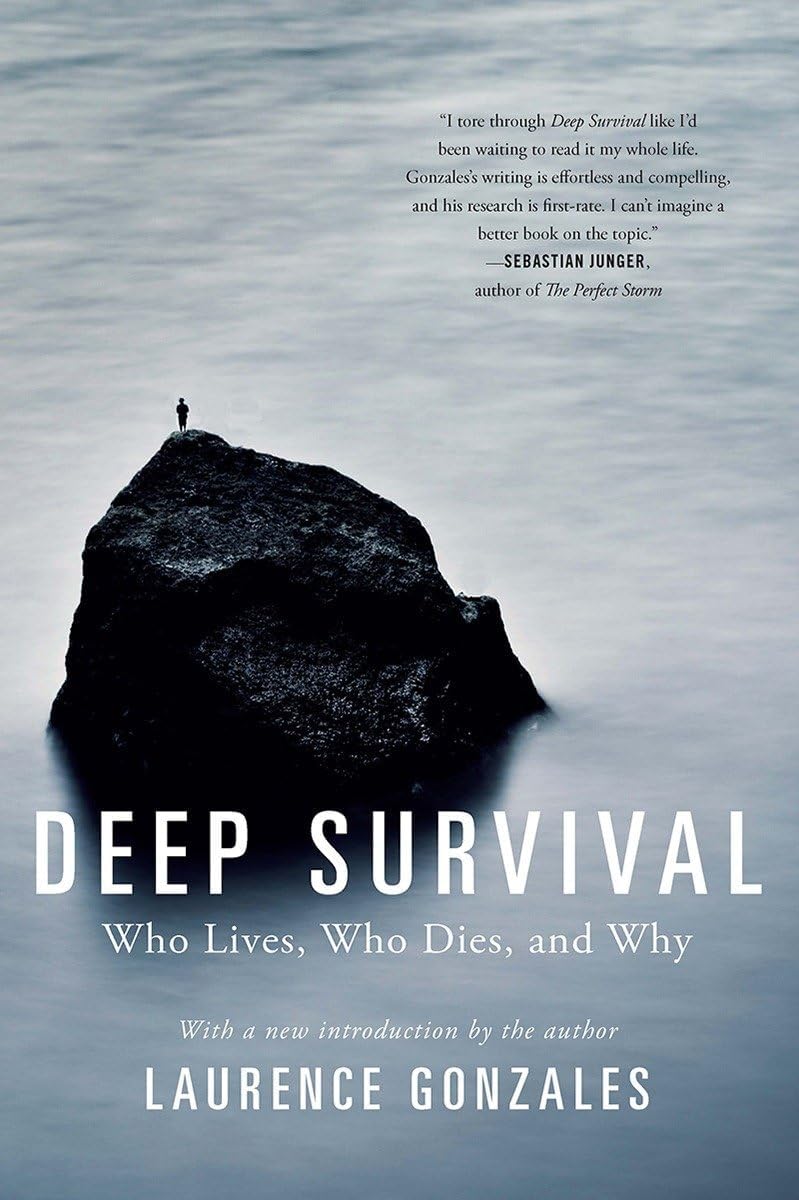
Deep Survival: Who Lives, Who Dies, and Why
Product ID: 38185723
Buy anything from 5,000+ international stores. One checkout price. No surprise fees. Join 2M+ shoppers on Desertcart.
Desertcart purchases this item on your behalf and handles shipping, customs, and support to Brazil.
"Unique among survival books…stunning…enthralling. Deep Survival makes compelling, and chilling, reading." ― Denver Post Laurence Gonzales’s bestselling Deep Survival has helped save lives from the deepest wildernesses, just as it has improved readers’ everyday lives. Its mix of adventure narrative, survival science, and practical advice has inspired everyone from business leaders to military officers, educators, and psychiatric professionals on how to take control of stress, learn to assess risk, and make better decisions under pressure. Review: Quite Simply - The Finest Book of its Kind that I Expect to Read - FIVE STARS!!!! - You talk about somebody being on top of his game. You have probably had the feeling before like this reader that you go through a book and say to yourself, this author has poured himself into the book. That is what we have here. Gonzalez has had a life-time to think about the different types of survival situations he is covering in this narrative, and each one is a story of courage, sacrifice, and living against the odds. He has somehow managed to figure out highly plausible explanations as to why some survive catastrophic circumstances while others fold, and die. Oddly enough most of the time it is not about who is the strongest physically, but rather who has what it takes INSIDE. Those who display bravado, they die the quickest. This reader simply loved this book, having read it when it first came out and then more recently once again on a trip out west, I would find myself sitting with pens underlining key statements, writing in margins, transposing sentences onto blank sheets in the front and back of the book. Who does this kind of thing? What kind of book can have that kind of effect on a reader? DEEP SURVIVAL is that kind of book. This is truly usable information we are dealing with. Other reviewers have done an excellent job of pointing out the assets and difficulties the book has. It is perhaps at this point more appropriate to point out some of the concepts you will learn by spending a few hours going through this book. It will dramatically change the way you look at your world around you, and perhaps if you discuss it with someone close to you, just might just save a life. The HIGHLIGHTS: * Gonzales talks about flying across the Pacific on vacation, stepping off a plane in Hawaii, and a few hours later putting on his bathing suit and going down to the beach for a swim whereupon he encounters a lifeguard and casually queries him, "Where do you think I should go for a swim today." Expecting a quick one or two sentence reply, he is astounded when the life guard gets down off his viewing post, and quietly spends several minutes looking at the water before replying. The guard then describes to the new vacationer in detail exactly the dangers that waiting for him in different sections of the visible water. To Gonzales it is obvious had he just gone casually into the water, he would have very easily wound him drowning. This leads us to the much bigger issue of how many people throughout the world would have just entered those waters with no awareness of the danger and then found themselves in trouble when it was too late to extricate themselves from danger. This whole concept is explored on page 130 of the book. * The dangers of mountain climbing and skiing are explored in detail. The author teaches you to have a new mindset when you enter the domain of the mountains. An amazing story is conveyed to the reader how people are trapped on a mountain, lifesavers from the ski patrol go up the trails, and successfully save those trapped. After it is all over, the lifesavers themselves then proceed to spirit their snowmobiles up and down the mountain to have a little fun after having been forewarned about the possibility of avalanches in this area, and then find themselves creating the very avalanche they were warned about. Several are killed instantly. How can this be? How can professionals totally aware of risk, trained to analyze and attempt to keep the odds on their side wind up killing themselves in the very environment that they are experts in? The answers are astounding, and there are lessons for each of us, if our minds are open to learning. * It is every parent's nightmare that their child gets lost, and Gonzales thoroughly covers this topic beginning on page 170. Years ago, I spent a week at the Squaw Valley Ski Resort. While traveling up the mountain with my daughter and a very experienced ski instructor, we met a young fellow about 8 years old traveling up the mountain alone. He was a member of a group that lives in the valley and has been trained in the ways of the mountain by professionals at Squaw that teach local children just this sort of activity. The ski instructor was completely comfortable with that boy going up alone. Now having been caught on two different mountains in a blizzard at Lake Tahoe over a ten year period, I simply could not believe it. Gonzalez explains in the book that people think because they are ensconced in a 50 million dollar set of buildings at the foot of a 21st century ski resort that somehow mother nature has been tamed. Man now rules the mountain - SURE. In this book you will learn why children 6 years and under have a much greater chance of survival and being found alive in a wilderness setting, than children 7 to 12 years of age. The evidence is in, the theories of why this is so are now known, and the information is available for our use in protecting our families. The author continues to both impress us, and educate us on topics that we really know nothing about, but think we know everything. * There is a direct correlation between the number of visitors to areas of danger such as the beaches in Hawaii, and mountain visitors and the number who disappear and die. The more visitors the more problems. This led the author to conclude that death in environments like this is a natural occurrence simply subject to ratios of the number of people involved. He also points out that these events like shark attacks are under-reported. As an example the number of people getting killed or bitten by sharks in Australia is much greater than what you read in newspapers. If you want to discourage tourism, just keep reporting high incidences of shark attacks. It makes sense, doesn't it? * For years we have all watched movies and television shows where actors do all kinds of stupid things that we say, no one would do that in real life. An example would be in a shootout, instead of protecting your body by shielding it behind something, you step out with your gun completely exposing your body and shoot from an exposed position. Sounds ludicrous, doesn't it? The author explains that people really do incredibly stupid things in survival situations, like take off their backpack and leaving it, or their jacket because they are feeling warm for the moment. There is an entire psychology and branch of survival thinking that explains this kind of behavior. Perhaps the best defense against acting this way is to understand deeply, the intuitive reflexes that guide this kind of behavior. The author is a master at conveying to us what we need to know to prevent falling into these cognitive traps. CONCLUSION: This book is fantastic and this reader does not expect to ever read anything as good as this book on this topic again. Very shortly after its publication, the author wrote another book on this very same topic. The first half of the sequel was once again excellent. The second half however meandered completely off topic, which leads this reader to believe that sometimes an author has just one great book in him. Once it gets written, the author seeks to capitalize on the success of his earlier works by writing another book. One last thought. You will remember a number of years back, a group of pros getting caught in a blizzard climbing Mount Everest. Several of them died on the mountain during that event. It is one of the worst catastrophes to hit Everest in years. Prior to climbing the mountain one of the guides with an international reputation who was killed during the storm told one of the group that was going to climb with him, "Don't worry about Everest, we have been climbing this mountain for so long, we have it WIRED." It's that type of thinking which is illustrated throughout this book that gets you into trouble very quickly in a hostile natural environment. If there is one book you want to read on survival and give to members of your family, then Deep Survival is it. Go for it, and thank you for reading this review. Richard Stoyeck Review: Managing Life's Challenges - "One of the ways in which I measure my appreciation and enjoyment of a book is by my desire to get back to it, with "Deep Survival" I looked forward to each time I had time to read and learn. From an overall perspective "Deep Survival" is well researched and balanced in delivering on multiple fronts. Gonzalez presents the how's and why's of people's survival through the vivid description of real life events, the biology within our heads, his life pursuit of the "cool" and finally, delivers a beautiful profile of his father. Did you know there is a battle going on in our head? The battle is one between your reasoning and emotions. Laurence Gonzalez provides a view into the biology of this battle. If you recognize that the hippocampus and amygdala are not only adversaries but also the keys to surviving, then you would have picked up on one of the messages within this book. The real life stories profiled in "Deep Survival" capture your attention as Gonzalez crawls into the smallest of details in their retelling. His use of these stories clearly profiles why people survive and why people don't. I was impressed how he so deeply captured this essence of the human spirit. In "Deep Survival" you may be provoked by a, "...well, of course..." response when reading about a survivor's behavior within their epic struggles. I propose that if you do have this response, then you need to shut down your hippocampus and truly "feel" their pain and their fear. For me Gonzalez delivered on this "feel" and I responded with, "how could they have remained calm?! How does one fall from the sky, have multiple serious injuries and then have the right of mind and spirit to survive? How!?" I don't view "Deep Survival" as a story of why people pursue such adventures, this is a book that tells the story of those people who succeed in returning from adventure. He addresses the question of why people "freeze in the moment" versus those who create and go to their "inner world" while in life threatening situations and why they return to their loved ones. What is survival? Is survival when something goes wrong while going into battle, sailing across an ocean, or climbing a mountain? Or, is survival the engagement with an upset customer, financial ruin, an angry boss, or the loss of a loved one? It is this last definition of surviving life's daily challenges that Gonzalez does not present in "Deep Survival", however the lessons are there within its pages and reading this book will assist you in your daily life events. The "between the line lessons" is the other reason why I recommend this book, it is not only those who go out and face nature, but to those who are surviving life."
| Best Sellers Rank | #15,617 in Books ( See Top 100 in Books ) #7 in Hiking & Camping Instructional Guides #30 in Popular Psychology Personality Study #63 in Cognitive Psychology (Books) |
| Customer Reviews | 4.4 out of 5 stars 2,960 Reviews |
R**T
Quite Simply - The Finest Book of its Kind that I Expect to Read - FIVE STARS!!!!
You talk about somebody being on top of his game. You have probably had the feeling before like this reader that you go through a book and say to yourself, this author has poured himself into the book. That is what we have here. Gonzalez has had a life-time to think about the different types of survival situations he is covering in this narrative, and each one is a story of courage, sacrifice, and living against the odds. He has somehow managed to figure out highly plausible explanations as to why some survive catastrophic circumstances while others fold, and die. Oddly enough most of the time it is not about who is the strongest physically, but rather who has what it takes INSIDE. Those who display bravado, they die the quickest. This reader simply loved this book, having read it when it first came out and then more recently once again on a trip out west, I would find myself sitting with pens underlining key statements, writing in margins, transposing sentences onto blank sheets in the front and back of the book. Who does this kind of thing? What kind of book can have that kind of effect on a reader? DEEP SURVIVAL is that kind of book. This is truly usable information we are dealing with. Other reviewers have done an excellent job of pointing out the assets and difficulties the book has. It is perhaps at this point more appropriate to point out some of the concepts you will learn by spending a few hours going through this book. It will dramatically change the way you look at your world around you, and perhaps if you discuss it with someone close to you, just might just save a life. The HIGHLIGHTS: * Gonzales talks about flying across the Pacific on vacation, stepping off a plane in Hawaii, and a few hours later putting on his bathing suit and going down to the beach for a swim whereupon he encounters a lifeguard and casually queries him, "Where do you think I should go for a swim today." Expecting a quick one or two sentence reply, he is astounded when the life guard gets down off his viewing post, and quietly spends several minutes looking at the water before replying. The guard then describes to the new vacationer in detail exactly the dangers that waiting for him in different sections of the visible water. To Gonzales it is obvious had he just gone casually into the water, he would have very easily wound him drowning. This leads us to the much bigger issue of how many people throughout the world would have just entered those waters with no awareness of the danger and then found themselves in trouble when it was too late to extricate themselves from danger. This whole concept is explored on page 130 of the book. * The dangers of mountain climbing and skiing are explored in detail. The author teaches you to have a new mindset when you enter the domain of the mountains. An amazing story is conveyed to the reader how people are trapped on a mountain, lifesavers from the ski patrol go up the trails, and successfully save those trapped. After it is all over, the lifesavers themselves then proceed to spirit their snowmobiles up and down the mountain to have a little fun after having been forewarned about the possibility of avalanches in this area, and then find themselves creating the very avalanche they were warned about. Several are killed instantly. How can this be? How can professionals totally aware of risk, trained to analyze and attempt to keep the odds on their side wind up killing themselves in the very environment that they are experts in? The answers are astounding, and there are lessons for each of us, if our minds are open to learning. * It is every parent's nightmare that their child gets lost, and Gonzales thoroughly covers this topic beginning on page 170. Years ago, I spent a week at the Squaw Valley Ski Resort. While traveling up the mountain with my daughter and a very experienced ski instructor, we met a young fellow about 8 years old traveling up the mountain alone. He was a member of a group that lives in the valley and has been trained in the ways of the mountain by professionals at Squaw that teach local children just this sort of activity. The ski instructor was completely comfortable with that boy going up alone. Now having been caught on two different mountains in a blizzard at Lake Tahoe over a ten year period, I simply could not believe it. Gonzalez explains in the book that people think because they are ensconced in a 50 million dollar set of buildings at the foot of a 21st century ski resort that somehow mother nature has been tamed. Man now rules the mountain - SURE. In this book you will learn why children 6 years and under have a much greater chance of survival and being found alive in a wilderness setting, than children 7 to 12 years of age. The evidence is in, the theories of why this is so are now known, and the information is available for our use in protecting our families. The author continues to both impress us, and educate us on topics that we really know nothing about, but think we know everything. * There is a direct correlation between the number of visitors to areas of danger such as the beaches in Hawaii, and mountain visitors and the number who disappear and die. The more visitors the more problems. This led the author to conclude that death in environments like this is a natural occurrence simply subject to ratios of the number of people involved. He also points out that these events like shark attacks are under-reported. As an example the number of people getting killed or bitten by sharks in Australia is much greater than what you read in newspapers. If you want to discourage tourism, just keep reporting high incidences of shark attacks. It makes sense, doesn't it? * For years we have all watched movies and television shows where actors do all kinds of stupid things that we say, no one would do that in real life. An example would be in a shootout, instead of protecting your body by shielding it behind something, you step out with your gun completely exposing your body and shoot from an exposed position. Sounds ludicrous, doesn't it? The author explains that people really do incredibly stupid things in survival situations, like take off their backpack and leaving it, or their jacket because they are feeling warm for the moment. There is an entire psychology and branch of survival thinking that explains this kind of behavior. Perhaps the best defense against acting this way is to understand deeply, the intuitive reflexes that guide this kind of behavior. The author is a master at conveying to us what we need to know to prevent falling into these cognitive traps. CONCLUSION: This book is fantastic and this reader does not expect to ever read anything as good as this book on this topic again. Very shortly after its publication, the author wrote another book on this very same topic. The first half of the sequel was once again excellent. The second half however meandered completely off topic, which leads this reader to believe that sometimes an author has just one great book in him. Once it gets written, the author seeks to capitalize on the success of his earlier works by writing another book. One last thought. You will remember a number of years back, a group of pros getting caught in a blizzard climbing Mount Everest. Several of them died on the mountain during that event. It is one of the worst catastrophes to hit Everest in years. Prior to climbing the mountain one of the guides with an international reputation who was killed during the storm told one of the group that was going to climb with him, "Don't worry about Everest, we have been climbing this mountain for so long, we have it WIRED." It's that type of thinking which is illustrated throughout this book that gets you into trouble very quickly in a hostile natural environment. If there is one book you want to read on survival and give to members of your family, then Deep Survival is it. Go for it, and thank you for reading this review. Richard Stoyeck
L**N
Managing Life's Challenges
"One of the ways in which I measure my appreciation and enjoyment of a book is by my desire to get back to it, with "Deep Survival" I looked forward to each time I had time to read and learn. From an overall perspective "Deep Survival" is well researched and balanced in delivering on multiple fronts. Gonzalez presents the how's and why's of people's survival through the vivid description of real life events, the biology within our heads, his life pursuit of the "cool" and finally, delivers a beautiful profile of his father. Did you know there is a battle going on in our head? The battle is one between your reasoning and emotions. Laurence Gonzalez provides a view into the biology of this battle. If you recognize that the hippocampus and amygdala are not only adversaries but also the keys to surviving, then you would have picked up on one of the messages within this book. The real life stories profiled in "Deep Survival" capture your attention as Gonzalez crawls into the smallest of details in their retelling. His use of these stories clearly profiles why people survive and why people don't. I was impressed how he so deeply captured this essence of the human spirit. In "Deep Survival" you may be provoked by a, "...well, of course..." response when reading about a survivor's behavior within their epic struggles. I propose that if you do have this response, then you need to shut down your hippocampus and truly "feel" their pain and their fear. For me Gonzalez delivered on this "feel" and I responded with, "how could they have remained calm?! How does one fall from the sky, have multiple serious injuries and then have the right of mind and spirit to survive? How!?" I don't view "Deep Survival" as a story of why people pursue such adventures, this is a book that tells the story of those people who succeed in returning from adventure. He addresses the question of why people "freeze in the moment" versus those who create and go to their "inner world" while in life threatening situations and why they return to their loved ones. What is survival? Is survival when something goes wrong while going into battle, sailing across an ocean, or climbing a mountain? Or, is survival the engagement with an upset customer, financial ruin, an angry boss, or the loss of a loved one? It is this last definition of surviving life's daily challenges that Gonzalez does not present in "Deep Survival", however the lessons are there within its pages and reading this book will assist you in your daily life events. The "between the line lessons" is the other reason why I recommend this book, it is not only those who go out and face nature, but to those who are surviving life."
D**R
Hiking? Don't forget your pack, your shoes, and your brain.
The prologue was enough to get my attention, but I read on and just a few sentences into the first chapter, I could see that Gonzales is a great story teller. Weaving prose back and forth and leading you to wanting more, he teaches you about the chemistry of the brain, bravery, and stupidity in the face of danger. You get his point in the first chapter but you want to read more. I thought I had what it takes to survive but now I just hope I don't go stark raving mad in the first fifteen minutes if ever faced with the challenge. This book isn't what I'd call an easy read, but it is deeply compelling. Gonzales tries to be as comprehensive as possible without being called a medical textbook. His discussion of the human body's functioning can get boring. For instance, he says, "In the case of vision, axons from the retina go to the visual thalamus." Who cares? I don't! He says more about this stuff than I would ever care to know. However, these points solidify what he is saying about our reactions in dangerous situations; a very important factor if you are to trully learn how to survive. His stories are more than interesting opinions, they are research based facts that explain what happens to people when they get lost and panic. The medical stuff tapers off, but you see how important it is later as he paints pictures of what happens to those who aren't prepared both with equipment and with mental stamina. The author compares emotions and cognition; two forces that spur us to action. You quickly learn that we rely on feelings, much more than we do our thinking. This is very dangerous because our feelings are not based on the hard evidence before us. People who should know better, make bad decisions because of what Gonzales calls emotional bookmarks. "This was a good idea last time, so it must be a good idea now." People emotionally rationalize behavior based on past experiences rather than what they see in the actual situation. He even admits to faulty reasoning of his own in the face of overwhelming evidence to the contrary. Once Gonzales establishes a firm base with stories and brain based studies, the book continues with comparisons and contrasts of events where people died and also lived even though their odds said just the opposite. You won't learn how to build a fire or skewer a wild pig like Rambo, but you will learn a great deal about the most important survival tool you have; your brain. Without it, even the best of equipment will be useless. Basically, Gonzales says, doing stupid things, not thinking, and being impatient will get you killed even if you know what you're doing. Sounds simple, but it is much more complicated than you might think.
A**N
Survivor's orientation
Gonzales, L. (2017). Deep survival: Who lives, who dies, and why: true stories of miraculous endurance and sudden death. W.W. Norton & Company. Laurence Gonzales is the author of numerous books. Gonzales explored a number of "accidents" from flying, boats, diving, climbing, hiking, etc. to learn what distinguished those who survived versus those who died. Through storytelling connected to interdisciplinary research (e.g., brain science, psychology), Gonzales creatively tells stories to identify actions survivors do in advance of an activity and after an accident. In advance, survivors: (1) Perceive, believe, then act. As the environment changes, what you need is versatility, the ability to perceive what's really happening and adapt to it (2) STOP thinking: Stop, Think, Observe, Plan; (3) Avoid impulsive behavior; (4) Know their stuff; (5) Ask questions; (6) Listen, observe from accidents; (7) Adopt humility and maintenance of a positive attitude. These qualities in general, support a person's calibration once an accident occurs where survivors: (a) Perceive, believe (look, see, believe); (b) Stay calm - use humor; (c) Think/Analyze/Plan (get organize; set up small, manageable tasks); (d) Take correct, decisive action; (e) Take joy in completing tasks; (f) Count blessings; (g) Play - sing, play mind games, recite poetry, count anything, do mathematical problems in their head; (h) See beauty; (i) Believe that they will succeed; (j) Let go of the fear of dying; (k) Do whatever is necessary; (l) Never give up. This would be a super book for those interested in organizational change, why things fail, and leadership.
O**E
Excellent read.
Read it in two days while camping. Normally non-story/info type books take me forever to read because the authors never seem to get to the point or repeat themselves constantly. This book was interesting to read with chapters for each point the author was trying to make that weren't overly long and redundant. Each chapter introduced a new real life story and then also referred to prior stories to help bring the point home. I know he says the information is useful outside of wilderness or disaster survival but all I can say is "maybe" on that point. I think if you're currently going thru some crisis or ongoing childhood trauma or problem at work, IMHO reading this book isn't going to make a light go on and you'll somehow work your way out of whatever you're mired in. By that point either you have the stuff to survive or you don't. However, in hoping that somebody could internalize the concepts for some future scenario that might happen and the draw on them, I'm going to be making the rest of my outdoorsy family read it. Probably the best lesson was the concept of "emotional bookmarks". That and apparently we shouldn't be calling people who die in the wilderness morons when they so obviously died from doing something very stupid. Nah, I'll still do that. I'm also going to just say that by the end of the book, I thought the author had daddy issues of some sort and writing the book was a sort of reflective therapy for him. But then again I think if anyone reflects on their life to any degree, they'll find most of their behavior can be rooted in childhood events and their parents.
J**N
Some survive
Mr. Gonzales certainly has lived an interesting life: stunt pilot, published writer, son of a pilot who survived one of the most unlikely situations in history (falling out of an airplane at high altitude without a parachute), friend of the famous (or at least Lyle Lovatt), narrowly escaped a famous airline crash, has shown up at accident scenes shortly after they occurred, etc. With life experiences like those, one can certainly understand why he would write such a book as this. Having had a near-death experience myself - and survived, needless to say - this subject interested me at lot. This book recounts a number of survival situations that illustrate the author's premise about why some survive and some do not. Survivors DO have certain characteristics in common. You can read the book to find out what the author thinks they are - I won't spoil that. Surprisingly, many "survivors" are not the ones you might expect. Indeed, he tells us that the "Rambo types" are often the first to perish, and tough guys like Army Rangers sometimes succumb in situations that others survive. This book isn't a recipe for survival. It does provide some interesting insights, though, and the stories are gripping. Unlike the author, I am not a professional investigator of survival, and although I agree with the survivor characteristics he describes, it seems to me that he omits the one I think is the most important of all: the sheer WILL to survive. While you might think that such a drive is present in any thinking human, it seems to be a variable quantity. Some of those who survived the adventures in this book clearly were possessed by an indomidable desire to live, while others were not. Some people give up much easier than others. One other comment: Mr. Gonzales has a writing style that you will either like or not like. It's ... different. Maybe it's the style of a survivor.
F**A
Rambling at times, but still worth a read.
I have mixed feelings about this book. It's mostly a retelling of famous survival stories, all told better elsewhere, with the authors own musings and stories mixed in. The text is rambling at times, sometimes obtuse, even incomprehensible. This book for sure could have used a better editor, and a better structure. Still the author has an interesting philosophy and shares many interesting observations about survival, which he thankfully summarizes in an appendix. This appendix makes the book in my opinion, as it is difficult to extract a useful summary from the rambling text itself. Note that the book mainly focuses on surviving once disaster strikes. And the examples given are often the most extreme and spectacular. In my mind this diminishes the value of this book, for three reasons: 1) It is much more helpful to learn how to avoid such a disaster in the first place. And this book does not focus on how to do that. 2) Most people would not be able to survive those situations anyway, even with significant training and preparation. At least this book makes that abundantly clear. 3) There is a huge survivorship bias here, in that we cannot read the stories of the ones who died. Even though they perhaps were just as prepared - they just were not as lucky. The book is an easy and engaging read. I read through it in just a few days. While it was not what I was hoping for, it did provide some valuable insights, and is worth a read if you are interested in the subject.
A**R
A Read for Every (life) Adventurer: A powerful intro to Stoicism, Life, and meeting your end
In my fourties my parents gave me this book for christmas. I didn't read it for several years. When I did, I had lived some, done some hard things and been tested. The message I take from several readings of this book is: How you live your life is how you die. Push through the first half (Gonszso you can get to the gold in the second half. First half is self important (though engaging) and a bit theoretical, but the second half is *crazy* case studies of actual survival (or not). Do your (spiritual) self a favor and read or listen to this book.... repeatedly..
E**H
One of the Best Books I’ve Ever Read
If you haven’t read this book do so immediately. It is fantastic and I try to read it again every year because it is so essential. I credit what I have learned from this book with a lot of the survival tactics and strategies I have used in various situations in my life and I really highly recommend everyone read it. I give it as a gift often. This is my favorite book by this author. I really cannot recommend it more highly.
R**I
Very interesting
If you are looking for tips, tricks and techniques of survival - look elsewhere. You will not find anything for you here. But...as surviving is about the mental state more than tools and techniques...here is where you are going to find the lot. When I started reading it - I was just thinking "ok - so now where are these tricks I have to learn". Just stories and brain functions. But soon I started realizing that we are discussing the core of survival -any survival - the way we process information under stress, what kills us or saves us in a survival situation from within us. This book is worth much more than any other that is going to tell you how to build a shelter or light up fire. This one tells you what your brain does in an extreme situation and what mental strategies work in your favor. My interest grew in this book with every page. And many things (behaviors) from my life also became understood. A very interesting trip into myself I have made while reading this book. This a book for all those who want to be prepared as well for all those who are interested in how the human brain works or in psychology in general. A lot of case studies (stories), a lot of very useful information. And all told in a very easy to read way. Recommended
M**H
Ein verdammt gutes Buch!
Sehr viel Recherche steckt in diesem Buch. Nicht nur die skurrilsten Unfälle (oft durch Unachtsamkeit) sondern auch die Funktion von Körper und Gehirn werden sehr gut erläutert. Wer Exttremsportarten macht oder generell viel "Unfug" treibt, wird es zu schätzen wissen, aber auch für Stubenhocker seehr empfehlenswert. Echt guter Lesestoff!
A**M
Excellent et exhaustif
Excellente surprise que cet ouvrage qui offre bien plus que sa couverture ne laisse penser. Par le biais d'exemples et d'histoires très bien narrées, l'auteur nous expose des principes de neurosciences et de survivalisme agréablement et équitablement distillés à travers le livre. C'est le genre de livre qui peut se lire d'une traite, et ce malgré la richesse de son contenu. Attention toutefois, à réserver aux anglophones confirmés, le niveau de langue est élaboré.
K**E
Great book
I bought this book when it was first released. I have read it half a dozen times. I bought this as a replacement copy as the copy I had was now in poor condition. I intend to read it again as it's such an interesting approach to how our brains help us (or not) to survive.
Trustpilot
3 weeks ago
3 weeks ago