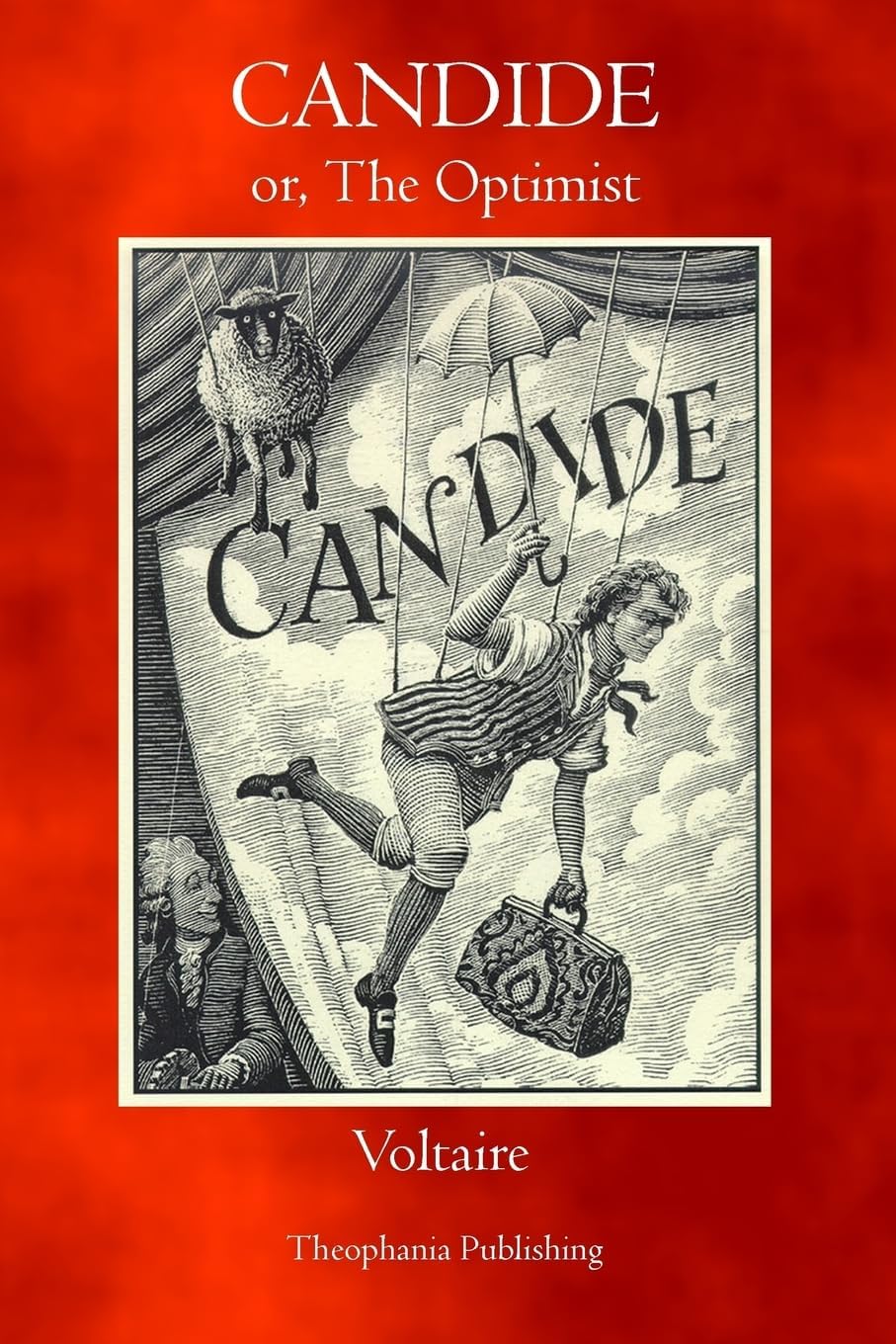
Candide
Product ID: 35734409
Buy anything from 5,000+ international stores. One checkout price. No surprise fees. Join 2M+ shoppers on Desertcart.
Desertcart purchases this item on your behalf and handles shipping, customs, and support to Brazil.
Thank you for checking out this book by Theophania Publishing. We appreciate your business and look forward to serving you soon. We have thousands of titles available, and we invite you to search for us by name, contact us via our website, or download our most recent catalogues. Candide, ou l'Optimisme is a French satire written in 1759 by Voltaire, a philosopher of the Age of Enlightenment. The novella has been widely translated, with English versions titled Candide: or, All for the Best (1759); Candide: or, The Optimist (1762); and Candide: or, Optimism (1947). It begins with a young man, Candide, who is living a sheltered life in an Edenic paradise and being indoctrinated with Leibnizian optimism (or simply Optimism) by his mentor, Pangloss. The work describes the abrupt cessation of this lifestyle, followed by Candide's slow, painful disillusionment as he witnesses and experiences great hardships in the world. Voltaire concludes with Candide, if not outright rejecting optimism, advocating an enigmatic precept, "we must cultivate our garden", in lieu of the Leibnizian mantra of Pangloss, "all is for the best in the best of all possible worlds". Candide is characterised by its sarcastic tone, as well as by its erratic, fantastical and fast-moving plot. A picaresque novel with a story similar to that of a more serious bildungsroman, it parodies many adventure and romance clichés, the struggles of which are caricatured in a tone that is mordantly matter of fact. Still, the events discussed are often based on historical happenings, such as the Seven Years' War and the 1755 Lisbon earthquake. As philosophers of Voltaire's day contended with the problem of evil, so too does Candide in this short novel, albeit more directly and humorously. Voltaire ridicules religion, theologians, governments, armies, philosophies, and philosophers through allegory; most conspicuously, he assaults Leibniz and his optimism. Review: The Best of All Possible Worlds? Let’s discuss... - After purchasing and reading Candide, the reader is left with the imprint of explicit and oppressive themes that occurred throughout the entire story. The author uses elements of oppression, war, philosophy and religion to develop similar themes and create a rather enthralling story. Voltaire used clashing archetypes to create complex relationships between characters. This review will elaborate on how the time period, themes and archetypes in the story contributed to the overall work as a whole. Candide was written in 1758 by Voltaire; a French philosopher and writer. He is known for his criticism towards Christianity, more specifically the Catholic Church, and throughout Candide the development of satirical themes are evident due to this. The satire used in the story allows the reader to better understand Voltaire’s opinions towards Catholic Church as well as other religions and philosophies. The novel is centered around the notion of philosophical optimism, an ideology associated with German philosopher Gottfried Wilhelm Leibniz. It is the idea that everything happens for the best and that we live in the best of all possible worlds. Pangloss served as a mentor who taught Candide and Cunégonde this philosophy. Candide is the hero of the story who, throughout his travels, experiences many events and meets many people with varying ideologies and religions as him. There were questions that arose within Candide of who is right, who is wrong and if everything happens for the best, how can such terrible things happen to good people? These questions created an intriguing crash between the archetypes of Pangloss and Candide, because although Candide sees him has a wise mentor, he couldn’t help but question and and rebel against some of his teachings that he had previously lived by. The story progressed through the use of location. Candide was born in Westphalia, Germany where he lived with the Baron, his wife, their daughter Cunegonde and their tutor Pangloss. Cunegonde and Candide were quite fond of each other, and one day where they kissed Candide was kicked out of the estate because she was a higher class than him. Once Candide leaves, he is taken by Bulgarian soldiers to travel with them, Eventually, after being mistreated and leaving them, he arrives in Holland. The plot thereafter is catastrophic in the seeing that Candide proceeded to travel to tens of places. In each place Candide experienced something new, whether it be religious oppression or notices self-righteous people of war. Although everything he experienced was clearly negative in every sense, he continues to naively live by the same idea of Optimism that Pangloss had once taught him. Candide is reunited with Pangloss, but only briefly, because both of them are whipped at the Catholic church for their varying religious views. The purpose of this was clearly satirical and contributes of Voltaire’s personal beliefs as well as how the church could be seen as contradicting to its apparently peaceful ways. Nonetheless, Candide did see this as another reason to illuminate his teachings from Pangloss and how this all happened for the best. All the events that would follow were also tragic. From having to escape Holland, reuniting with Cunegonde but finding out the hardships she faced that were sexually oppressive, being shipwrecked in Lisbon, meeting Cacambo and going to El Dorado only to be utterly unsatisfied with their religion and way of life, a disastrous trip to Paris that lead to Candide losing his money, etc. All of these events came directly after another which contributes to the theme of endless hardships. For most of these situations, Candide and who ever he was with were struggling yet the clear answer for Candide was optimism and that everything that had happened up to that point had been the best possible outcome of all worlds. It is this ignorance that contributes to the overwhelming satire purposely placed in this story by Voltaire. After purchasing and analysing Candide by Voltaire, it can be said that it was rather intriguing. The use of clashing archetypes, overwhelming satire, and interesting themes ensure that the reader will definitely be entertained. All of these element combine to create a rather spontaneous story. I recommend Candide for anyone curious about this period in history and would enjoy a glimpse into the life of Candide; a young man who although faces the most unfortunate events, remains as optimistic as can be until the end. Review: A Classic and a Classic in the problem of reading old material with an appreciation for the world wherein it was written - Bottom Line first: There is something presumptuous about attempting a critical review of something as classic and acclaimed as Voltaire‘s Candide. The official verdict is that this is great literature. I shall write naught to gainsay my betters. That said it can be hard for the modern reader to do better than to accept that the several hundred years of approval may not temper the problems of reading it several hundred years later. Recommendation: It may be that the best way to grasp what is a broad and darkly comic satire is the Operetta of the same name music by Lenard Bernstein and libretto by several besides Voltaire, including Lillian Hellman. Candide (1956 Original Broadway Cast) Ok the Blah Blah Blah Part: A German natural philosopher and mathematician Gottfried Wilhelm Leibniz, 1646 – 1716 argued that as God is a loving God and the maker of all things, the reality we live in the reality of choice by a loving God and therefore we live in the best of all possible worlds. The reader is advised to remember this, The Formula. The novella is a test of this conclusion. It is perhaps something of a spoiler to tell you that Voltaire is not impressed by the arguments of this philosophical polymath. Our story opens in a palace in Westphalia, the 18th century cultural equivalent of the poorer and less desirable quarters of an unfashionable city. Here living in relative splendor of a backwater palace we find all of our major characters. Our leading male for whom the story is titled, Candide is the illegitimate son of a relative being raised among his betters including the love of his life Cunegunda. Plus various secondary characters not necessary for this discussion. Very quickly the misadventures begin. Candide is run from his idyllic life and never again do we see the best and the balance shall be the possible. Cunegunda survives the destruction of her home and family and begins her adventures, more about anon. Without listing the various evils and hurts our hero suffers; a few points. Everything he sees and suffers that argue against the 18th century being the best of all possible are things that actually happened. Evil is afoot in many forms often lead by seniors within the Catholic Church. Not to limit this to a shamming of the Church there is evil petty and grand from treacherous friends and servants to local politicals and businessmen. It is argued that the evil is a necessary thing to maintain a principal of proportionality but this case is made by the quickly dismissible Panglos (Pan=all Glos=talk) the broadly shamed stand-in for Leibniz. There will be for Candide one happy interval in a land much like the Utopia dreamed up by friend to Voltaire, Thomas More. Later Candide will fall in with and benefit from friendship with cynical and more practical Martin, Martin Luther perhaps. It is easy to fixate on the story of Candide and forget about Cunegunda. She is also subject to all of the vagaries of her sex. Instead of being sold off, I mean married off to some neighboring lordling in a commercial marriage, she is pushed in to a number of variations in the the other kinds of commerce based on young female flesh. At her side is a loyal old woman with but one buttock. Between the two we are regaled with the funny, only not so funny variations of evils set aside for 18th Century womankind. So 75 pages of violence , treachery, petty and great wrongdoings and we are supposed to laugh? Ok maybe grim grins? I suggest that Voltaire pretty much dismisses our magic ‘best of all possible…’ formula very quickly. The rest is a plea for tolerance and a condemnation of extremism. Especially were the most doctrinaire are also unlikely to be practicing much else that is admirable. Also the conclusion is not so much a refutation of The Formula, as it is a case for a simpler and bucolic life. Final note on my edition. The quality of the translation is not something I can address. I can say that I liked the presence of so many extra pages of scholarly material.
| Best Sellers Rank | #2,190 in Literary Fiction (Books) |
| Customer Reviews | 4.3 out of 5 stars 5,618 Reviews |
A**A
The Best of All Possible Worlds? Let’s discuss...
After purchasing and reading Candide, the reader is left with the imprint of explicit and oppressive themes that occurred throughout the entire story. The author uses elements of oppression, war, philosophy and religion to develop similar themes and create a rather enthralling story. Voltaire used clashing archetypes to create complex relationships between characters. This review will elaborate on how the time period, themes and archetypes in the story contributed to the overall work as a whole. Candide was written in 1758 by Voltaire; a French philosopher and writer. He is known for his criticism towards Christianity, more specifically the Catholic Church, and throughout Candide the development of satirical themes are evident due to this. The satire used in the story allows the reader to better understand Voltaire’s opinions towards Catholic Church as well as other religions and philosophies. The novel is centered around the notion of philosophical optimism, an ideology associated with German philosopher Gottfried Wilhelm Leibniz. It is the idea that everything happens for the best and that we live in the best of all possible worlds. Pangloss served as a mentor who taught Candide and Cunégonde this philosophy. Candide is the hero of the story who, throughout his travels, experiences many events and meets many people with varying ideologies and religions as him. There were questions that arose within Candide of who is right, who is wrong and if everything happens for the best, how can such terrible things happen to good people? These questions created an intriguing crash between the archetypes of Pangloss and Candide, because although Candide sees him has a wise mentor, he couldn’t help but question and and rebel against some of his teachings that he had previously lived by. The story progressed through the use of location. Candide was born in Westphalia, Germany where he lived with the Baron, his wife, their daughter Cunegonde and their tutor Pangloss. Cunegonde and Candide were quite fond of each other, and one day where they kissed Candide was kicked out of the estate because she was a higher class than him. Once Candide leaves, he is taken by Bulgarian soldiers to travel with them, Eventually, after being mistreated and leaving them, he arrives in Holland. The plot thereafter is catastrophic in the seeing that Candide proceeded to travel to tens of places. In each place Candide experienced something new, whether it be religious oppression or notices self-righteous people of war. Although everything he experienced was clearly negative in every sense, he continues to naively live by the same idea of Optimism that Pangloss had once taught him. Candide is reunited with Pangloss, but only briefly, because both of them are whipped at the Catholic church for their varying religious views. The purpose of this was clearly satirical and contributes of Voltaire’s personal beliefs as well as how the church could be seen as contradicting to its apparently peaceful ways. Nonetheless, Candide did see this as another reason to illuminate his teachings from Pangloss and how this all happened for the best. All the events that would follow were also tragic. From having to escape Holland, reuniting with Cunegonde but finding out the hardships she faced that were sexually oppressive, being shipwrecked in Lisbon, meeting Cacambo and going to El Dorado only to be utterly unsatisfied with their religion and way of life, a disastrous trip to Paris that lead to Candide losing his money, etc. All of these events came directly after another which contributes to the theme of endless hardships. For most of these situations, Candide and who ever he was with were struggling yet the clear answer for Candide was optimism and that everything that had happened up to that point had been the best possible outcome of all worlds. It is this ignorance that contributes to the overwhelming satire purposely placed in this story by Voltaire. After purchasing and analysing Candide by Voltaire, it can be said that it was rather intriguing. The use of clashing archetypes, overwhelming satire, and interesting themes ensure that the reader will definitely be entertained. All of these element combine to create a rather spontaneous story. I recommend Candide for anyone curious about this period in history and would enjoy a glimpse into the life of Candide; a young man who although faces the most unfortunate events, remains as optimistic as can be until the end.
P**D
A Classic and a Classic in the problem of reading old material with an appreciation for the world wherein it was written
Bottom Line first: There is something presumptuous about attempting a critical review of something as classic and acclaimed as Voltaire‘s Candide. The official verdict is that this is great literature. I shall write naught to gainsay my betters. That said it can be hard for the modern reader to do better than to accept that the several hundred years of approval may not temper the problems of reading it several hundred years later. Recommendation: It may be that the best way to grasp what is a broad and darkly comic satire is the Operetta of the same name music by Lenard Bernstein and libretto by several besides Voltaire, including Lillian Hellman. Candide (1956 Original Broadway Cast) Ok the Blah Blah Blah Part: A German natural philosopher and mathematician Gottfried Wilhelm Leibniz, 1646 – 1716 argued that as God is a loving God and the maker of all things, the reality we live in the reality of choice by a loving God and therefore we live in the best of all possible worlds. The reader is advised to remember this, The Formula. The novella is a test of this conclusion. It is perhaps something of a spoiler to tell you that Voltaire is not impressed by the arguments of this philosophical polymath. Our story opens in a palace in Westphalia, the 18th century cultural equivalent of the poorer and less desirable quarters of an unfashionable city. Here living in relative splendor of a backwater palace we find all of our major characters. Our leading male for whom the story is titled, Candide is the illegitimate son of a relative being raised among his betters including the love of his life Cunegunda. Plus various secondary characters not necessary for this discussion. Very quickly the misadventures begin. Candide is run from his idyllic life and never again do we see the best and the balance shall be the possible. Cunegunda survives the destruction of her home and family and begins her adventures, more about anon. Without listing the various evils and hurts our hero suffers; a few points. Everything he sees and suffers that argue against the 18th century being the best of all possible are things that actually happened. Evil is afoot in many forms often lead by seniors within the Catholic Church. Not to limit this to a shamming of the Church there is evil petty and grand from treacherous friends and servants to local politicals and businessmen. It is argued that the evil is a necessary thing to maintain a principal of proportionality but this case is made by the quickly dismissible Panglos (Pan=all Glos=talk) the broadly shamed stand-in for Leibniz. There will be for Candide one happy interval in a land much like the Utopia dreamed up by friend to Voltaire, Thomas More. Later Candide will fall in with and benefit from friendship with cynical and more practical Martin, Martin Luther perhaps. It is easy to fixate on the story of Candide and forget about Cunegunda. She is also subject to all of the vagaries of her sex. Instead of being sold off, I mean married off to some neighboring lordling in a commercial marriage, she is pushed in to a number of variations in the the other kinds of commerce based on young female flesh. At her side is a loyal old woman with but one buttock. Between the two we are regaled with the funny, only not so funny variations of evils set aside for 18th Century womankind. So 75 pages of violence , treachery, petty and great wrongdoings and we are supposed to laugh? Ok maybe grim grins? I suggest that Voltaire pretty much dismisses our magic ‘best of all possible…’ formula very quickly. The rest is a plea for tolerance and a condemnation of extremism. Especially were the most doctrinaire are also unlikely to be practicing much else that is admirable. Also the conclusion is not so much a refutation of The Formula, as it is a case for a simpler and bucolic life. Final note on my edition. The quality of the translation is not something I can address. I can say that I liked the presence of so many extra pages of scholarly material.
T**M
Candide is a satiric novel from centuries ago but is enjoyable to read today.
During the early years of Saturday Night Live, Gilda Radner would often appear during the Weekend Update segment as Roseanne Roseannadanna who would respond to a letter from Mr. Richard Feder from Fort Lee, New Jersey. At the end of her segment, she would say to the Weekend Update host, Jane Curtin, something like the following. "Well, Jane, it just goes to show you, it's always something! If it's not one thing, it's another! Either you're depressed at Christmas or you got toilet paper hangin' from your shoe!" For Candide, it isn’t one thing or another; it is one thing after another. He enjoys life in a castle with a Baron’s family. His tutor, Pangloss, teaches Candide the philosophy that all is for the best. Candide’s life teaches him otherwise, but he continues to believe what Pangloss told him. After Candide kisses the hand of the Baron’s daughter, Lady Cunegonde, he is literally kicked out of the castle. Then, after being penniless and dying of hunger, he is rescued by two men in blue who say that Candide is a well built young man who is just the right height. They put him into the army of the Bulgars. After taking a walk one day, he is given his choice of punishments. He eventually escapes but then runs into another problem. This is the life of Candide throughout the book. He is up and then down and then up and then down and so on. Poor Candide has more ups and downs than a rollercoaster! Voltaire wrote Candide as a satire. It isn’t a straightforward adventure novel. You can tell that from the absurdity of situations. In Candide, Voltaire attacked the doctrine of philosophic optimism. Also, Voltaire’s dislike or contempt or generally bad opinion of religious figures is obvious from the writing. Voltaire’s other experiences in life are reflected in the book. You can get some of the context from the fourteen notes at the back of the book. However, it is helpful to read a study guide concurrently with the novel. I chose Cliff’s Notes but there are others which you can choose. I actually found an error in Cliff’s Notes. In one chapter, while Candide is on a French ship, he sees two other ships engaged in battle. In the novel, it says they are Dutch and German ships. Cliff’s Notes indicates that one of those two other ships is French. Actually, the French ship is the ship on which Candide is traveling. The music for various stage performances can sometimes be described by a single word. For one military oriented work, I think of the word “majestic.” For a ballet like Sleeping Beauty with dancers flowing across the stage, I think of the word “romantic” or “sweeping.” The overture of the operetta Candide, based on the novel and with music composed by Leonard Bernstein, makes me think of the word “frantic.” That is how the life of Candide seems to me — frantic. I can’t read French, so, like most people, I read a translation of Candide. A little research showed that there are variations in words and phrases in different editions of the book. I suppose that is inevitable when a book is originally written in a language other than English. At the beginning of the Bantam Classic edition is “The Sage of Ferney: An Appreciation” by André Maurois. Ferney is the retreat where Voltaire spent his old age. This introductory section was very informative. Other editions probably have different scholarly material. Whatever edition you choose to read, I think that you will enjoy the novel Candide.
W**H
What is "the best of all possible worlds"?
"Candide" is an accessible masterpiece which demonstrated to the world Volatire's genius as a satirist. The eponymous Candide is a young man tutored by an optimist who is convinced according to the cause and effect philosophy of Leibniz and perhaps is best summarized in the Voltaire's leitmotif that human beings live in the "best of all possble worlds." Alexander Pope rather laughably made the same outrageous claim in his "Essay on Man" in which he writes, "Everything that is is right." How can this be so, you may well ask? Here is the nut of the problem: it seems that a perfect God has created a highly imperfect world. How can a good, omnipotent, loving God create a world in which so much catastrophic evil exists and which is so often allowed even to thrive? It is a question for the ages. Theologians argue that God created mankind with free will and without it they would simply be puppets without the freedom to make choices. Theologians also point out that the majority of the evil resident in our world is perpetuated on vast masses of humanity by other human beings, not God, and that evil is the cause and effect of conflicting self-interests imposed by people with more power upon the less powerful. But this point doesn't explain why a loving, all-powerful God would allow any of it to exist and endure. Why not cast down all the devils and give his human creatures a perfect garden, a paradise on earth, without snakes anywhere? Why did God create the serpent in the Garden of Eden in the first place? Voltaire, like Rousseau, was an avid gardener and Voltaire jests at Rousseau's good faith in the "Confessions" as if the latter were simply a country bumpkin. But gardens have a great deal of meaning in "Candide" as in, for example, Milton's "Paradise Lost" or "Genesis" and are thematically significant for Voltaire who concludes that gardens are, after all, a wise place to reside out of harm's way. Voltaire absolutely skewers the optimistic cause and effect of Pope and Leibniz with a catalogue of tragicomic catastrophes which plague not only Candide and Pangloss but all of mankind infinitely. Consider the Great Lisbon Earthquake of 1755 which burst suddenly out of nowhere with all its raging fires and tidal waves to destroy nearly all of the city and the ships in its harbor. Is there no end even to the great catastrophes in which man has no hand but from which we are compelled to suffer except for God's grace? Voltaire's vivid and piercing wit is hilarious as he brazenly brings parody to places high and low, near and far, rich and poor to depict our world as the ultimate dystopia. In his novel Candide can only find a semblance of happiness in El Dorado, a rich, hidden world in South America: in other words, happiness in real life can only be found in a utopia without a basis for reality. So what are we to deduce about Candide? Is he a sometimes violent fool for all his naivete? And is Pangloss not a buffoon who earns his suffering so extensively at every turn of the road for his unjustified, unbridled optimism? Or are they heroic for their optimism despite the epic disasters that nearly devastate them time after time. Or is their fate really just the human condition and are they both just being all too human? You decide. In the course of your reading of this brief novel you may discover, as I did, that the optimists are constantly challenged by the gap between their optimism and reality, and that the pessimists are doomed to be the unhappiest people on the planet because they cannot imagine a world without misery and, thereby, create it for themselves wherever it doesn't really already exist. Take your pick of perspectives as a "free" human being and challenge your own assumptions about the human condition. Clearly, Balzac would seem to agree with his compatriot, Voltaire, that whatever you make of life on this earth, surely it is no less than an epic human comedy. At least in this life, thankfully, if you can stand back far enough, there is, God knows, no end to the laughter of the human condition.
Y**I
Good for price
No me gusto mucho. I did not like it that much
C**Y
A Timeless Classic with lessons for the 21st century and beyond!
Francois-Marie Arouet (1694--1778), who later took the name of Voltaire, was the illegitimate son of a wealthy notary and his mother who died when he was seven years of old. He was educated at a Jesuit school in Paris. His father wanted him to study the law, but he was determined on a literary career. Voltaire was the friend and guest of Friedrich the Great of Prussia. He wrote many plays, essays and poetry and was a great success. In 1758, at the age of 64, he wrote his masterpiece--Candide or Optimism. Candide tells the story of "a young boy (illegitimate like Voltaire) on whom nature had bestowed the gentlest of dispositions. His countenance expressed his soul. He combined solid judgement with complete openness of mind; which is the reason, I believe, that he was called Candide." The picaresque novel follows the adventures and tribulations of Candide through the world. In the very fist chapter, he is kicked out of the Westphalian castle of Monsieur the Baron von Thunder-ten-tron for kissing his true love, the 17 year-old daughter of the Baron and Baroness--the beautiful Cunegonde. Dr. Pangloss, who is Candide's tutor, "could prove to wonderful effect that there was no effect without cause, and that, in this best of all possible worlds, his Lordship the Baron's castle was the finest of castles and Her ladyship the best of all possible baronesses." Pangloss is an optimist. Through the Pangloss character Voltaire satirizes the Leibnizian doctrine that this is the best of all possible worlds. Leibniz argued that an omnipotent and benevolent God could not have created a world that was anything other than the best of all possible worlds. Moreover, Pangloss is a Utopian socialist who parrots Rousseau's Discourse on the Origins of Inequality, 1755. After her jewels and money are stolen, Cunegonde asks, "'What shall we live on? How will we manage?'...'The good Pangloss often demonstrated to me,' said Candide with a sigh, 'that the things of this world are common to all men, and that everyone has an equal right to them.'" The remainder of the book demonstrates the folly of Pangloss' s philosophy. It ultimately becomes a disquisition on the nature of evil. How can the reality of evil in the world be reconciled with the existence of a divine and omnipotent creator? This is simply one of my favorite books of all time. Christopher Kelly is the author of America Invades: How We've Invaded or been Militarily Involved with almost Every Country on Earth and Italy Invades .
A**R
he takes great pains to ridicule the writings of both Milton and ...
Voltaire had an interesting and sometimes tumultuous relation with "The Church" and religious thought of his time. In Candide, he takes great pains to ridicule the writings of both Milton and Alexander Pope, more specifically the latter in An Essay on Man, in which both writers attempt to "vindicate the ways of God to man". To understand this, or better, to have read these writings will further illuminate what Voltaire is attempting in Candide. Candide is the protagonist and is a seemingly good-hearted but rather simple fellow whose mentor, Pangloss, teaches him that no matter what happens it is always for the best. As a note, pay attention to each of the main characters names as they seem to me to have a descriptive quality to them, e.g. Pan, meaning "all" and gloss from the Greek glossa, meaning tongue, to get a name that roughly means "all talk". The story begins with Candide and his love interest being suddenly separated and the events of his life from there. What follows in the story is a series of horrible events mixed with some virtuous ones that Pangloss continuously explains to Candide that whatever happens is for the best. Even if you have no philosophical interest, the book is both funny and sad, entertaining yet thought provoking with a couple of memorable passages. I consider it a pretty good read and, as a bonus, a quick one.
C**C
We must cultivate our own garden
Affordable option. One of my favorite stories. As with many writings, this one is more interesting and entertaining if you do a quick review of what was happening in France at the time that led Voltaire to write this.
J**.
Good read!
A classic. Love the notes.
D**A
Surprisingly funny even in the modern day
I actually really enjoyed this book. I had no idea it was a comedy until I actually received it and read the back cover (I had just impulsively bought multiple books from notable authors to read to and from Europe). Despite being obviously outdated, it was pretty funny. However, you have to really have a somewhat thorough grasp of the philosophies of people like Kant and others during that time period. There are a lot of references in there that will make any philosophy major chuckle a bit. It's a super entertaining and ridiculous story that's quite unfortunate. It's a short read though and I'm glad. Any longer would just be pushing it. If you want something lighthearted and are a philosophy major or familiar with the discipline you should definitely check this book out.
A**R
Nothing else.
Must be read.
G**B
daha kötü ne gelebilir başımıza ?
"kötünün kötüsü var" diyen bir kitap, trajik ??? komik ?? iyimserlik ve iyilik felsefesi üzerine...
J**N
Much easier read than expected!
I was expecting this to be a book which required a lot of concentration but it's one of the easiest books to read you can imagine. An innocent young man journeys around the world in search of love and enlightenment but finds that both are harder to attain than he expected. It's said to have influenced the French Revolution later in the 18th century by exposing the hypocrisy and cruelty of mankind, though the tale is told in such a charming and innocent way that it doesn't seem anything like the highbrow read it sounds. All in all, a short book in short chapters which is well worth a read.
Trustpilot
3 weeks ago
2 months ago