We remain fully operational. Our teams are working around the clock to ensure your deliveries continue safely.

DOWNLOAD THE APP


Copyright © 2025 Desertcart Holdings Limited
DOWNLOAD THE APP
Buy anything from 5,000+ international stores. One checkout price. No surprise fees. Join 2M+ shoppers on Desertcart.
Desertcart purchases this item on your behalf and handles shipping, customs, and support to Brazil.
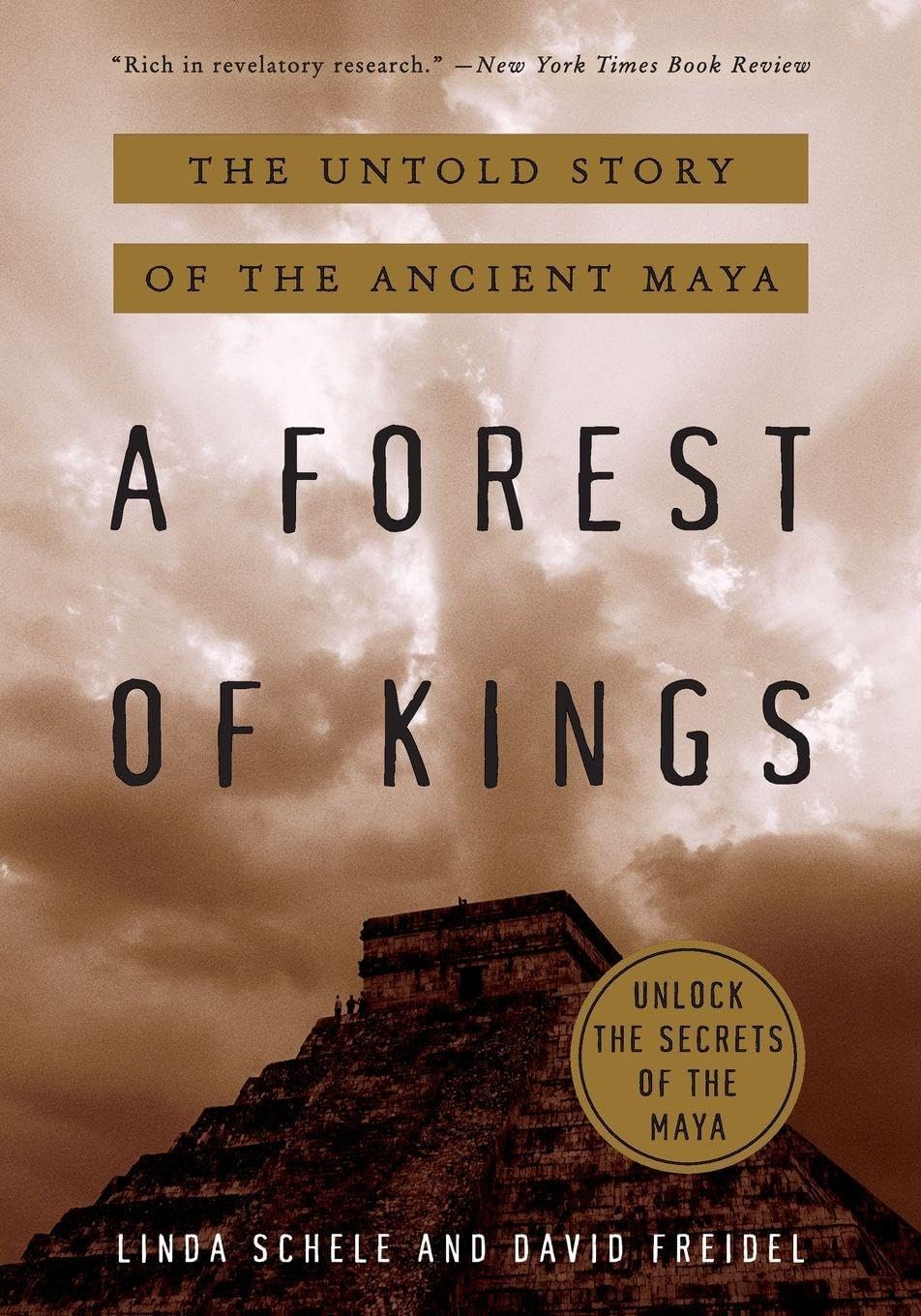
desertcart.com: A Forest of Kings: The Untold Story of the Ancient Maya: 9780688112042: Freidel, David, Schele, Linda: Books Review: Interpreting the written (hieroglyphic) history of the Maya - 10 chapters Approximately 40 rulers in dynasty timelines (12 rulers in each of 4 lists) Main cities of the Yucatan Peninsula and south to Guatemala Including Tikal, Naranja, and Carachol with list on pg 168 Palenque dynasty on 219 Copan 311 Chichen Itza 362 Rule of brothers 1st Chapter Geography 2nd Chapter Calendar count 3rd Chapter Temple Architecture 4th Chapter Expanding empire Tikal against Uaxactun 700AD 5th Chapter Carachol 6th Chapter Mythology First beginnings Palenque 3000BC 7th Chapter Contested succession Yaxchilan 8th Chapter End of Copan 9th Chapter Chichen Itza foreign influence from Mexico and Spain 10th Chapter Last stelae (stone inscriptions) in many cities 900AD First stelae dates to 50BC. Only a few color photographs. Most pictures are small, detailed black and white outlines. Glossary of gods and notes in the back. (pg 400-500) Main gods are mother, father tree of life, first son water monster (crocodile?), second son smoking mirror with an ax through forehead and a serpent foot associated with witz monster (mountain) and maize, third son who is second born? jaguar sun is probably a fire type. Sacred tree is ceiba which grows out of caves. This is associated with the father and mother of the gods. As for the calendar, no doomsday stuff here associated with the end of the age in 2012. While the end period is a time of change and fear, there is also a belief in the renewal and cycling of the world. There are a lot of place names and the names of the Mayas are difficult to grasp as they are foreign as well. This book is not an easy read, but there are short imaginative segments included that narrate a victory celebration, etc. Forest of Kings can get monotonous, repetitive, with blood sacrifices all over the place. 1990. There is a newer book out Chronology of Kings from 2000 that is supposed to include dynasty lists with 250 names. It is half the size of this book at 250 pgs. I haven't read it. There may also be some better picture books out there. That said, Forest of Kings gives a good summary of the regions it does cover and links them with both wars and alliances. the book is not a dictionary but does enable you to read some glyphs. I bought Thompsen's 1965 guide for further vocabulary and Maya religion. Thompsen's is not the best organized or perhaps most accurate and updated book. Sir Eric Thompsen thought the calendar dates were all that could be read from the rocks. Personal names and events like births, accessions, and war trophies are not mentioned. Have fun exploring! Review: A Fascinating Book Full of Translations of Maya Glyphs - Note: It looks like I have offended some Mormons who don't want you to read this book. Nevertheless, science won't go away. Your "helpful" votes are appreciated Schele and Freidel's book takes you into the mind of the ancient Maya, where bloodletting induced visions that opened doors into the world of pagan spirits and everyone had an animal "familiar." The description of the "War of Conquest" of Tikal (tee-kal) against Uaactun (wa-shak-toon) is riviting. It is fascinating that we know the name of the general of Tikal, "Smoking-Frog." At other places, we now also know the names of the Maya leaders. "Ah Zacol...governed Lacanja for Knot-eye-Jaguar, the king of Bonampak." Other names are equally strange. I won't list the name of one king because desertcart's filter's would reject my review. Anyway, his name was "p-n-s of the jaguar." I came to my interest in the Maya from my early encounters with Mormon authors who used specious scholarship to connect the Maya to the religious novel called the "Book of Mormon." Now that Maya writing has been deciphyered, all those false claims have been exposed. In many cases, the truth was known, but Mormon writers were engaging in the practice of lying for the Lord to promote their faith. When the Spanish first saw Maya art, they misinterpreted it. They named one temple, for example, the "temple of the cross." The cross-like tree was seen as evidence that the Maya were Christians. Now we know that in the case of the temple of the "Foliated Cross" that the cross-bar of the cross is actually a maize plant with a "human head as an ear of maize." The maize plant is growing out of the "waterlily monster." It was interesting to learn that the upright stone monuments, or stela, were known as "tree-stones" and the doorways into the temples were represented as the mouths of mountain monsters. The doorways are seen as caves into the mountain. "Bloodletting, the focus ritual of Maya life, was the instrument" of the materialization of other-worldly beings. The claims of Mormons and others that Stela B at Copan depicts elephant trunks was refuted even before the translation of the Maya glyphs. The trunks are actually the long beaks of macaws (you can see the colorful birds there today). The false claim is now doubly refuted because the writing on the stela refers to "macaw mountain," a nearby hill--not "elephant mountain." Mormons are still claiming that there is a horse carved on the Temple of the Wall Panels at Chichen Itza. It is actually a damaged feathered-serpent (one feather hangs down to make the so-called horse's head). In reality, the Maya were so ignorant of horses that when Cortes left his lame horse among the Itza, they fed it meat. The strange diet cause the horse to die and the Maya made a statue, calling it "Tzimin Chac," from the "Tzmin," meaning tapir (the animal most similar his general shape to a horse), and "Chac," the god of rain and thunder. When Father Urbita came to convert the Itza, he destroyed the idol at great risk to his life. The Book of Mormon connection to ancient mesoamerica is without foundation. As you go back in time, the paganism only increases. There was no Hebrew civilization in mesoamerica. This 500-page book belongs on the shelf on anyone interested in the mind of the ancient Maya.
| Best Sellers Rank | #223,754 in Books ( See Top 100 in Books ) #15 in Mayan History (Books) #183 in Archaeology (Books) #218 in Native American History (Books) |
| Customer Reviews | 4.6 4.6 out of 5 stars (177) |
| Dimensions | 7 x 1.38 x 10 inches |
| Edition | Edition Unstated |
| ISBN-10 | 0688112048 |
| ISBN-13 | 978-0688112042 |
| Item Weight | 2.35 pounds |
| Language | English |
| Print length | 552 pages |
| Publication date | January 24, 1992 |
| Publisher | William Morrow Paperbacks |
S**S
Interpreting the written (hieroglyphic) history of the Maya
10 chapters Approximately 40 rulers in dynasty timelines (12 rulers in each of 4 lists) Main cities of the Yucatan Peninsula and south to Guatemala Including Tikal, Naranja, and Carachol with list on pg 168 Palenque dynasty on 219 Copan 311 Chichen Itza 362 Rule of brothers 1st Chapter Geography 2nd Chapter Calendar count 3rd Chapter Temple Architecture 4th Chapter Expanding empire Tikal against Uaxactun 700AD 5th Chapter Carachol 6th Chapter Mythology First beginnings Palenque 3000BC 7th Chapter Contested succession Yaxchilan 8th Chapter End of Copan 9th Chapter Chichen Itza foreign influence from Mexico and Spain 10th Chapter Last stelae (stone inscriptions) in many cities 900AD First stelae dates to 50BC. Only a few color photographs. Most pictures are small, detailed black and white outlines. Glossary of gods and notes in the back. (pg 400-500) Main gods are mother, father tree of life, first son water monster (crocodile?), second son smoking mirror with an ax through forehead and a serpent foot associated with witz monster (mountain) and maize, third son who is second born? jaguar sun is probably a fire type. Sacred tree is ceiba which grows out of caves. This is associated with the father and mother of the gods. As for the calendar, no doomsday stuff here associated with the end of the age in 2012. While the end period is a time of change and fear, there is also a belief in the renewal and cycling of the world. There are a lot of place names and the names of the Mayas are difficult to grasp as they are foreign as well. This book is not an easy read, but there are short imaginative segments included that narrate a victory celebration, etc. Forest of Kings can get monotonous, repetitive, with blood sacrifices all over the place. 1990. There is a newer book out Chronology of Kings from 2000 that is supposed to include dynasty lists with 250 names. It is half the size of this book at 250 pgs. I haven't read it. There may also be some better picture books out there. That said, Forest of Kings gives a good summary of the regions it does cover and links them with both wars and alliances. the book is not a dictionary but does enable you to read some glyphs. I bought Thompsen's 1965 guide for further vocabulary and Maya religion. Thompsen's is not the best organized or perhaps most accurate and updated book. Sir Eric Thompsen thought the calendar dates were all that could be read from the rocks. Personal names and events like births, accessions, and war trophies are not mentioned. Have fun exploring!
R**R
A Fascinating Book Full of Translations of Maya Glyphs
Note: It looks like I have offended some Mormons who don't want you to read this book. Nevertheless, science won't go away. Your "helpful" votes are appreciated Schele and Freidel's book takes you into the mind of the ancient Maya, where bloodletting induced visions that opened doors into the world of pagan spirits and everyone had an animal "familiar." The description of the "War of Conquest" of Tikal (tee-kal) against Uaactun (wa-shak-toon) is riviting. It is fascinating that we know the name of the general of Tikal, "Smoking-Frog." At other places, we now also know the names of the Maya leaders. "Ah Zacol...governed Lacanja for Knot-eye-Jaguar, the king of Bonampak." Other names are equally strange. I won't list the name of one king because Amazon's filter's would reject my review. Anyway, his name was "p-n-s of the jaguar." I came to my interest in the Maya from my early encounters with Mormon authors who used specious scholarship to connect the Maya to the religious novel called the "Book of Mormon." Now that Maya writing has been deciphyered, all those false claims have been exposed. In many cases, the truth was known, but Mormon writers were engaging in the practice of lying for the Lord to promote their faith. When the Spanish first saw Maya art, they misinterpreted it. They named one temple, for example, the "temple of the cross." The cross-like tree was seen as evidence that the Maya were Christians. Now we know that in the case of the temple of the "Foliated Cross" that the cross-bar of the cross is actually a maize plant with a "human head as an ear of maize." The maize plant is growing out of the "waterlily monster." It was interesting to learn that the upright stone monuments, or stela, were known as "tree-stones" and the doorways into the temples were represented as the mouths of mountain monsters. The doorways are seen as caves into the mountain. "Bloodletting, the focus ritual of Maya life, was the instrument" of the materialization of other-worldly beings. The claims of Mormons and others that Stela B at Copan depicts elephant trunks was refuted even before the translation of the Maya glyphs. The trunks are actually the long beaks of macaws (you can see the colorful birds there today). The false claim is now doubly refuted because the writing on the stela refers to "macaw mountain," a nearby hill--not "elephant mountain." Mormons are still claiming that there is a horse carved on the Temple of the Wall Panels at Chichen Itza. It is actually a damaged feathered-serpent (one feather hangs down to make the so-called horse's head). In reality, the Maya were so ignorant of horses that when Cortes left his lame horse among the Itza, they fed it meat. The strange diet cause the horse to die and the Maya made a statue, calling it "Tzimin Chac," from the "Tzmin," meaning tapir (the animal most similar his general shape to a horse), and "Chac," the god of rain and thunder. When Father Urbita came to convert the Itza, he destroyed the idol at great risk to his life. The Book of Mormon connection to ancient mesoamerica is without foundation. As you go back in time, the paganism only increases. There was no Hebrew civilization in mesoamerica. This 500-page book belongs on the shelf on anyone interested in the mind of the ancient Maya.
C**G
Lovely book
I loved reading this book and I went far beyond to read all the footnotes in the back and appendices. I studied all of the scholars/people in this book at some length. I hated a few of them and I loved a majority of them. I walked through many of the Mayan ruins and current villages eating Mayan foods in my imagination. I saw the burning library in Dresden. I was terrified that I was a captured king and my head would roll down the stone stairs. I felt the rock floor and read the hieroglyphs. I also discovered the way to read the Mayan writing. I bathed in the waters at Palenque and studied the stars in the observatory. Yes this book captured me.
D**U
Rather interesting history that added to my knowledge.
C**R
Obsequio
T**S
This is wonderful . The understanding of Maya cultural and religious practice has advanced so much and there is much revealed in this wonderful book . I enjoyed every minute of my reading , couldn't put it down . I do hope it's followed up in a few years with new discoveries about this extraordinary civilization .
S**D
This book was published in 1993, as you might imagine some key arguments in this book are now very dated. If you are totally new to the Maya then this book will be quite a misleading read and you'd be better off reading "The Maya" by Stephen Houston and Micheal Coe even though it is a lot more dry to read. Positives and Negatives: The problem is, there is still lots to learn from this book, especially on the theme of Maya religion and the role of the Divine kings. The book follows the monuments left by select Ahauob (kings) of Maya city states including Palenque, Tikal and Copan. The descriptions of the monuments are extremely detailed which for the most part is very interesting though it can border on the pedantic at times. Now and then there are narratives written as though from a Maya person's perspective which are fun and interesting reads though felt highly speculative at times. That is the main problem with this book, its age and also the bias of its authors, its hard to know what is still relevant and what is now discounted and biased. Traditionally "Mayanists" have been very against the idea of foreign entities invading or even influencing Maya Civilisation but today we know that they were heavily influenced. The classic Maya were invaded and influenced by the Mexican city known as Teotihuacan with its generals usurping native Maya dynasties (like at Tikal). Friedel and Schele gall at the idea of the Maya actually being impressed by central Mexicans when this was clearly the case with Teotihuacan though they at least acknowledge that the Maya learned "Venus star wars" from them. They also go out of their way to deny any Toltec involvement at Chichen Itza, even going so far as to suggest that the Maya inspired the Toltec art and architecture in central Mexico when it is very clear that the Maya of the Post classic Yucatan were invaded by a Branch of Toltec who introduced Mexican gods, art and concepts to the late Maya world. Not to mention the Puuc Maya who were heavily influenced by central mexico and the Itza who they wrongly identify as the Toltec invaders despite the Itza coming after Toltec Chichen Itza failed (where it then became known AS Chichen Itza; Well of the Itza) As mentioned there are some really interesting concepts explained that seem to still be relevant as well as the exploits of Maya Kings, there are just too many times where the authors are simply wrong which is not something you want from a history book.
R**N
Great
Trustpilot
5 days ago
4 days ago