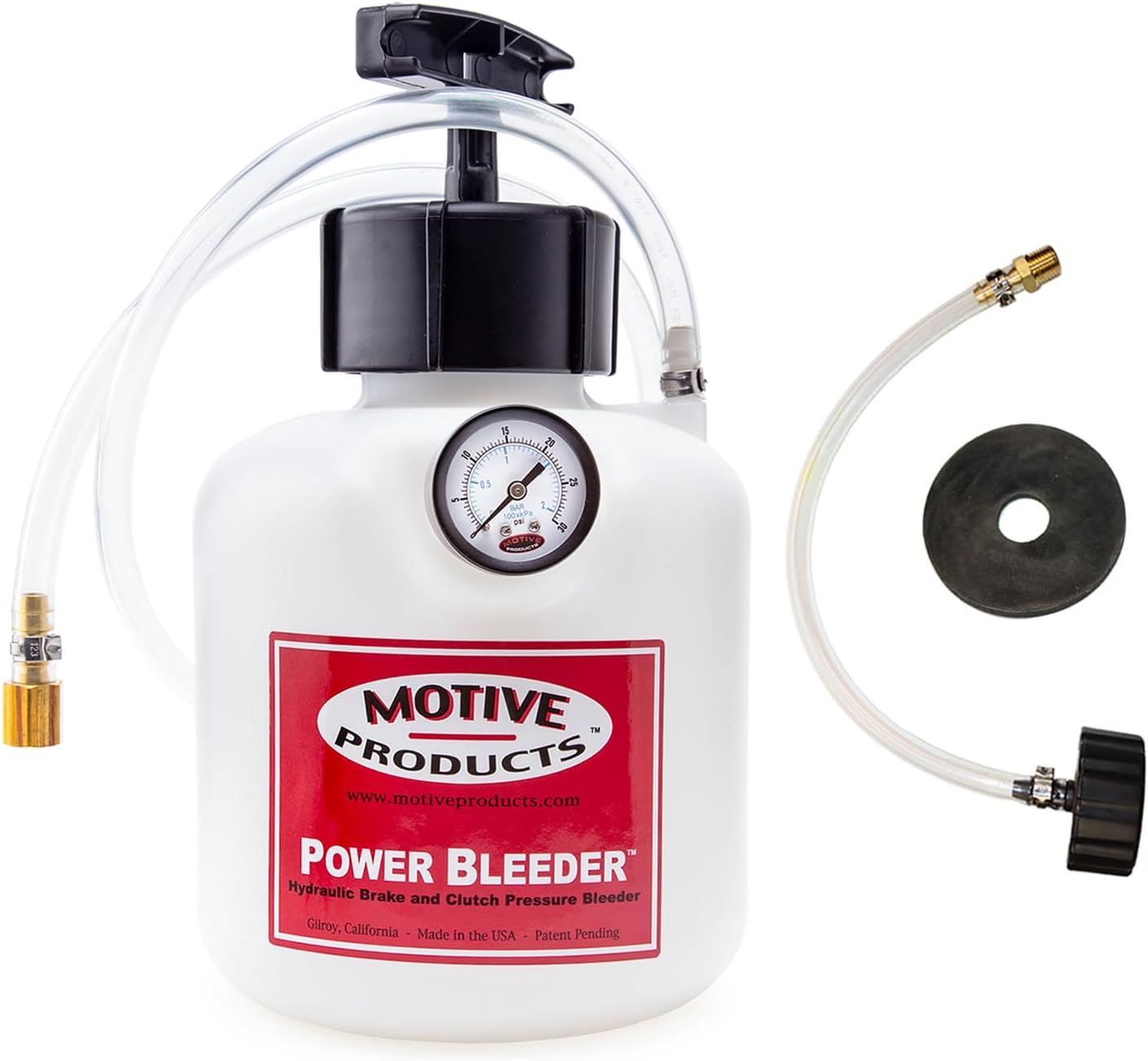



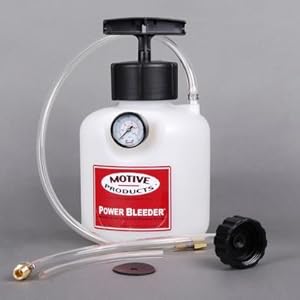
0100 European Power Brake Bleeder Kit
Product ID: 2406236
💨Pressurized fluid expels air & old brake fluid
🔩45mm adapter fits most European cars
🛡️Rust-proof design for long-lasting durability
Desertcart purchases this item on your behalf and handles shipping, customs, and support to Brazil.
🚗 Bleed like a pro—pressure-powered precision for flawless brakes every time!
The Motive Products 0100 European Power Brake Bleeder Kit features a 45mm threaded adapter compatible with most European cars, using pressurized brake fluid to efficiently remove air and old fluid from brake lines. Its rust-proof design ensures long-lasting durability, while the easy one-person operation makes it ideal for home, shop, or track use. Proudly made in the USA, this kit delivers professional-grade brake bleeding with minimal effort.

| ASIN | B0002KM5L0 |
| Best Sellers Rank | #88,372 in Automotive ( See Top 100 in Automotive ) #155 in Brake System Bleeding Tools |
| Brand | Motive Products |
| Customer Reviews | 4.2 4.2 out of 5 stars (2,813) |
| Date First Available | July 2, 2004 |
| Item Weight | 2.45 pounds |
| Item model number | 100 |
| Manufacturer | Motive Products |
| Manufacturer Part Number | 100 |
| OEM Part Number | 100 |
| Position | Rear |
| Product Dimensions | 11.9 x 8 x 6.9 inches |
W**R
Definite Buy! Don't waste money on a mityvac! Get a power bleeder!
I really truly love this device. It is by far both the best and the quickest way to bleed your brakes that I have ever found. I've bought and used every type of bleeder out there, and this style is by far my favorite. I've tried the whole pedal pump method, and let's face it...it sucks. Not only that, but it's actually a good way to kill your master cylinder too! The rod inside the MC is only used to traveling so far, but when you're bleeding your brakes it can easily go too far. It ends up destroying internal seals, and you end up wondering why on earth your brakes won't work anymore no matter what you do. 6 months ago I bought a "MityVac"...worst product ever made! Within a few days it was falling apart, and it honestly just never worked all that well to begin with. It actually snapped in half earlier today. I will say that it was better than bleeding your brakes by pumping the pedal, but not by a lot. The only other method I can really highly recommend for brake bleeding is the gravity method. It works wonderfully in almost every situation. I can't say for sure how it works with ABS systems without a scan tool, but it works great in pretty much every normal situation you can think of. The problem, however, is that it takes forever! It's literally a 12-24 hour long process to gravity bleed your brakes. On the plus side, you only need to be there at the beginning and the end, but still... The Power bleeder...requires the absolute least amount of effort, and you can bleed your brakes in like 10 minutes. You fill it up with fluid. You pump up the pressure, and you go around the car cracking each bleeder screw one at a time. The best part? You don't have to keep an eye on the fluid level. You don't have to go add more every few minutes. You don't have to go through a whole setup process at each wheel. You've got pressure going to all 4 wheels, so crack any one of them you like. Actually, you have pressure going to the master cylinder outlets too for that matter! I did a really half...you know what...job of bench bleeding my new master cylinder, but the power bleeder worked just fine with it. I just used the power bleeder to bleed the MC in the car by cracking the line open for a few seconds before moving on to the wheels. It worked great, and I've got a perfectly firm pedal after maybe 10 minutes of work. I can not recommend this product enough! DO NOT WASTE YOUR MONEY ON A MITYVAC!!! GET A POWER BLEEDER!!!
J**R
An exceptional quality tool
I'm going to do two reviews on this: initial impressions, and impressions in use. All the car nuts reading this know what this tool is for, but maybe you're looking for a gift for a car nut (hint: this would be a really good one) and you're wondering what this is. Follow along. You have hydraulic brakes on your car, and they are fairly simple things: your foot pushes the brake pedal. The brake pedal pushes a piston in the master cylinder. The piston pushes brake fluid into a series of steel tubes and rubber hoses...which are already full of brake fluid. The new fluid pushes old fluid against pistons at the wheels of your car. The pistons push against abrasive pads. The pads push against steel discs that are rotating (because the wheels of your car are bolted to them) and cause them to slow down and, eventually stop. Good so far? All this works great if the only thing in your brake system is brake fluid...but if air gets in there some of the force of your foot will go into compressing the air instead of stopping your car, which gives you longer stopping distances - not what you want. And air looks for ways to get into your brake system. You, therefore, will have to get it out in a process called "bleeding the brakes." There are three basic ways to bleed your brakes. The "classic" way to do it is to stick someone with a very strong right leg in the driver's seat of your car, while you sit beside your car with a box-end wrench on the bleeder valve at the wheel. He pumps then holds the pedal down, and you open the bleeder valve and watch for bubbles. When that one's bubble-free you go to another. This takes forever to do, you go through a lot of brake fluid, and you wind up owing your buddy a lot of beer. Then there's the "vacuum pump" method. It's the same basic thing as the "classic" way but instead of using your formerly best friend, you use a little handheld vacuum pump to suck the bubbles out of your brake system. I've known a lot of people who tried it this way. I don't know anyone who's actually gotten his brakes to bleed this way. The problem is, the vacuum pump pulls air through the minuscule gap between the bleeder valve and the hose you stuck on it. Which brings us to power bleeding, the method every manufacturer recommends. You get a replacement cap for your master cylinder that has a hose sticking out of it. It is plumbed to a tank of brake fluid that's connected to your shop air supply. You hook it all up, hook a hose to a bleeder valve, submerge the other end of the hose in brake fluid, turn on the pressure, crack the bleeder, then stand back and watch all the worn-out fluid, air and crud get shoved out of your brake system, just as pretty as a picture. Which, as you may have guessed, is why manufacturers like pressure bleeding! The only problem with pressure bleeding has pictures of dead presidents on it: they used to cost hundreds and hundreds of dollars. Then someone must have been in the garden aisle at the hardware store, noticed the pump-up weed sprayer, and realized the same basic device could be used to pressure bleed brakes. Which leads us to the subject of this review. The Motive Power Bleeder is made out of plastic that feels like it's at least 1/4" thick. It has a gauge that seems like it will hold up, a nice-quality air pump, some clear tubing and brass fittings. Included with it is a separate little sack that contains the adapter for your master cylinder, and about a foot of hose to shove over the bleeder valves and dunk in brake fluid. You can't lose the instruction book because it's printed right on the container. In all, a very nice presentation. This comes in several models. The difference is the adapter. If you get the wrong one don't worry, they sell adapters separately. Once my new master cylinder gets here I'll review this thing's performance. The quality of the product, and the other million glowing reviews of this thing, make me hopeful.
G**T
Makes bleeding brakes by yourself an easy job! It's even better when you add quick-connect fittings!
This thing is great. I added some quick connect air fittings to make it even better. I wish I would have bought one of these things years ago. No more getting my wife or daughter to pump the brake pedal while I keep opening and closing the bleeder screws! The cap that is included with this kit fit perfectly on my 2005 Passat. I know you can fill this bleeder with fluid and use it that way, but I decided to use it to just hold air and pressurize the system that way. Yes, this does require refilling the master cylinder frequently to avoid letting it run empty. But there is less cleanup and mess that way. The bonus is if you use the quick connect fittings like I did, you don't lose all of your air pressure when you disconnect the hose to refill the master cylinder. The quick disconnect fittings hold the pressure you have built up in the tank while you refill the reservoir. Just reconnect the fittings, pump up the pressure a little more as needed, and continue bleeding! To add quick connect fittings, this is what I used (1 of each): Primefit IK1015S-5 1/4-Inch Steel Quick Coupler Set, 5-Pieces Anderson Metals 57001 Brass Hose Fitting, Adapter, 1/4" Barb x 1/4" NPT Male Pipe You'll also need a hose clamp of suitable size and some plumber's Teflon tape. I already had some of each laying around, so I used what I had. Just to avoid any sharp edges that might get caught on stuff, I wrapped up the hose clamp area with electrical tape after I was done. All you need to do is cut off the fitting that is pre-attached to the hose coming from the bleeder, then install the nipple listed above and clamp it in place. Then install the quick-connect fitting using some Teflon tape on the threads to avoid leaks.
M**S
Nice Product
I just used this and the companion bleeder bottle to change out the brake fluid on my VW Tiguan. I have never done this before, but found it to be straightforward and not all that difficult. From the YouTube videos I watched, I knew you don't really need these things, but they make it a lot easier and less chance of messing things up by getting air in the master cylinder. Some points: 1) As the top comment says, there is no swivel between the cap and the pump. You should have the adapter part fairly snug with tape on the fittings (same as you would use in plumbing) before you put it under pressure. I only did it hand tight and did have some minor leakage (no big deal, just put a paper towel under it). When you put the cap on the fluid reservoir, you have to turn the whole bottle along with it. Not too much of a problem without fluid already in it, but a bit of a pain if you dumped a bunch in. 2) Things you will need besides this and brake fluid: Lots of paper shop towels. Brake fluid is nasty stuff. You want to clean it off off any surface or yourself quickly. A cheap turkey baster. Get the old fluid out of the reservoir and have a bottle to put it in. Denatured alcohol. This is stuff you find in a Home Depot paint section. Use it to clean the bleeder and the bottle. The directions make a point of saying to use that instead of brake cleaner.
J**1
Pumping the pedal is a much more reliable method
I know people love this power bleeder, but I gave up on it halfway through my 3rd liter of expensive Pentosin brake fluid, and called a friend to come pump my brake pedal for me. After the dirty fluid was purged from the right rear of an 08 BMW 528i using the power bleeder, the fresh fluid stream that followed was full of air bubbles, two inches apart. I let the fluid continue to flow, thinking the bubbles would eventually clear, but they never did. When I ran low on my first liter of fluid (In the past, I’ve always used only about three fourths of a liter when using the brake pumping method), I closed the valve, and left to buy more fluid. After filling the bleeder bottle with 2 additional liters, I continued bleeding the right rear, but the bubbles never stopped flowing. When it became obvious that I would run out of fluid again (and this was just the first wheel, with three left to go!), I called a friend, who tore himself away from the Auburn-Alabama football game to come pump my brakes for me. With him pumping, I properly bled all four corners—twice—in about ten minutes. I rate this product 1 star for two reasons. First, it failed miserably, increasing my time, expense, mess, and frustration level drastically. I have no idea about the source of those air bubbles, but I followed the instructions diligently, including drawing the old fluid from the master cylinder and refilling with fresh. There should have been no air bubbles, but there were and, somehow, the power bleeder was the cause. Second, comparing the power bleeder with my usual method of brake pumping, I can’t see why I wanted to use it in the first place, other than I had no one handy to pump the pedal for me. The power bleeder required the same amount of work: I still had to jack the car up, I still needed a bleeder bottle, I still had to open and close the bleeder valves at each and every corner. All the power bleeder did was replace the assistant, and eliminate the need to occasionally check that the master cylinder had fluid; in exchange I had more waste, more mess, and the need to clean the power bleeder when I’d otherwise have been done. And actually, the only part of brake bleeding that I dislike is having to jack the car up; once that’s done, it takes only a few easy minutes to bleed all four corners by pumping the brakes—where does the power bleeder save time, or make the job any easier? Kudos to Amazon for letting me return it.
D**.
Why pay the dealer $350 for a job you can do yourself for less than $50 (after you buy this tool)
All cars should have their brake fluid replaced every 3 years. The fluid absorbs water over time and reduces braking performance. Replacing the fluid is called "bleeding the brakes" and requires 2 people unless you have a tool like this. I've used Motive products for nearly 20 years. They are a US company and make a very high quality product. Watch a few YouTube videos to learn how to do it and then have at it. It takes about 2 hours for the novice and will save you about $200 each time you do it. You more than pay for the tool the very first time you use it!
N**F
Simply Incredible Tool
This tool is simply awesome. I have done the Pump-N-Bleed thing for years, and hated that. I moved on to the Miti-Vac which has done me well for years, but would end up with a lot of wasted fluid chasing bubbles out of the lines because of imperfect seals on the bleeder valves. Not to mention the pain in the butt of having to go back and forth to re-fill the reservoir then back to bleeding. Not that big of a deal, but time consuming. Now, the Power Bleeder. It took me a few minutes to get going with it but use it once and it is brain-less. I have multiple vehicles so I needed multiple adapters. I used air tool couplings (quick disconnects) for a couple of reasons. First, it allowed me to swap adapters easily with good seals and not lose fluid all over the engine compartment. Second, it allowed me to get a good seal screwing the cap onto the master cylinder reservoir without the PVC hose twisting up. I did what every guy will do (not read the instructions) and ended up not getting a perfect seal the first time and lost some fluid. Should have placed a rag under the master cylinder. Others have stated that they only used the bleeder to pressurize the system and didn't put fluid in the container. I put the fluid in the container. This made the bleeding very easy. I pumped up the container's hand pump to 15 psi which allowed me to complete the whole job only having to re-pressurizing the container one time. I also used the Genesis Magnetic Bleeder bottle. I strongly recommend this tool to anyone who does their own work on their car. It is well constructed and should stand up to frequent use.
Y**N
Just dont hesitate
Still great after 8yrs
A**A
Ottimo
Davvero ottimo e ben realizzato, permette il cambio olio freni ma anche di mettere in pressione il circuito raffreddamento tramite il tappo della vaschetta di espansione per cambio liquido o controllo perdite.
A**R
Really great product to help with proper brake & clutch bleeding ...
Really great product to help with proper brake & clutch bleeding with my VWs. Especially since garages here in India do not even keep proper equipment for brake fluid change or even understand how important it is to change brake fluid. 1 star less due to no swivelling mechanism while screwing cap on fluid reservoir which means one has to rotate the pump in order to avoid kinking of pipe.
A**ー
良い
問題なく使える
A**R
Best bleeding system on the market.
Best brake bleed system out there! Also used to bleed the clutch slave cylinder on my Porsche 924S, works well. Just make sure you clean out the plastic reservoir, there will be plastic shavings left over from factory AND let it dry out before using, brake fluid is hygroscopic and will absorb water.
F**I
galletti francois
Un outil a ne pas manquer pour les très bons amateurs de mécanique automobile. .en effet il réunit efficacité et de plus un outil professionnels. ..son prix de 98 € ne doit pas vous freiner fait comme moi car je vous garantit ce un outil genial
Trustpilot
5 days ago
1 week ago