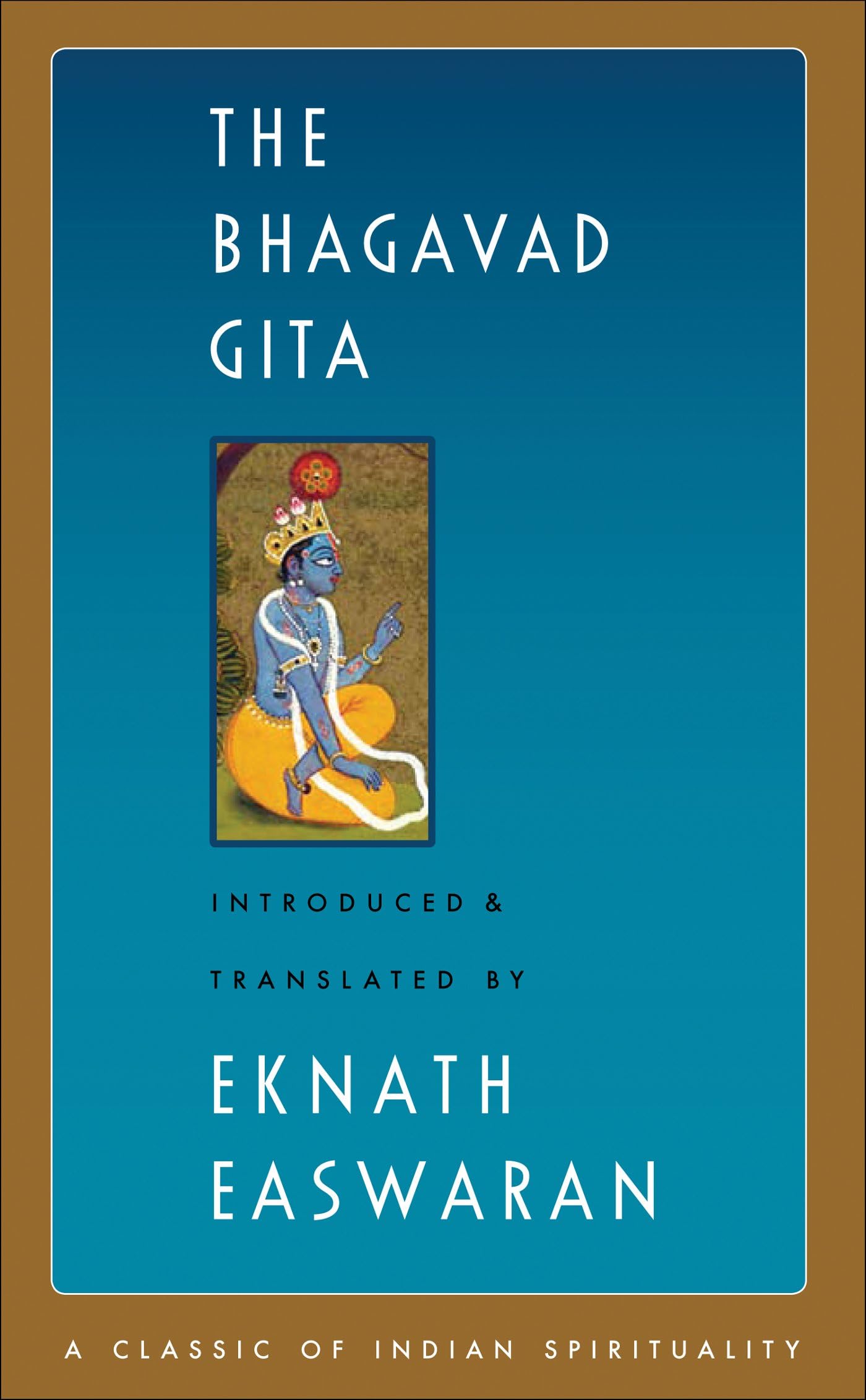
The Bhagavad Gita
Product ID: 225602
Desertcart purchases this item on your behalf and handles shipping, customs, and support to Brazil.
The Bhagavad Gita is the best known of all the Indian scriptures, and Eknath Easwaran's best-selling translation is reliable, readable, and profound. Easwaran's 55-page introduction places the Bhagavad Gita in its historical setting, and brings out the universality and timelessness of its teachings. Chapter introductions clarify key concepts, and notes and a glossary explain Sanskrit terms. Easwaran grew up in the Hindu tradition in India, and learned Sanskrit from a young age. He was a professor of English literature before coming to the West on a Fulbright scholarship. A gifted teacher, he is recognized as an authority on the Indian classics and world mysticism. The Bhagavad Gita opens, dramatically, on a battlefield, as the warrior Arjuna turns in anguish to his spiritual guide, Sri Krishna, for answers to the fundamental questions of life. Yet, as Easwaran points out, the Gita is not what it seems - it's not a dialogue between two mythical figures at the dawn of Indian history. "The battlefield is a perfect backdrop, but the Gita's subject is the war within, the struggle for self-mastery that every human being must wage if he or she is to emerge from life victorious." Arjuna's struggle in the Bhagavad Gita is acutely modern. He has lost his way on the battlefield of life and turns to find the path again by asking direct, uncompromising questions of his spiritual guide, Sri Krishna, the Lord himself. Krishna replies in 700 verses of sublime instruction on living and dying, loving and working, and the nature of the soul. Easwaran shows the Gita's relevance to us today as we strive, like Arjuna, to do what is right. Review: One of my top 10 favorite books ever, easily. - I first heard about the Bhagavad Gita a few years ago on a podcast that the comedian Duncan Trussell was on. For those who may not know, Duncan, in addition to being hilarious, is incredibly smart, and has spent many years studying various religions and philosophy. I still remember the first verse he quoted- It is better to be an honest street sweeper than a dishonest king. This and many others, all spoke to me, and for the longest time, I couldn’t figure out which version of the Gita to get. Obviously, I went with this one, translated by Eknath Easwaran, mostly because of all the positive reviews. While I was slightly disappointed that several verses I’d become so familiar with through Duncan (the one I just mentioned, and the infamous “I am become death” one), I actually liked how they were translated here just as much as those I originally heard. I don’t know what it was, but I read through the Bhagavad Gita very quickly, which is rare for me because when I read a book, my eyes will eventually jumble the words together, causing me to take a long time just to get through one short chapter. Here, I felt driven to read through the book. Maybe it’s because so much of it clicked with me. Easwaran’s translation is very easy to understand. It tells the story of Arjuna, a prince stuck between two armies, not wanting to fight because he doesn’t understand what the good of killing others would be. This is a very honest question, and over the 18 chapters, he gets his answer from Krishna, (one form of Vishnu, one of the holy trinity), who happens to be serving as his charioteer in the war. Krishna is loving and gives Arjuna all the information he needs about life and death, and about his responsibilities as a warrior. To be completely honest, I don’t know how to write a review for The Bhagavad Gita. My best advice would be to simply do a search for ‘Bhagavad Gita quotes’ and see if you like what you read. For anyone wondering if this book is only for “religious people”, I don’t think so. It’s explained several times in the introduction that the Gita can be seen as a book to help people through life, a kind of guide book. It never tells you what you’re supposed to be doing, or how you’re supposed to act. It simply tells you, in the same way a good friend might give you advice while trying to be nice about it, how to improve. This version also has introductions before each chapter. At first, I would read a chapter, then the introduction, but after the fifth or sixth, I started with the introductions. Some have mentioned that the introductions are a little intrusive, or reiterate things you’re already going to be reading about. Personally, I found them to be very helpful. Some terms that just plain couldn’t be translated into English, are broken down in these introductions, making it a lot easier to read the chapter without going “wait, what does that mean?” and having to look it up or keep skipping to the glossary. There is also a lengthy introduction at the beginning of the book, further explaining certain Hindu ideas and terms, and even going over some very interesting history. Even some things I though I fully understood, like renunciation, are explained more here than they are in the individual chapter intros, and I appreciated it. Basically, this is as complete as you could probably get if you wanted a copy of the Bhagavad Gita with a little more than the Gita itself. Again, it was hard to sit here and type up anything for this book. If I could, I’d just type up a couple of my favorite verses…but that may be several pages of material that you can easily find elsewhere. You know what’s funny? I’ve memorized many Indian words while reading the Gita, and even after just reading it once, I’ve memorized what chapters some of my favorite verses come from. I’d sit there and ask myself, “what chapter was [x verse] in again?”, then I’d flip right to it, almost always on the exact page the verse was on. The Bhagavad Gita is one of those books that I can honestly say I got something out of while, and after, reading it. Look up some quotes, and if anything sticks, get the book. It’s very inexpensive and full of good advice. Review: One of the Most Important Texts created by Humanity - This text is absolutely eternal and unchanging. If the Library of Alexandria was to be burned down again and only this text remained, all other books which were lost could have a basis for being rewritten. Hearing Krishna explain the nature of the Self and it's relation to existence throughout the text to Arjuna constantly evokes a sort of primordial epiphany, as if the wisdom contained in the Gita is innate to all man, but don't realize it because of the various sensory distractions and mirages we concern ourselves with that act as veils shielding us from this wisdom. The Gita removes these veils, and to those souls who have an intuitive understanding of the Self they will notice these veils being removed. But to those whose experiences and concerns are limited to temporal affairs, they will see just another "superstitious sky god book". Even though Krishna is straight-forward and does not speak in symbolism, metaphor or parable as Muhammad or Jesus do, not everyone will understand or make use of the Gita. But if you've always felt that there was something off about the world even since you were a child, and feel lost in this godless and artificial modern world, and are put off from atheistic and corrupt "New Age" spirituality, the Gita is a priority for you. Eknath Easwaran's translation is supreme, and it's usually less than $8 on desertcart. Unlike most translators, Easwaran truly lived by this doctrine. His translation wasn't a mere scholarly work, but a spiritual duty of his, his gift to the West. There's chapter summaries before each chapter which explain in depth what is about to go down, which is very helpful. The Gita itself is not a lengthy or difficult read, it's actually difficult to put down once it's picked up. I would definitely recommend it to anyone who's serious about a spiritual path.


| Best Sellers Rank | #2,165 in Books ( See Top 100 in Books ) #1 in Gandhi #1 in Bhagavad Gita (Books) #1 in Hindu Theology (Books) |
| Customer Reviews | 4.8 out of 5 stars 8,919 Reviews |
A**N
One of my top 10 favorite books ever, easily.
I first heard about the Bhagavad Gita a few years ago on a podcast that the comedian Duncan Trussell was on. For those who may not know, Duncan, in addition to being hilarious, is incredibly smart, and has spent many years studying various religions and philosophy. I still remember the first verse he quoted- It is better to be an honest street sweeper than a dishonest king. This and many others, all spoke to me, and for the longest time, I couldn’t figure out which version of the Gita to get. Obviously, I went with this one, translated by Eknath Easwaran, mostly because of all the positive reviews. While I was slightly disappointed that several verses I’d become so familiar with through Duncan (the one I just mentioned, and the infamous “I am become death” one), I actually liked how they were translated here just as much as those I originally heard. I don’t know what it was, but I read through the Bhagavad Gita very quickly, which is rare for me because when I read a book, my eyes will eventually jumble the words together, causing me to take a long time just to get through one short chapter. Here, I felt driven to read through the book. Maybe it’s because so much of it clicked with me. Easwaran’s translation is very easy to understand. It tells the story of Arjuna, a prince stuck between two armies, not wanting to fight because he doesn’t understand what the good of killing others would be. This is a very honest question, and over the 18 chapters, he gets his answer from Krishna, (one form of Vishnu, one of the holy trinity), who happens to be serving as his charioteer in the war. Krishna is loving and gives Arjuna all the information he needs about life and death, and about his responsibilities as a warrior. To be completely honest, I don’t know how to write a review for The Bhagavad Gita. My best advice would be to simply do a search for ‘Bhagavad Gita quotes’ and see if you like what you read. For anyone wondering if this book is only for “religious people”, I don’t think so. It’s explained several times in the introduction that the Gita can be seen as a book to help people through life, a kind of guide book. It never tells you what you’re supposed to be doing, or how you’re supposed to act. It simply tells you, in the same way a good friend might give you advice while trying to be nice about it, how to improve. This version also has introductions before each chapter. At first, I would read a chapter, then the introduction, but after the fifth or sixth, I started with the introductions. Some have mentioned that the introductions are a little intrusive, or reiterate things you’re already going to be reading about. Personally, I found them to be very helpful. Some terms that just plain couldn’t be translated into English, are broken down in these introductions, making it a lot easier to read the chapter without going “wait, what does that mean?” and having to look it up or keep skipping to the glossary. There is also a lengthy introduction at the beginning of the book, further explaining certain Hindu ideas and terms, and even going over some very interesting history. Even some things I though I fully understood, like renunciation, are explained more here than they are in the individual chapter intros, and I appreciated it. Basically, this is as complete as you could probably get if you wanted a copy of the Bhagavad Gita with a little more than the Gita itself. Again, it was hard to sit here and type up anything for this book. If I could, I’d just type up a couple of my favorite verses…but that may be several pages of material that you can easily find elsewhere. You know what’s funny? I’ve memorized many Indian words while reading the Gita, and even after just reading it once, I’ve memorized what chapters some of my favorite verses come from. I’d sit there and ask myself, “what chapter was [x verse] in again?”, then I’d flip right to it, almost always on the exact page the verse was on. The Bhagavad Gita is one of those books that I can honestly say I got something out of while, and after, reading it. Look up some quotes, and if anything sticks, get the book. It’s very inexpensive and full of good advice.
R**Y
One of the Most Important Texts created by Humanity
This text is absolutely eternal and unchanging. If the Library of Alexandria was to be burned down again and only this text remained, all other books which were lost could have a basis for being rewritten. Hearing Krishna explain the nature of the Self and it's relation to existence throughout the text to Arjuna constantly evokes a sort of primordial epiphany, as if the wisdom contained in the Gita is innate to all man, but don't realize it because of the various sensory distractions and mirages we concern ourselves with that act as veils shielding us from this wisdom. The Gita removes these veils, and to those souls who have an intuitive understanding of the Self they will notice these veils being removed. But to those whose experiences and concerns are limited to temporal affairs, they will see just another "superstitious sky god book". Even though Krishna is straight-forward and does not speak in symbolism, metaphor or parable as Muhammad or Jesus do, not everyone will understand or make use of the Gita. But if you've always felt that there was something off about the world even since you were a child, and feel lost in this godless and artificial modern world, and are put off from atheistic and corrupt "New Age" spirituality, the Gita is a priority for you. Eknath Easwaran's translation is supreme, and it's usually less than $8 on Amazon. Unlike most translators, Easwaran truly lived by this doctrine. His translation wasn't a mere scholarly work, but a spiritual duty of his, his gift to the West. There's chapter summaries before each chapter which explain in depth what is about to go down, which is very helpful. The Gita itself is not a lengthy or difficult read, it's actually difficult to put down once it's picked up. I would definitely recommend it to anyone who's serious about a spiritual path.
B**R
A book that helped me decide my purpose on this earth
This book doesn't prescribe a "religion". It doesn't tell you what to believe. What it does, is compile a library's worth of notes and findings from ancient indian meditation reflections. And it distils it into a helpful and approachable guide for living life truly, meaningfully, lovingly, and spiritually. You have to slow. down. And look within.
M**O
Very special
Beautifully written and a very significant read
E**P
THE BATTLE WITHIN
Although not the oldest of Hindu texts nor even the most authoritative, the BHAGAVAD GITA does deserve special recognition for its ease of readability. I say this as someone who has read the unabridged RIGVEDA SAMHITA, both RIGVEDA BRAHMANAS and a selection of 12 of the most significant UPANISHADS. Where those earlier texts constantly beat one over the head with Soma, Sacrifice, Agni, Indra and cryptic passages that raised more questions than answers, the straight-forward dialogue of the BHAGAVAD GITA comes as a breath of refreshment. My red ink pen was constantly flowing as I was highlighting passages left and right. Most surprising to me was the volume of passages stating principles that could easily be applied to Christianity and possibly other religions. Some examples include: Chapter 2.62-63 on the topic of the dangers of lust. Chapter 7.24-26 on the nature of God, emphasizing that as Creator, He is not created--a concept that a lot of atheists fail to grasp. Chapter 9.13-14 on the worship of God. Chapter 16 on the topic of the demonic/sinners. Finally, the idea of Arjuna's internal spiritual battle is also something I think that is common to many religions and that people can easily relate to. Although this edition is translated by Eknath Easwaran, all the chapter introductions are done by Diana Morrison. My method was to read the chapters of the Gita first--to establish my personal first-impression--and then read the introductions and see if my understanding matched that of someone more versed in this text. Often I found that some of Morrison's observations and commentary were just as enlightening as the Gita itself. Easwaran's translation itself is very easy to read. Probably a Junior High or High School reading-level, if you overlook the occasional Sanskrit words that pop up. On that note, I was glad to see a GLOSSARY at the end that explains some of the more difficult terms like manas, buddhi, and ahamkara, to name a few. There is also a rather lengthy introduction by Easwaran, but I personally found it not as informative as it could have been. For one, I would have liked more commentary on HOW he translated the Gita. On what text was his translation based? What was his method for translating words with multiple meanings? Was his approach to the translation strictly theological, or was he trying to squeeze in the social and cultural context of the timeframe the Gita was written? Was content compromised for readability? For anyone who has ever showed even a casual interest in Hinduism, this book does a great job of explaining the concepts of Karma, Reincarnation, Self-Realization, and the identity of Krishna. There are many great passages and analogies. However, there are some chapters that--understandably--will be harder for most English-speakers to grasp, due to the Sanskrit terminology. The Gita by being translated has certainly passed many borders, but there still remains the language barrier that plagues all the Hindu texts I've read.
C**M
Excellent piece of Eastern philosophy and allegory for self-discipline
As an atheist, I personally believe the Gita should not be understood as a literal description of events, and any passages that make too precise a claim (like the ones about the age of the universe) should be gently ignored. Instead, the Gita should be understood as a beautiful literary allegory that triggers all the right food for thought in every chapter. This book is an excellent piece of philosophy worth comparing with any work of Stoicism or Zen as well modern schools like virtue ethics and psychoanalysis. The writing style and story will feel similar in places while presenting a fresh perspective on some of life's deepest questions. The most significant detail of this book compared to those others is the choice to have the information shared in a dialogue between 2 people, Arjuna and Krishna. For much of the time I was reading, I imagined Arjuna and Krishna as the conscious and unconscious struggling with the challenges of life inside a single individual, as described by Neumann's psychoanalysis. Imagining their dialogue and claims in this way led me to reflect deeply about my own particular conscious and unconscious, and the lessons on integration fit relevantly. This book is also a core text in the Advaita Vedanta tradition, where it's argued that each individual has a long-lasting Atman as well as short-lived Avatars. I also recommend interpreting the words of Arjuna and Krishna through this lens. There are probably several frameworks that fit, so try to keep in any mind that are relevant to you as you read. This book is great for reading short passages at a time or for seeking out particular topics when relevant. If you're performing some tough activity, I recommend reading some of the passages from time to time as a boost to fortitude. I've been reading during rest periods from working out, and it's like an inspiring jolt of focus for bringing 100% of my strength to every set. I firmly believe I'll be bringing chapters from this book out for the rest of my life.
K**R
A breath of fresh air
In a world where spirituality is filled with judgement, damnation, and suffering.. I found this perspective of spirituality to be a breath of fresh air
M**N
On this path effort never goes to waste, and there is no failure!
A great translation of the Gita!
B**N
Must read !! One of the best Gitas
I started with this Gita and I truly adored it. Not always so "precise", meaning not very much sticking to the source (sanskrit), which is anyway missing in it (this being the biggest drawback in my opinion), still it's a wonderful reading. Especially I liked the commentaries of different other people, enriching the Bhagavad Gita itself. So interesting to see cross references and comparisons with various other Saints writings, in all corners of the world and in different times. I recommend this book for a first reading of the Gita. It's written in quite simple English and thus easy to grasp. After that you may dig more and buy some other versions. There are many which illuminate the Gita from different perspectives and philosophical angles. There is no right and wrong I believe. There are just various interpretations and any sincere spiritual practitioner will have to find the answer deep in himself I believe. But for those interested to dig more, here are a few other editions which I bought and which I also mostly read. I added a few comments which are of course eminently subjective: * The Bhagavad Gita translated by Winthrop Sargeant (This is the Gita I would highly recommend for someone wanting to dig close to the source. It's not so smooth to read, not poetic but it's presenting for every verse Sanskrit in Devanagari and transliterated in Latin alphabet, a word by word translation of the Sanskrit and 2 more stages to bring it to a full sentence in English. No extras, no fancies, just the crude Gita!) * The Bhagavad Gita and it's message with text, translations and commentaries form Sri Aurobindo. (Personally I did not like it so much. I find the commentaries difficult to understand and rather confusing. It's containing the Sanskrit verses in Devanagari but below is immediately the full interpretation in English. Thus it's impossible to analyse anything actually. Then you like or not to be lead by Sri Aurobindo. I did not presently.) * Bhagavad Gita as it is from HDG Swami Prabhupada (I like to call it "Bhagavad Gita as it is NOT". That again is just my personal opinion. But I came to this very conclusion, once I started to compare it with other commentaries. The feel the many "purports" as being just a totally biased approach leading to Bhakti Yoga, as being the only practicable way in our present times. I am happy I got it for free because I would not even want to pay a cent for it!) I hope this short presentation, albeit I emphasize again, being totally subjective, may help the readers here. I would simply like to conclude by saying that there is not only one Yoga. There are four, like clearly presented in by Krishna himself. And these are just like four threads building a solid rope! OM shanti
P**S
Love this book - simple and easy to understand
Good book, very easy to understand. Love it
A**A
Truly great!
I believe that philosophy, beauty and truth are the very best things in life. And the experience of this book for me was a combination of all. For every person, this book is different I believe. For me, the greatest lesson was that singleness of purpose, or focus in our talent and duty, brings peace of mind and spirit once we understand we are part of the whole. I became aware of so many things that is hard to put in words the joy and calmness I experienced with the book. A life experience worth having, not magical, but the clarity and beauty of the text makes us see the world more maturely and objectively, and yet more tolerant and patient with its unpredictable continuous change. Just loved it!
A**R
Top item
Nooit gelezen het was gegeven als kado. Ik ga vanuit dat het goed was.
D**A
Buy it
Buy and read it.
Trustpilot
2 months ago
1 week ago