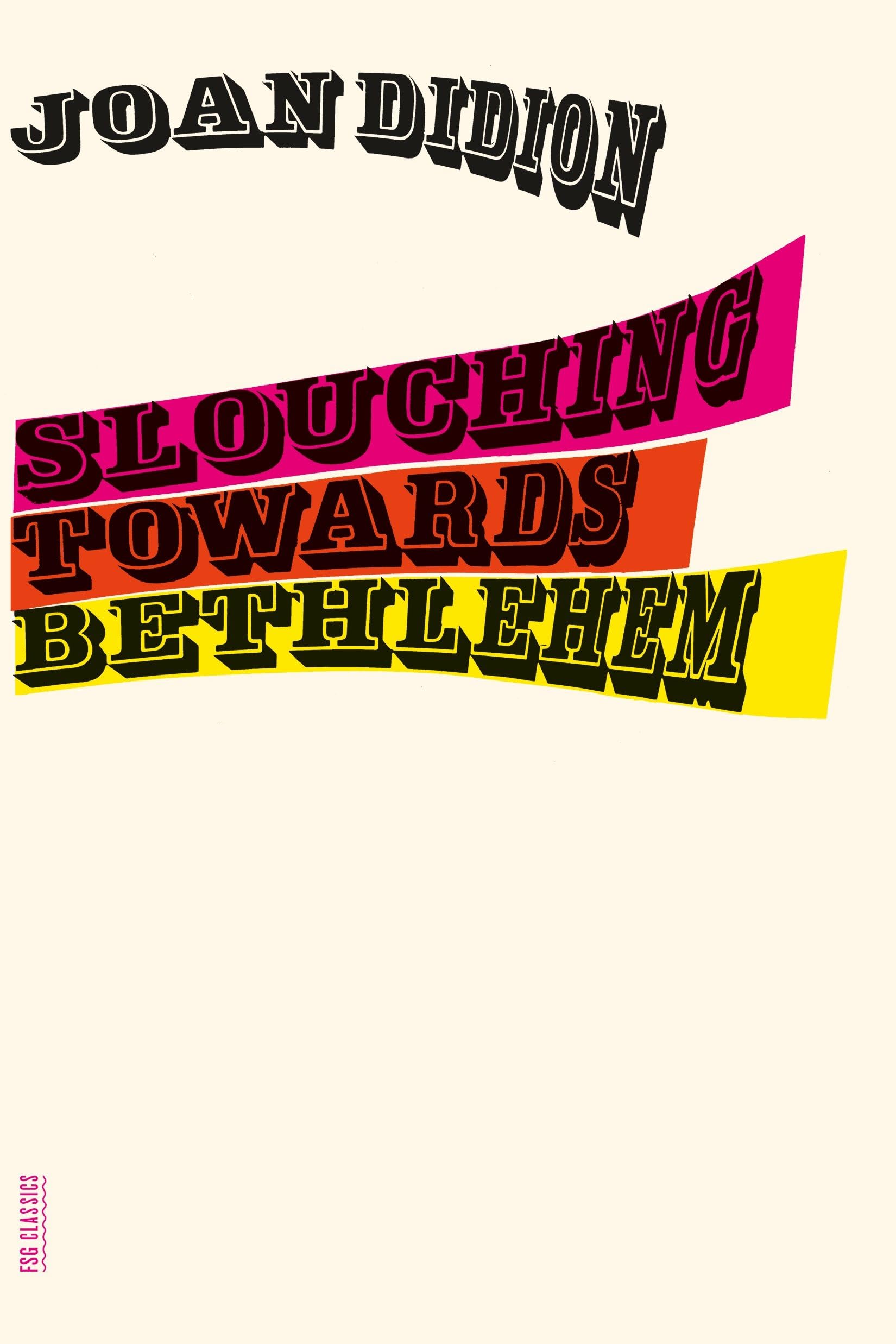
Slouching Towards Bethlehem: Essays (FSG Classics)
Product ID: 1729966
Desertcart purchases this item on your behalf and handles shipping, customs, and support to Brazil.
Joan Didion’s first work of nonfiction, Slouching Towards Bethlehem , is considered a masterpiece of American literature and the “foundational text” of her oeuvre ( New York Times ). First published in 1968, the book remains a defining work about the Sixties, about California, about America. More than perhaps any other book, this collection of essays by Didion―one of the most distinctive prose stylists of our era―captures her focus on time and place at a unique moment in history. Here, Didion explores people and subjects such as John Wayne, Howard Hughes, growing up in California, the nature of good and evil in a Death Valley motel room, San Francisco’s Haight-Ashbury, and the birth of American counterculture. Didion’s work in Slouching has become a totem for readers “who have lost their sense of place or sense of time or sense of self” ( The Rumpus ). “In her portraits of people,” writes the New York Times , “Didion is not out to expose but to understand.” Hailed as one of the 100 best nonfiction books of all time ( Time Magazine ) and as a classic of New Journalism, Slouching Towards Bethlehem is Didion at her finest. Review: ... always selling somebody out. - Once I read The Year of Magical Thinking, I made it my goal to read all of Didion’s books; this in preparation or rather leading up to her latest endeavor, Let Me Tell You What I Mean, which features twelve never before collected pieces, that “offer an illuminating glimpse into the mind and process of a legendary figure.” It is scheduled to be released January 26th. The Year of Magical Thinking is a beautifully written exploration of the self, enveloped in grief. While doing research for her latest, I googled her page and found a Vanity Fair article from 2016, “How Joan Didion the Writer Became Joan Didion the Legend.” In The Atlantic, a post from 2015, “The Elitist Allure of Joan Didion,” and finally, from the Inquirer. Net, a post from yesterday, January 15, “What did Joan Didion smell like in her 20s?” Of course I clicked on it. It led me to the last chapter in Slouching Towards Bethlehem, “Goodbye to All That,” her instinctive yet enthralling ode to New York. “For a lot of the time I was in New York I used a perfume called Fleurs de Rocaille, and then L’Air du Temps, and now the slightest trace of either can short-circuit my connections for the rest of the day.” Slouching Towards Bethlehem was published in 1968 and both are still available; the former launched in 1933, the latter, 1948. The title comes from the Yeats poem, The Second Coming, and “conveys the complexity and the ‘atomization’ of the hippie scene not as the latest fashionable fad, but as a serious advanced stage of society in which things are truly “falling apart.”” Didion is always relevant. I didn’t know Slouching Towards Bethlehem is Didion’s first collection of non-fiction writing; at the time there were questions whether this type of writing was acceptable other than “mere journalism,” but in reality, it is a “rich display of some of the best prose written today in this country.” In Dan Wakefield’s review from the New York Times at the time of its publication, “… in her portraits of people, Ms. Didion is not out to expose but to understand and she shows us actors and millionaires, doomed bridges and naïve acid trippers, left wing idealogues and snobs of the Hawaiian aristocracy in a way that makes them neither villainous nor glamourous but alive and botched and often mournfully beautiful in the midst of their lives’ debris.” Divided into 3 sections, Lifestyles in the Golden Land, Personals, and Seven Places of the Mind; it doesn’t matter what she writes, her personality comes through in such a self-effacing way, as if speaking with a friend. Her prose can meander without losing the reader, then lead you right to a Kleenex. And you don’t know how you got there. “My only advantage as a reporter is that I am so physically small, so temperamentally unobtrusive, and so neurotically inarticulate that people tend to forget that my presence runs counter to their best interests. And it always does. That is one last thing to remember: writers are always selling somebody out.” Review: Turbulent '60s Essays - This is my third by Didion, after her memoirs The Year of Magical Thinking and Blue Nights . It's a collection of 20 turbulent essays -- mostly social commentary but some personal, and all personally felt -- published in various magazines in the mid-1960s. Much of the commentary remains relevant; even many of the details feel current -- for example, these opening lines of the long title essay, set during Haight-Ashbury's 1967 summer of love: "The center was not holding. It was a country of bankruptcy notices and public-auction announcements and commonplace reports of casual killings and misplaced children and abandoned homes and vandals who misspelled even the four-letter words they scrawled. It was a country in which families routinely disappeared, trailing bad checks and repossession papers." I enjoyed most of these essays, where Didion seems like a naturalist in close observation; she infuses more so than reports, and eschews transitions so that I suddenly realized things that hadn't been written. It's been long enough since I read them to recognize a few that still pop up as especially memorable, among them the piece about Haight-Ashbury; one about infidelity and murder outside Los Angeles; another about becoming enamored of John Wayne and forever after dreaming that a man would, as Wayne did in a film, "build her a house 'at the bend in the river where the cottonwoods grow' "; and one about the psychological effects of the Santa Ana and other "foehn" winds that compels me to read more on the phenomenon. I've always been struck that Didion is about the size of a mosquito, and here I was interested to read her take on the matter: "My only advantage as a reporter is that I am so physically small, so temperamentally unobtrusive, and so neurotically inarticulate that people tend to forget that my presence runs counter to their best interests. And it always does." Yeah, don't let appearances fool you, Didion is brave and passionate and compelling, and it occurs to me that one of the essays, "On Self-respect," details the stitching behind her strength of character. And she's shockingly wise: "I remember one day [...] we both had hangovers [...] and we walked to a Spanish restaurant and drank Bloody Marys and gazpacho until we felt better. I was not then guilt-ridden about spending afternoons that way, because I still had all the afternoons in the world. Are you kidding me? That wasn't written by today's septuagenarian Didion looking back; that's her at age 32. I look forward to reading more, next up probably The White Album .


| Best Sellers Rank | #4,050 in Books ( See Top 100 in Books ) #2 in Women Writers in Women Studies #2 in Women Author Literary Criticism #9 in Essays (Books) |
| Customer Reviews | 4.4 out of 5 stars 5,732 Reviews |
C**T
... always selling somebody out.
Once I read The Year of Magical Thinking, I made it my goal to read all of Didion’s books; this in preparation or rather leading up to her latest endeavor, Let Me Tell You What I Mean, which features twelve never before collected pieces, that “offer an illuminating glimpse into the mind and process of a legendary figure.” It is scheduled to be released January 26th. The Year of Magical Thinking is a beautifully written exploration of the self, enveloped in grief. While doing research for her latest, I googled her page and found a Vanity Fair article from 2016, “How Joan Didion the Writer Became Joan Didion the Legend.” In The Atlantic, a post from 2015, “The Elitist Allure of Joan Didion,” and finally, from the Inquirer. Net, a post from yesterday, January 15, “What did Joan Didion smell like in her 20s?” Of course I clicked on it. It led me to the last chapter in Slouching Towards Bethlehem, “Goodbye to All That,” her instinctive yet enthralling ode to New York. “For a lot of the time I was in New York I used a perfume called Fleurs de Rocaille, and then L’Air du Temps, and now the slightest trace of either can short-circuit my connections for the rest of the day.” Slouching Towards Bethlehem was published in 1968 and both are still available; the former launched in 1933, the latter, 1948. The title comes from the Yeats poem, The Second Coming, and “conveys the complexity and the ‘atomization’ of the hippie scene not as the latest fashionable fad, but as a serious advanced stage of society in which things are truly “falling apart.”” Didion is always relevant. I didn’t know Slouching Towards Bethlehem is Didion’s first collection of non-fiction writing; at the time there were questions whether this type of writing was acceptable other than “mere journalism,” but in reality, it is a “rich display of some of the best prose written today in this country.” In Dan Wakefield’s review from the New York Times at the time of its publication, “… in her portraits of people, Ms. Didion is not out to expose but to understand and she shows us actors and millionaires, doomed bridges and naïve acid trippers, left wing idealogues and snobs of the Hawaiian aristocracy in a way that makes them neither villainous nor glamourous but alive and botched and often mournfully beautiful in the midst of their lives’ debris.” Divided into 3 sections, Lifestyles in the Golden Land, Personals, and Seven Places of the Mind; it doesn’t matter what she writes, her personality comes through in such a self-effacing way, as if speaking with a friend. Her prose can meander without losing the reader, then lead you right to a Kleenex. And you don’t know how you got there. “My only advantage as a reporter is that I am so physically small, so temperamentally unobtrusive, and so neurotically inarticulate that people tend to forget that my presence runs counter to their best interests. And it always does. That is one last thing to remember: writers are always selling somebody out.”
E**Y
Turbulent '60s Essays
This is my third by Didion, after her memoirs The Year of Magical Thinking and Blue Nights . It's a collection of 20 turbulent essays -- mostly social commentary but some personal, and all personally felt -- published in various magazines in the mid-1960s. Much of the commentary remains relevant; even many of the details feel current -- for example, these opening lines of the long title essay, set during Haight-Ashbury's 1967 summer of love: "The center was not holding. It was a country of bankruptcy notices and public-auction announcements and commonplace reports of casual killings and misplaced children and abandoned homes and vandals who misspelled even the four-letter words they scrawled. It was a country in which families routinely disappeared, trailing bad checks and repossession papers." I enjoyed most of these essays, where Didion seems like a naturalist in close observation; she infuses more so than reports, and eschews transitions so that I suddenly realized things that hadn't been written. It's been long enough since I read them to recognize a few that still pop up as especially memorable, among them the piece about Haight-Ashbury; one about infidelity and murder outside Los Angeles; another about becoming enamored of John Wayne and forever after dreaming that a man would, as Wayne did in a film, "build her a house 'at the bend in the river where the cottonwoods grow' "; and one about the psychological effects of the Santa Ana and other "foehn" winds that compels me to read more on the phenomenon. I've always been struck that Didion is about the size of a mosquito, and here I was interested to read her take on the matter: "My only advantage as a reporter is that I am so physically small, so temperamentally unobtrusive, and so neurotically inarticulate that people tend to forget that my presence runs counter to their best interests. And it always does." Yeah, don't let appearances fool you, Didion is brave and passionate and compelling, and it occurs to me that one of the essays, "On Self-respect," details the stitching behind her strength of character. And she's shockingly wise: "I remember one day [...] we both had hangovers [...] and we walked to a Spanish restaurant and drank Bloody Marys and gazpacho until we felt better. I was not then guilt-ridden about spending afternoons that way, because I still had all the afternoons in the world. Are you kidding me? That wasn't written by today's septuagenarian Didion looking back; that's her at age 32. I look forward to reading more, next up probably The White Album .
R**A
Literary journalism at its best
This collection of essays chronicles some of the most iconic places and moments in American history of the 60s and 70s, but in words and symbols and metaphors that only Joan Didion’s brilliant mind and hallmark writing could conjure. Her lyrical locution perfectly captures the zeitgeist of the times. Didion’s writing is similar to Richard Grant’s in its beauty and depth and literary style.
F**Y
A Great Series of Non Fiction Essays From The 1960s By A Great Author
This is a diverse series of essays authored by Joan Didion in the 1960s. They are in a range of subjects about various aspects of California Society, personal philosophical viewpoints, and autobiographical sketches. Joan Didion combines interesting insights with an artistic flair consistent with also being a fine novelist. In that this was a series of essays, I generally just listened to one at a time, when I had no other distractions, so that I could fully contemplate them. Therefore it took me, perhaps two weeks to slowly work my way through these fine essays. Generally when I study an author, I prefer to read her works in chronological order. I have already read a previous novel, "Run, River", which I completely loved. I then read a second novel, "Play It As It Lays", published after these essays. I was ambivalent about this second novel. If I had it to do over again, I would have read these essays prior to reading those two novels. There is a semi autobiographical aspect to her first two novels that I now have a fuller appreciation of. As is often the case, I listened to an audiobook as I simultaneously read these essays. The narrator is Diane Keaton and she is excellent. This very much added to my personal reading enjoyment. I have become a fan of Joan Didion. "Run, River" flows slowly. It will not appeal to every modern reader, but I found it very mature quite elegant. Likewise, these essays are very mature and intelligent. They are somewhat dated, but in that context also provide a non fiction, literary "time capsule" that I completely enjoyed. Thank You...
B**N
Writing at its best
Didion’s book Slouching Towards Bethlehem is a marvel. I lavished in her wonderful descriptions even as I sat jealous that I couldn’t construct such beautiful and expressive sentences. They say “be specific” when you write, a suspiciously generic recommendation, but Didion shows us how. “Alcatraz island is covered with flowers now: orange and yellow nasturtiums, geraniums, sweet grass, blue iris, black-eyed Susans, Candytuft spring up through the cracked concrete in the exercise yard. Ice plant carpets the rusting catwalks, ‘Warning! Keep off! Us Property,’ the sign still reads, big and yellow and visible for perhaps a quarter of a mile…” Her observations are unblinking even in the face of the horrible, as evidenced by her trip to San Francisco’s drug scene. “When I finally find Otto he says ‘I got something at my place that’ll blow your mind,’ and when we get there I see a child on the living-room floor. She keeps licking her lips in concentration and the only off thing about her is that she’s wearing white lipstick. ‘Five years old,’ Otto says. “On acid.’ “ The five-year-old’s name is Susan, and she tells me she is in High Kindergarten. She lives with her mother and some other people, just got over the measles, wants a bicycle for Christmas, and particularly likes Coca-cola, ice cream, Marty in the Jefferson Airplane, Bob in the Grateful Dead, and the beach. She remembers going to the beach once a long time ago, and wishes she had taken a bucket. For a year now her mother has given her both acid and peyote. Susan describes it as getting stoned.” Essays “On Self-Respect” and “On Morality” are two of my favorite pieces in the collection, not because they are better composed than the others (they are not), but because Didion takes subjects that are nebulous and fluid, and she makes them concrete and visceral. Written in 1965, one cannot help but connect “On Morality” to the Vietnam war, yet reading it today gives one pause for every moralistic crusade we’ve embarked upon, whether it be personal, or national. This is the very definition of timeless writing. I’m now putting other works by Didion in my slush pile. I can only hope they bring the joy that this work did.
C**X
Pithy, perfect sentences
This collection of essays is organized into three sections, "I. Life Styles of the Golden Land", "II. Personals", and "III. Seven Places of the Mind". Section I. contains a series of vignettes, which read like articles you might find in The New Yorker. Section II. is more introspective, while Section III. combines personal reflection with geographic locations. Of these, section I. was my least favorite. The essays were presented with such detachment, and it was clear that they had been written on hot-button issues of the time. Section II. was again mixed, but I found that I connected more with the personal nature of these essays. I particularly liked "On Keeping a Notebook" and "On Going Home". Section III. was my favorite, and "Notes from a Native Daughter", "Letter from Paradise", and "The Seacoast of Despair" were especially good. Throughout, the writing can be truly excellent. There are many pithy, perfect sentences in these essays, the kind of sentences where you stop, note them, and think about that turn of phrase for a while after. This collection has a lot to savor in it. If you are interested in well-written reflections on the 1960s, mostly in California, or in Joan Didion, it is worth your time to read.
Z**L
Beautiful essays about 1960s America and the American Dream
Now that's what I call writing! It's so good that I was always excited to read the next essay, even if it was all about the decaying, changing American Dream. Even when some of the essays were snoozefests (*cough* the 'Personals'), they were always well-written, with a sardonic, neurotic, and playful voice. It's a bizarre combination of a mythic America, and very down-to-earth details that slowly but surely unravel that beautiful dream. Didion really works when she just tells a story --dinner with an old John Wayne, three people (and two dogs) living on Alcatraz Island, hippies whiling away their evening, and a big lady in a muumuu ramming her shopping cart into Didion's because Joan had the audacity to wear a bikini. "What a thing to wear to Ralph's." Now, I REALLY wanted to give this 5 stars right from the preface--that's just how good of a writer Joan Didion is. The problem is the collection starts to really sag in the middle. They started to get more rambling and unfocused, and it's not nearly as fun when Didion just gets up on her soapbox. It's also a little odd which sacred cows she mourns, and which she chooses to tip (I don't know if Dr. Strangelove deserved the shade thrown at it, Ms. Didion). But still, I like this a lot. Didion knows how to choose the exact correct word or turn of phrase to illuminate a whole world. I didn't always agree with her opinions, but darn if I wasn't interested in what she had to say.
G**G
A highly authentic and well rounded, engaging understanding of California
Joan Didion is my "new" favorite author. These essays are just killer. They will appeal to you if you have an interest in '60s culture, particularly as it relates to California, as a number of essays are California centric. Her understanding of the 1960s and California culture isn't just cookie cutter in the way most people think of it who never experienced it due to it being before their time, etc. Didion understands the state, regionally, very well. In this highly engaging read, you'll find a very unique account of Joan Baez that gives an unprecedented insight into who this person is, and the interest generated by the author has little to do with whether or not the reader has an active interest in Baez' music or herself as an artist. You'll be privy to (again) an highly unique account of John Wayne in his sunset years, on location in Mexico with Dean Martin, shooting a film. In the title essay, a decidedly dark portrait and objective reality of San Francisco's Haight-Ashbury district circa 1967 is shown to the reader. A true crime 1964 noir-tinged murder case in the heart of San Bernardino is recounted, replete with adultery and a potential double indemnity scenario. In another essay, Didion contrasts Los Angeles from New York living from her own personal experience, which is bound to bestow accurate but previously inconceivable insight upon the reader in their own impressions of both cities. In a rare departure from CA and NY, Didion recounts the soulless, hard coldness and effect of big business and money on the exclusive shoreline living of Rhode Island in "The Seacoast of Despair." Etc, etc. A FASCINATING READ of engaging essays to say the least. This book also will improve your vocabulary tenfold. Didion's use of language is preternatural in the best sense possible.
K**Z
As advertised ,
As advertised, came 1 day after order was placed
P**1
Brilliant journalism
Joan Didion's writing is superb. This is an oldie, but what a goodie. For any thinking reader, this is a fabulous addition to a library.
B**S
Short
Good
K**E
a good choice for readers who enjoy thoughtful literary essays
I enjoyed the collection of essays and the way the author observes people, places, and everyday experiences. The writing has a distinctive style that makes the pieces interesting to read. A good choice for readers who enjoy thoughtful literary essays.
P**Y
Fabuleux
Une des plus grandes autrices du XXème siècle. Peut-être son recueil le plus connu, malheureusement pas intégralement traduit en français.
Trustpilot
2 weeks ago
1 month ago