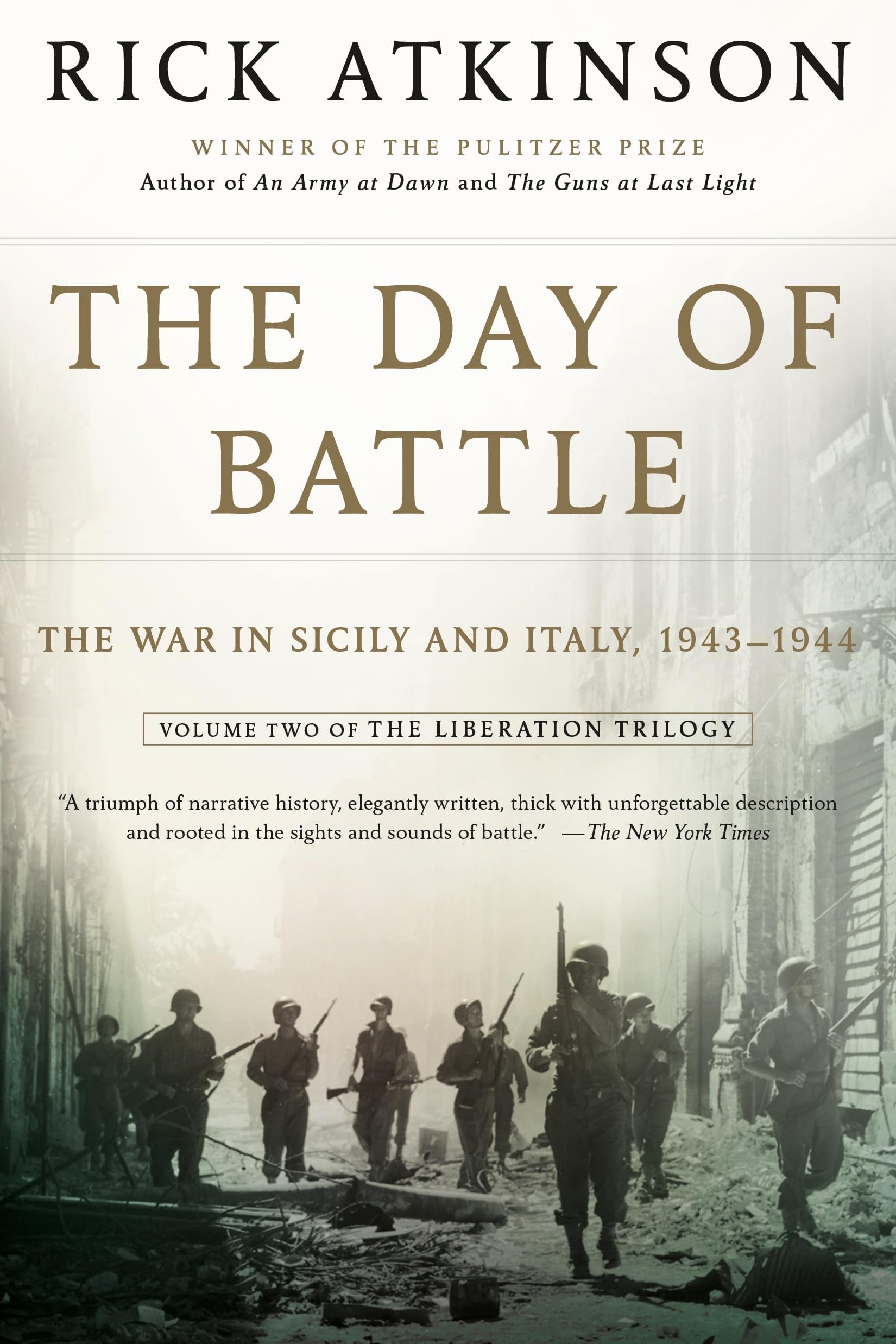
The Day of Battle: The War in Sicily and Italy, 1943-1944 (The Liberation Trilogy, 2)
Product ID: 1702319
Buy anything from 5,000+ international stores. One checkout price. No surprise fees. Join 2M+ shoppers on Desertcart.
Desertcart purchases this item on your behalf and handles shipping, customs, and support to Brazil.
A New York Times Bestseller In the second volume of his epic trilogy about the liberation of Europe in World War II, Pulitzer Prize winner Rick Atkinson tells the harrowing story of the campaigns in Sicily and Italy In An Army at Dawn ―winner of the Pulitzer Prize―Rick Atkinson provided an authoritative history of the Allied triumph in North Africa during World War II. Now, in The Day of Battle , he follows the strengthening American and British armies as they invade Sicily in July 1943 and then, mile by bloody mile, fight their way north toward Rome. The decision to invade the so-called soft underbelly of Europe was controversial, but once under way, the commitment to liberate Italy from the Nazis never wavered. The battles at Salerno, Anzio, the Rapido River, and Monte Cassino were particularly lethal, yet as the months passed, the Allied forces continued to drive the Germans up the Italian peninsula. And with the liberation of Rome in June 1944, ultimate victory at last began to seem inevitable. Drawing on a wide array of primary source material, written with great drama and flair, The Day of Battle is a masterly account of one of history's most compelling military campaigns. Review: Brilliant Work -- A Masterpiece - Rick Atkinson's "The Day of Battle: The War in Sicily and Italy, 1943-1944" is a masterpiece of military history that should be read by anyone with any interest in World War II or American military history. Following on the heels of his Pulitzer Prize-winning "An Army at Dawn," this is the second work in Atkinson's "Liberation Trilogy" and deserving of yet another Pulitzer Prize. This book is awash in details about the difficult - and often forgotten - fighting in the Mediterranean Theater, but it also clearly and effectively describes the bigger picture of the war in Sicily and Italy. Two things will immediately strike the reader about this book: the detail with which Atkinson describes the fighting, and the dazzling prose that he uses to tell this story. Atkinson describes the personalities and details of the main characters in the story - the leaders, from Eisenhower to Kesselring to Patton to Mark Clark to - and also gives telling glimpses of the personal lives of the "grunts" who did the fighting on the ground. His emphasis on detail knows no bounds, as he describes Churchill's meals, the furnishings in Mark Clark's office, and the "Anzio Ritz" - the underground cinema at the Anzio beachhead that showed movies to the soldier's at the world's largest self-sufficient POW camp. For many authors, these details would detract from the story, but through Atkinson's incredible writing, these details instead add life, character, and flavor to this story. He captures the frustrations and difficulties of preparing and leading these forces, such as when he says that "for reasons known only at echelons above reason" a typical convoy required more than six thousand pages of names. My only complaint or criticism is that, in his effort to weave a seamless narrative, some of the militarily-significant details - the exact unit's designation, the exact date and time, the number of casualties - are omitted. That prevents this book from being a definitive source on the fighting in Sicily and Italy and means that anyone trying to do research on these campaigns needs to look elsewhere. But despite that extremely minor criticism, this book stands head and shoulders above most other military histories. I've waited for this book for over three years, since reading "An Army at Dawn," and it was well worth the wait. I am already anxiously awaiting Rick Atkinson's concluding work in the "Liberation Trilogy." Review: wow; earns its accolades. - i had little hope for this as I could not imagine anyone with a pedigree including the Washington Post writing anything objective but Mr. Atkinson did. This is a truly monumental effort. I've read quite a # of WWII books and they all have something to offer, and many are far superior to this as far as their story but to write a massive missive like this, well documented, with one hell of a vocabulary as well (polders?)....well, kudos to Mr. Atkinson and a moment of reverent silence to the millions of military and civilian dead who went into its writing. A few minor quibbles; there's almost nothing in there at all about Norway, nothing about the eastern front, and little about things like the Jedburgh's, but those can be filled in by other books, and for anyone wanting a comprehensive look at the war 50 years later, this is as good as I can imagine. I got a little annoyed with his treatment of patton early on, but the more I read it the more I realize it was probably pretty balanced and Patton was truly a bizarre hero. He tended to buff Mark Clark a bit, who by many other accounts was an absolutely inept soldier, and I truly enjoyed the way he introduced little known other generals - Devers, Buckner, Slim - to the reader. Also, without knowing which side of the coin he was on, he managed to get across that Montgomery was a blithering foppish fool, and that DeGaulle was perhaps the most nauseating leader in the entire morass with his timely return and idiotic and unsubstantiated demands. My own take was that Roosevelt and Eisenhower were not quite the geniuses we've been lead to believe they are, especially with some of the events that occurred in the east toward the end of the war with British and US prisoners being basically sold out to the Russians, but I was also disappointed to realize that my hero Churchill was a great leader, and a great soldier, but a bit more of a military klutz than I'd ever realized - a great leader of his nation but a meddler and perhaps the Dardanelles wasn't entirely a one off mistake on his part; he had great missteps in Italy and Western Europe as well. What came across was the gallantry and the fallibility of all of these men in various ways. But it is all in the books, and they are superbly written, with excellent gripping syntax, just enough varied style to keep you riveted, and a great balance between the battles, the logistics, the great men, and the little people who make up war history. Some of the personal recollections and personal histories were the most moving in the entire series.


| Best Sellers Rank | #29,649 in Books ( See Top 100 in Books ) #4 in Italian History (Books) #16 in Military Strategy History (Books) #44 in World War II History (Books) |
| Customer Reviews | 4.6 out of 5 stars 3,290 Reviews |
T**C
Brilliant Work -- A Masterpiece
Rick Atkinson's "The Day of Battle: The War in Sicily and Italy, 1943-1944" is a masterpiece of military history that should be read by anyone with any interest in World War II or American military history. Following on the heels of his Pulitzer Prize-winning "An Army at Dawn," this is the second work in Atkinson's "Liberation Trilogy" and deserving of yet another Pulitzer Prize. This book is awash in details about the difficult - and often forgotten - fighting in the Mediterranean Theater, but it also clearly and effectively describes the bigger picture of the war in Sicily and Italy. Two things will immediately strike the reader about this book: the detail with which Atkinson describes the fighting, and the dazzling prose that he uses to tell this story. Atkinson describes the personalities and details of the main characters in the story - the leaders, from Eisenhower to Kesselring to Patton to Mark Clark to - and also gives telling glimpses of the personal lives of the "grunts" who did the fighting on the ground. His emphasis on detail knows no bounds, as he describes Churchill's meals, the furnishings in Mark Clark's office, and the "Anzio Ritz" - the underground cinema at the Anzio beachhead that showed movies to the soldier's at the world's largest self-sufficient POW camp. For many authors, these details would detract from the story, but through Atkinson's incredible writing, these details instead add life, character, and flavor to this story. He captures the frustrations and difficulties of preparing and leading these forces, such as when he says that "for reasons known only at echelons above reason" a typical convoy required more than six thousand pages of names. My only complaint or criticism is that, in his effort to weave a seamless narrative, some of the militarily-significant details - the exact unit's designation, the exact date and time, the number of casualties - are omitted. That prevents this book from being a definitive source on the fighting in Sicily and Italy and means that anyone trying to do research on these campaigns needs to look elsewhere. But despite that extremely minor criticism, this book stands head and shoulders above most other military histories. I've waited for this book for over three years, since reading "An Army at Dawn," and it was well worth the wait. I am already anxiously awaiting Rick Atkinson's concluding work in the "Liberation Trilogy."
J**N
wow; earns its accolades.
i had little hope for this as I could not imagine anyone with a pedigree including the Washington Post writing anything objective but Mr. Atkinson did. This is a truly monumental effort. I've read quite a # of WWII books and they all have something to offer, and many are far superior to this as far as their story but to write a massive missive like this, well documented, with one hell of a vocabulary as well (polders?)....well, kudos to Mr. Atkinson and a moment of reverent silence to the millions of military and civilian dead who went into its writing. A few minor quibbles; there's almost nothing in there at all about Norway, nothing about the eastern front, and little about things like the Jedburgh's, but those can be filled in by other books, and for anyone wanting a comprehensive look at the war 50 years later, this is as good as I can imagine. I got a little annoyed with his treatment of patton early on, but the more I read it the more I realize it was probably pretty balanced and Patton was truly a bizarre hero. He tended to buff Mark Clark a bit, who by many other accounts was an absolutely inept soldier, and I truly enjoyed the way he introduced little known other generals - Devers, Buckner, Slim - to the reader. Also, without knowing which side of the coin he was on, he managed to get across that Montgomery was a blithering foppish fool, and that DeGaulle was perhaps the most nauseating leader in the entire morass with his timely return and idiotic and unsubstantiated demands. My own take was that Roosevelt and Eisenhower were not quite the geniuses we've been lead to believe they are, especially with some of the events that occurred in the east toward the end of the war with British and US prisoners being basically sold out to the Russians, but I was also disappointed to realize that my hero Churchill was a great leader, and a great soldier, but a bit more of a military klutz than I'd ever realized - a great leader of his nation but a meddler and perhaps the Dardanelles wasn't entirely a one off mistake on his part; he had great missteps in Italy and Western Europe as well. What came across was the gallantry and the fallibility of all of these men in various ways. But it is all in the books, and they are superbly written, with excellent gripping syntax, just enough varied style to keep you riveted, and a great balance between the battles, the logistics, the great men, and the little people who make up war history. Some of the personal recollections and personal histories were the most moving in the entire series.
R**Z
Solid but not Definitive History of the Campaign
Atkinson is a good writer and he tries to accomplish much here in 600 pages. He is trying to describe in good authoritative narrative style the causes, courses and consequences of the Italian campaign. It is a worthy ideal, but, given the nature and scope of the campaign, almost doomed before from the start. But Atkinson does write well enough and on engendering sheer excitement he passes very admirably. What this book is about: This is primarily an American description of the campaign in Italy. He does an great job of rendering the reality of some of these men who are larger than life and (much to Atkinson's credit) all flawed. From the odious Patton to aloof Alexander, British and American, NewZealander, Canadian and French Commanders all come up for their very necessary critical analysis. I liked this very much. Atkinson destroyed a few of my heroes (Terry Alan, General Alexander), chipped a few down a block (Churchill and Eisenhower). And shreds a few all to pieces -- Patton, Dawley. Some are flawed but tragic, Lucas (Anzio beachhead commander) and Walker (Texas Div Commander), and Freyberg, the crusty and incorrigable New Zealand Commander. For better or worse there are almost no military commanders who survive being anything else than tragic -- in that sense they are complete mirrors of this campaign. Atkinson also describes the folley of waging war without specific objectives. It is clear that at almost any part of the campaign, there were no solid objectives: the first objective was to be Sicily, if that went well, according to the judgement of the theatre commander, they were to have a go at the boot of Italy. Then Salerno and then Anzio and the creep up and battle at the Gustav Line. Plans were haphazard at best. At no point was any commander endeared with forsight,tactical or strategic genius. When resistance was encountered, it was addressed with frontal assault and heavy artillery in much the same way as WWI. And the Allied grunts and many Italians sufferred. What the book is not about: Atkinson has an American feel to his writing and is best at home when he describes American unit action (in which he weighs the narrative). It is clear that the British Commonwealth regimental sctructure is not his forte. He refers to British regiments in ways that are not normally used and he he rarely uses the British shorthand terms. While he refers to Americans and there hometowns by state, Brits are just Brits. Indian division officers are quoted -- they are not however Indians, they are British officers attached to the Indian Divisions. How were these divisions structured? What makes the fact a person is attached to the Seaforth Highlanders of Canada is part of a regiment and not a division that defines him? What and how were the Poles integrated into the British Commonwealth Armies? All of this is a rich narrative that most Americans find confusing and have traditionally little understood. It does however go to the heart of the British way of war. Having said this he almost pulls off a good overview of both sides in a balanced fashion at times. But while there is good description of the American Battle at Triona in Sicily, there is virtually nothing about the British battle at Catania -- which consumed many more troops and casualties. Nothing of the War north of Rome. This is the nub of the matter. In overall terms of troops deployed and casualities taken, the Commonwealth forces contributed more men and took more casualties than their American cousins. This should not detract from this book as a great read. It should encourage American readers to move beyond their often rather narrow interpretation of WWII. I should note in tribute to Atkinson, that he does included a 10 page segment -- and even an map!! -- on the pointless and particularly brutal battle of the Canadians at Ortona. There are other things that should be included: there is nothing on the use of airpower or history of the Air Forces in this sector (ditto for the Navy). There is also an annoying use of contemporary terms such as "parse" which Atkinson seems to use to mean everything from "to sort" or "arrange" to also mean "separate." Also using the contemporary term "tube" to describe any artillery piece does little for understanding the discrepancy between allied and German artillery power and usage. As mentioned by another review Nebelwerfers were rocket launchers, not mortars. The book does give and excellent idea of the tragedy of this campaign, the personalities and the parts they played. The tragedy comes from the fact that not only do we know ex post facto that these men will be thrown into many hopeless battles, but that their commanders on the ground at the time also knew. A magnificent book that pleases warts and all... maybe being flawed is an essential element to great narrative.
U**G
Great Story Teller
When you look at the thickness of this book, it can be a little intimidating. However, 1/4 of it is endnotes and the other 3/4 goes by very quickly due to the excellent stories and details provided by the author. This book was such an interesting read that it was, at times, hard to put down. Kudos to the author for the research and information provided on the phase of the war that did not get too much attention. Prior to reading the first two books, there was an aura or mythology about General Patton, Eisenhower, and Montgomery. But after reading the first two books, it was very disappointing how these generals handled themselves during the war. Tactically, all three had to be the most incapable leaders of adapting and changing strategy on the enemy. As a former military officer, it was always engrained in our head to make sure we took care of the troops and looked out for their well being. But one thing is for sure, these 3 would be the poster child for what not to do as military generals. For example, the landings in North Africa were such a fiasco that it was an embarrassment to the Army. You would think that Patton's after action reporting would provide him with the knowledge necessary to make strategic adjustments on the landing in Sicily. But he was so hard headed that he failed to "look out for the troops" and made the same mistakes on the Sicily landings. Overall, the generals were like a bunch of divas. They did not care how many men died fighting, but more about getting from point A to point B first and take all the glory. The infighting to with the Americans and the British caused more people to lose their lives than necessary. The cherry on top of the cake was how Patton was given the privilege of assisting with the landing in Normandy. Eisenhower was notorious for being a better politician and getting people to follow rather than a general who was strong on tactics and making the right adjustments on the battlefield The General Clark fiasco was another example of the hypocrisy that occurs in the upper ranks. If a LT or Capt. disobeyed a lawful order, they would be relieved and most likely subject to UCMJ articles. Gen Clark blatantly disobeyed an order from the Allied commander because he wanted the glory of the first general to make it to Rome before the British did. He did not suffer any consequences and went down in history as one of the most controversial fighting generals in history. General Clark should thank the French general (Juin) for saving his butt. If it was not for the French and their colonial fighters, the Allies would never have broken the German lines and made it to Rome. But Juin found a way to screw it up by allowing his troops to commit rapes and murders on the Italian women without repercussions. He actually enabled it and had a laissez faire attitude. Once again, great book just like the first volume. Highly recommend to those who would like the details as to what happened in Italy during WWII.
J**Y
superb history, brilliantly written and researched
Rick Atkinson deservedly won the Pulitzer Prize for "Army at Dawn." His eagerly awaited and fascinating sequel of the Italian campaign focuses on the Allies' long, slow, deadly slog from Sicily, up the Italian boot to the gates of Rome. His sympathies and foci are always on the soldier, the doughboy, the boots on the ground, not the commanding generals. Largely non judgmental until the end on Mark Clark, Atkinson, early on, paints Patton as the preening egotist of modest achievement and enlarged reputation who is saved by Eisenhower after his two disgraceful slapping incidents in Sicily. The real axe falls when Patton is characterized as lax on logistics and ambivalent on the medical care for his troops. His heroes are the soldiers or their line commanders; Terry Allen, Teddy Roosevelt, Jr., Walker, Truscott, Juin, and Leese, he is distrustful of Alexander and the questionable strategies of Churchill. His admiration in a military sense even extends to Kesselring, the brilliant and effective German general. Liberally quoting from letters home and the observations and comments of Eric Sevareid, Ernie Pyle, Audie Murphy, and Bill Mauldin, Atkinson, with his considerable journalistic skill, adds dash to the story by shifting away from the long sad accounts of death and destruction, the individual battles, by interspersing vivid metaphors, personal life tales and descriptions of the once beautiful and history filled Italian landscape. The battles are filled with movement, thrust, counter thrust, with color and freshness, his les bon mots and asides capture the ground war; the mention of one famous flyboy, James Stewart, the death of Max Brand, the well known writer of Westerns, the grisliness of a French goumier offering a cocktail of German fingers, the American destroyers off Anzio moving back and forth along the beach like anxious dogs along a fence line. Tantalizing writing enthuses the reader along despite the mounting deaths of GIs. The sheer magnitude of the military enterprise overwhelms; casualties, aircraft, equipment, materiel, flights, the percentage of the women in Naples who succumb to prostitution. Fine maps and telling photographs add to one's understanding of the Allied's northward march. His criticism falls on the logistical failures stemming from the confusion in the amphibious landings and the constant demands of the supply train. Generally not given to second guessing the tactics of Eisenhower, Alexander, or Clark, Atkinson has sufficient confidence as a military historian to quote favorably from Douglas Porch's "The Path to Victory" which is a more discerning critique on the broader tactics, the American British rivalry, and strategic importance of the Italian campaign to the impending Normandy invasion and the ultimate war for Germany so aptly detailed in Max Hastings' "Armageddon." Read together, the painful reality of the death and carnage of this campaign emerges. Rick Atkinson's fine history deserves wide spread recognition and appreciation from the public and historians alike.
M**Y
A Fine History of a Long and Depressing Campaign
This is volume two of Atkinson's fine history of World War Two. Like the first volume, it is very well written with a sharp eye for detail. An immense amount of research is presented in excellent prose with an artistic flair for the human story. The Italian campaign is rather depressing and one wonders if it was necessary although, as Atkinson points out, the Allies could not have spent the ten months between the victory in Sicily and Overlord resting. Stalin would not have tolerated this interlude and Hitler would have benefited, although perhaps not as much as the Allies believed. General Mark Clark was one of Marshall's two favorite subordinates, along with Eisenhower. He completely skipped the rank of colonel and was one of the youngest three star generals in the history of the army. Clark succeed to command when Eisenhower and Montgomery left for England to plan the Normandy invasion. This book shows his weaknesses as a commander. He hated the British and constantly resented the role of Alexander, the commander in chief for the Mediterranean Theater. The campaign involved two amphibious landings, Salerno and Anzio. The lessons learned may have been the best reason for the invasion of Italy. The campaign was always underpowered in men and ships. The Allies dominated in the air but the weather was terrible most of the time. Kesselring, the German commander, made the most of terrain best suited for defense. Churchill's enthusiasm for the "soft underbelly" of Europe was especially misplaced in Italy. The only soft underbelly was in France, the site of Anvil, an operation Churchill determinedly opposed. Atlkinson uses men's diaries and personal stories to advance his narrative. Some of it is heartbreaking when the diarists and letter writers do not survive. It is the most personal and revealing war history I have read and is similar to some of the best writing about the US Civil War. It is not really a story of triumph and more of survival. The campaign was conducted through a wet and cold Italian winter. The capture of Rome, at last, occurred the day before the Normandy invasion so Clark was denied the great publicity he sought. The book is a well written and very well researched story of a dreary and depressing campaign. All in all, it is well worth reading for those who want to know about the Italian campaign, which is a far less common topic for World War II history.
B**U
A POIGNANT OPUS. (200+ pages bibliography/index)
From an American's perspective, an eloquent diatribe of the Allied WWII efforts in Sicily and Italy. Disturbing of the countless deaths, casualties, destruction, caused by the U.S. Army's higher command's failure to incorporate essential battle elements into simple detailed tactical plans for achieving victory, including: (1) terrain, (2) foliage, (3) temperature, (4) weather, (5) elevation, particularly favorable heights, (6) appropriate fighting apparel. Moreover, negative consequences resulted from uncooperation and rivalry between air, navy, army, especially concerning casualties from "friendly fire." For instance, "five confused P-40 Warhawks heeled over in a bombing and strafing run .... More than one hundred men were killed or wounded" (p. 551). Further, extreme inepitude caused ""[m]ore American artillery fell on American soldiers" (p. 545). Such extreme errors cannot be compensated. "The meshing of infantry, armor, artillery, air, and combat arms into an integrated battle force -- the essence of modern combat -- remained ragged; at times it was unclear whether Allied air and ground forces were even fighting the same campaign" (p. 173). Patton was not alone in the slapping incidents. "'Never will I forget that nightmare of a march,' a Gurkha officer wrote. 'At times we had no alternative but to strike soldiers who just gave up interest in anything, including a desire to live''" (p. 471). Immense publicity regarding Patton ballooned. "By mid-December, the White House and War Department had received fifteen hundred letters, pro and con, though a Gallup poll indicated that by a four-to-one margin Americans opposed sacking Patton" (p.296). Clearly, imperfect, Patton proved aggressive, astute, victorious, especially in his subsequent European campaign. The author's subjective attitude towards Eisenhower's relationship with his driver, Kay Summersby, negatively reflects upon the material's overall neutral objectivity. "Lately he [Eisenhower] had taken special pains to reassure her [wife Mamie] of his constancy, because lately she had asked pointedly about Kay Summersby" (p. 57). "No convincing evidence would ever prove a carnal relationship between the two ..." (p.57). Upon Army Chief of Staff George Marshall's order for a brief visit in Washington, "[t]wice he [Eisenhower] absently called his wife Kay ..." (p. 318). Interestingly, British Field Marshal Lord Alan Brooke, Chief of CIGS, noted in his singular "War Diaries 1939-1945:" "When we lunched with Ike I was interested to see that Kay [Summersby], his chauffeur, had been promoted to hostess, and sat at the head of the table with Winston on her right. At Versailles she had been promoted to personal secretary ran the lobby next to his office. Now she had moved one step up the ladder. In doing so Ike produced a lot of undesirable gossip that did him no good" (War Diaries, p. 625). Notwithstanding innocence, hypothetically, if a spouse complains of possible inappropriateness, then the offending spouse would transfer her/him to a lateral position in a different location, in respect of the complaining spouse's feelings. But, in the case of Eisenhower, Kay remained by his side, wherever -- England, North Africa, France -- throughout his entire command, until finally returning to the USA. The stagnant attrition defining the Italian War actually fulfilled its goal which was to distract Germany and push its soldiers to Italy as a diversion for the upcoming Allied Normandy D-Day invasion, as well as, appeasing Stalin. "Twenty-three German divisions were mired in Italy, with nearly 300,000 troops. Joseph Goebbels lamented that if the Wehrmacht had another fifteen or twenty divisions to throw into the Eastern Front 'we would undoubtedly be in a position to repulse the Russians. Unfortunately, we must put these fifteen or twenty divisions into combat in the Italian theater'" ( p. 315). A challenging work distilling overwhelming information.
F**.
Even better than the first in this trilogy in every way
Even better than the first in this trilogy in every way: background of the main actors on both sides, topography of the battlefields with effective maps, descriptions of the action as it unfolds with little bits of personal experience gleaned from personal letters, and thoughtful evaluation of the context and consequences of the each of the major battles. The setting is the basic quandary of how to proceed in 1943 – lots of arguments against wasting resources in Italy, but that confounds the fundamental question of what else is there to do. Patton and his personality figure into the campaign in Sicily, and then it’s mostly Clark and Alexander in charge for the rest of the thrust to Rome. The fighting is indeed tough, and the analogy to WWI made repeatedly, but always fades before the logic of needing some kind of progress to maintain the war momentum. Afterwards Kesselring faults the allies for a serious lack of inventiveness in always going for the frontal attack and never trying to outflank or otherwise maneuver to find some advantage. One suspects that the difficulty of the terrain and the constant need to move under observation of the enemy from his high observation posts really limited options. Plus the Germans were just very professional in their defense and consistently move to meet threats whether a single attack along the Rapido or the massive landing at Anzio. A major theme is the controversy around Clark and his quest for battle glory, which is repeatedly dismissed as he could not avoid all the hype about taking Rome, but had to plug onwards with the tools at his disposal. Working under the rather dull and unimaginative Alexander probably limited his options, too. Enjoyed the sidebar about TR Jr encouraging the unruly and undisciplined behavior of his troops. The allies had some real problems coordinating units from different countries, especially at Solerno. Americans made up for the lack of operational coordination with the advantage of all that naval firepower which really made a difference at the two landings in Italy. Two surprises for me were the great importance of snipers and friendly fire throughout. Snipers were constantly taking a toll. Including the incident where a lieutenant has his elbow shot off and then personally executes the sniper who did it. The friendly fire from artillery and aircraft is also repeated on almost a daily basis. Worst of all was the paratroop drop over Sicily where the troops on the ground were not properly notified of the action and proceeded to shoot down so many of their own aircraft. No bones made about the futility and waste of Freyberg’s destruction of Monte Cassino - it was a truly senseless destruction of a great monument. Audie Murphy, Ernie Pyle, Eric Sevareid, and Bill Mauldin all figure into the story. The action in Italy is generally acknowledged as very tough, but this book shows exactly how bad it really was, while suggesting that there really was no other option available. Other insights are incidental such as the great toll taken on the civilian population, and the suppression of the mustard gas release during the attack on the port at Bari.
V**O
semplicemente magnifico.
E' un libro semplicemente magnifico.
J**N
Excellent
An excellent read of the lesser known theatre in WW2. Rick Atkinson brings to life the hardships suffered by both sides in the Sicilian and Italian campaigns. His skill is to provide wonderful narrative which encapsulates both the strategic essence of the campaigns as well as the humanity found in the individual soldier from general to private. Highly recommended!
K**Y
Another superb account
Having read the first in the author’s trilogy I was really looking forward to this second book. I was certainly not disappointed. The reader is presented with a detailed account covering all aspects of the campaigns in Sicily and Italy, from the experiences of the front line participants to the political and nationalist machinations of the senior commanders and their political masters. The detailed accounts of combat operations are both riveting and at the same time harrowing. We are introduced to participants and come to know them as they cope with the hell that was thrust upon them and for my part there was genuine shock and sadness when individuals made the ultimate sacrifice. This is a well written and engrossing story highly recommended for the general reader and those with an interest in the Second World War. It stands as a fitting tribute to all those who fought for the cause of freedom.
R**H
Five Stars
Very nicely packed book with no pages bending! impressive.
C**T
Exquisitely researched details in smoothly flowing prose.
A fair and balanced account. The maps are very awkward to read in Kindle.And the book ends when you are 57% through, because of photos and references. Not Atkinsons fault.
Trustpilot
3 days ago
2 weeks ago