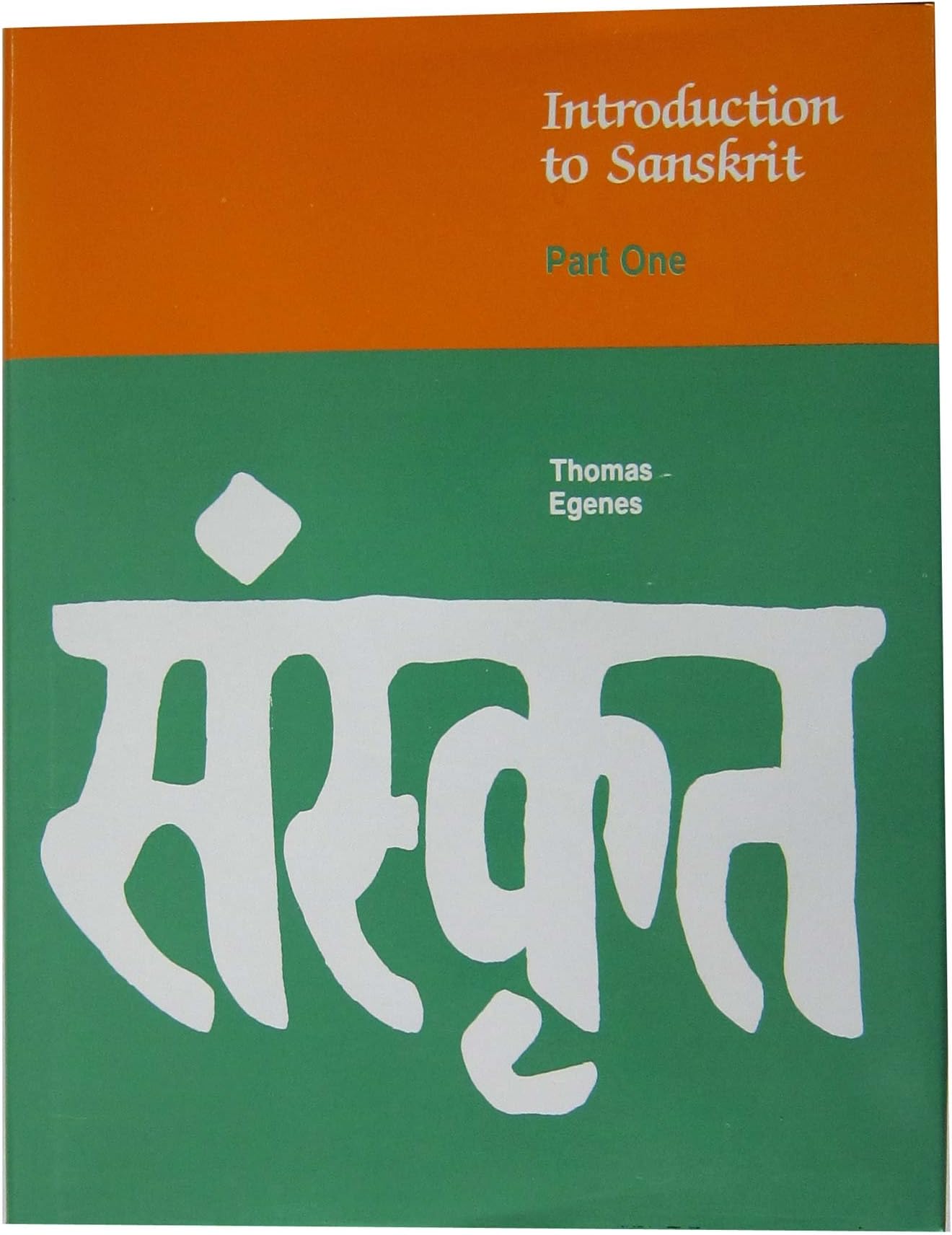
Introduction to Sanskrit, Part 1
Product ID: 12459324
Desertcart purchases this item on your behalf and handles shipping, customs, and support to Brazil.
Introduction to Sanskrit is designed to open the door to India`s rich spiritual literature. This self-teaching guide presents Sanskrit pronunciation, grammar, and vocabulary in simple and systematic steps, allowing students to easily master the fundamentals of this enchanting language. The text gently leads the beginner through small steps with clear, concise explanations. Each lesson includes instruction in alphabet, grammar, and vocabulary, with easy practice exercises at the end. Also included is a reading from the Bhagavad-Gita and Sanskrit quotations from the R.K. Samhita, Upanisads, Yoga Sutras, Brahma Sutra, and Manu Smrti. Review: Great for beginners - I haven't studied Greek or Latin. Like many people I took French in highschool. I'm not a linguist. Sanskrit is the first exposure to a language with so much conjugation tables and so on. The initial learning curve on Sanskrit is painfully steep. Everything is conjugated, including nouns and verbs, and there are seven cases, three genders, and three pluralities (singular, dual and plural). On top of that there are rules for how sounds change when words come together, called sandhi rules, and these sound changes are written. All of this needs to come into play in every sentence you write, no matter how simple, like, "The man goes to the village." First you find the singular masculine nomitive of "man". Then you find the accusative singular of "village". Then you conjugate "goes". Then you put them together and see if sandhi rules apply where the words come together. Oh and you have to write this all in Devanagari script, and Devanagari has about 45 basic letters which can combine together into about 200 variations. Finally, Sandhi rules often join two words together when written so very often not only has a word's spelling changed, but it's now joined to the following word(s). So there's no easy way to get started in simple Sanskrit. Everything you write must go through the process of conjugation and sandhi formation. It's not like learning Spanish where you can start saying basic things correctly in the first chapter and start making basic correct sentences within a couple of weeks. No, not at all. No matter what you do, it's not going to be easy. And with this book, I was able to get going, without a teacher or class and it's not painful. It's slow and takes effort but it works. If any book can achieve that, for a language with the difficulties that are present in Sanskrit, I think that speaks very highly of the book. That's why I'm giving this five stars. I think this book may be unsatisfactory for someone who already speaks Latin or ancient Greek, because you've already seen all these conjugation tables and Sanskrit conjugations will not be totally unfamiliar to you. It's an Indo-European languages and you can see similarities to English and other European languages everywhere. I also think that this book will be overwhelming and overkill for someone who does yoga and wants to get a few Sanskrit words and phrases as an addition to the yoga practice. If that's what you want, find the phrases or words you want to learn and learn them, but don't try to get into the overwhelming complexities of Sanskrit grammar / declension / sandhi / devanagari which you need to master in order to say anything at all. Expect to spend a couple of years of study of this book and Part II to be able to read and write in Sanskrit. Review: Learn Sanskrit - Great book to learn Sanskrit. Everything is clearly explained and lot of good exercises,
| Best Sellers Rank | #1,787,882 in Books ( See Top 100 in Books ) #103,011 in Textbooks (Special Features Stores) #117,352 in Reference (Books) |
| Customer Reviews | 4.6 out of 5 stars 111 Reviews |
T**E
Great for beginners
I haven't studied Greek or Latin. Like many people I took French in highschool. I'm not a linguist. Sanskrit is the first exposure to a language with so much conjugation tables and so on. The initial learning curve on Sanskrit is painfully steep. Everything is conjugated, including nouns and verbs, and there are seven cases, three genders, and three pluralities (singular, dual and plural). On top of that there are rules for how sounds change when words come together, called sandhi rules, and these sound changes are written. All of this needs to come into play in every sentence you write, no matter how simple, like, "The man goes to the village." First you find the singular masculine nomitive of "man". Then you find the accusative singular of "village". Then you conjugate "goes". Then you put them together and see if sandhi rules apply where the words come together. Oh and you have to write this all in Devanagari script, and Devanagari has about 45 basic letters which can combine together into about 200 variations. Finally, Sandhi rules often join two words together when written so very often not only has a word's spelling changed, but it's now joined to the following word(s). So there's no easy way to get started in simple Sanskrit. Everything you write must go through the process of conjugation and sandhi formation. It's not like learning Spanish where you can start saying basic things correctly in the first chapter and start making basic correct sentences within a couple of weeks. No, not at all. No matter what you do, it's not going to be easy. And with this book, I was able to get going, without a teacher or class and it's not painful. It's slow and takes effort but it works. If any book can achieve that, for a language with the difficulties that are present in Sanskrit, I think that speaks very highly of the book. That's why I'm giving this five stars. I think this book may be unsatisfactory for someone who already speaks Latin or ancient Greek, because you've already seen all these conjugation tables and Sanskrit conjugations will not be totally unfamiliar to you. It's an Indo-European languages and you can see similarities to English and other European languages everywhere. I also think that this book will be overwhelming and overkill for someone who does yoga and wants to get a few Sanskrit words and phrases as an addition to the yoga practice. If that's what you want, find the phrases or words you want to learn and learn them, but don't try to get into the overwhelming complexities of Sanskrit grammar / declension / sandhi / devanagari which you need to master in order to say anything at all. Expect to spend a couple of years of study of this book and Part II to be able to read and write in Sanskrit.
T**N
Learn Sanskrit
Great book to learn Sanskrit. Everything is clearly explained and lot of good exercises,
U**S
A well structured introduction to a complex and interesting language
Sanskrit is naturally of interest to anyone who is fascinated by the Indo-European (IE) language group, as it was the discovery of Sanskrit that first brought the common features of IE languages into focus. The Sanskrit numbers for 1-10 (eke, dvi, tri, catur, panca, sas, sapta, asta, nava, and dasa) echo their equivalents in French, German, Russian (odin, dva, tri, chitire, pyat, sest, sem, vosem, devit, decit), and English. The author gives a clear introduction to the Devanagari alphabet (which means "city of the gods" in Sanskrit), which is also the alphabet used in the modern Indian language Hindu. Sanskrit grammar is complex, with noun declension encompassing eight cases (nominative, accusative, instrumental, dative, ablative, genitive, locative, and instrumental), so the author really has his work cut out him for him--but he introduces this difficult grammar in well measured lessons so that the student is not unduly intimidated. There is a list of vocabulary for each of the eighteen chapters of this book. There are also exercises with a complete set of answers at the back of the book. The book itself has a large footprint, which allows for a large typeface that facilitates the reading of the somewhat ornate and unfamiliar Devanagari alphabet. In addition to the usual grammatical complexities that one encounters in a foreign language, Sanskrit has a function that I have not seen elsewhere, the explicit modification of the spelling of the end of a word in order to blend easily with the sound of the word following it--which in Sanskrit is called "sandhi", which means something like "combination" or "joining point." The author begins the discussion of sandhi in Chapter 8, which is before even half of the text of the 18 Chapters has passed. It is also worth noting that appendices constitute one third of the pages of the book. I regard this as a very good feature, as tables, indexes, and the answers to exercises in most books seem like little more than an afterthought. Such is not the case here, however, so that the student can easily find what he is looking for and refresh his memory without having to laboriously thumb through previous chapters.
M**F
Excellent Introduction To Sanskrit
Egenes' Introduction to Sanskrit, Part I is a well-written primer for the study of Sanskrit. I bought this item as a relearning tool for learning Sanskrit, which I studied in college. When I took Sanskrit on the University level, I had a relatively difficult time learning the language in the classroom setting. As I picked up this book, I really needed something that would really lay out the best possible way to self-study an historical language. The good: - 18 lessons lined out in a clear and concise way. - List of relevant vocabulary and aligned gramamar. - Much assistance with the formation of the "devanagari" script. - List of exercises covering the grammar and vocabulary of chapter with answers given in the back of the book. - A summary list of grammar and vocabulary learned in culminating chapters given after most lessons (1-10). The bad: - Many of the exercises have answers given in the back of the book that can have multiple answers or answers, which may need more explanation to them. For self-study, this can be challenging, as you may be confused on whether or not your answer to the exercise is also correct. If you have a teacher, this may not be so much of an issue, but when you only have the book as a reference, it may be difficult. - May be somewhat difficult to use if you do not have exposure to other historical language, such as Latin and Greek. Overall, I am pleased with this book and recommend it for someone, who would like to learn this beautiful language.
A**R
Excellent Sanskrit primer for self-study
This is an excellent first book to study Sanskrit from. The material is very thoughtfully sequenced and so are the exercises. Some things I really liked about this book - 1. Each chapter has three sections - alphabet, grammar and vocabulary. So the student can make equal progress in each area as she goes through the book. 2. The book encourages the student to switch to the devanagari script early on. Learning the script can be an initial hurdle for some students but having learnt it, it is the natural language to learn the language in. It also makes it easier to reference dictionaries and other books. 3. The exercises are very thoughtfully sequenced and is as much a source of learning as the lessons themselves. Each chapter has both English-to-Sanskrit and Sanskrit-to-English exercises. 4. The book uses tables to teach Sandhi rules. Which is a big help because it's easier to see patterns in the Sandhi rules when presented that way and hence it's easier to remember them. Contrast that to Lesson 3 of Goldman that has a purely textual description of Sandhi rules. 5. The reference tables in the appendix are great for reference and revision. Apply frequent and consistent effort with this book and you will be well rewarded. And revise often.
A**L
Gentle Gentle Gentle - And Perfect Beginner's Text
Very sweet and gentle introduction to Sanskrit. Honestly, you learn more Sanskrit in the first 5 chapters of Coulson, than in this entire book by Egenes, but chances are you may not be able to get through those five chapters. To anyone attempting to learn Sanskrit on his own without background in classical languages I can highly recommend Egenes. Yes, you will get through it. Yes you will read some Gita. And did I mention that this path is gentle? ***UPDATE*** I gave up on the Coulson and decided to do all the exercises in this one and volume two. My admiration for Egenes' Sanskrit text has only increased and wish I could give it more stars. One of the really great features is that the introduction of Sandhi is complete, yet gentle and natural. You will pick it up as you go, without memorizing pages of rules. The other great feature (in my opinion) is the surprisingly small amount of vocabulary this book teaches (a total of just 180 words). Your full concentration can go to forms and drills, without additional burden to your memory by words. This makes the content a bit boring (how many ways are there to say "Rama went to the forest and brought some fruits"?). But be patient, soon you can read Bhagavad Gita without too much trouble, beginning somewhere in volume 2.
R**A
Seller did better than expected
This is an extremely useful book on learning Sanskrit. I had it years ago, saw it advertised, bought it. Exceeded my expectations, pristine, condition well ahead of time, couldn't be happier. This is a great book for novice Sanskrit learners, you don't feel overwhelmed, nice 'n easy. Thank you seller.
S**T
good book, bad smell
The book is good as expected and probably deserves 4 or 5 stars. However, it has a very strong unpleasant odour. It smells like it has been stored with cow manure. It was wrapped in plastic wrap inside a paper bag from a store whose name I didn't recognize. Thinking it was the packaging that smelled I immediately threw that away. But the bad smell persists. It is very off-putting and I'm not sure I'll be able to use the book. This item was shipped from South Asia Books, whom I've purchased from before without this negative experience.
A**R
Consigliato
Trovo questo corso davvero utile e funzionale: semplice e di facile comprensione anche per chi, come me, si trova all'inizio. Una precisazione: è redatto in lingua inglese.
M**M
ただいま学習中
18章あるうちの9章まで終えたところです。率直なところとても使いやすいです。 以下のことを考慮できればお勧めです。 ・ 基本的な英語の読み書きができること(サンスクリット文英訳や英文サンスクリット訳の問題がでます) ・ 文法に関する英単語が理解できること ・ 印欧語にでてくる文法の特徴がなんとなくわかっていること(格・数・性・時制など) 以下よかったと思う点です。 ・ 各章の最後に今まで出てきたボキャブラリがまとめられている ・ 問題の答えが最後にまとめてある(答えのないテキストってつらいので) ・ 日本のテキストにありがちな仏教のバイアスがない(ラーマーヤナの例文が9章にありました) 以下悪かった点です ・ 製本が今一つ(背表紙が取れそうになってます 要補修テープ) ・ かさばる(B5サイズですが厚みがあります) ・ デーヴァナーガリーとラテン文字の対照表がほしかった 学習につらくなったときには近くのインド・ネパール料理店に行ってお店の人に助けを求めるといいと思います。
V**S
Sans doute la meilleure méthode actuelle
Ayant essayé 3 méthodes (Assimil, Coulson et celle-ci), je trouve que celle d'Egenes est très supérieure aux deux autres. Elle est très progressive, très pédagogique, et en même temps intéressante car, finalement, assez vite on est en contact avec de "vrais" textes. La méthode Coulson est beaucoup plus dense, il faut s'accrocher et, à vrai dire l'aborder plutôt quand on a déjà des rudiments ; mais l'approche est intéressante, elle est assez érudite au bon sens du terme. La méthode Assimil a pour elle (pour un francophone...) d'être en français, et surtout d'être enregistrée, ce qui est vraiment utile car le sanskrit est fondamentalement une langue parlée et récitée, encore de nos jours. Mais elle est très, très ardue, pas très pédagogique, je trouve, et le choix des textes n'est pas très appétissant. En conclusion, je dirais que je ne regrette pas d'avoir les trois, car chacune apporte quelque chose, mais pour débuter, aucune hésitation : Egenes...
T**N
As good as it gets
Mr Egenes has produced a superb introduction to this difficult language. The nagari alphabet and sandhi are introduced slowly and almost painlessly over 18 skilfully consructed chapters each one containing easily assimilable sections on grammar, alphabet, and vocabulary. The reason behind sandhi is explained so that it becomes possible to forecast some of the phonetic changes for yourself without referring to the text (always best to check at first though!). Learing Sanskrit will never be easy but this introduction is unlikely to be surpassed and having completed it you will be equipped to use all those other Sanskrit books that you found too difficult as well as moving on to Mr Egenes' "Introduction to Sanskrit, Pt 2" which goes deeper into the grammar by studying a different part of the Bhagavad Gita in each chapter.
A**F
Fantastic practical introduction, highly recommended
This book is a delight to go through. Excellent for people with no academic or linguistic background. The author builds your knowledge step by step, keeping it practical and simple. You'll be able to learn by yourself. There are many exercises in varying difficulties, all the while solvable. You'll find yourself being able to read and write Sanskrit so quickly. This book makes it fun! The book initially is quite slow, which allows you to build confidence and take it easy. The pace and difficulty does pick up in later chapters. Which is fair enough, and still very well done. The book is very much "to the point" and does not bombard you with innumerable details (like Coulson's Teach Yourself Complete Sanskrit for example...). In a way, this "Part 1" does not go very deeply into academic linguistics and grammar. Rather it is a more practical introduction and acquisition. So for example while learning nouns, you'll learn what are, and how to use the various declensions (like Ablative and Genitive) of nouns of different endings (like "a" and "an"), but you won't learn how to build the noun from the stem. However, the author goes into those more advanced topics in the second book in the series, "Part 2". This keeps it practical. With this book you start learning really what is Sanskrit and acquiring it. It looks like in part 2 you'll dive deeper and "learn" it more academically. This is part of the reason why this book is such a great start to learn Sanskrit. Compared to Coulson's heavy TYCS, for a newbie like myself, this book is simply a delight. Speaks to you simply and plainly. Very practical. You'll be able to learn by yourself and enjoy the process. I recommend getting the hardcover as you'll be able to keep the book open and flip pages more easily (which you'll do a lot), and it's physically bigger than the paperback version. It feels nicer. Kudos for the author for making such a great introduction.
Trustpilot
4 days ago
2 months ago