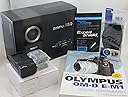
🚀 Elevate your vision with Olympus OM-D E-M1 — where pro power meets unstoppable adventure!
The Olympus OM-D E-M1 is a flagship mirrorless camera featuring a 16.3MP Four Thirds Live MOS sensor, ultra-fast dual phase and contrast autofocus, and a rugged magnesium alloy body that’s weather-sealed for all conditions. Its groundbreaking 5-axis in-body image stabilization ensures sharp photos and smooth videos, while a high-resolution electronic viewfinder and tiltable touchscreen LCD provide intuitive control. With built-in Wi-Fi and compatibility with over 57 lenses, it’s engineered for professionals and serious enthusiasts seeking versatile, high-quality imaging on the move.
| ASIN | B00EQ07PG2 |
| Batteries | 1 Lithium Ion batteries required. (included) |
| Best Sellers Rank | #171,896 in Electronics ( See Top 100 in Electronics ) #439 in Mirrorless Cameras |
| Customer Reviews | 4.1 4.1 out of 5 stars (193) |
| Date First Available | September 9, 2013 |
| Is Discontinued By Manufacturer | No |
| Item Weight | 15.6 ounces |
| Item model number | V207010BU000 |
| Manufacturer | Olympus |
| Product Dimensions | 5.13 x 2.48 x 3.68 inches |
D**S
Excellent Camera
I have been shooting Olympus cameras since 1978. I have always loved the lenses. With over 2,000,000 shots on my Olympus E-500 camera, I decided it was time to invest in a new camera. I was reluctant at first to try the EM-1 for three reasons: - The format is Micro-Four Thirds, not Four Thirds. I take 99% of my photos in the telephoto range, and that is what Four Thirds was optimized to use. Micro-Four Thirds is geared more towards wide angle lenses. - The camera is mirrorless and uses an electronic Viewfinder (EVF). - I have to use a converter to mount my existing Four Thirds lenses, and converters have a very bad history. Out of the box: The first thing that you notice when you pull the body out is that it is SOLID. The thing feels like it is built like a tank. I have not tried the "splashproof" and other claims, but just holding this body I can believe them. The camera fits well in my hand. My hands are a little large, and my pinky occasionally slides off the bottom. I may buy the grip/extra battery holder later if this proves to be a problem. YMMV. Using Four Thirds lenses: I have no Micro Four Thirds lenses and a lot invested in Four Thirds lenses, so using them was a key issue. Olympus has 1/17 or 1 MP of the sensor dedicated to phase detection auto focus, the only type of auto focus that will work with these lenses. I find that the system works very well. Focusing is fast and accurate. Mounting the converter is easy, as expected. Once mounted, you use a button on the side to release the lens. This is a learning issue since I still normally hit the lens release button on the camera body. I anticipate little real problems with this since as soon as I try to put the cover on the back of the lens I realize my error. Balance with the 12-60 mm Four Thirds lens is excellent. Holding the lens by the zoom collar, the weight is only slightly behind my left hand. I only have to support the body lightly with my right hand. I personally like that balance. Longer lenses like the 70-300 are also well balanced. EVF: I have used a mirrored SLR since 1978 and a rangefinder 35 mm camera and 126 film P&S cameras before that. As you might guess, I favor a direct view to see what I am shooting. EVF have issues with resolution and lag when moving to a different point of interest or following a subject, especially in low light. The EVF has turned out to be great. I really like Olympus' implementation. There is some lag, but it is generally minimal. The "What You See Is What You Get" is a big plus in my book. Adjust the exposure compensation or manual exposure settings, and the view in the EVF changes to reflect what the image will look like. It is not perfect, but it gets 95%+ of what you will actually get. The display of settings is bright, clear, crisp, large, and surprisingly unobtrusive. The EVF also allows a lot of changes in camera settings to be done without removing the camera from your eye. Use the two dials, and you can see where the focus points that you are using are. Hit the OK button on the back, and you can use the dials to adjust just about every setting while watching the selections you are making in the EVF. Ditto with the other buttons like HDR and auto exposure mode. HDR: I had the opportunity to use in-camera HDR while on a recent trip. The day was cloudy, and there was a lot of shadow against bright grey clouds. The in-camera HDR used a series of shots at different exposures and combined them in the camera. The results were better than HDR Pro in Photoshop CS5.5 IMO. I was much, much happier with the dynamic range and overall look of the images. the 10 fps shooting mode was also great for minimizing camera movement, ghosts and other problems associated with HDR. Image stabilization: The EM-1 has a five axis image stabilization system for the sensor. That means any lens becomes can be used. The fourth and fifth axes are for rotations. One compensates for the slight turn of the camera that often occurs when you press the shutter button. I had good success using IS in low light with my 70-300 mm lens set at 300 mm. Scenes: the EM-1 has many useful scene modes. I used landscape and panorama with great success. The artistic filters and story modes may also interest you. I prefer to do those types of things in post-processing. ISO: The camera has an almost insane 25600 maximum ISO. Yes, you get image quality degradation and noise at that ISO, but the in-camera JPEG processor can actually give you some relief from the problems at higher ISOs. I so far have found shooting up to ISO 1600 produces no discerned degradation. I tried ISO 6400 and found minimal issues. For those who started with film and were in love with the "high ISO" 1000 film for low light shooting, this is a major and welcome advancement. For those newer to photography that have been using higher ISO cameras for a while, the speed may not be much of a gain, but the image quality should be. The low end ISO is 200, which is the new normal. I do not find it to be a problem. I would rather shoot at a faster shutter speed than have an ISO 100 setting in most cases. There is an ISO LOW setting, but I do not plan to use it. If you regularly shoot in bright light and want lower f-stops, invest in a neutral density filter. Back display: The back display is slightly disappointing. It can only tilt up and down, not rotate so that you can see your composition when you are getting into the shot. It works well for shooting over crowds or getting a low angle shot. On the plus side, the display is clear, bright and a touchscreen that can be used to select a point of interest for focusing and can be used to take the shot in live view mode. You can also use it to select settings to change. The next generation should be even better, and hopefully it will have a screen that rotates. SD card: One change from the E-500 that I do not like is the use of SD rather than CF cards. CF cards are nearly indestructible, and a good Sansdisk Extreme card works virtually anywhere, anytime and is virtually impossible to physically break. The xD card slot disappearing is no loss, but not having a second card slot is somewhat surprising given the high-end prosumer/professional positioning of this camera. Controls and customization: The controls are pretty well placed for me with the exception of the auto exposure lock button. That is right beside the viewfinder and too far to the left for my liking. You can do a lot of customization with the control buttons and dials, but there are limits. I have not made any changes yet because I am still learning the camera. Overall the defaults seem logical and useful. This camera has two dials, one on the front and one on the back. The E-500 only had a back dial, so I am learning to use the two dial system. They work well for adjusting and selecting options. I think the second dial was a good addition. Both are conveniently located for my fingers. Image quality: All of this is meaningless if the image you get out is bad. The EM-1 does not disappoint. I know that there are people who insist that they need 48 MP or some other ridiculously large number. The reality is that 16 MP is a great size for printing full-size 300 dpi images on your printer or using a commercial photo printing service. If all you do is screen displays, it is about eight times more pixels than you need for a typical 2 MP monitor. The quality of the EM-1 pixels is very high, and you get excellent out-of-the-camera RAW and JPEG images. I have no problems seeing fine detail at 100% and higher magnifications. Summary: This camera is a winner, and it works with my existing Four Thirds lenses so I do not have to invest another $3000+ in lenses to use it. I have a lot to learn, and it will take some time to get the most out of the camera, but out-of-the-box, using my E-500 techniques, it is already doing great work.
R**R
One of the best camera
Olympus OMD EM1 is an awesome camera. I used to be a Nikon guy with D300. i bought D300 for better quality from my friend but hated the size. I wanted a smaller size camera with DSLR quality. I purchased Nikon 1 series camera but was never satisfied with the image quality. I was waiting for one of the new Nikon 1 series which kept getting delayed so i thought to try out Olympus OMD EM5. it was an expensive camera and i never tried Olympus before, i thought it was some cheap company since you never see in Bestbuy and all Anyway, the reviews were so good for EM5 that i thought, i would try it out from Amazon since Amazon's return policy is awesome and worst case scenario, i can always return it. i also purchased 45mm F1.8 lens since it was cheap and had very good reviews. When i got the EM5,i took 3 pictures of my daughter in the night and I couldn't believe what i saw. The pictures were sharp, bokeh was amazing (45mm f1.8) and the pictures were better than my D300. it just became better when i realized how awesome the stabilization was specially in videos. My videos were smooth, not jerky. So, when OMD EM1 came, i purchased it immediately. EM1 - this is the next generation of OMD EM5. It's even better than EM5 (EM5 looks better). Pros - 1) Image Stabilization on the sensor - If you have never tried Olympus with 5 axis image stabilization, you have no idea how good and important this is. Period. I can never think about taking a picture of my daughter in the room light without some flash ot tripod with D300. With OMD, i hardly ever use flash with EM5 or EM1. There is no lens stabilization by any other company which even comes near and here is the best part, it works on video too. So, your video looks smooth. 2) M43 lens are not only awesome, they are cheap - With Nikon, a good quality lens were atleast $1000 or more. Just buy Olympus 45mm f1.8 for $279 refurbished or buy Olympus 25mm F1.8 for $319 refurbished or Panasonic 25mm F1.4 for $529 new. Not only you can buy these high quality lens, you will be blown away by the image quality they produce + bokeh is awesome. 3) Size - this was also big for me. There were times, i just didn't feel like carrying around my DSLR. t was big bulky and the lenses were bulky too. M43 lens are much smaller and light. in the winter, i can carry a pancake on EM5 in my jacket pocket. Try that with DSLR. 4) image quality - EM1 and even EM5 produces better quality than D300. 5) Olympus colors - This is something you have to try. The colors, skin tones with olympus camera are better. BTW, the auto white balance works way better than Nikon if i remember. Cons - 1) Video - If you want video, you are better off with Panasonic bodies. Specially in high motion in day light when i'm taking video of my kids, the fast action shows pixilation. I wish Olympus provides better video codec. I would say unless you are carry fullframe Canon or Leica, try Olympus. You would be impressed by the quality.
B**L
I did plenty of research. Before settling on this camera. I was a little worried that it would be in less than perfect condition. Though it was not in its original packaging and did not have the printed material, it was very well packaged and the manual is online. I highly recommend this camera and the vendor.
M**R
A very fine camera. I like the 4/3 format, a full featured camera with smaller lenses. A million modes. Takes great fast action nature shots.
S**R
Works great, and is very fast. I use this with the Olympus 75 f1.8 to shoot hockey, and the AF with the latest firmware is fantastic. Much better AF than any of Olympus's previous efforts including their SLR's. Best handling Olympus MILC, but there is a steep learning curve, especially with regards to set up. It's almost too configurable, but once it's dialed in to your preferences, it's not so onerous. I have mine set so I can quickly and easily switch between general shooting and hockey.
D**7
amazing camera lives up to all the hype, best camera i have had in 10 years . takes wonderful pics can't recommend it higher. love the size for travel. build quality is amazing. five axis stabilization works so good you dont need a tripod with 100 to 300 zoom . love this camera, more features than you will ever use unless you are a pro. suprizing how easy it is to use.
A**R
Packed well and shipped on time. Very happy with this camera, quality and design and compactness cannot be beat at this size and price point. Well below retail, warranty is with Olympus so not an issue. Sharp with even entry level zoom, but really shines with pro lenses.
Trustpilot
2 months ago
3 days ago