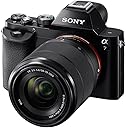
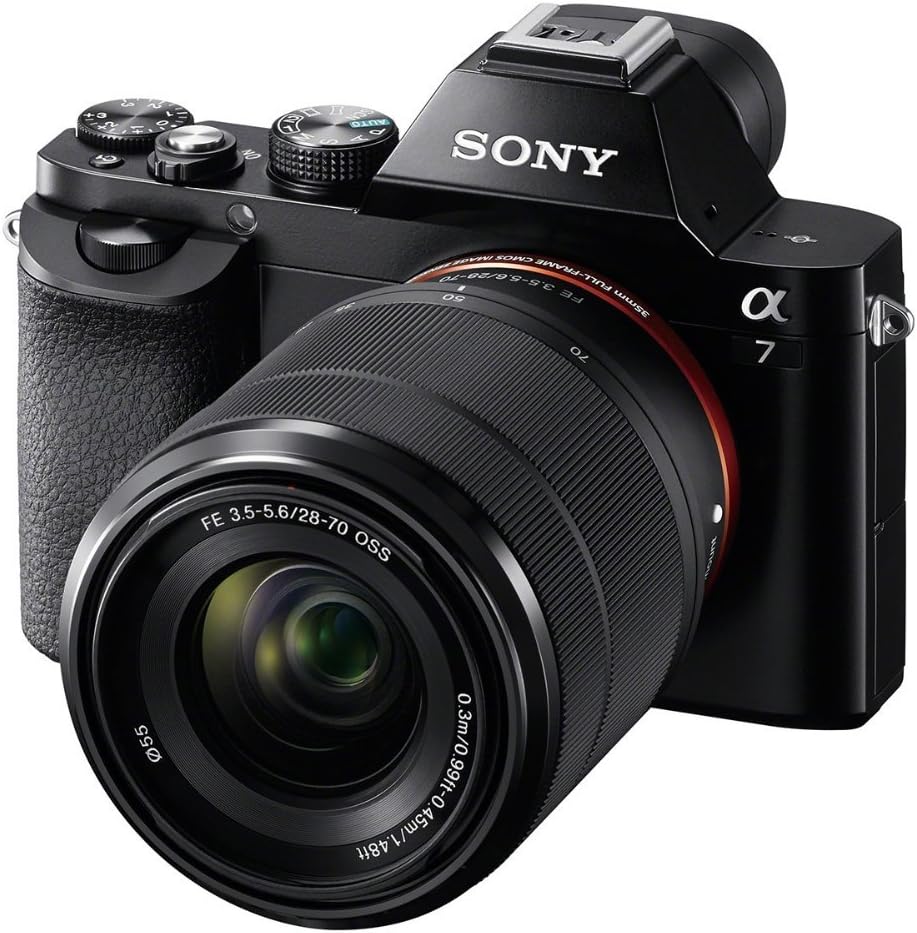
๐ท Elevate your vision with the lightest full-frame pro cameraโdonโt just shoot, create iconic moments.
The Sony a7 is a groundbreaking full-frame mirrorless camera combining a 24.3MP Exmor CMOS sensor with fast hybrid autofocus and a compact, lightweight design. Equipped with a versatile 28-70mm lens and advanced connectivity options like Wi-Fi and NFC, it empowers professionals and enthusiasts alike to capture stunning, high-resolution images with DSLR-level speed and share them instantly. Ideal for travel, portraits, and low-light shooting, the a7 redefines portable pro photography.


| ASIN | B00FRDV06I |
| Age Range Description | Adult |
| Aperture modes | F3.5โF5.6 |
| Are Batteries Included | Yes |
| Aspect Ratio | Unknown |
| Auto Focus Technology | Center, Continuous, Contrast Detection, Face Detection, Live View, Multi-area, Phase Detection, Selective single-point, Single |
| Autofocus | Yes |
| Autofocus Points | 25 |
| Best Sellers Rank | #180,849 in Electronics ( See Top 100 in Electronics ) #553 in Mirrorless Cameras |
| Bit Depth | 8 Bit |
| Brand | Sony |
| Built-In Media | Lens Cap, Rechargeable Battery (Np-Fw50), Sony A7 Full-Frame Mirrorless Digital Camera With 28-70Mm Lens |
| Camera Flash | Hotshoe |
| Camera Lens | Sony 28-70mm f/3.5-5.6 FE Standard Zoom Lens (SEL2870) |
| Color | Black |
| Compatible Devices | Sony E-mount Full Frame |
| Compatible Mountings | Sony E-mount Full Frame |
| Connectivity Technology | HDMI, NFC, USB |
| Continuous Shooting | 4 FPS |
| Customer Reviews | 4.3 out of 5 stars 372 Reviews |
| Digital Zoom | 4 |
| Digital-Still | Yes |
| Display Fixture Type | Tilting |
| Display Maximum Resolution | 921,600 pixels |
| Display Resolution Maximum | 1230000 |
| Display Type | LCD |
| Dots Per Screen | 1230000 |
| Effective Still Resolution | 24.3 |
| Expanded ISO Maximum | 25600 |
| Expanded ISO Minimum | 50 |
| Exposure Control | Aperture priority, Automatic, Manual, Shutter priority |
| File Format | JPEG (DCF 2.0, EXIF 2.3), RAW (ARW 2.3) |
| Flash Memory Bus Interface Type | UHS-I |
| Flash Memory Speed Class | Class 10 or U1 |
| Flash Memory Type | SD/SDHC/SDXC, Memory Stick Duo/Pro Duo/Pro-HG Duo |
| Flash Modes | P-TTL |
| Flash Sync Speed | 1/250_sec |
| Focal Length Description | 28 to 70mm |
| Focus Features | Hybrid |
| Focus Mode | Manual Focus (MF) |
| Focus Type | Manual Focus |
| Form Factor | SLR-style mirrorless |
| Generation | 1 |
| Global Trade Identification Number | 00027242874800 |
| HDMI Type | Type D Micro HDMI |
| Hardware Interface | AV Port |
| Has Color Screen | Yes |
| Image Capture Type | Stills & Video |
| Image Stabilization | No |
| Image stabilization | No |
| Item Weight | 1 Pounds |
| JPEG Quality Level | Basic, Fine, Normal |
| Lens Construction | 9 elements in 8 groups |
| Lens Type | other |
| Manufacturer | Sony |
| Manufacturer Part Number | ILCE7K/B |
| Maximum Focal Length | 70 Millimeters |
| Maximum Shutter Speed | 1/8000 Seconds |
| Memory Slots Available | 1 |
| Metering Methods | Multi, Center-weighted, Spot |
| Minimum Focal Length | 28 Millimeters |
| Minimum Shutter Speed | 30 seconds |
| Model Name | Sony a7 |
| Model Number | ILCE7K/B |
| Model Series | Alpha 7 |
| Movie Mode | Yes |
| Night vision | No |
| Number of Diaphragm Blades | 7 |
| Optical Zoom | 4 x |
| Photo Filter Size | 49 Millimeters |
| Photo Sensor Resolution | 24.3 MP |
| Photo Sensor Size | Full Frame (35mm) |
| Photo Sensor Technology | CMOS |
| Real Angle Of View | 46.2 Degrees |
| Remote Included | No |
| Screen Size | 3 Inches |
| Self Timer | 10 Seconds |
| Sensor Type | CMOS |
| Series Number | 8 |
| Shooting Modes | Aperture Priority, Automatic, Manual, Shutter Priority |
| Skill Level | Professional |
| Special Feature | Shockproof, Temperature Extremes, Waterproof, X-Ray Proof |
| Supported File Format | JPEG (DCF 2.0, EXIF 2.3), RAW (ARW 2.3) |
| Supported Image Format | AVCHD |
| Total Still Resolution | 24.3 MP |
| Total USB 2.0 Ports | 1 |
| Total Video Out Ports | 1 |
| UPC | 027242874800 |
| Video Capture Format | mpeg-4;avchd |
| Video Output | HDMI |
| Video Resolution | FHD 1080p |
| Viewfinder | Electronic |
| Viewfinder Magnification | 0.71x |
| Warranty Description | 1 year coverage for labor, 1 year coverage for parts |
| White Balance Settings | Auto |
| Wireless Technology | NFC, Wi-Fi |
| Write Speed | up to 100 MB/s |
| Zoom | optical |
A**T
Great camera! Sony has hit a home run with this one.
To start off, I'd just like to mention that I am not a professional photographer. I am a serious hobbyist traveler photographer, mainly photographing my travel adventures as well as photographing my children's precious moments when I'm at home. I must say, this Sony A7 really hits the bulls-eye for my needs. I used to carry a Nikon D600 with a 24-70mm f/2.8G "beast" lens. The complete system was quite cumbersome and heavy but the combination of the full framed Nikon D600 and the 24-70mm lens took absolute stunning shots when I was on the go. When Sony came out with the RX1r, I decided to give it a try and I was truly amazed with the quality of the pictures I was able to take with that camera. The RX1r's ability to take hand held night shots made that camera a real winner for me. Though my main issue with the RX1r was that I was stuck with the 35mm lens. That made the travel photography difficult but as a full frame "point and shoot" camera, the RX1r was as good as it gets. Then the A7 and A7r came out and general apples to apples, it looked as if the A7 was essentially a interchangeable lens version of the Sony RX1 series cameras. Being so happy with the RX1r, I decided to get the A7r paired with the Sony SEL2470Z Vario-Tessar T* FE 24-70mm F4 ZA OSS Lens. The A7r took FANTASTIC photos during good light conditions but my main issue was that it was TERRIBLE in low light. At just an ISO of 1200, you can already see a hint of noise in low light conditions and once you bump that up to 2000+, the photos are generally polluted with noise. At 6400, it's essentially game over. As my home is generally not very well lit, using the A7r to take photos of my children only created photos that were generally not photo album worthy. However, the A7r really shines once you slap on a tripod and take scenery shots or when lighting is good. The imagine quality on the A7r is EXCEPTIONAL and the level of detail is top notch quality. The larger MP capabilities of the A7r are utilized very well. But since I generally shoot in low light and only 20% of my shots are scenic, I returned the A7r and got the A7 instead. Image quality wise, the A7 performs MUCH better in low light conditions over the A7r. There is a significant reduction in noise at ISO 2000 and 3200 shots and at ISO 6400, many of the shots I got were still very good. I generally found that the A7 performed better with portrait shots while the A7r really thrived with landscape shots. The autofocus on the A7r had a tendency to hunt more while the A7 was quicker in focusing, especially in low light conditions. I believe this is mainly due to the fact that the A7 has Phase Detection Auto focus (PDAF), while the A7r does not. Many have complained that the A7 also has a slow autofocus compared to other DSLR cameras on the market but I honestly can't really tell the difference. Compared to the A7r's 36.4 MP, the A7 does have a lower MP at "just" 24.3. Though I honestly, I doubt you'll really tell the difference unless you do some serious cropping or you do photography that really just requires high MPs. Exterior wise, both the A7 and A7r essentially look and feel exactly the same. Though the A7r has more metallic parts, like the dials and apparently the body as well, you generally can not tell the difference between them. Both the A7 and A7r are very nice to hold and shoot with. Both feel very fluid and crisp. The A7r does make a bit more noise when taking shots and the A7 is noticeably more quiet. I know some have complained that the A7 is still noisy when taking shots but I don't find it bothersome and I actually quite like the sound it makes. Coming from the Nikon D600, I did find that I had to get used to the layout of the Sony cameras. The menu system as well as the location of certain commands are not where I was used to them being. Though after a few days with the camera, navigating through the camera became a breeze. My only main complaint would be that the "zoom" button is a bit of a stretch for my fingers and does require for me to preposition my grip on the camera in order to press is properly. Battery life for the A7 and A7r are borderline decent to poor as you generally would get about 350 to 400 shots before you need a battery swap. I purchase a Wasabi battery charger and extra batteries to solve that problem. I also found the Wasabi wall battery charger much better than using Sony's direct to camera charging system. Another drawback I've noticed is that the start up time of the camera is relatively slow compared to the RX1r and significantly slow when compared to the Nikon D600. I never shoot video with my cameras so I'm sorry to say I can't comment on the A7's video capabilities. Overall, the A7 is a fantastic camera. Granted the A7r had a higher MP, the A7 just suited my shooting needs better (low light shots, portraits, running after the kids shots and travelling shots). Furthermore, even when paired with the larger SEL2470Z Vario-Tessar 24-70mm lens over the standard 28-70mm kit lens, the over all size and weight is still a HUGE upgrade over the significantly larger Nikon D600 and heavier the Nikon 24-70mm f/2.8G "beast" lens. The A7 really gave me the flexibility to carry the camera almost everywhere, making it perfect for my travel photography, while at the same time giving me the perfect shots that I look for in a camera, making it the perfect go to camera for me. All that's left is to hope Sony comes out with better and a wider range of lenses soon, which according to the news reports out there, they will. PS: If you see a Nikon D600 and a Nikkor 24-70mm lens for sale on eBay anytime soon, there's a good chance it's mine! I hope this review helps!
R**D
The perfect camera
As an enthusiast photographer, that I am, I wanted to give a review from that perspective rather than a more technical perspective from , perhaps, a professional, which I am not capable of doing just yet Upon opening the box for the first time, I was immediately struck by the small form factor (and somewhat retro look - but just my opinion) and light-weight of the camera body. Indeed, I wasn't sure, at first, there was my camera inside the Amazon box UPS handed to me upon delivery (and UPS will require your signature for this item. Otherwise they are going to leave with nothing and come back another day). This camera body looks sharp. It's not completely magnesium metal body like its A7R higher priced sibling, but, rather, a mixture of metal and better plastics. But very hard to tell the difference. Point being, no one's going to accuse you of having anything less than a fine well-built camera. It feels good in the hand. A good grip for your right-hand. It's built like a tank. And it's weather sealed. All the buttons are where I want them to be. Perhaps the shutter button could be a little farther forward but it should be just a matter of getting use to it. The menu system is far easier to use and navigate than on my NEX6. And the NFC between the camera and my Android phone (Galaxy S4) is fast and convenient. The remote control function works very well. Checking latency revealed a very, very slight hesitency. But so minor. You'll hardly notice it. Just a nit-pick on my part (like the shutter button-certainly no game changers). I bought two lenses (there are only 5 of the FE lenses out as of this writing but Sony is releasing a total of 15 by 2015). The 35mm (very light) and the 55mm somewhat heavier and built well. I use the 35mm as a walk-around street lens because it compliments the light-weight and portability of the full-frame A7. In fact, this is why I bought the A7 in the first place. For street photography and scenics. At first I thought it would be a good 'stealth' camera for the street, but I have come to realize that with todays digital age we're just fooling ourselves if we think they don't know what we're doing. These two lenses, by the way, are Carl Zeiss and they have received some of the highest praise of any lenses on the market today. (A word of note, Sony is coming out with a 70-200mm lens full-frame for this camera April 20 2014 here on Amazon, $1495.00). So yes, the lens are expensive. But they are proving their worth. But one of the great advantages of these Sony cameras are their absolute adaptability too legacy lenses given numerous availability of lens-mount adapters for Minolta, Leica, Hasselbad, and then, of course, there's Nikon and Canon, as well as some others. So there is a way to get around the expense if you have legacy lenses laying around. Or you can buy some great glass on ebay cheaply which I'm told can rival, in some cases, some of the great glass of today. Finally, another great accessory which I bought, is Sonys Battery Grip which allows the use of 2 batteries and has a great form factor for the camera giving it a great grip, especially for larger hands as I have. Also I like the button placement. As you can see. I can't say enough about this camera. But it's totally worth it. In fact it's a steal at this price for what it does as a full-frame camera. With the 35mm lens (minus the battery grip), you can throw it in your shoulder bag or pocketbook, go about your day, and take stellar pictures. You won't regret this purchase. [...] Have a great day. Richard
J**S
Love this camera.
Disclaimer off the top: I am not a professional photographer. I'm an obsessed and informed enthusiast. This camera is amazing. And I'm not the first to say so. Go read one of the hundred other review websites where they gush about it. I can't add anything more to the conversation about how good the image quality is or how great it is to shoot with it. Instead I'm posting this review to discuss some of the issues people have raised about this camera. THE LCD DISPLAY A lot of people are upset that it's not a touchscreen. It doesn't bother me in the slightest. With my previous SLR I would check settings on the LCD and then use the viewfinder to compose the shot. Not so with the A7. I rarely use the viewfinder. Instead I do it all with the LCD. This wasn't a conscious decision. It just felt nature. I also don't mind that the LCD doesn't fully articulate, or swing out like some other cameras do. Though it may look a bit curious to only slide out as it does I prefer this. I had a camera with a fully articulating LCD before and I didn't care for it. It required you to fold the display out to swivel up. This means you're looking to the left of your camera. Kind of annoying. I much prefer the simple method Sony employed here. SHUTTER SOUND I'm fine with it. It clicks at a reasonable volume to me. NO FLASH I don't want an onboard flash. I prefer to shoot in natural light. And if I do want a flash I'm going to buy an external flash and shoe mount it anyway. An onboard flash is a waste to me. I'm glad Sony realized this. LENSES I did not buy the "kit" lens, 28-70mm. Some of the reviews on it weren't so kind. Instead I opted to rent a number of lenses, including a Metabones adapter to try Canon and older Zeiss lenses. They were all great. Some didn't allow for autofocus but manually focuses with focus peaking on was as good as advertised. However I had the best time using the Zeiss 35mm 2,8 glass that was specifically designed for the A7. It took fantastic pictures and the profile was so small. I had read some negative reviews about that lens but I loved using it. It's definitely going to be the first lens I purchase. AUTOFOCUS It is sometimes sluggish in lower light situations. Not horrible but of note. SPOT FOCUS I haven't seen anyone discuss this so maybe it's my problem but I take issue with how you move the spot focus. On my old Nikon I'd half depress the shutter, it would auto-focus on a single point, and then I could use the arrow dial to move the point of focus. That's not how the Sony works. I have to press a custom button first, then arrow the point of focus to the new location, then depress the shutter to auto-focus, and then take the picture. Maybe I'm missing something. But as of right now this does slow me down. THE MANUAL When I got my first Nikon I read the manual front to back and it made sense. The manual for the Sony A7 was long, robotic, and confusing. I eventually gave up and went to YouTube videos to learn how to use it. ACCESSORIES I got the Sony VGC1EM Digital Camera Battery Grip because I loved using a battery grip with my Nikon. The Sony grip is fantastic but I'm not sure yet how much I'll use it. One of the best features of this camera is it's small profile. The jury is still out on this one. Since my camera got smaller it only made sense that my camera bag should too. I grabbed the ONA Bowery Shoulder Bag. It's beautiful and doesn't cry CAMERA HERE! And though it is small it can hold more than you think. Due to poor battery life of the A7 batteries I also picked up the Wasabi Power Battery (2-Pack).
A**K
Probably the best the value-for-image-quality available in 2017
Given that this camera has been available for many years, and has been reviewed down to the last screw, I am writing a review that refers specifically to my personal experience with this camera. I hope such a review will give you a sense of what it is to live with this camera on an everyday basis. What I write may or may not apply to how others might use this camera, but I hope it will add to people's overall understanding of what they are buying. 1. Why I chose this camera. After using cameras from the Nikon APS-C system for ten years I found myself hitting the system's performance barriers with higher frequency as I grew as a photographer. Most often, the issue I faced was the limited dynamic range. After looking at many sample images, reviews, and tests of the Sony a7 series, the Pentax K-1, and Nikon and Canon full-frame cameras, I chose the a7 for its combination of a great sensor, a compact body, and in 2017, a very reasonable price. Having used a Samsung NX300 as a secondary camera for a few years, mirrorless cameras were not entirely alien to me, so the jump from SLR to mirrorless was not something I was scared of. 2. The operation and use of the camera. a. Image quality: When I got the a7 in my hands, its miniscule size (much smaller than my APS-C Nikon D7000, and only a little bigger than the Samsung NX300) was a revelation. The camera reminded me a lot of the Nikon FM-10 and Olympus OM-2000 film cameras in size. The image quality that I got from the camera was better than I could have imagined - I almost never had files with blown-out highlights, and so much data in the raw files to play with. b. Handling: After ten years of using the Nikon interface, transitioning to Sony's system of tabs with multiple pages was, and after some months of using the camera, still is rather frustrating. Another frustration I have with the camera is the inability to move the spot-metering area with the focus point. The layout and interface of the a7 seems to be optimized for the use of matrix metering and automatic focus-point detection, with the photographer using the exposure compensation dial to make adjustments. This is the complete opposite of my style of shooting - I like to use the spot-meter to check the light levels in different parts of my frame and then decide what exposure to set depending the final result I want to achieve. Being unable to move the spot-metering area, this means that I have to point my camera in a variety of different directions to meter different parts of the scene before finalizing the framing. This isn't so bad when I'm hand-holding the camera, but is extremely inconvenient when I have the camera on a tripod. It's not that I specifically distrust Sony's matrix metering - I distrust all matrix metering. It's just that I like to know exactly how my exposure is going to affect the image I am shooting. Since it's impossible to know the exact way in which the matrix-metering algorithm will calculate an exposure, I do not use it unless I am in an extreme hurry. In such cases I shoot in program mode with matrix metering to simply make a documentary record of what is in front of me (like when Joe Biden happened to be getting into a car 20' away from me). c. Build quality: After getting used to the build quality of Nikons, the Sony does feel a little delicate, specifically the doors for the USB, HDMI, and audio ports. My combination of camera and lens does have the now infamous a7 lens-mount wobble. Initially I found this terribly disconcerting, but having used the camera extensively over some months, I've found that this has no effect on the structural integrity of the camera or lens (accidentally dropping the camera from a height of 8-10" onto a hard floor shattered my UV filter, but did not make the lens-mount wobble any worse). I've also not experienced any light-leaks through the mount. d. The kit lens: The lens that comes with the camera has atrocious corner sharpness, especially wide open at the 28 mm end of the zoom range. But more inconveniently, the lens consistently produces purple fringing at virtually all apertures and focal lengths - much more so than what I've seen in kit zooms from Nikon and Canon. I have done test shots comparing the fringing with and without a filter, and have found that it is not my filter that is causing the issue. I'm not sure if these issues with corner sharpness and fringing are because the sensor of this camera is less forgiving of lens faults, or if this is just a badly designed lens, but as a combination this camera-lens pair has image-quality issues. Vignetting, however, has not been a problem. 3. Conclusion. In spite of the issues that I have with this camera the value-for-image-quality that it gets you in 2017 is, in my opinion, worth the annoyances.
J**N
exactly the right camera if you have a bunch of old, but good nikon or canon lenses.
I inherited a trunk full of Nikon F lenses. I'd been using various digital cameras since 2001, latest Lumix which I like a lot. So i needed a full frame digital which could handle the Nikon lenses. Nikon makes one but it's as ugly as their old film cameras - think early Nikormats, and EXPENSIVE. I bought the Sony and went through the learning process with the adapters. I wanted one which would allow the lens to focus on infinity when I racked the ring over to the stop. A lot of the adapters which cost in the $20 range are a bit short which means that when you rack the focus ring over it goes right past infinity and into really out of focus quite quickly. Kipon makes a good one - it costs ~$75US. I've now taken this setup on two long trips, taken something like 8k photos, some duds, but almost all well focused and reasonable exposures although sometimes with some adjustment. This setup is an absolute joy. I mostly use a 20MM F4 Nikkor. But occasional 210mm, 100mm, and a sort of funky 35-105 Macro Nikkor. I can't imagine what Dad was thinking when he bought it - it's heavy, but if I'm not sure what I'm going to need, i take it along. I like that the viewfinder stays bright when you stop the lens down. camera has a way of grossly enlarging part of the screen in the eye level viewfinder to you can focus. this takes getting used to but once i was comfortable with it, it didn;t seem any different from looking in a second window to focus the old Leica G. There is another issue with interchangeable lens digitals. you have to keep the sensor clean. if you get a particle on the sensor, after you've looked at 3 or 4 shots you'll fix on it because it will be in exactly same place on every frame. I wish they made one of these for about $600 without the big LCD on the back. I never use it. I also bought a bracket which is affixed to the bottom of the camera with a 1/4-20 screw into tripod socket. These are made to make it easier to mount camera on quick change tripods. I don't use tripod, but camera was too small for my hands. With the bracket it's a bit heavier, but for me, a whole lot easier to hold on to. this is a great camera.
N**S
Nice camera in January, but there's trouble ahead I'm afraid....
This camera is amazing for its size, and is producing great pictures. Unfortunately, it has a major, major design flaw - overheating. This is limiting the amount of time you can shoot video before the camera puts up an overheating warning and shuts off. Sony are aware of the issue - the back of each camera has a permanently-printed warning saying the camera "gets warm during use, but this is not a malfunction". Using this camera in a chilly North America January is fine - but for the last week I've been using it in temperatures of between 75-80 degrees. Even in the shade, recording times vary between 15-30 minutes before an orange temperature symbol appears, and then a text warning saying the camera is shutting off due to overheating. This has been a problem with earlier, cheaper Sony NEX cameras and I would have expected Sony to have resolved the issue by now. Come the summer, I expect we'll hear a lot more about the issue & have more data points showing the recording time / ambient temperature trade-off.
M**H
Best camera I have ever used
What a delight, this Sony A7 is a photographers dream. Sony is way out front with this. Small, light, compact, tough as nails, brilliant design. The viewfinder is excellent, and I can't wait to see how they improve it in the coming years. The back LCD is the best and brightest I have ever used making back shooting in the sun a real possibility, perfect for astrophotography. The focus peaking is amazing, manual lenses come to life in real environments. Auto lenses get it done, with speed focus and aperture changes instant. I have nothing to complain about really, as usual the menus are good but not great, a few features I use a lot are hidden, and there could always be more programmable keys. Also the inability to cross use the special features like the in camera exposure stacking and HDR with timer is a little annoying. Would like to see less restrictions but I suppose that is what the will put in the next version with more memory. Write speeds on Long Exposure are about equal to the exposure time so the buffer is limited. Continuous shooting is machine gun speeds, I can rip off 10 shots and be back shooting in 2 seconds. Ok, now back to what is great, everything else. Full frame is amazing, with good glass it is mind boggling. And good glass that is manual focus is all over Amazon from Minlota's Rokkor series of the 70's, Quntaray, tamron, Sigma and Leica. Go look find the cheap adapters and see what you have been missing. Sony makes an adapter for it's alpha lenses and that even switches the focus to phase focusing for better results. I haven't bothered with that yet because the chinese adapters are so cheap and work so well even some of the automatic canon stuff will work on this. This is so much easier to carry than a DSLR, and yet the pictures are fantastic, huge, detailed, color rich. The only limitations are your lenses so start saving up. Rented an OTUS lens..my goodness I never knew such imaging was possible. Added Nikon lenses and now a canon EF from Tamron Vi VC with the Commlite addaptor, I will let you know about that auto lens adapter soon. The Kit lens (14-70mm) is actually a blast and I picked that up used as well, no regrets. There are faster sports cameras, but this thing with OSS can really grab anything short of a bullet so don't listen to the detractors. For the price it can do anything. Go buy a Nikon D4 if you are shooting the Olympics for NBC, otherwise use this and get there with twice the lenses because of the lighter weight. I bought an external Sony charger and Sony batteries, they get over 1000 shots RAW+JPG per charge. Buy Sony folks, don't go cheap on this. I do shut off the camera between shots so I get better life than some. Get a fast big memory card for this. I love the internal charging of the battery, it uses a standard Android car charger plug! I use a 64GB Sony class 14 card and am happy, though a faster card never hurts for long exposure work. CONS: Lack of built in stabilization on the sensor and Sony's slow roll out of lenses are both annoying, that being said this is one of the best cameras ever made, a game changer, and the results with good glass are ASTOUNDING. Pro quality, and I have sold stock photos already. 6000x4000 people, for under $2k. I shoot in Shutter Priority or Aperture priority with manual lenses, the AUTO feature is great with the kit lens but obviously defaults to goofy settings on manual lenses. You need to know how to use an SLR to get the results from this. A remote trigger works with my Android phone and hopefully Sony will build it into the Smartwatch 2 at some point. the buttons and dials all work very well, I think the exposure dial is almost perfect, though my Fuji x series does spoil me. You cannot find a better camera if you are looking for an all weather portable pro shooter. Well the A7R is better in some ways at least for tripod work but not for day to day shooting. Low light capabilities of this sensor are unreal. Video is great but huge files and not quite what the most serious pros are looking for in video frame rates perhaps. Still, it works great with a manual lens and puts out Bluray quality. Great headphones jacks and mic jacks! Ergonomics are spot on. Connectors rock solid. Manual programming hot buttons easy to setup. Getting out of zoom in play mode is annoying, but you will figure it out. Most menu items are well placed. So much love for Sony, such a stellar piece of equipment. Run and buy one, collect good glass. Profit.
3**D
A good studio and portrait camera
The A7 is better suited for studio and portrait. It's a great camera to use everyday as well but definitely not for sports action or telezoom. There's no telezoom lens until April and it's only 200mm. If you buy the A7/R with the Zeiss 35mm, 55mm and 24-70mm then you will have a solid system for portrait, studio and walk around system. You will probably be able the take the best pictures you've ever taken for something this compact. Pros 1. Amazing Picture Quality especially in RAW(ARW new format). Update your software to read this format. IQ higher than 5DMK3 but lower than Nikon D800. 2. There are dedicated dials for aperture, shutter and exposure. No messing around with menus. 3. Great EVF. The eye detection works great. It will turn off the screen and turn on the EVF when you put your face up on it. 4. Hybrid AF has decent PDAF especially in daylight. Much faster and more accurate than any of the NEX series. Slower than my 5DMK3 and Nikon D800. 5. Available Zeiss lenses are some of the best on the market regardless of what system you compare to. Check DXOmark to confirm. 6. Very portable with the 35mm 7. In camera usb charging. Great for traveling because there's one less thing to lose/carry/forget. 8. NFC is convenient to quickly sling photos to your Android devices. Apple devices uses wifi which is also fast but a little less convenient. 9. SD memory slot actually support UHS-1 speeds!! finally! My Nex 5R was severely handicapped because it only supported Class 10. 10. Full Frame sensor. Compared to APS-C Nex series: less noise, more picture, etc... 11. Video quality looks great. It has continuous focus and works well. Quality is higher than a Nikon D800 but lower than the 5DMK3. Cons 1. Slow AF low light compared to DSLRs 2. Battery life is short. Buy extra batteries and external charger! 3. Bigger lens can throw the balance off and make it easy to slip out of your hands. 4. Shutter vibrations confirmed to blur pictures under 1/160. Keep shutter speed 1/160 at least. Recommend 1/250. 5. Very limited FE mount lens selection. You can use other E mount lens but most lenses will force you to crop. 6. In camera usb charging. Charge time unacceptable ~5-6 hours. 7. No dual memory slots. 8. AF too slow to be effective for sports or anything fast moving. 9. Scene modes doesn't work that well sometimes because of shutter vibrations. I don't think most people will be using these modes anyways. 10. Annoying squishy feeling shutter button. There's no click to it at all. 11. No touch screen. Don't understand this decision. I want a touch screen because it makes videos a whole lot easier. I don't see a point in reiterating what many reviews have already said so I will just answer the most common questions and misinformation. I will also update more as I go. The high ISO problem in Auto mode and shutter vibrations From what I've researched, these cameras have sensor shakes due to the shutter impacts. Anything slower than 1/160 sec shutter speed will show up in the picture. It is easily noticeable when you are at 1/60 and below. I highly recommend you use 1/250 or faster speed. I normally choose higher shutter speed anyways since the 55mm and 35mm does not have OSS. But OSS does not eliminate the shutter vibrations, just the hand shakes problems. So regardless of what lens you use, use high shutter speed. I honestly don't see much IQ degradation from ISO 320 to 1600 due to noise or details. It's when you hit 6400 that it becomes a problem. The sony A7/R will still have better IQ at ISO 1600 than an OMD EM1 at ISO 320. I wouldn't call that a con. In manual mode, auto iso should work properly if you choose aperture and shutter speed yourself. It should only come up with the correct ISO or the picture will be too bright. The complaints here sounds like people moving up from enthusiasts cameras and not fully knowing the professional side. Auto everything doesn't work and you don't use it. Pros will use some auto settings but not fully auto. The most common modes are aperture priority, shutter priority and manual. The high ISO problem also disappear when you turn off DRO. I prefer HDR over DRO anyways. If you buy this camera and pair it with good lens like the Zeiss 55mm and 35mm, then most of your problems are solved. You will actually get better IQ than a 5DMK3 with a 50mm 1.2L(I have this set up as well so I know). The 5DMK3 will have better AF, AF speed, and much much longer battery life though. Depending whether you are shooting from a Tripod or not, your choices are clear. The battery problem. We don't have much choices here. I hate the idea of a compact pro camera that can only get 340 shots. The good news is there is actually a battery grip. The bad news about that is it adds more bulk, weight and kind of defeating the whole purpose of being compact. However, I do like the added bulk of the grip. It does balance out the camera when you use bulkier lens like the Zeiss 55mm. It also gave me better grip and I feel more confident about not dropping it. Having 2 batteries does give me roughly the same amount of shoot time as a 5DMK3 with no battery grip. The bonus with the A7 is that it is still lighter and less bulky than the 5DMK3. It cost about $250 and there's bundles here for $250 with some accessories with a half decent SD card for back up. I would pick the one with the wall battery charger. I hate the in camera charging for obvious reasons. Good luck and I hope I answered the questions. I wish I could rate the camera as 4.5 stars. It seriously meets most marks. What it lacks is battery life(easy to fix) and good native lens collection(takes some time). There are only 4 FF Zeiss lenses but they are amazing. The 55mm Zeiss($1000) rivals the $4000 Otus for Nikon. I highly recommend you use the Zeiss 35mm and 55mm lens with this. It's actually relatively cheap compared to its performance.
M**.
Good high quality camera to start off with
It took me a really long time to decide if I wanted to spend the money and buy this camera. I'd give this camera a 4.6 if I could, because it is an older remodel with a few flaws. If you're starting off with really photography and wanted to buy a high end camera that might be a little cheaper than the others, buy this one. Every feature it has is amazing, and although the screen and view finder could have better pixel density (the newer models probably improved it) its definitely a better experience than mirror cameras in my opinion. It can connect to your phone and everything. The interface is a little jumbled and can be difficult at times, but that wouldn't change my review because the quality of photos I got from it are amazing. (I am also putting up a bunch of different unedited photos I took with this camera) And if you do buy the camera here are some tips I'd suggest and I've heard: Make sure you don't expose the sensor too much, and get a small can of compressed air to get things out of the cavity if you something happens to get in. The battery isn't the best so buy a few extra batteries packs (and get a charging hub that doesn't over charge the batteries)
Q**A
what a fantastic camera
This camera has exceeded my expectations in every way. I was a lifelong canon user, and am probably a sony user for life now. It was a bit of a learning curve making the switch but this has made me a better photographer and has made me more able to take on new photography adventures since getting it. I would absolutely buy a Sony alpha camera again.
C**S
Fast shipping, excellent price, great camera
Awesome camera. Delivered before schedule. Excellent deal with kit lens. Still very much a great camera in 2018. Very happy with my purchase
C**E
Five Stars
Best camera I have ever owned.
Y**S
Five Stars
nice
Trustpilot
1 week ago
2 weeks ago